
Radio Control: Old-Timers
Dr. D.B. Mathews 909 N. Maize Rd., Townhouse 734 Wichita, KS 67212
Nainsook and "China" silk
NOW I know! In the February 1988 column I mentioned the Moyer Cloud Cruiser originally covered in nainsook and asked if anyone could enlighten me about that material. Over 70 readers responded with everything from direct quotes from the dictionary to actual samples of the material.
Nainsook is a rather open-weave, lightweight cotton fabric which was apparently very inexpensive and, therefore, an alternative to relatively expensive silk. It is also, being much more puncture-resistant than G.M. silkspan, more durable. Several readers also advised that the material was used for Navy-issue undershorts in WWII.
In several construction articles I've jokingly said, "This model can be covered with any material from old socks to underwear." I had no idea how close to the truth that was!
Several readers also sent samples of "China" silk, which I had also asked about. This material is still available in some bridal shops. It is nubbier than Japanese silk with a closer weave, and should require less dope to fill—but would not give a really glassy finish.
To all who responded I give considerable gratitude for taking the time to share your information—and also because it reassures me to find that there are some folks reading this column! Your kind words are encouraging, and I wish time would allow personal responses to all of you.
McGovern's Monster
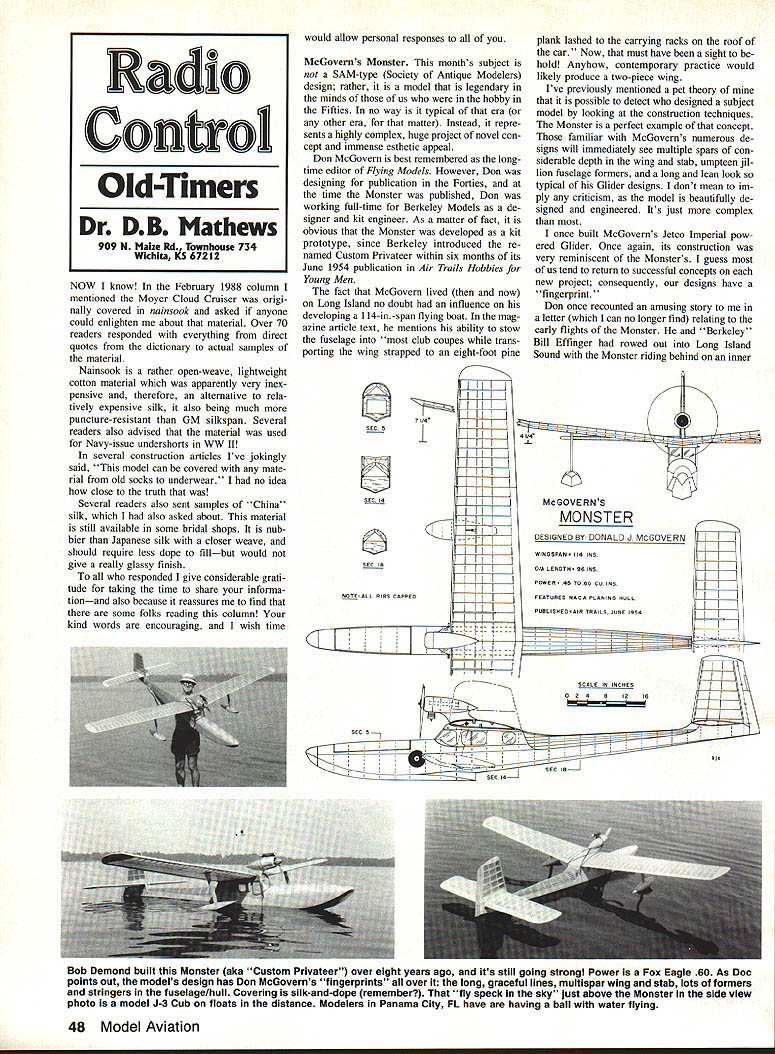
This month's subject is not a SAM-type (Society of Antique Modelers) design; rather, it is a model that is legendary in the minds of those of us who were in the hobby in the Fifties. In no way is it typical of that era (or any other era, for that matter). Instead, it represents a highly complex, huge project of novel concept and immense aesthetic appeal.
Don McGovern is best remembered as the longtime editor of Flying Models. However, Don was designing for publication in the Forties, and at the time the Monster was published he was working full-time for Berkeley Models as a designer and kit engineer. It is obvious that the Monster was developed as a kit prototype, since Berkeley introduced the renamed Custom Privateer within six months of its June 1954 publication in Air Trails Hobbies for Young Men.
The fact that McGovern lived (then and now) on Long Island no doubt influenced his developing a 114-in. span flying boat. In the magazine article text he mentions his ability to stow the fuselage into "most club coupes while transporting the wing strapped to an eight-foot pine plank lashed to the carrying racks on the roof of the car." Now, that must have been a sight to behold! Contemporary practice would likely produce a two-piece wing.
I've previously mentioned a pet theory that it is possible to detect who designed a model by looking at the construction techniques. The Monster is a perfect example of that concept. Those familiar with McGovern's numerous designs will immediately see multiple spars, long, lean lines, and lots of formers — typical of his glider designs. I don't mean to imply any criticism; the model is beautifully designed and engineered. It's just more complex than most.
I once built McGovern's Jetco Imperial powered glider. Its construction was very reminiscent of the Monster's. Most designers tend to return to successful concepts on new projects; consequently designs have the designer's fingerprint.
Don once recounted an amusing story to me in a letter relating to an early flight of the Monster. He and "Berkeley" Bill Effinger had rowed out onto Long Island Sound with the Monster riding behind on an inner tube. For some reason the plane's Fox .60 turned recalcitrant—perhaps because it was cold late October—and repeated attempts to get the model to rise off the water failed. Effinger suggested the model's heavy wheels be removed from the wells in the fuselage sides. Again the engine was fired up, the model placed in the water, and after a fast taxi it acted like a boat, made a 180-degree left-hand turn whereupon the engine suddenly cleared whatever was reducing its power and, with a mighty roar, took off, barely clearing the boat occupants now lying face down in the bottom. Obviously the prototype was radio controlled.
As an illustration of the signs of our times, the Custom Privateer kit was originally priced at $19.95 (while a Chuck Hollinger Cub went for $8.95). Since Sig now produces that same Cub and sells it for $64.95, the Privateer would be about a $150 kit today—and that might be cheap!
Bob Demond's model
This month's photos are almost self-explanatory and clearly illustrate the beauty of the design. Bob Demond lives in Panama City, FL, which likely explains the appeal of water flying. His Privateer is eight years old and still going strong. It is a great favorite locally—pretty easy to understand, since the fuel tank is located down in the hull about a foot from the engine. (I presume he doesn't mean a gallon tank!) The local fliers are obviously much into water flying; in addition to the Privateer they fly Kadets, North Stars, Kittiwakes, Sig J-3s, and Ace R/C 4-40s. He says that "...most of the guys have made the transition to ROW flying with a minimum of mishaps and problems. About half of them, in fact, had instant success beginning with their first flights."
The model in the photo is powered with a 12-year-old Fox Eagle .60, and Bob says it will fly nicely at 1/4 throttle.
To avoid the usual flood of letters asking where to get plans, I'll tell you right now that both the Hobby Helpers and Berkeley drawings are available from John Pond Old Time Plan Service:
John Pond Old Time Plan Service 253 No. 4th St., P.O. Box 90310 San Jose, CA 95109-3310 Phone: (408) 292-3382 (Tuesdays or Fridays)
Float Fly (Higginsville, MO)
An exception: while as a matter of policy I do not normally plug contests other than the AMA Nats and the SAM Champs, I am going to mention a "Float Fly" (my suggestion was to call it a "sock soak," but the suggestion was rejected). Ace R/C will be the host and Top Flite and Goldberg are the cosponsors of this all-fun, no-competition event. It's to be held June 11–12, 1988 in Higginsville, MO. Write to Ace R/C for more details (get the address from their ad in this issue).
This looks to shape up as a super event, with a starting number of participants already signed up as of late February. Several notables, such as Ken Willard, are slated to be there. I've flown off water one day in my whole career, but I hope to have a 4-120 and a Powerhouse on floats by then.
Rules and upcoming events
Finally, don't forget the SAM Champs in Lawrenceville, IL on July 18–22, 1988—and the AMA Nats.
The NFFS (National Free Flight Society) will sponsor Nostalgia Gas Free Flight events at the SAM Champs. There will be these classes:
- 1/2 A
- A
- B
- C
- Ignition
For details, send a SASE to: M. J. Whittemore, Jr. RR #1, Box 296 New Palestine, IN 46163
Mark your calendars now for the largest and best SAM Champs ever in Reno, NV, June 19–22, 1989. The site may also be used for the AMA Nats the following week. As those who have attended Nats or races at Stead AFB can attest, this is likely the finest site in the West, and the meet may be the finest modeling event of the decade. You'll find pleasant weather, a resort setting, and excellent facilities.
Anecdote
Remember S&H Green Stamps and such? This is the tale of the modeler whose wife sent him to the grocery store to pick up a few items. As he checked out, the checker asked, "Do you save the stamps?" Whereupon he replied, "Nah. I build model airplanes."
Dr. D. B. Mathews 909 N. Maize Rd., Townhouse 734 Wichita, KS 67212
Transcribed from original scans by AI. Minor OCR errors may remain.

