
Radio Control: Old-Timers
Dr. D. B. Mathews 909 N. Maize Rd., Townhouse 734 Wichita, KS 67212
Bootstraps RC — Background and History
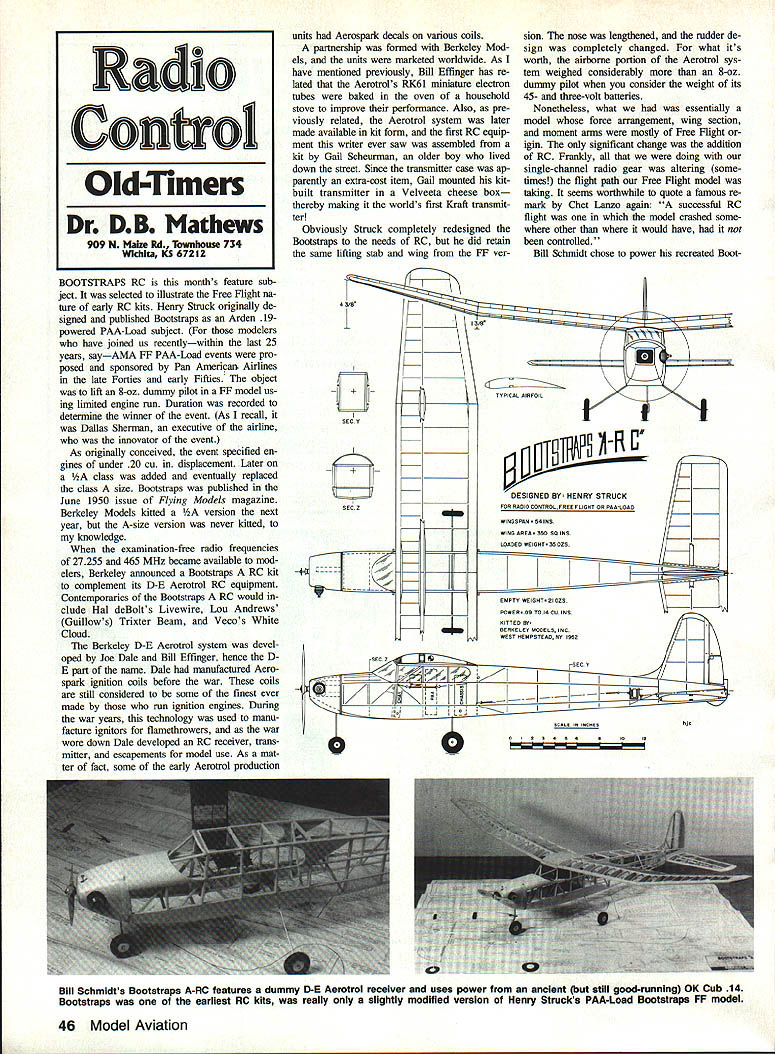
BOOTSTRAPS RC is this month's feature subject. It was selected to illustrate the Free Flight nature of early RC kits. Henry Struck originally designed and published Bootstraps as an Arden .19-powered PAA-Load subject.
For those modelers who have joined us more recently: AMA FF PAA-Load events were proposed and sponsored by Pan American Airlines in the late 1940s and early 1950s. The object was to lift an 8-oz. dummy pilot in a Free Flight model using a limited engine run. Duration was recorded to determine the winner of the event. As I recall, Dallas Sherman, an executive of the airline, was the innovator of the event.
As originally conceived, the event specified engines under .20 cu. in. displacement. Later a 1/4 A class was added and eventually replaced the A-size class. Bootstraps was published in the June 1950 issue of Flying Models magazine. Berkeley Models kitted a 1/4 A version the next year; the A-size version was, to my knowledge, never kitted.
When the examination-free radio frequencies of 27.255 and 465 MHz became available to modelers, Berkeley announced a Bootstraps A-RC kit to complement its D-E Aerotrol RC equipment. Contemporaries of the Bootstraps A-RC included Hal deBolt's Livewire, Lou Andrews' Trixter Beam, and Veco's White Cloud.
Obviously Struck completely redesigned Bootstraps to the needs of RC, but he retained the same lifting stab and wing from the Free Flight version. The nose was lengthened and the rudder design was completely changed. The airborne portion of the Aerotrol system weighed considerably more than an 8-oz. dummy pilot when you consider the weight of its 4.5- and 3-volt batteries. Nonetheless, the model's force arrangement, wing section, and moment arms were mostly of Free Flight origin; the only significant change was the addition of RC. Frankly, with our single-channel radio gear we were mostly altering (sometimes!) the flight path of our Free Flight models. Chet Lanzo's remark still rings true: "A successful RC flight is when the model crashed sooner than it would have, had it not been controlled."
If this project creates an interest in building any of the early single-channel RC designs, the majority are available in plan form from John Pond.
Berkeley D-E Aerotrol System
The Berkeley D-E Aerotrol system was developed by Joe Dale and Bill Effinger, hence the D-E part of the name. Dale had manufactured Aerospark ignition coils before the war; these coils are still highly regarded by ignition-engine enthusiasts. During the war years this technology was used to manufacture ignitors for flamethrowers, and as the war progressed Dale developed an RC receiver, transmitter, and escapements for model use. Some early Aerotrol production units even had Aerospark decals on various coils.
A partnership with Berkeley Models marketed the units worldwide. Bill Effinger has related that the Aerotrol's RK-61 miniature electron tubes were baked in a household oven to improve performance. The Aerotrol system was later made available in kit form — the first RC equipment this writer ever saw was assembled from a kit by a neighbor, Gail Scheurman. Since the transmitter case was apparently an extra-cost item, Gail mounted his kit-built transmitter in a Velveeta cheese box — thereby making it the world's first Kraft transmitter.
When constructing a period-correct Bootstraps RC, the Aerotrol receiver was typically hung from the four corners of the cabin with elastics. In a restoration or display the Aerotrol receiver is often a dummy, with a modern receiver and servo hidden under the dummy unit to preserve flight capability while retaining authentic appearance.
Spook and Mystery Man — Origins and Influence
Gordon Codding (Kingman, AZ) confirms that Barney Snider was influenced by Joe Weathers' Mystery Man when he designed the Spook series.
Barney Snider was a graduate pharmacist who preferred airplanes. He set himself up in the full-sized aircraft supply business, but the Depression caused him to switch to supplying model airplane kit companies such as Dennyplane. He then went into the kit business himself, first with the Scout and Pacific Ace rubber-powered designs. Shortly thereafter he introduced Miss Tiny in several sizes; the larger version used a tapered wing and became the gas-powered Pacific Ace.
Elbert ("Joe") Weathers came along with the Mystery Man, and Barney told Gordon that the 72-in. Spook was a simplified Mystery Man. Barney recalled a Precision contest (Free Flight) held at night at the Rosecrans-and-Western model airport in Gardena, CA. Concentric circles were drawn on the ground and takeoff was from the center. Contestants announced in advance how many turns their model would make, then tried to adjust the model to land on the bullseye. For two years the winner flew a Spook.
RC Old-Timers — Notes and Continuations
Continued from page 47.
Some weight comparisons done by Jim Aldrich and published in the San Diego Aerocrossers' newsletter add another dimension to "flat." Jim found:
- A pair of Du-Bro 3-1/2-in. tires weighs 6.6 oz.
- A pair of Dave Brown Lite-Flite wheels weighs only 1.2 oz.
Jim also noted that among Dave Brown wheels the lighter the color, the lighter the weight: charcoal gray ones are noticeably lighter than black ones. They are a bit lighter than Treaders — and they don't go flat, either.
April's Mystery Model
George Armstead (Glastonbury, CT) says he found the unidentified model in the October 1938 Model Airplane News (MAN) the night before the April 1988 issue of Model Aviation arrived. The model was pictured in that old magazine. MAN's information read:
"Picture No. 4 shows Kenneth Peterson's high-stabilizer job. Kenneth lives at 13512 Rutherford, Detroit, Michigan. He designed his ship from the data given by Mr. Grant in MAN. Possibly some will recognize it from the drawing. One significant change was that Ken raised the stabilizer so it would be out of the downdraft of the wing. The model flew beautifully (at the 1938 Detroit Nats) without wavering a moment. It is extremely steady and flew out of sight after about two minutes due to extremely strong winds."
I presume this was a one-off project and that the drawings were discarded long ago. Should that presumption be incorrect, it would be a delight to learn otherwise.
A Notable MAN Issue
My collection of MAN is 12 issues short of being complete; October 1938 is one of those missing issues. George sent a photocopy of the "Airways" section, which is enlightening on the Peterborough item and illustrates the Casimer Lae four-cycle engine that later became the Feeney engine mentioned years ago. Additionally, a twin-boom, tractor, gull-winged model by Roy Marquardt (of Marquardt Engineering) is shown.
Perhaps the most mind-boggling item in that issue is a photo of Clinton DeSoto adjusting radio equipment in a huge high-wing design he displayed at the same Nats. The text states DeSoto was the assistant secretary of the American Radio Relay League (ARRL). DeSoto's earlier 12-ft. RC glider presently hangs in the lobby of the ARRL's headquarters in Connecticut. The transmitter in the photo looks about the size of a suitcase; the model's fuselage is at least two feet high and the power plant is a .19 — big birds aren't new.
Requests and Notes
I am always interested in obtaining photos of unusual Old-Timers. They can be black-and-white or color prints. I am most interested in designs from the immediate post-WWII era and in cabin-type prewar designs. Please include a SASE when you write if you expect an answer.
SAM Old-Timers — Towline Glider Event
Several SAM (Society of Antique Modelers) Old-Timers chapters are experimenting with RC Old-Time Glider events. SAM 26 used the following rules for their event at this year's annual contest:
- Any glider or model of a glider first designed prior to December 1945.
- All appropriate and applicable SAM rules will be followed with respect to plans, construction, materials, modifications, etc.
- Wingspan will be limited to 120 in. planform measurement. Scaling is permitted. No loading limitation.
- Three official flights with a target time of 20 minutes each; cumulative time determines placing. (Penalties are assessed for flights over the target.)
This provides an opportunity to build and fly classic designs using a winch or Hi-Start instead of chasing a towline. It would be a lot of fun and might expand the circle of participants. Anyone for enlarged thermals, and such?
Transcribed from original scans by AI. Minor OCR errors may remain.

