
Radio Control: Old-Timers
Dr. D. B. Mathews 909 N. Maize Rd., Townhouse 734, Wichita, KS 67212
Bowden's "Mouse"
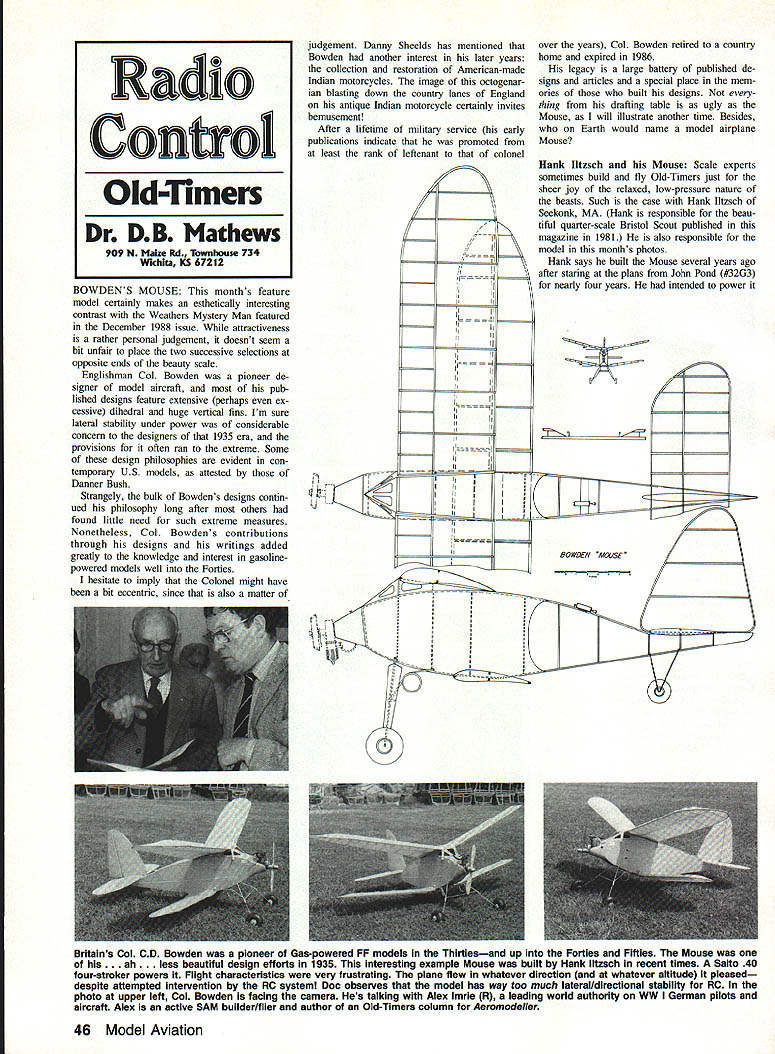
Col. Bowden's Mouse — this month's feature model — makes an aesthetically interesting contrast to Weathers' "Mystery Man" featured in the December 1988 issue. Attractiveness is, of course, a personal judgment; it doesn't seem unfair to place two successive selections at opposite ends of the beauty scale.
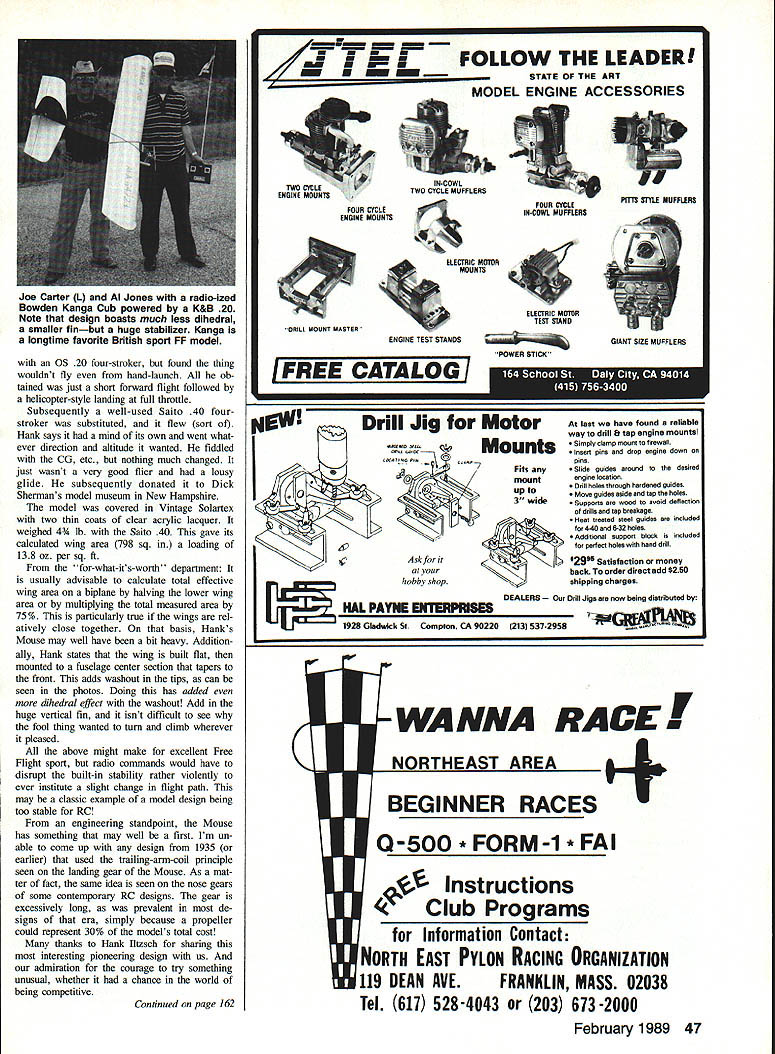
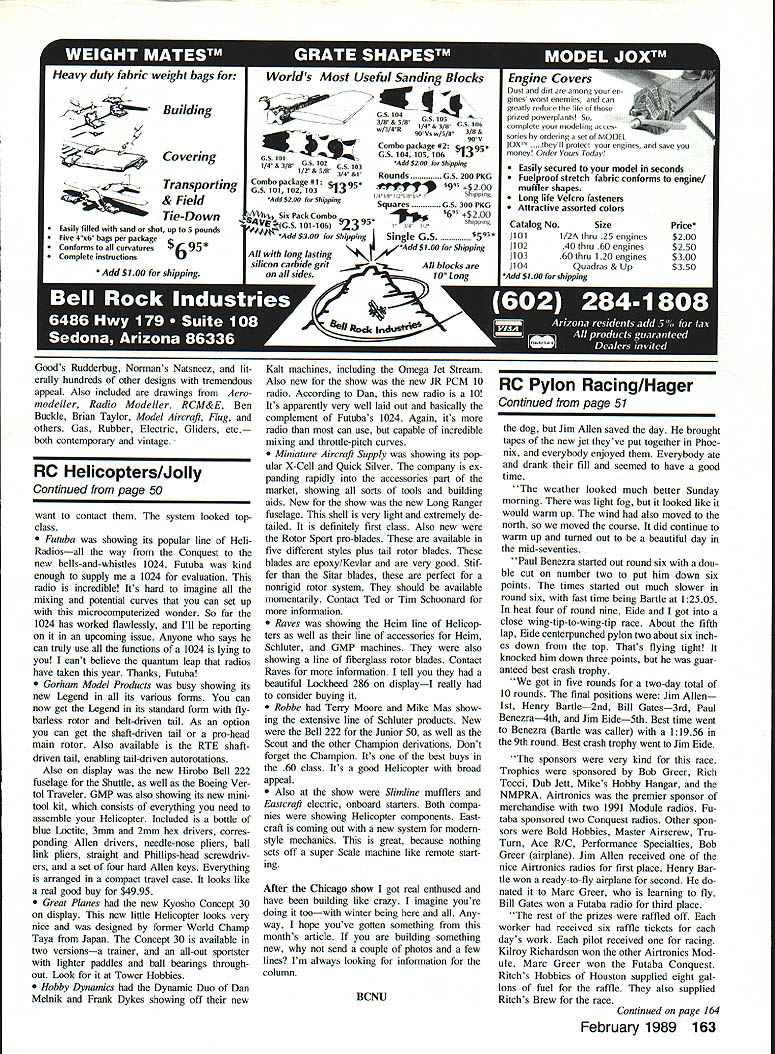
Englishman Col. Bowden was a pioneer designer of model aircraft. Many of his published designs show extensive — perhaps excessive — dihedral and very large vertical fins. Lateral stability under power was a major concern for designers in the 1935 era, and provisions often ran to the extreme. Some of these philosophies appear in contemporary U.S. models as well. Strangely, Bowden continued this philosophy long after many others found little need for such extreme measures. Nonetheless, his designs and writings added greatly to the knowledge of and interest in gasoline-powered models well into the 1940s.
Danny Shields has mentioned another of Bowden's later interests: collecting and restoring American-made Indian motorcycles. The image of an octogenarian blasting down English country lanes on an antique Indian invites bemusement. After a lifetime of military service (early publications indicate promotion at least to lieutenant colonel), Col. Bowden retired to the country and passed away in 1986. His legacy includes a large body of published designs and articles and a special place in the memories of those who built his designs.
Hank Iltzsch and his Mouse
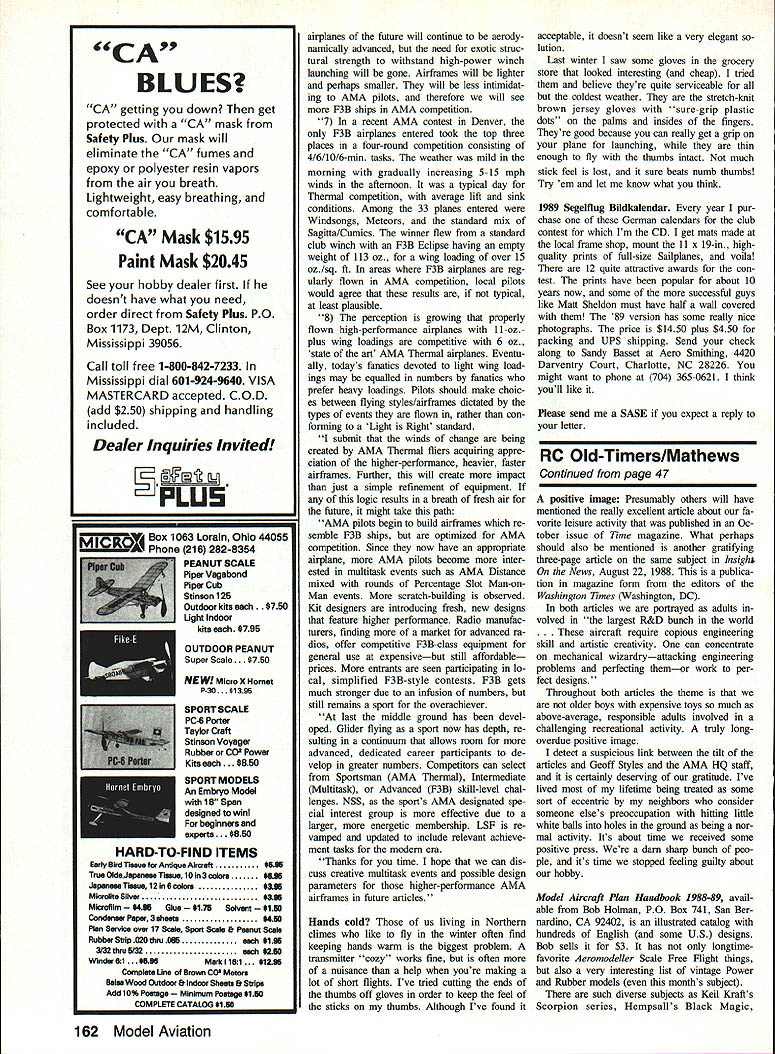
Scale experts sometimes build and fly Old-Timers simply for the relaxed, low-pressure enjoyment of them. Such is the case with Hank Iltzsch of Seekonk, MA. Hank built the Mouse several years ago after staring at the plans in John Pond (#32G3) for nearly four years. He originally intended to power it with a .46 engine, but the Mouse pictured here is powered by a Saito .40 four-stroke.
Flight characteristics were very frustrating: the airplane tended to fly whatever direction and at whatever altitude it pleased despite attempted intervention by the radio system. The model exhibited far too much lateral/directional stability for RC.
Hank tried an OS .20 four-stroke at one point, but the Mouse would not fly from a hand-launch — it would make a short forward hop and then descend in a helicopter-like landing at full throttle. Substituting a well-used Saito .40 produced limited success: the plane flew, but behaved as if it had a mind of its own, wandering in direction and altitude. Adjustments to CG and trim produced little improvement. Ultimately Hank donated the model to Dick Sherman's Model Museum in New Hampshire.
The model was covered with Vintage Solartex and finished with two thin coats of clear acrylic lacquer. It weighed 4-3/4 lb with the Saito .40. Its calculated wing area is 798 sq. in., yielding a wing loading of about 13.8 oz per sq. ft.
Flight characteristics and design causes
Hank reports the wing was built flat and mounted to a fuselage center section that tapers toward the nose. That construction introduces washout at the tips and, combined with the large dihedral and the very large vertical fin, greatly increases inherent lateral/directional stability. The result is a model that naturally wants to turn and climb — characteristics that are desirable in Free Flight but problematic for RC, since radio inputs must overcome strong built-in stability to effect modest changes in flight path.
This may be a classic example of a design that is too stable for RC.
Notes and observations
- Wing area and loading:
- Measured wing area: 798 sq. in.
- Weight: 4-3/4 lb (76 oz)
- Wing loading: ≈ 13.8 oz per sq. ft.
- Biplane wing-effect rule of thumb:
- For total effective wing area on a biplane, halve the lower wing area or multiply the total measured area by 75%, especially when the wings are relatively close together. Using that adjustment, Hank's Mouse may have been a bit heavy for its effective lifting area.
- Construction details affecting stability:
- Flat-built wing mounted on a tapered center section → tip washout.
- Significant dihedral plus washout → strong roll stability.
- Very large vertical fin → strong directional stability.
- Combined effects → high resistance to RC control inputs.
Gear design
From an engineering standpoint, the Mouse shows an interesting — perhaps pioneering — feature: a trailing-arm main gear. I am unaware of earlier designs (circa 1935 or before) that used this form of trailing-arm main gear. The same idea is seen on the nose gear of some contemporary RC designs. The gear on the Mouse is long, consistent with the era's practice of accommodating large propellers.
Many thanks to Hank Iltzsch for sharing this interesting pioneering design and for the courage to try something unusual, even if it was unlikely to be competitive in the RC environment.
Transcribed from original scans by AI. Minor OCR errors may remain.

