
Radio Control: Old-Timers
Dr. D. B. Mathews 909 N. Maize Rd., Townhouse 734 Wichita, KS 67212
Transformation: from rodent to waterfowl
I've varied the featured models from the ridiculous to the sublime in these last two columns for a reason. Both are designs of the same man but separated in time by about four years. February's subject (Mouse) exemplifies excesses in almost all categories of inherent stability with a resultant strange (if not bizarre) appearance. Col. Bowden's Mouse may well be one of the least attractive Old-Timer designs of all time.
The poor thing was designed in 1934 and published a year later. This makes it a contemporary of the U.S. KG-3 and Maxwell Bassett's Miss Philadelphia. Very little was known about designing for gasoline-powered engines in those days and consequently many of the design parameters used were based on experience with rubber-powered models. Take a look at the Mouse, and you will see the structure is certainly reminiscent of rubber-power practice, as are the huge amounts of down and side thrust.
Anyone who has flown Unlimited Rubber or Wakefield with those huge props (often having diameters approaching 35% of wingspan) can understand a tendency to compensate for a preconceived (often erroneously) amount of thrust and torque from the new gas engines. On that basis, 6° of down and right thrust might be explainable.
The Mouse's incredible amount of dihedral and washout had us a bit puzzled until—by coincidence—the newsletter of the Aeroneers included a delightful and comprehensive flying and historical report of Alex Imerie's Elf-powered, Joe Weathers–designed Miss San Diego. In that report Imerie quoted Charles Grant from the April 1937 edition of Model Airplane News, in which the father of power model design takes to task designers who tended to use excessive dihedral.
Grant reasons that all one accomplishes with disproportionate dihedral is spiral instability. That is, as the dihedral is increased, the center-of-lateral-area (CLA—which he also calls the directional center) is moved away from the center-of-gravity (CG).
As we have learned the hard way, for best stability the CLA and CG need to be close together. The farther up the CLA is, the more likely the model will drop a wing and enter a spiral. Free Flight Scale often suggests adding some sort of weight in the undercarriage wheels or else the model fails to point properly. In short, the Mouse probably behaves strangely under radio assist because it has excessive dihedral and a relatively high CLA. Rudder movements likely just exacerbate the problems; the down and side thrust make a lot of sense. The incredible dihedral also likely explains the plane's oversized fin.
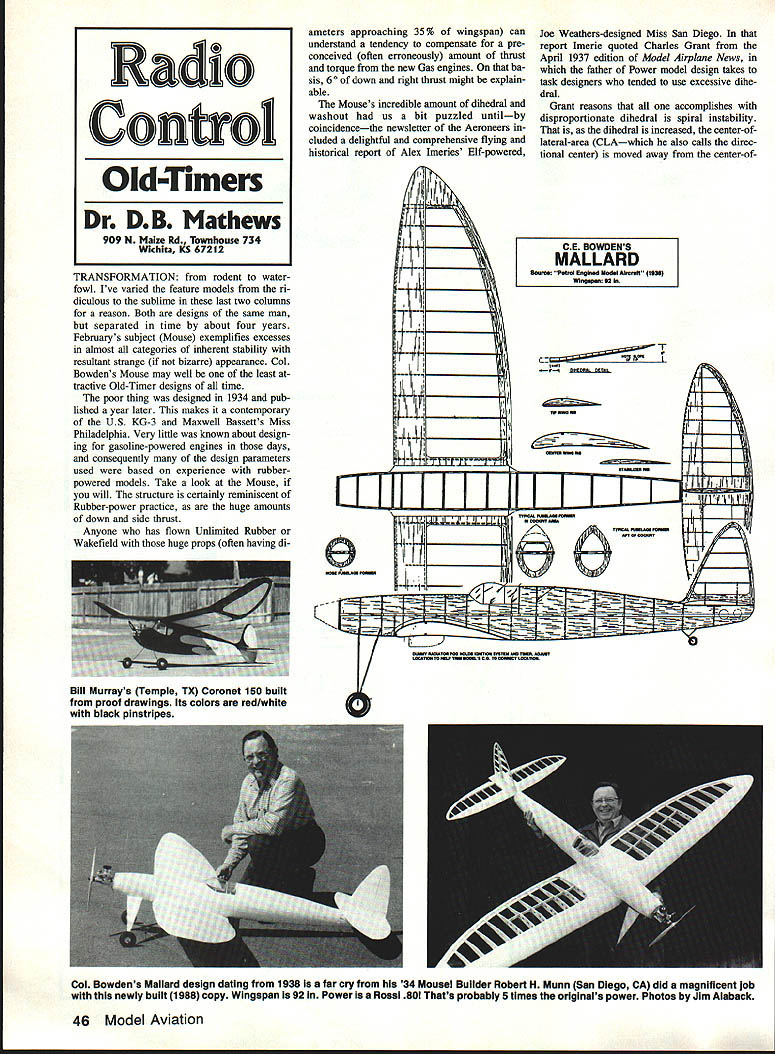
So, four years and several designs later, Colonel Bowden and other designers had learned a few things, many the hard way. The Mallard displays the net result of these lessons. There is no need for nonscale dihedral, no need for huge amounts of down and side thrust, and no need for a disproportionate fin. One could now design a model that looked like a full-scale airplane with a reasonable expectation of good flying characteristics.
Bob Munn of San Diego, CA, fell in love with the Mallard. Exceptional workmanship is evident in the construction; the clean design is notable and the model is actually overpowered by a Rossi .80 model engine (a SAM-legal power plant). It is a beautiful model and marvelous craftsmanship.
Oddities pulled from the aforementioned April 1937 issue of Model Airplane News include C. H. Grant's "Gas Lines" discussion. Also on the same page is a photo of the Berkeley Cavalier, sun shining through its structure, held by its much younger builder. John Pond recently bought Bob Munn's Mallard. Sorta spooky, don't you think?
Radio Control: Old-Timers (SAM news and Spirit of SAM)
Army recruiting posters with the old guy pointing his finger at you? Well, if you're not a member of SAM (Society of Antique Modellers), you have been pointed at! The newsletter is reason enough to join. If you've never seen one, you'll be surprised at its contents. There's a whole lot more than contest reports and rules controversies. Lots more! It's really a highly interesting compendium of Old-Timer activities in both Free Flight and RC-Assist from around the world.
New members should send $10 to Robert P. Dodd, 209 Summerland Lane, Encinitas, CA 92024. You might also want to ask for the available list of area SAM chapters to help locate kindred spirits in your neighborhood.
That's the spirit! SAM Speaks editor (and now president) Jim Adams wrote a thoughtful editorial several months ago lamenting the trend toward over-designed, overpowered, and totally unrealistic entries in Old-Timer RC-Assist events. His challenge was to return some semblance of the way things were at contests when these designs were seen. Something to more closely recreate a historical era was the intent of SAM's founders.
Our builder-of-the-month, Bob Munn, read this challenge and set out to develop an event which would, it was hoped, encourage builders to bring out models developed not for their ability to climb almost out of sight in a near-vertical climb, but to fly gently with the majesty peculiar to many of those classic—but noncompetitive—designs. He and others who took up Jim Adams' challenge settled on the name Spirit of SAM Concours, distributed a set of rules, and encouraged the idea wherever they could.
The San Diego Aeroneers included the Concours event in their 1988 annual contest. To everyone's delight and surprise it drew more entries than any other event. Such beautiful models as Red Zephyr, Super Buccaneer, Miss America, Flying Quaker, etc., were entered and displayed to the delight of contestants and spectators. We don't recall who "won," and it isn't particularly important, really.
The real winners are the whole bunch of us who enjoy seeing these lovely old ladies in action. Without the Concours event, their builders would have had no reason to bring them out. A very similar phenomenon is a much-enjoyed part of the Old Warden Old-Timer Day in England. Builders exhibit what begs absolutely no competitive potential but with vast aesthetic appeal.
One thing the writer first became interested in was adding radio systems to pre-World War II designs. SAM was primarily a Free Flight organization with only provisional rules for RC-Assist. Even after RC-Assist began to catch hold, most events were more social than competitive.
I recall SAM events at the Chicago Nats in 1972 as an illustration. Several fellows were dressed in clothing from the Thirties. I don't recall anyone paying much attention to flight times or position on the tally boards. I don't recall Playboys in 5.5 cc increments everywhere we looked. And I certainly don't recall hearing any K&B .35 power plants screaming away at 17,000 (or more) rpm.
I do recall such things as Sal Taibi starting his Forster .99-powered Powerhouse on the first flip of the prop. Sal also had a Green Hornet. There was Hale Wallace flying a .23-powered Brigadier after losing a beautiful RC Scale Clipper in radio interference. There was the lovely slow-swept climb and flight of a Brown-powered KG-1, and many other delightful, fun things. That's the way it was 17 years ago.
Spirit of SAM Concours — Ground rules (courtesy of Bob Munn)
- A special new event in which the fliers themselves decide which of the models entered best represents the spirit of imagination, experimentation, and craftsmanship which characterized the early days of aeromodelling.
- No entry fee, no restrictions on size, engine, or radio.
- Any model which qualifies under current SAM rules as an Antique or Old-Timer and originally designed for gas power or Free Flight or Flying Scale can be entered.
- One demonstration flight, consisting of climb using only engine power and glide for landing, is required, but no judging or timing is involved.
- While you could enter Spirit of SAM Concours with the same aircraft entered in one of the competitive events, the hope is that entrants will instead bring an authentic, noncompetitive model which, while not competitive under current rules, nevertheless radiates the pleasure of seeing your own handiwork take gracefully to the air.
Photographs in either color or black & white of any models from the pre-1957 era are always needed and greatly appreciated.
For those who have written seeking a source of vintage covering material, White Silk, sold under the trade name White Silk, is available from Aerospace Composite Products, P.O. Box 16621, Irvine, CA 92714.
Flash: The 1989 SAM Champs site has been finalized. After several disappointments over locations, SAM has chosen Jean, NV and October 8–9, 1989. The site is south of Las Vegas on Highway I-15. The headquarters hotel is about 2-1/2 miles from the dry lakebed selected for the flying site. The site is 1-1/2 by 2-1/2 miles in size. Larry Jeno will be the CD, and an effort is being made to make this an international SAM Champs with participants from chapters in Italy, England, Australia, New Zealand, Canada, etc. It sounds like a real winner, so mark your calendars, and ENJOY!
Transcribed from original scans by AI. Minor OCR errors may remain.

