
Radio Control: Old-Timers
Dr. D.B. Mathews 909 N. Maize Rd., Townhouse 734 Wichita, KS 67212
Before I start off, there is something I'd like to get off my chest: I love my readers, and I love to get letters from them. However, when a reader asks something which necessitates my making a reply, I sure would appreciate it if he would include a SASE—or at least return postage. Believe me when I tell you that I am not getting rich from writing this bimonthly column! I do it as a labor of love. Spending one quarter for a postage stamp won't break me—but I get lots of letters, and it all adds up. Gimme a break, folks!
One other thing: When you write to me, please don't send your letter to the Model Aviation editorial offices in Virginia. That just means they have to forward it to my home here in Wichita, KS, and that takes additional time and effort on somebody's part. Send things to me directly at the address given above.
Early Birds
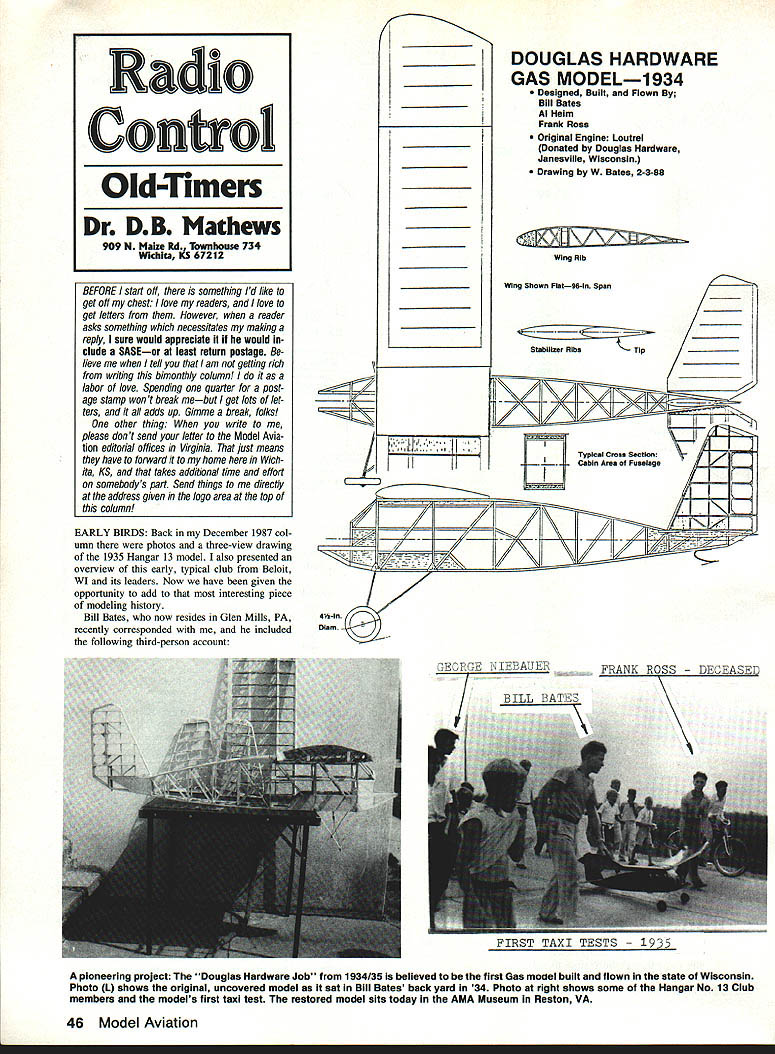
Back in my December 1987 column there were photos and a three-view drawing of the 1935 Hangar 13 model. I also presented an overview of this early, typical club from Beloit, WI and its leaders. Now we have been given the opportunity to add to that most interesting piece of modeling history.
Bill Bates, who now resides in Glen Mills, PA, recently corresponded with me and included the following third-person account:
Back in 1932 a model airplane club was organized in Beloit, WI. Originally there were 13 members, which led to the name of the club, Hangar #13. The club became a junior chapter of the National Aeronautic Association (NAA) in 1935. The NAA was the predecessor of the AMA. During this period Bill Bates, now a member of the Salem club, was president, and Conrad Hansen (now of Dayton, OH) was the club advisor. Bill's license at that time was NAA 2026.
The club met twice a month at the YMCA, and its dues were 10¢. This was right after the Depression of 1929, and money was still tight. In order to conserve limited resources, all building materials—balsa, Ambroid cement, banana oil, tissue, silk, rubber, music wire, and airplane dope—were purchased by the club in bulk by mail order and dispensed free to members for normal projects. Large amounts, for say, a gas model, were supplied at cost.
The club meetings were actually building sessions with the older members teaching and helping the younger members. There was lots of competition within the club and with clubs from surrounding areas. Several members attended the Nationals.
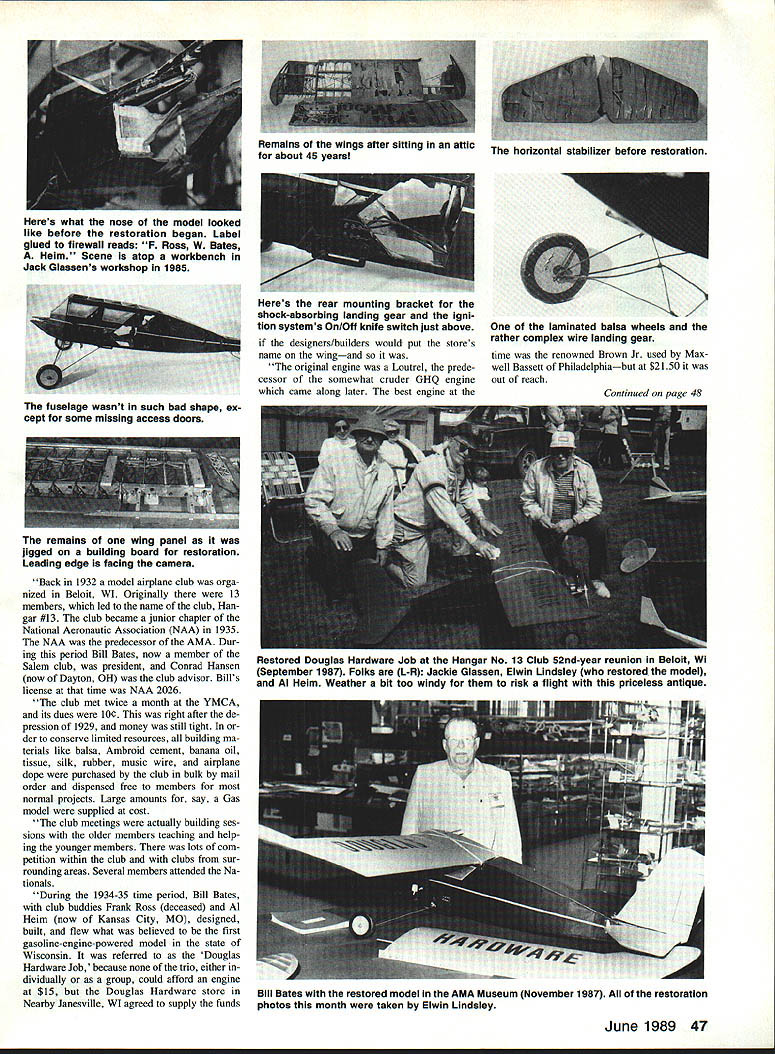
During the 1934–35 time period, Bill Bates, with club buddies Frank Ross (deceased) and Al Heim (now of Kansas City, MO), designed, built, and flew what was believed to be the first gasoline-engine-powered model in the state of Wisconsin. It was referred to as the "Douglas Hardware Job," because none of the trio, either individually or as a group, could afford an engine at $15, but the Douglas Hardware store in nearby Janesville, WI, agreed to supply the funds if the designers/builders would put the store's name on the wing — and so it was.
The original engine was a Loutrel, the predecessor of the somewhat cruder GHQ engine which came along later. The best engine at the time was the renowned Brown Jr., used by Maxwell Bassett of Philadelphia—but at $21.50 it was out of reach.
On one occasion during the winter of 1935 Bill and Al, along with fellow club member Elwin Lindsley (now retired Senior Engineering Editor of Popular Science magazine), managed to get the balky Loutrel fired up on the Beloit city golf course, and off went the DH on a nice flight.
The engine almost always quit after a short run—but not that day. Bill and Al started legging it after the plane and finally crossed the nearby frozen Rock River. Meanwhile, Elwin drove his father's car around and over the bridge. You guessed it: Bill broke through the ice but was lucky enough to be able to crawl out alone while Al stayed back for fear of making matters worse. Dripping wet with the water freezing on Bill, they made it to the car side just as Elwin came along the river road with the car. The heater in the car saved the day. It was a good thing Elwin found them, as the temperature was well below freezing.
The plane was later found in good shape on the nearby country club golf course. Lucky, right? There were only the two golf courses in the area.
The Douglas Hardware plane was a cabin job with an 8-ft wingspan and polyhedral, a feature made popular in those days by Maxwell Bassett. The wing had a Clark Y airfoil with built-up ribs, a main box spar, and a truss-type rear spar. It was built in three sections and joined with dowel joints. The cabin-type fuselage was reminiscent of early Bellanca full-scale designs. It was 52 1/2 in. long, 9 in. deep at the cabin, and 6 1/2 in. wide. Boy! All that room and no radio! Weight was about 5 1/2 lb.
By 1940 the Douglas Hardware job was a basket case, and the remains were left in the care of Jackie Glassen of Madison, WI, who was one of Bill's young modeling protégés and the state Junior Gas model champion of 1939.
Following the 49th-year reunion of Hangar #13 in 1984, Bill learned that Jackie still had the plane in his attic with all the pieces—sans engine. Knowing that Hangar #13 was going to have another reunion in Beloit, WI in 1987, Elwin (who lived in Beloit) convinced Bill that a restored Douglas Hardware Job would make a nice attraction for the next reunion. It did not take much convincing.
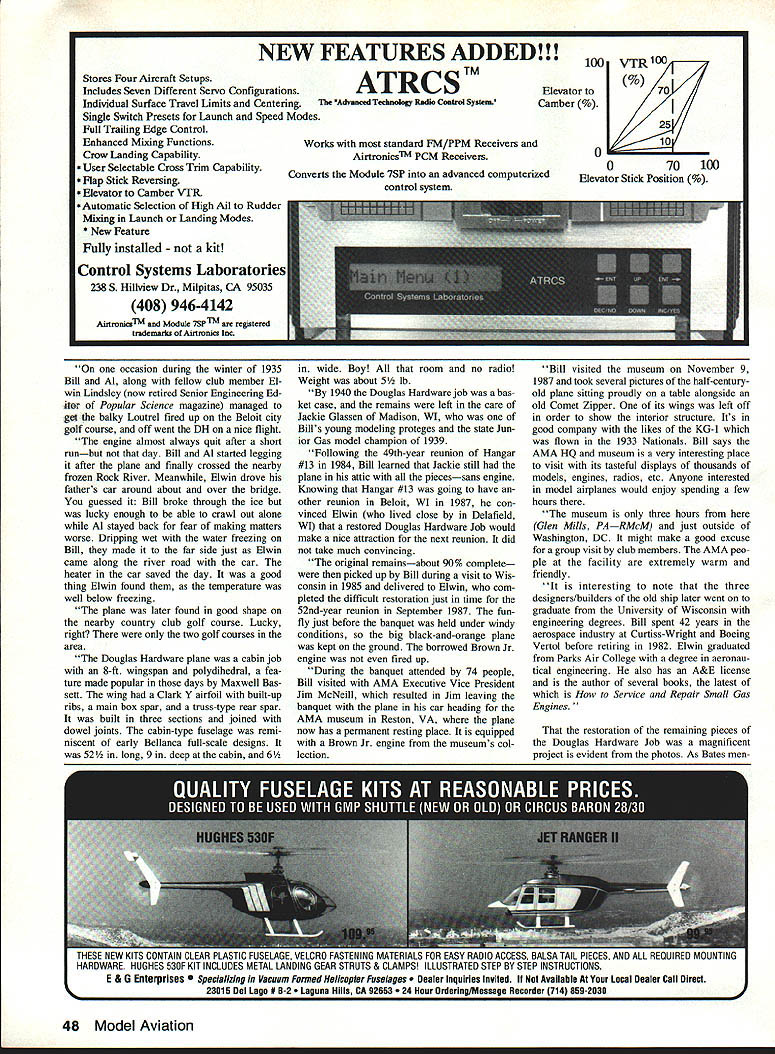
The original remains—about 90% complete—were picked up by Bill during a visit to Wisconsin in 1985 and delivered to Elwin, who completed the difficult restoration just in time for the 52nd-year reunion in September 1987. The fully restored plane was then used under winged conditions, so the big black-and-orange plane was kept on the ground. The borrowed Brown Jr. engine was not even fired up.
During the banquet attended by 74 people, Bill visited with AMA Executive Vice President Jim McNeill, which resulted in Jim leaving the banquet with the plane in his car heading for the AMA museum in Reston, VA, where the plane now has a permanent resting place. It is equipped with a Brown Jr. engine from the museum's collection.
Bill visited the museum on November 9, 1987 and took several pictures of the half-century-old plane sitting proudly on a table alongside an old Comet Zipper. One of its wings was left off to show the interior structure. It sits in company with the likes of the KG-1, which was flown in the 1933 Nationals. Bill says the AMA HQ and museum is a very interesting place to visit with its tasteful displays of thousands of model airplanes, engines, radios, etc. Anyone interested in model airplanes would enjoy spending a few hours there.
It is interesting to note that the three designers/builders of the old ship later went on to graduate from the University of Wisconsin with engineering degrees. Bill spent 42 years in the aerospace industry at Curtiss-Wright and Boeing Vertol before retiring in 1982. Elwin graduated from Parks Air College with a degree in aeronautical engineering. He also has an AAE license and is the author of several books, the latest of which is How to Service and Repair Small Gas Engines.
That the restoration of the remaining pieces of the Douglas Hardware Job was a magnificent project is evident from the results and from the enthusiasm shown by those who attended the reunion and subsequent events.
Elwin Lindsley's restoration report
The first time I saw the DH "Gas Job," which had been built by Bill Bates, Alfred Heim, and the late Frank Ross of the Hangar 13 Club of Beloit, WI, was on a bright, cold winter's day—probably in 1936. Suffice it to say that it was a splendid, gleaming example of its builders' craftsmanship, and even on that bitter day they managed to breathe life into the Loutrel engine. That day the DH flew well, high, and stable—but too far. There was no engine timer on this first gas model in the state of Wisconsin.
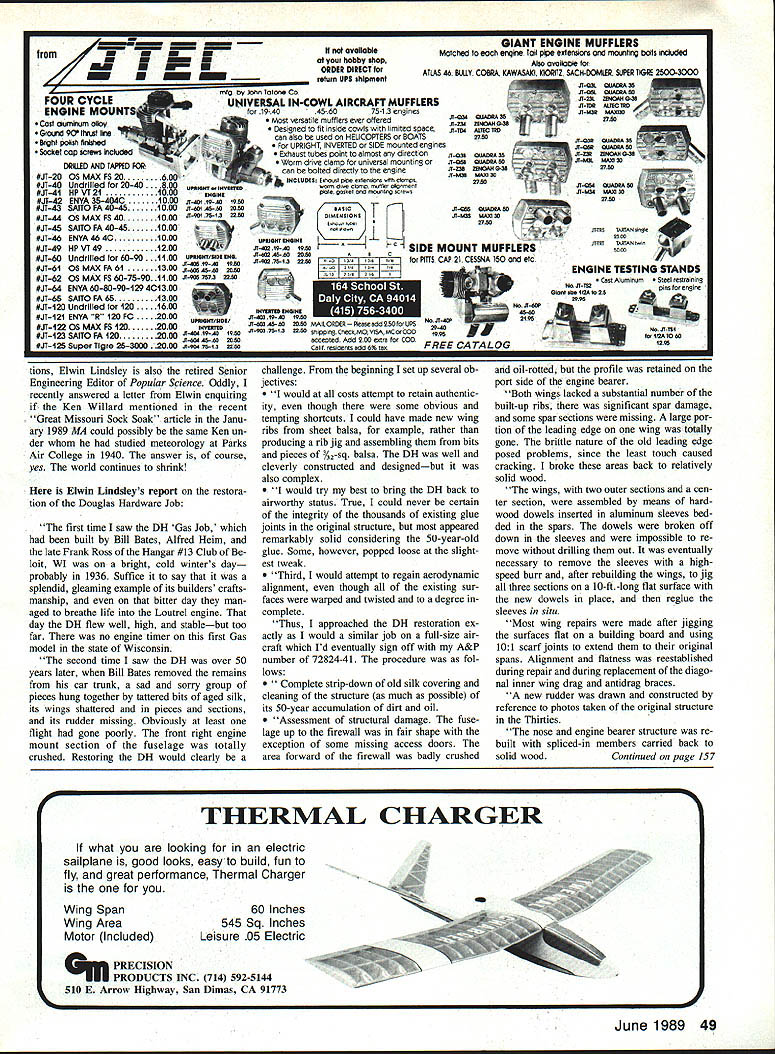
The second time I saw the DH was over 50 years later, when Bill Bates removed the remains from his car trunk: a sad and sorry group of pieces hung together by tattered bits of aged silk, its wings shattered and its pieces and sections missing, and its rudder missing. Obviously at least one flight had gone poorly. The front right engine mount section of the fuselage was totally crushed. Restoring the DH would clearly be a challenge. From the beginning I set up several objectives:
- I would at all costs attempt to retain authenticity, even though there were some obvious and tempting shortcuts. I could have made new wing ribs from sheet balsa, for example, rather than producing a rib jig and assembling them from bits and pieces of 1/32-sq. balsa. The DH was well and cleverly constructed and designed—but it was also complex.
- I would try my best to bring the DH back to airworthy status. True, I could never be certain of the integrity of the thousands of existing glue joints in the original structure, but most appeared remarkably solid considering the 50-year-old glue. Some, however, popped loose at the slightest move.
- Third, I would attempt to regain aerodynamic alignment, even though all of the existing surfaces were warped and twisted and to a degree incomplete.
Thus, I approached the DH restoration exactly as I would a similar job on a full-size aircraft which I'd eventually sign off with my A&P number of 728244-1. The procedure was as follows:
- Complete strip-down of old silk covering and cleaning of the structure (as much as possible) of its 50-year accumulation of dirt and oil.
- Assessment of structural damage. The fuselage top to the firewall was in fair shape with the exception of some missing access doors. The area forward of the firewall was badly crushed and oil-rotted, but the profile was retained on the port side of the engine bearer.
- Both wings lacked a substantial number of the built-up ribs, there was significant spar damage, and some spar sections were missing. A large portion of the leading edge on one wing was totally gone. The brittle nature of the old leading edge posed problems, since the least touch caused cracking. I broke these areas back to relatively solid wood.
- The wings, with two outer sections and a center section, were assembled by means of hardwood dowels inserted in aluminum sleeves between the spars. The dowels were broken off or worn in the sleeves and were impossible to remove without drilling them out. It was eventually necessary to remove the sleeves with a high-speed burr and, after rebuilding the wings, to jig all three sections on a 10-ft long flat surface with the new dowels in place, and then re-glue the sleeves in place.
- Most wing repairs were made after jigging the surfaces flat on a building board and using 10:1 scarf joints to extend them to their original spans. Alignment and fairness were reestablished during repair and during replacement of the diagonal inner wing drag and anti-drag braces.
- A new rudder was drawn and constructed by reference to the photos taken of the original structure in the Thirties.
- The nose and engine bearer structure was rebuilt with spliced-in members carried back to solid wood.
Continued from page 49
The original ignition wiring which remained consisted of mid‑Thirties‑type automotive accessory wire which had totally deteriorated so that the insulation cracked at a touch. This was removed, but the engine double‑pole, double‑throw knife switch was disassembled, cleaned of corrosion, buffed, and installed (although it's not used in its original location).
Although the laminated balsa wheels were removed and sanded, and the "tire" area repainted, the remaining metal fittings were cleaned and preserved rather than replaced. The original landing gear was left intact and slightly bent.
Recovering and refinishing was done in the conventional manner with Koverall fabric and nitrate dope.
The foregoing rather superficial relating of the basic restoration steps necessarily omits a host of interesting details about the construction of this pioneer gas model. Plainly, the designers/builders drew heavily upon their own judgment and engineering skills. The fact that the DH flew, and flew well, and survived for over half a century is a testimonial to their abilities.
My August column will feature a new Douglas Hardware model constructed by master craftsman Ralph Beck, who also built the Hangar 13 Special I featured in the December 1987 issue. For those who can't wait, Ralph's address is RR #2, Box 131, Beloit, WI 53511. He can likely help the truly interested person obtain working drawings.
Did you know this?
Joe Butler (Granbury, TX) recently sent me photos of his Ole Reliable (featured as a construction article in the June 1978 issue) and made available as Full-Size Plan No. 225—$4.25 with a Smog Hog airfoil section. In his letter, he called attention to a mild piece in another model magazine which accompanied the construction article of a "new" Old-Timer having a wing loading of 15 oz./sq. ft. To protect the author, I quote without source:
"Most of us 'old geezers' know how to properly balance an aircraft. However, for the benefit of new modelers, the following is the method I used: Mark the underside of the wing next to the cabin windows with a dot corresponding to the CG position shown on the plans. Place the index fingers on these dots, and lift the aircraft. The aircraft is balanced when it hangs slightly (10° to 12° nose down)."
Son of a gun! And all these years we all thought that meant the model was nose-heavy! This truly is the age of enlightenment!
Transcribed from original scans by AI. Minor OCR errors may remain.

