
Radio Control: Old-Timers
Dr. D. B. Mathews
909 N. Maize Rd., Townhouse 734 Wichita, KS 67212
Unique Experience
I've been writing this column for nearly 11 years now. I've always sent my manuscript to the MA editorial offices three to five weeks before my deadline. That's a trick I learned long ago in college: get the paper in early and you'll invariably get a better grade.
This month I decided to do it differently. I held off writing this until the previous one (June 1989 issue) arrived from the printer. I was concerned about how the June article would look in print. I was pleased at the layout, and I was thankful our editor knocked off some of the rough edges and made it "sing" better. I certainly felt that the subject matter made for an interesting column, too.
Most of us with interest in model matters from the pre-WWII era are content to recreate designs from that time frame. But here we found Elwin Lindsley actually restoring a model that was over 50 years old! I've seen this sort of dedication to authenticity in the Antique and Classic aircraft classifications at the big EAA Oshkosh fly-in and have always felt deep respect for the restorers. This is my first encounter with the same sort of effort in modeling.
Here's a story to illustrate a restorer's dedication: many years ago at Oshkosh I stumbled onto the most beautiful yellow Curtiss Robin I had ever seen. While visiting with the father and son who had restored it (you used to be able to do that personal sort of thing at Oshkosh before it grew so huge), I noticed the plane's like-new axle caps, complete with the famous Curtiss logo on them. I asked, "Where on earth did you find new brass castings like that?" They replied, "We couldn't find any—so we sandcast new ones."
They had gone to the library and read everything they could find on the subject, and taught themselves how to develop the patterns and pour the molds. Then I looked inside the Robin and saw new-looking wicker seats. Yep. They'd followed the same path and recreated the originals.
I admire and respect that sort of dedicated effort. Has my point been made? You're invited to read into the above whatever you wish.
Ralph Beck — Historian
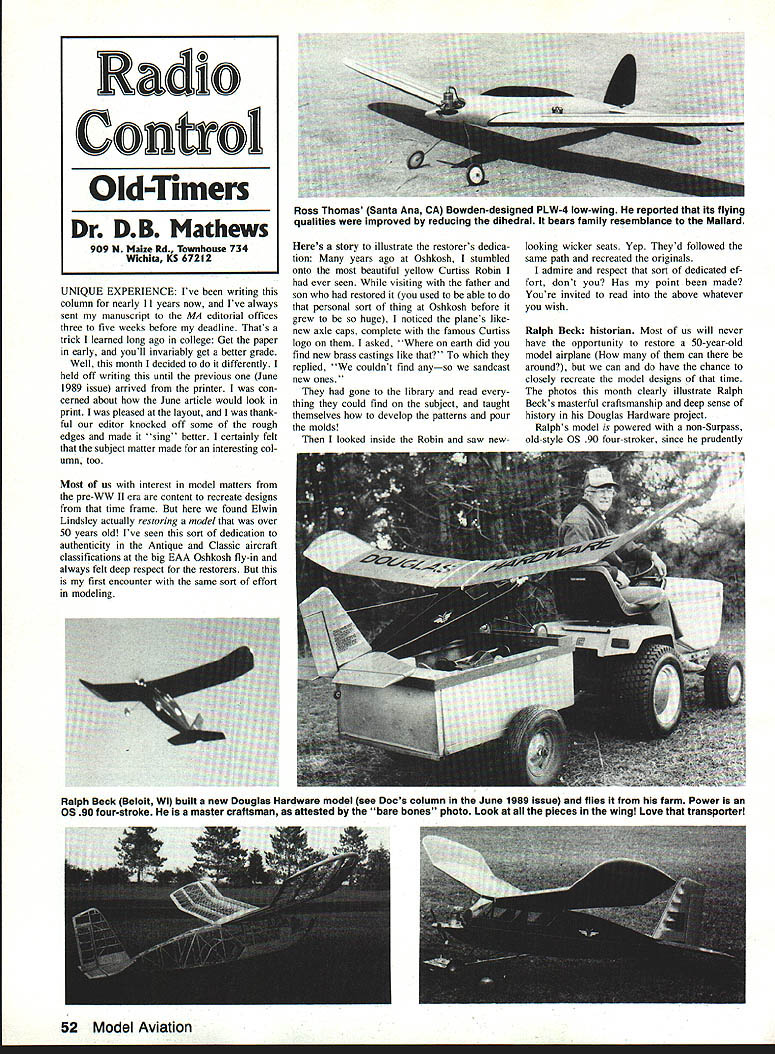
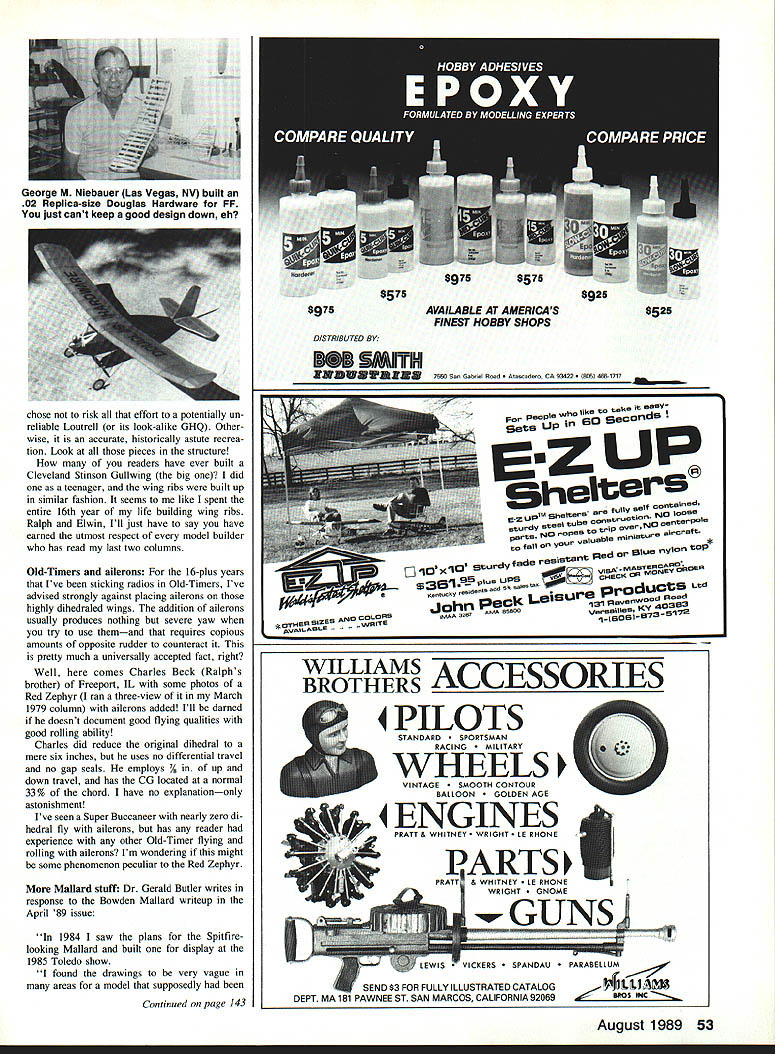
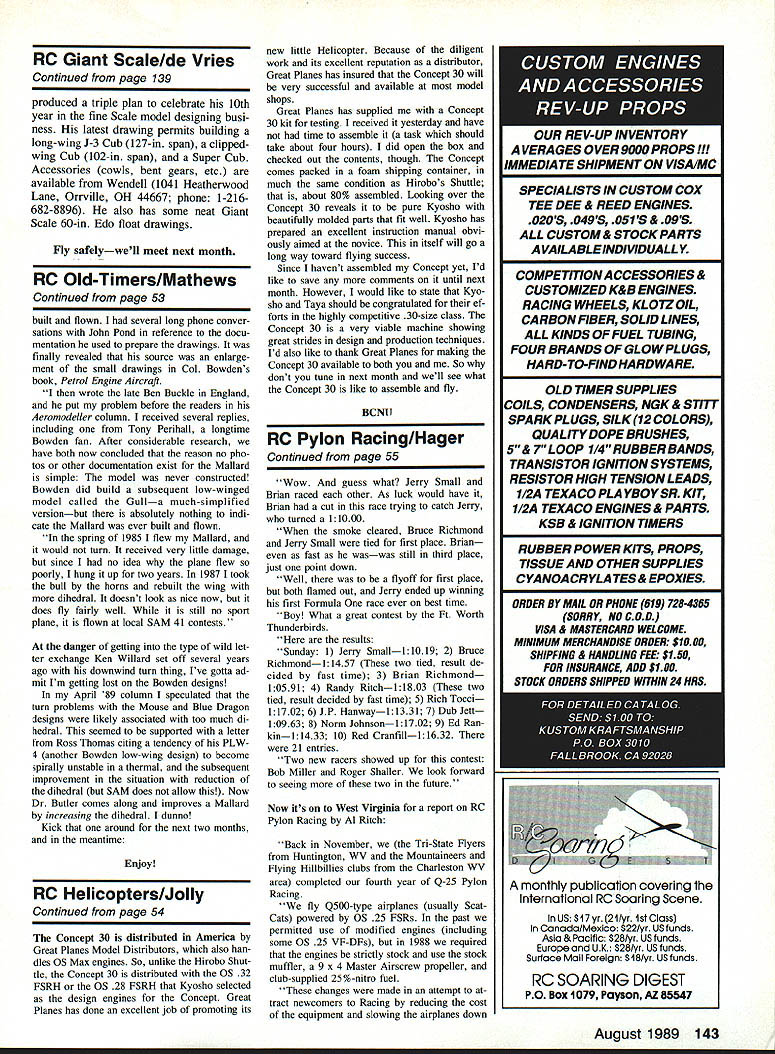
Most of us will never have the opportunity to restore a 50-year-old model airplane (how many of them can there be around?), but we can and do have the chance to closely recreate the model designs of that time. The photos this month clearly illustrate Ralph Beck's masterful craftsmanship and deep sense of history in his Douglas Hardware project.
I'll just say he has earned the utmost respect as a model builder.
Ailerons on Old-Timers
As I've said in the last two columns on Old-Timers and ailerons—for 16-plus years I've advised strongly against placing ailerons on highly dihedraled wings. In addition, ailerons usually produce nothing but severe yaw; try to use them and it requires copious amounts of opposite rudder to counteract. This is a pretty much universally accepted fact, right?
Well, along comes Charles Beck, Ralph's brother from Freeport, IL. Some photos of his Red Zephyr (a three-view that ran in the March 1979 column) show ailerons added. I'll be darned if it doesn't demonstrate good flying qualities and good rolling ability. Charles did reduce the original dihedral by a mere six inches, uses no differential travel, no gap seals, employs 3/4" up/down travel, and has the C/G located at the normal 33% chord. I have no explanation—only astonishment.
I've seen the Super Buccaneer with nearly zero dihedral fly with ailerons. Has any reader experienced other Old-Timers flying with rolling ailerons? I'm wondering if there might be some phenomenon peculiar to the Red Zephyr/Mallard combinations.
More Mallard Stuff (Dr. Gerald Butler)
Dr. Gerald Butler writes in response to the Bowden Mallard writeup in the April 1989 issue.
"In 1984 I saw the plans for the Spitfire-looking Mallard and built one for display at the 1985 Toledo show. I found the drawings to be very vague in many areas for a model that supposedly had been built and flown. I had several long phone conversations with John Pond in reference to the documentation he used to prepare the drawings. It was finally revealed that his source was an enlargement of the small drawings in Col. Bowden's book, Petrol Engine Aircraft.
"I then wrote the late Ben Buckle in England, and he put my problem before the readers in his Aeromodeller column. I received several replies, including one from Tony Perihall, a longtime Bowden fan. After considerable research, we have both now concluded that the reason no photos or other documentation exist for the Mallard is simple: the model was never constructed! Bowden did build a subsequent low-winged model called the Gull—a much-simplified version—but there is absolutely nothing to indicate the Mallard was ever built and flown.
"In the spring of 1985 I flew my Mallard, and it would not turn. It received very little damage, but since I had no idea why the plane flew so poorly, I hung it up for two years. In 1987 I took the bull by the horns and rebuilt the wing with more dihedral. It doesn't look as nice now, but it does fly fairly well. While it is still no 'sport' plane, it is flown at local SAM 41 contests."
Enjoy!
Transcribed from original scans by AI. Minor OCR errors may remain.

