
Radio Control: Old-Timers
Dr. D. B. Mathews 909 N. Maize Rd., Townhouse 734 Wichita, KS 67212
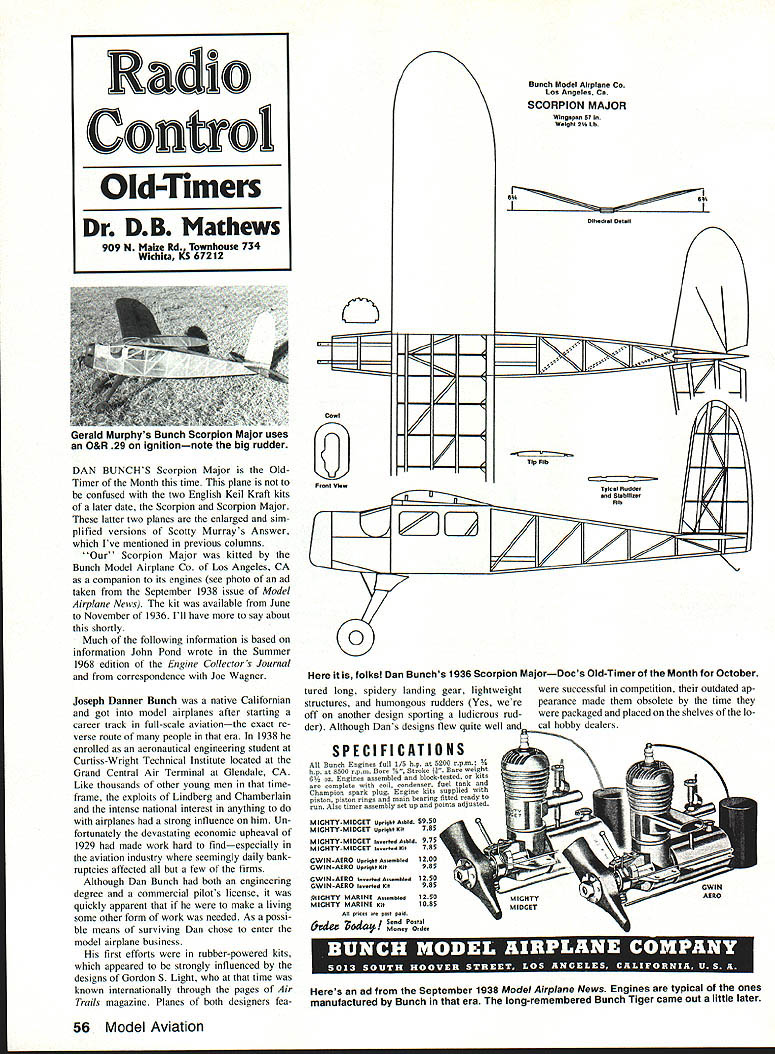
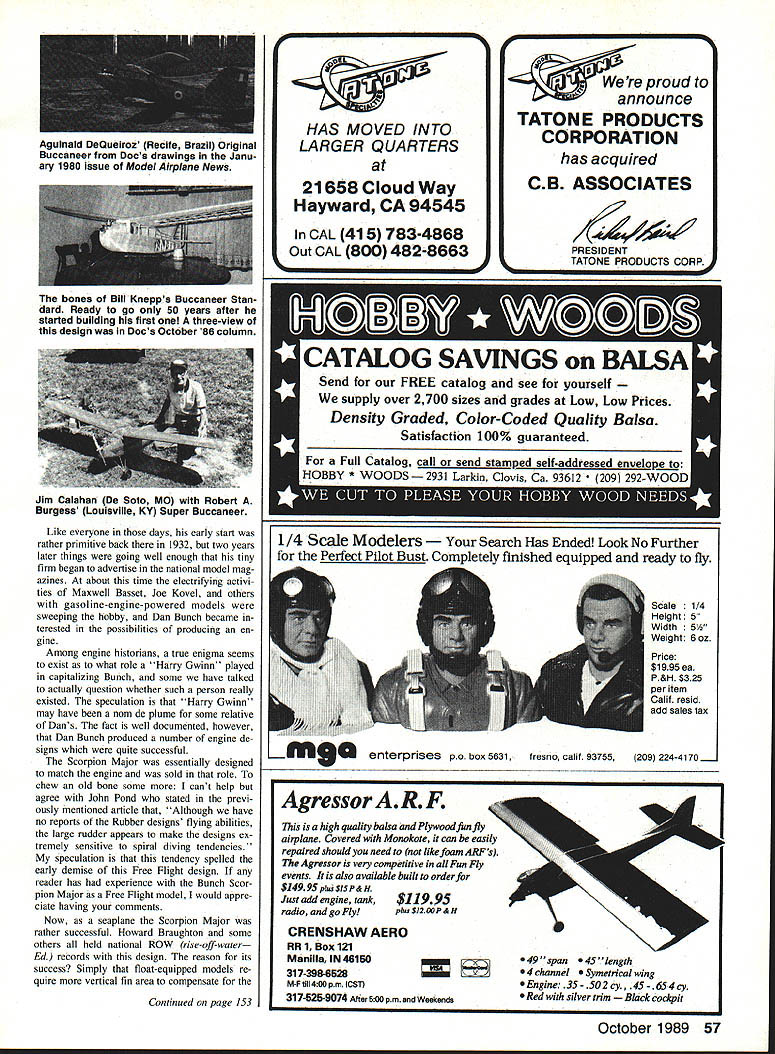
Dan Bunch's Scorpion Major is the Old-Timer of the Month this time. This plane is not to be confused with the two English Keil Kraft kits of a later date, the Scorpion and Scorpion Major. Those later planes are the enlarged and simplified versions of Scotty Murray's Answer, which I've mentioned in previous columns.
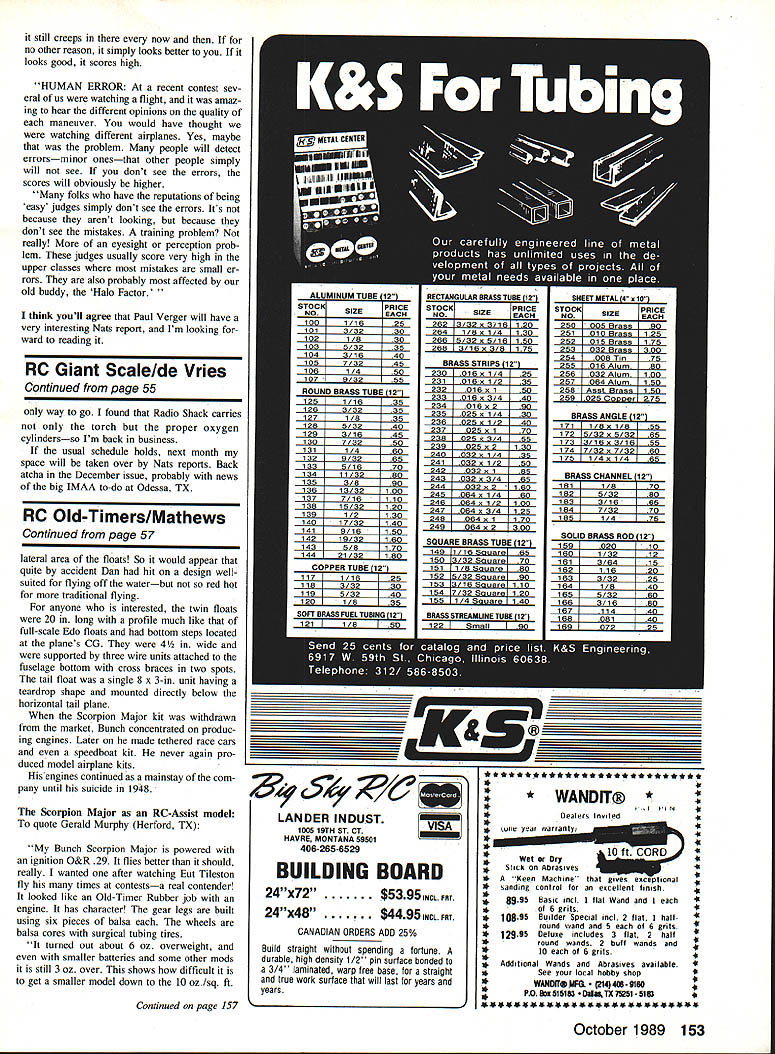
Our Scorpion Major was kitted by the Bunch Model Airplane Co. of Los Angeles, CA as a companion to its engines (see photo ad taken from the September 1938 issue of Model Airplane News). The kit was available from June to November of 1936. I'll have more to say about this shortly.
Much of the following information is based on what John Pond wrote in the Summer 1968 edition of the Engine Collector's Journal and from correspondence with Joe Wagner.
Joseph Danner Bunch was a native Californian and got into model airplanes after starting a career track in full-scale aviation—the exact reverse route of many people in that era. In 1938 he enrolled as an aeronautical engineering student at the Curtiss-Wright Technical Institute located at the Grand Central Air Terminal at Glendale, CA. Like thousands of other young men in that timeframe, the exploits of Lindbergh and Chamberlin and the intense national interest in anything to do with airplanes had a strong influence on him. Unfortunately, the devastating economic upheaval of 1929 made work hard to find—especially in the aviation industry where seemingly daily bankruptcies affected many firms. Although Dan Bunch had both an engineering degree and a commercial pilot's license, it was quickly apparent that if he were to make a living some other form of work was needed. As a possible means of surviving, Dan chose to enter the model airplane business.
His first efforts were in rubber-powered kits, which appeared to be strongly influenced by the designs of Gordon S. Light, who at that time was known internationally through the pages of Air Trails magazine. Planes of both designers featured long, spidery landing gear, lightweight structures, and humongous rudders. Although Dan's designs flew quite well and were successful in competition, their outdated appearance made them obsolete by the time they were packaged and placed on the shelves of the local hobby dealers.
Like everyone in those days, his early start was rather primitive back in 1932, but two years later things were going well enough that his tiny firm began to advertise in the national model magazines. At about this time the electrifying activities of Maxwell Basset, Joe Kovel, and others with gasoline-engine-powered models were sweeping the hobby, and Dan Bunch became interested in the possibilities of producing an engine.
Among engine historians, a true enigma seems to exist as to what role a "Harry Gwinn" played in capitalizing Bunch, and some we have talked to actually question whether such a person really existed. The speculation is that "Harry Gwinn" may have been a nom de plume for some relative of Dan's. The fact is well documented, however, that Dan Bunch produced a number of engine designs which were quite successful.
The Scorpion Major was essentially designed to match the engine and was sold in that role. To chew the old bone some more, I can't help but agree with John Pond who stated in the previously mentioned article that, "Although we have no reports of the rubber designs' flying abilities, the large rudder appears to make the designs extremely sensitive to spiral diving tendencies." My speculation is that this tendency spelled the early demise of this Free Flight design. If any reader has had experience with the Bunch Scorpion Major as a Free Flight model, I would appreciate having your comments.
Now, as a seaplane the Scorpion Major was rather successful. Howard Broughton and some others all held national ROW (river-of-water — Ed.) records with this design. The reason for its success? Simply that float-equipped models require more lateral fin area to compensate for the yawing moment of the floats.
So it would appear that quite by accident Dan had hit on a design well-suited for flying off the water—but not so red hot for more traditional flying.
If anyone is interested, the twin floats were 20 in. long with a profile much like that of full-scale Edo floats and had bottom steps located at the plane's CG. They were 4 1/2 in. wide and were supported by three wire units attached to the fuselage bottom with cross braces in two spots. The tail float was a single 8 x 3-in. unit having a teardrop shape and mounted directly below the horizontal tailplane.
When the Scorpion Major kit was withdrawn from the market, Bunch concentrated on producing engines. Later on he made tethered race cars and even one speedboat kit. He never again produced model airplane kits.
His engines continued as a mainstay of the company until his suicide in 1948.
The Scorpion Major as an RC-Assist model
To quote Gerald Murphy (Hereford, TX):
"My Bunch Scorpion Major is powered with an ignition O&R .29. It flies better than it should really. I wanted one after watching Earl Tietson fly his many times at contests—a real contender! It looked like an Old-Timer rubber job with flaring nose. It has character! The gear legs are built using six pieces of balsa each. There are two small castors which take the weight. It turned in neat circles on flat fields with even smaller batteries and some 7-volt motors; the model was 3 oz. over. This shows how difficult it is to get a smaller model down to the 10 oz./sq. ft.
"The Scorpion tends to balance nose-heavy. The CG should be at 1/4 chord, and the weight should be as close to the 10-oz. rule as possible.
"The Scorpion is a satisfying model to build and fly, and with its thin wing airfoil has a really good climb—even with the O&R .29 which doesn't have the power of some of the repro .29s. The glide isn't as good as some of the floaters, but it is much faster and outstanding in windy weather."
Notice that Gerald doesn't say anything about spiral stability. Obviously with a radio installed the Scorpion has something going for it. Plans (No. 48) are available from John Pond Old-Time Plan Service, 253 No. 4th St., P.O. Box 90310, San Jose, CA 95109-3310.
An anatomical impossibility
I started to make the heading of this paragraph, "Wanna put a Tiger in your Scorpion?" But that isn't sensible. Herb Wahl (Box 61, Forksville, PA 18616) is currently manufacturing reproductions of the Bunch Tiger engine. Those who are familiar with Herb's previous Brown and Ohlsson reproductions can attest to the quality of his work, and I recommend him to the hobby. The Tiger is a later Bunch engine that looks much like the Mighty Midget/Gwinn Aero shown in the reproduced ad. Contact Herb Wahl for availability and price of his reproductions.
Another option
Forster .29 and .35 power plants are being reproduced by RL Industries out in California. Forster's original casting dies are being used, but the new engines are being machined on modern computer-controlled units. Both of these are the late-model front-intake versions of the engines; however, they are equipped with original-style Forster ignition and the Phantom P-30 fuel tank. One aspect of this operation which I find most fascinating is the fact that the engines are being boxed in original (not reprinted) Forster boxes of the fifties and will include original Forster instruction sheets! Write RL Industries, P.O. Box 5, Sierra Madre, CA 91024; telephone 1-818-359-0016.
Now here's a slow builder!
Back in the Sixties and Seventies when my sons and I were competing on a Nats level, one of the fun aspects of a Nationals was the Scale cage. Back then as many as 100 Free Scale entries were placed in a chicken-wire cage mounted on risers. A handful of RC Scale ships would be in there too, as well as lots of CL Scale planes. They were all on view from the first day of the meet until the night before their Scale event was to be flown.
Since the Navy was the host for the meet, the Scale cage was usually in a hangar separate from the larger one which housed all the contest workbenches and model boxes. Yes, many evening events and the late hours of the night, with modelers actually working on entries all night for completion flights the next day. It was great fun and an unforgettable experience now long gone.
At any one of those Nats, the chief judges and contest directors for the Free Flight—and occasionally the CL—events were also there in attendance: a friendly couple named Bill and Irene Knepp. My son Bill still calls them fondly to this day. As the years have worn on, we have managed to keep in touch with them, and Bill has frequently provided three-views of full-scale aircraft which are so rare that one would question their authenticity were it not for the integrity of the source.
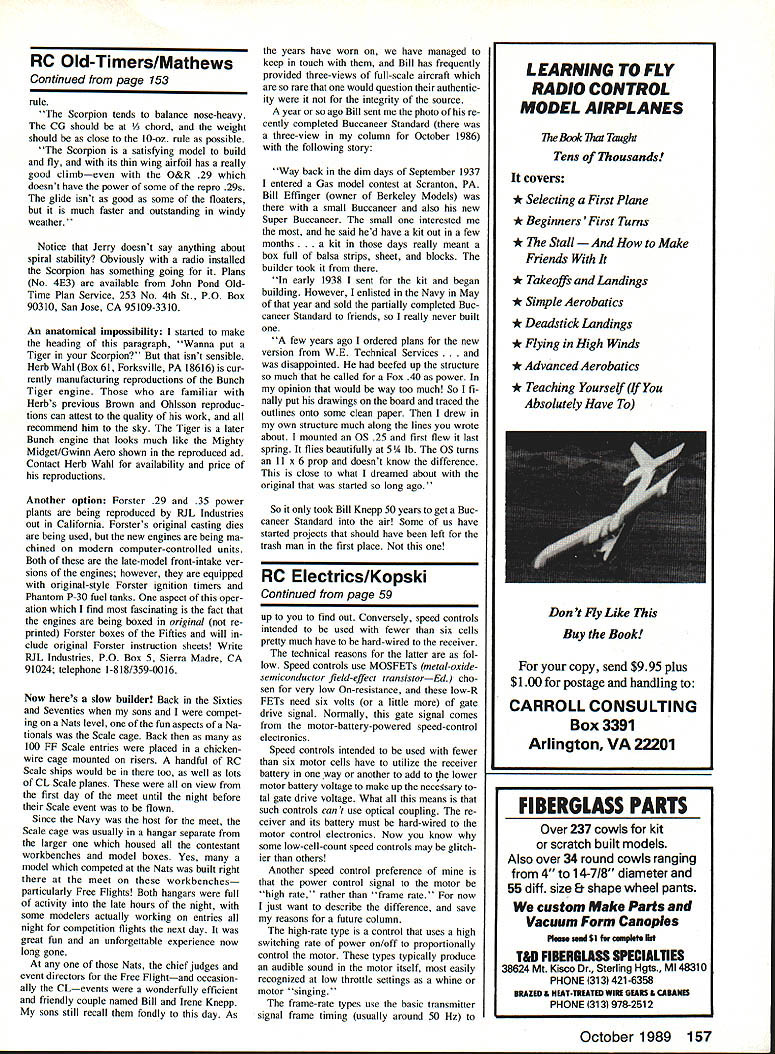
A year or so ago Bill sent me the photo of his recently completed Buccaneer Standard (there was a three-view in my column for October 1986) with the following story:
"Way back in the dim days of September 1937 I entered a Gas model contest at Scranton, PA. Bill Ettinger (owner of Berkeley Models) was there with a small Buccaneer and also his new Super Buccaneer. The small one interested me the most, and he said he'd have a kit out in a few months . . . a kit in those days really meant a box full of balsa strips, sheet, and blocks. The builder took it from there.
"In early 1938 I sent for the kit and began building. However, I enlisted in the Navy in May of that year and sold the partially completed Buccaneer Standard to friends, so I really never built it.
"A few years ago I ordered plans for the new version from W.E. Technical Services . . . and was disappointed. He had beefed up the structure so much that he called for a Fox .40 as power. In my opinion that would be way too much! So I finally put his drawings on the board and traced the outlines onto some clean paper. Then I drew in my own structure much along the lines you wrote about. I mounted an O.S. .25 and first flew it last spring. It flies beautifully at 5 1/2 lb. The O.S. turns an 11 x 6 prop and doesn't know the difference. This is close to what I dreamed about with the original that was started so long ago."
So it only took Bill Knepp 50 years to get a Buccaneer Standard into the air! Some of us have started projects that should have been left for the trash man in the first place. Not this one!
Transcribed from original scans by AI. Minor OCR errors may remain.

