
Radio Control: Old-Timers
Dr. D. B. Mathews 909 N. Maize Rd., Townhouse 734 Wichita, KS 67212
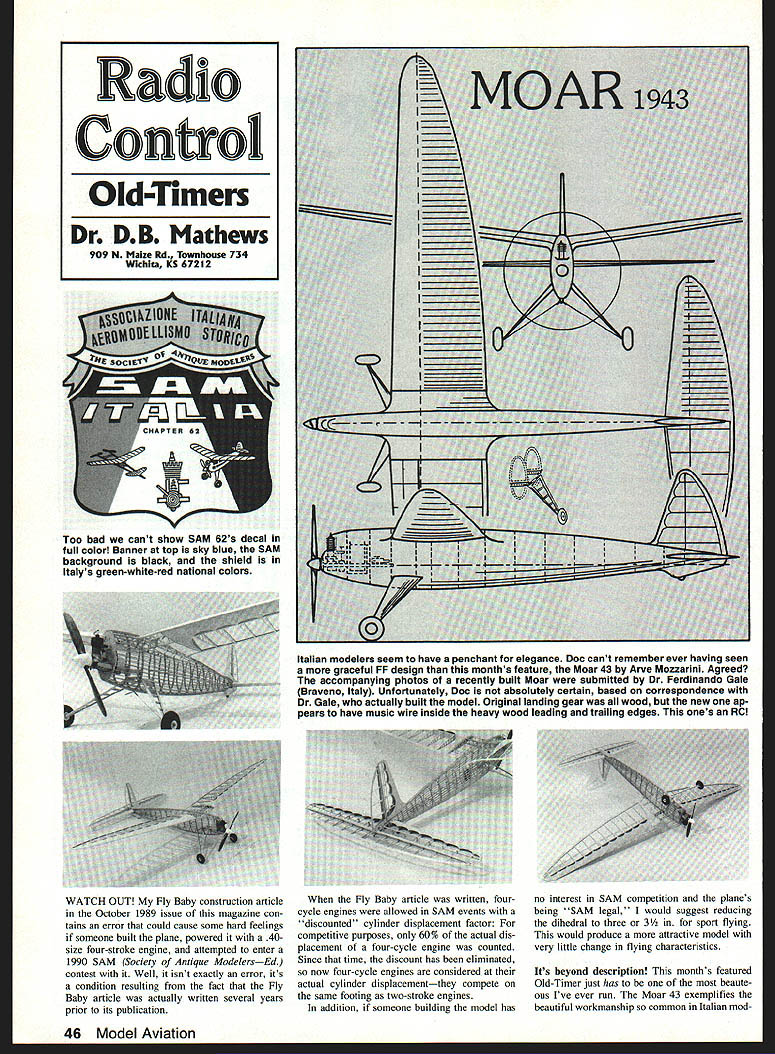
Italian modelers seem to have a penchant for elegance. I can't remember ever having seen a more graceful FF design than this month's feature, the Moar 43 by Arve Mozzarini. The accompanying photos of a recently built Moar were submitted by Dr. Ferdinando Gale (Braveno, Italy). Based on correspondence with Dr. Gale, I'm not absolutely certain who actually built the model. The original landing gear was all wood, but the new one appears to have music wire inside the heavy wood leading and trailing edges. This one's an RC!
WATCH OUT! My Fly Baby construction article in the October 1989 issue of this magazine contains an item that could cause hard feelings if someone built the plane, powered it with a .40-size four-stroke engine, and attempted to enter a 1990 SAM (Society of Antique Modelers — Ed.) contest with it. Well, it isn't exactly an error; it's a condition resulting from the fact that the Fly Baby article was actually written several years prior to its publication.
When the Fly Baby article was written, four-cycle engines were allowed in SAM events with a "discounted" cylinder displacement factor: for competitive purposes, only 60% of the actual displacement of a four-cycle engine was counted. Since that time, the discount has been eliminated; now four-cycle engines are considered at actual cylinder displacement — they compete on the same footing as two-stroke engines. In addition, if someone building the model has no interest in SAM competition and wants the plane for sport flying, I would suggest reducing the dihedral to 3 or 3½ in. This would produce a more attractive model with very little change in flying characteristics.
It's beyond description! This month's featured Old-Timer just has to be one of the most beauteous I've ever seen. The Moar 43 exemplifies the fine workmanship so common among Italian modelers.
The Moar 43 is a 1943 design by Arve Mozzarini who, at that time, was assigned to Guidonia AFB. The model was flown frequently (Free Flight, of course!) at the airfield, which was sort of an Italian equivalent to our Wright Field. When the German Army retreated from the Rome area, the Moar (minus its Brown Jr. power plant) was confiscated along with other aeronautical material. That must make the Moar 43 one of the few model airplanes ever considered war booty!
The Moar 43 features a stringered fuselage built on elliptical formers with shoulder-mounted, plug-in wings. The airfoil section is a NACA 23012, while the empennage utilizes a symmetrical section. The undercarriage is wooden with hinges at the fuselage and spring-loaded wire cross braces. The projected wingspan is 2.4 meters (roughly seven feet).
The original model was covered in tissue tautened with Emaillite and the original colors were dark green with pale blue undersides and a white stripe-and-cross of the House of Savoy. The information and photos were provided by Dr. Ferdinando Gale, Braveno, Italy. Unfortunately, the identity of the actual builder of the model is unclear from our correspondence.
International SAM
The three-view and some of the details included with this month's article are from Yearbook #3 of SAM 35 — the English chapter of SAM. Copies of these interesting yearbooks are available from SAM Speaks, 1237 Grant St., Tacoma, WA 98405. They include plans for the Moar 43 and several other Italian Old-Timers.
John Pond has reported often of his trips to Australia and New Zealand to attend SAM events in those countries. SAM chapters are also very active in Canada. Dr. Gale tells me that the Associazione Italiana Aeromodellismo Storico (Italian Association for Historical Model Aircraft) was established in June 1986 and soon became Chapter 62 of SAM. Today its membership runs over 200. They publish The Old-Timer Gazette, which is included free of charge in the monthly magazine Modellistica — the only publication of its kind in Italy. Modellistica has a monthly printing of about 10,000 copies.
The cutoff for eligible designs in Italy is 1950 in order to best reflect the development of model building in that country. The big project of Old-Timer builders in Italy is the availability of genuine old-time engines. Imported replica engines are incredibly expensive and difficult to get. Rules are still somewhat fluid, as most get-togethers are not contests but rather social gatherings similar to IMAA jumbo fly-ins in the U.S.
RC Old-Timers / Mathews
International competitors sometimes get hammered by the judges; however, one standout is Hanno Pretner, the reigning World Champion. So, if a four-cycle engine is ever to win in the World Championships, Hanno Pretner will probably have to do it.
I wrote to TruTurn's Bob Obenberger to find out if he had any three- or four-blade spinners, because Graupner has three-blade propellers and Bolly has three- and four-blade propellers, and I wanted to do some comparisons with two-blade props. The only reasonable way to do it would be if the airplane always had a spinner mounted, and all I had were two-blade spinners.
Bob responded that three- and four-blade spinners are available, even though not all distributors stock them. He asked that anyone who has special requirements give him a call at Romco Mfg., Inc., 713-943-1867.
By the way, I also asked him if he had two-blade spinners to fit the Graupner propellers. He responded that he can cut a spinner for any prop and recommended supplying the files so he can cut the spinner, because it's not a simple task to make sure the slots are identical and 180° apart. He said that at least 1/2" clearance around the blade is necessary for safety, since "the prop rubbing on the aluminum can work-harden the material and start cracks to form at this point."
Give Bob a call at TruTurn, because "service is almost a thing of the past, but we intend to carry on that commodity at TruTurn for a long time to come."
When Bob offered me a TruTurn spinner to try on my Tiporan at a Lake Charles Nats several years ago, I had no idea I'd be the first Nats competitor to run a TruTurn spinner; but Bob says it's true.
Scale Old-Timer events
Several years ago I mentioned potential interest in flying Scale designs in the format of V/A Texaco. Since very little correspondence was received relating to this subject at the time, I dropped the idea, figuring there was no interest. Apparently I was wrong, since two separate clubs are sponsoring trial events of this nature in 1989.
The Niagara Frontier Chapter (New York) has tried a special event called V/A Texaco Scale RC. Their rules are:
- Model shall be a replica of a reciprocating-engine-powered, man-carrying aircraft of the pre-World War II era.
- Model shall be capable of ROG (rise-off-ground — Ed.).
- Powered tailplanes are not acceptable.
- Although models will not be judged for scale, a reasonable effort should be made to realistically simulate color and markings.
- Minimum wing loadings are 8 oz./sq. ft. for monoplanes and 6 oz./sq. ft. for multiwings.
- Model shall be powered with Cox .049 reed-valve-type engines having a maximum fuel tank capacity of 8 cc. No throttles allowed. No diesels allowed. Maximum prop diameter allowed is 8 in. Only commercially available glow fuel allowed.
- Model to be of balsa/plywood construction. Foam can be used only for details.
- No foam ARFs (almost-ready-to-fly) allowed.
- Plan or three-view needed for confirmation.
- The bottom line is that the model must resemble a full-scale plane of that era.
- All flying and scoring regulations pertaining to SAM V/A Texaco will apply to this event.
If this sounds like fun, contact Jack Brown, 1446 Red Jacket Rd., Grand Island, NY 14072 for more information.
Personally, I can see this catching on like gangbusters! Consider enlarging many of the classic Stahl, Struhl, Comet, Migee, etc. designs to about 300 sq. in. of wing area, adding a two-channel micro radio system, and seeing the thing thermal like a V/A Texaco — that turns me on. How about you?
The San Diego Aeroneers — and especially Bob Munn — have also been developing a Scale Duration event, but space doesn't permit a comprehensive review of their rules here. Those interested should contact Jim Alaback, 16634 Diaz Drive, San Diego, CA 92128.
Finally: I recently had the opportunity to tour the new Boeing Museum in Seattle. Anyone with an interest in aviation history would enjoy the displays as much as I did. I was particularly impressed with the use of many largish models to complement the displays; this was much better than the little plastic models so often seen. I have no idea who built them, but the workmanship and coloration was most impressive.
An artist had the opportunity to tour the reconstructed San Diego Museum, which features many display models as well as a large display of modeling memorabilia, much of it organized by SAM Chapter 41 and its members.
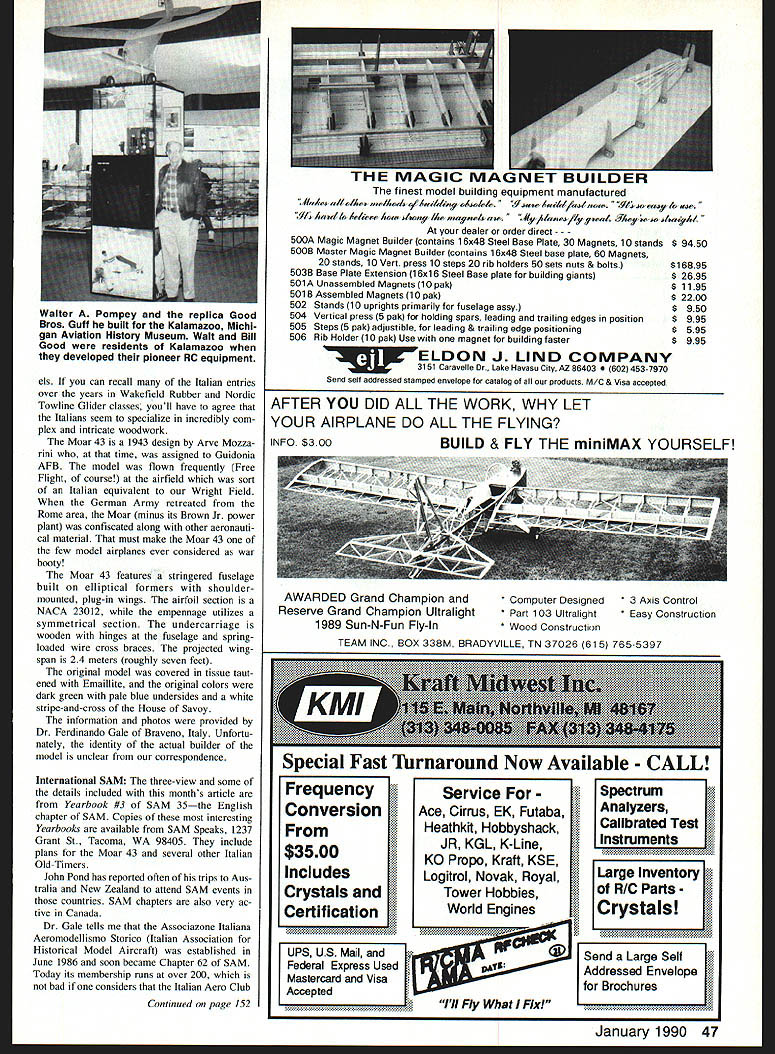
Additionally, I have been informed that the Kalamazoo (Michigan) Aviation Historical Museum has recently added a reproduction of the Good brothers' Gulf R/C model to its display. The original Gulf resides in the Smithsonian, so Walter A. Pompey built the replica. The Good twins were residents of Kalamazoo at the time of the original's construction and flights. The model adds considerably to the museum.
Transcribed from original scans by AI. Minor OCR errors may remain.

