
Radio Control: Old-Timers
Dr. D.B. Mathews 909 N. Maize Rd., Townhouse 734 Wichita, KS 67212
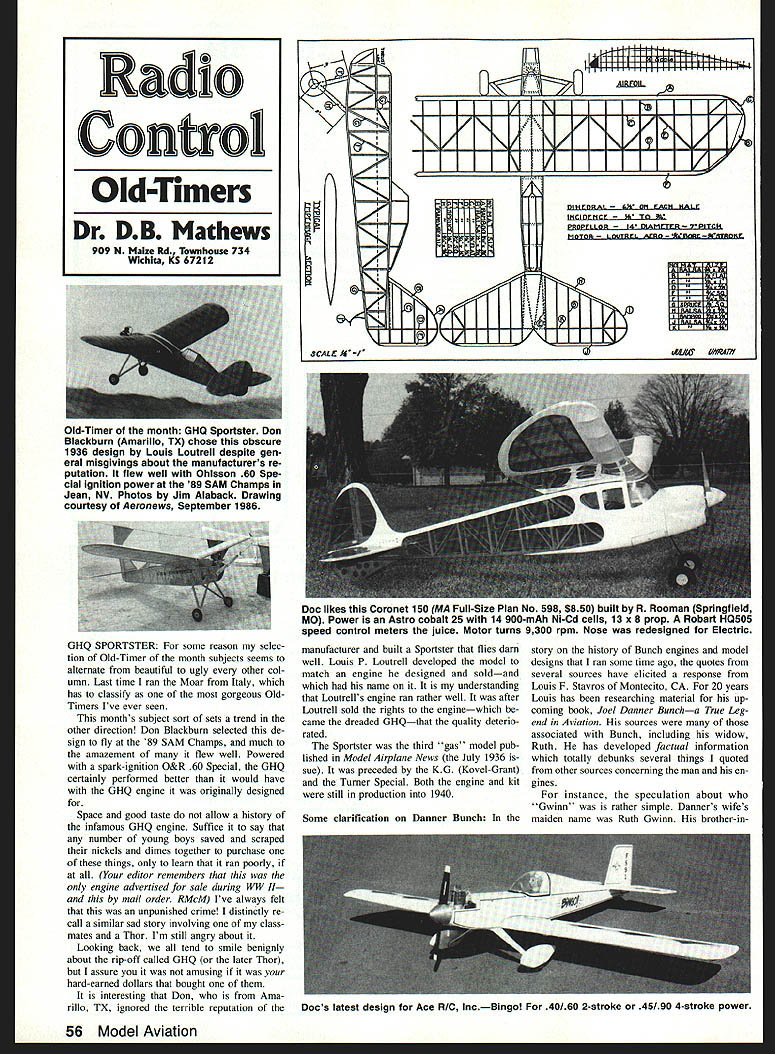
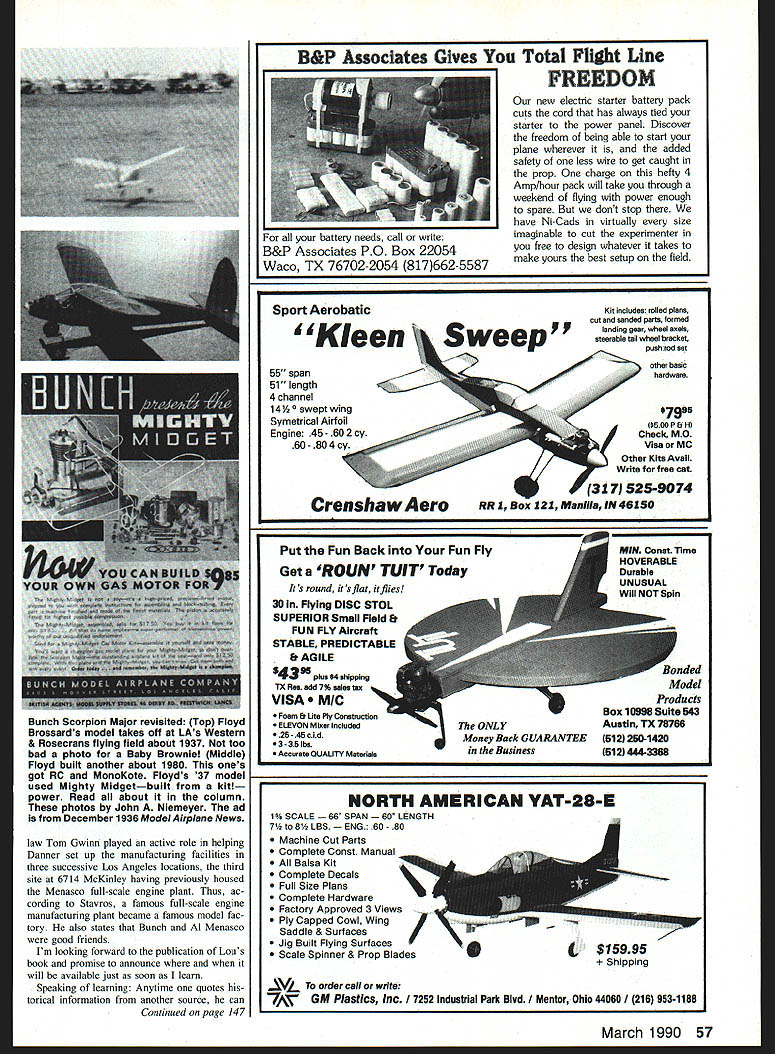
GHQ Sportster
For some reason my selection of Old-Timer of the month subjects seems to alternate from beautiful to ugly every other column. Last time I ran the Moar, from Italy, which has to classify as one of the most gorgeous Old-Timers I’ve ever seen.
This month’s subject sort of sets a trend in the other direction. Don Blackburn of Amarillo, TX, selected the design to fly at the ’89 SAM Champs and, much to the amazement of many, it flew well. Powered with a spark-ignition O&R .60 Special, the GHQ Sportster certainly performed better than it would have with the GHQ engine it was originally designed to use.
Space and good taste do not allow a full history of the infamous GHQ engine. Suffice to say that any number of young boys saved and scraped their nickels and dimes together to purchase one of these things, only to learn that it ran poorly, if at all. (Your editor remembers that this was the only engine advertised for sale during WWII — and this by mail order. — RMcM) I’ve always felt that this was an unpunished crime! I distinctly recall a similar sad story involving one of my classmates and a Thor. I’m still angry about it.
Looking back, we all tend to smile benignly about the rip-off called GHQ (or the later Thor), but I assure you it was not amusing if it was your hard-earned dollars that bought one of them.
It is interesting that Don, who is from Amarillo, ignored the terrible reputation of the manufacturer and built a Sportster that flies darn well. Louis P. Loutrell developed the model to match an engine he designed and sold — and which had his name on it. It is my understanding that Loutrell’s engine ran rather well. It was after Loutrell sold the rights to the engine — which became the dreaded GHQ — that the quality deteriorated.
The Sportster was the third “gas” model published in Model Airplane News (July 1936). It was preceded by the K.G. (Kovel-Grant) and the Turner Special. Both the engine and kit were still in production into 1940.
Danner Bunch: clarification
Some clarification on Danner Bunch: In the story on the history of Bunch engines and model designs that I ran some time ago, the quotes from several sources have elicited a response from Louis F. Stavros of Montecito, CA. For 20 years Louis has been researching material for his upcoming book, Joel Danner Bunch — A True Legend of Aviation. His sources were many of those associated with Bunch, including the widow Ruth, and he has developed factual information which totally debunks several things quoted in other sources concerning the man and his engines.
For instance, the speculation about Gwinn was rather simple. Danner’s wife’s maiden name was Ruth Gwinn. His brother-in-law Tom Gwinn played an active role helping Danner set up manufacturing facilities in three successive Los Angeles locations, the third site, 6714 McKinley, having previously housed the Menasco full-scale engine plant. Thus, according to Stavros, the famous full-scale engine manufacturing plant became a famous model factory also. Stavros states Bunch and Al Menasco were good friends. I’m looking forward to Louis’s book and he promises to announce when it will be available.
I only hope the data is accurate. It is obvious that much of what I had on Danner Bunch was not, and I can only apologize and plead helplessness, since there isn't any way to test another writer's sources.
Letter from John A. Niemeyer (Eagle Point, OR)
My friend Floyd Brossard and I built rubber models from the time we were six or seven years old. We lived in Manhattan Beach, Cal., which is about 25 miles southwest of Los Angeles. By 1935, when we were 12 years old, we began to see gas model airplanes and developed that all-consuming urge to advance to this next stage. There was a depression on, and $21.50 for a Brown Jr. or a Tlus was out of the question. But at least we could start saving our pennies for that first little plane.
By the end of the summer of 1936 we had saved up about 10 bucks and still had little hope of getting enough for a gas engine and some kind of decent airplane for a year or two. We would take any kind of odd job for a nickel or a dime an hour.
About then a nice lady needed a couple of kids to help with some yard work, so Floyd and I went to work for her three evenings a week after school. Somewhere along the line she learned we were saving our money to buy model airplane engines and models. The lady mentioned that her son was in the model airplane business. You see, the nice lady was Danner Bunch's mother!
Floyd and I worked on and off for several months for Mrs. Bunch, and along with the other odd jobs we each managed to save about $17. Mrs. Bunch arranged for us to go directly to the Bunch factory on Hoover St., and we each picked up a Mighty Midget engine kit for $9.85. With most of the remaining money I bought a Scientific Red Zephyr kit, and Floyd bought a Curtiss Robin.
Building the kits for the engines was no big deal, but the gas tank assemblies were another matter. We spent days heating soldering irons on a gas stove trying to get the little brass tube and oil cup soldered on. Finally Floyd's mother told us to get out of the way and proceeded to do the slickest soldering job you ever saw. It seems she worked in a cannery as a girl and had soldered cans till she could do it in her sleep!
The engines ran well and had lots of power. Unfortunately our solder work on the ignition wiring wasn't very good, and we spent lots of time at the flight line of the Southern California Gas Model Association model field at Rosecrans and Western. The balky engines gave us lots of time to observe some of the real pros at work, like Barney Snider of Modelcraft and his line of small, fast, high-powered planes like the Scout. And we saw Irwin Ohlsson and his growing line of gas engines, Major Mosely and his Super Cyclones, and Reginald Denny and his Denny Mite engines.
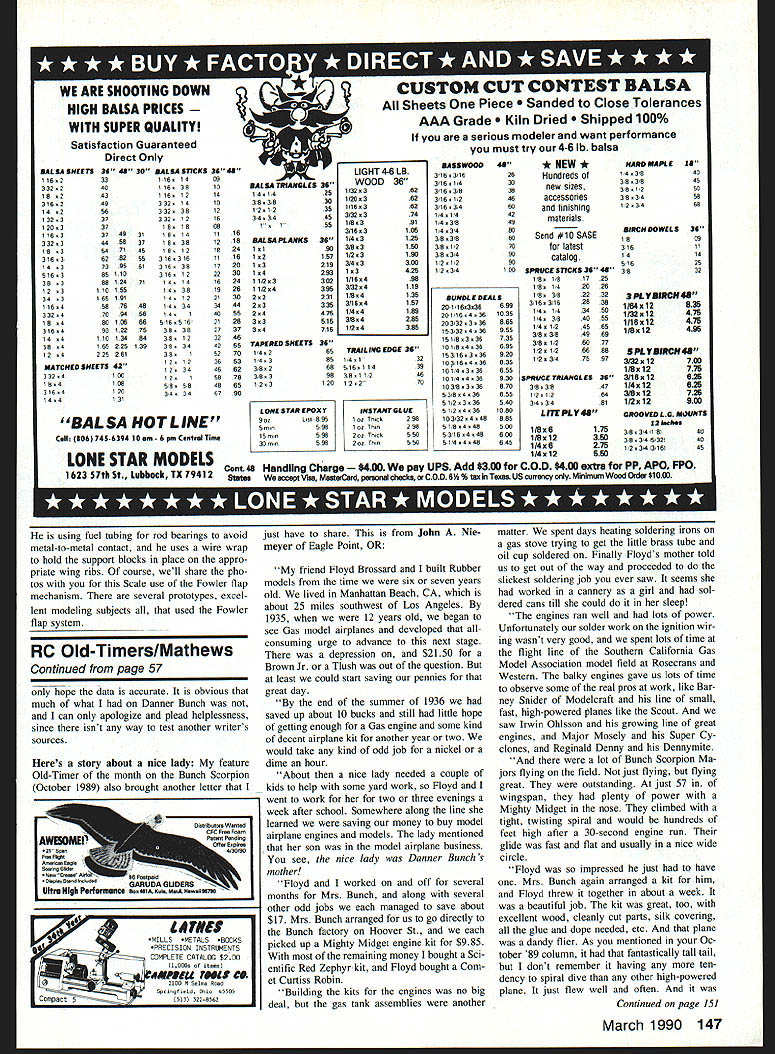
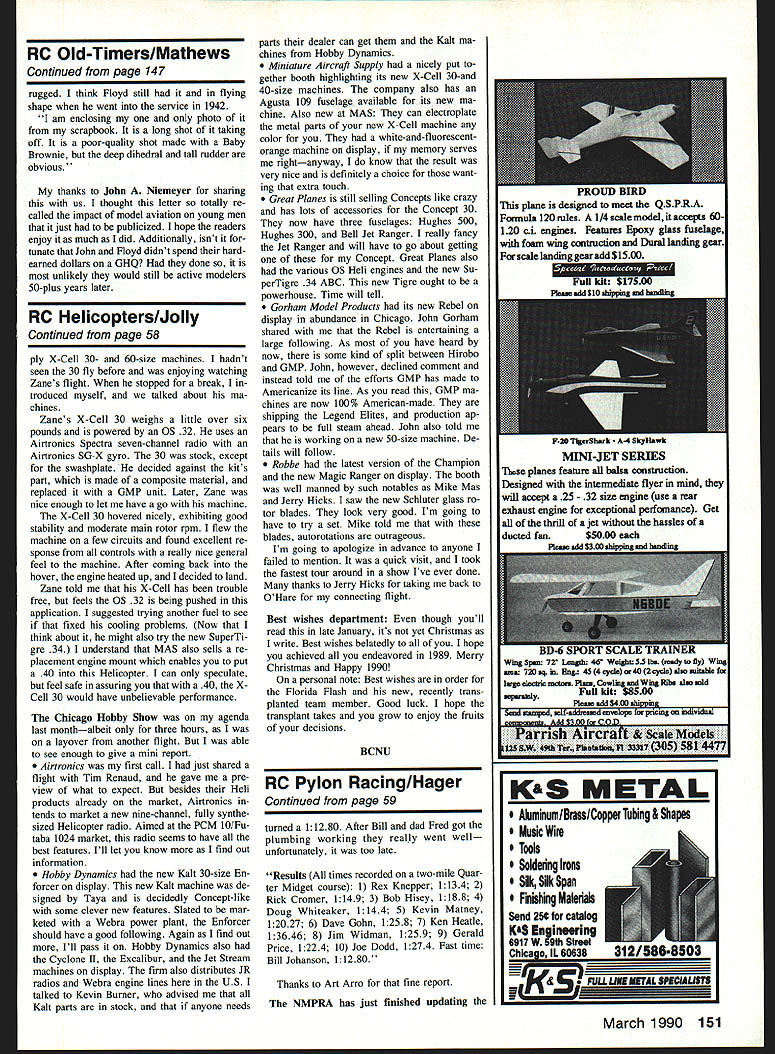
There were a lot of Bunch Scorpion Majors flying on the field. Not just flying, but flying great. At just 57 in. of wingspan, they had plenty of power with a Mighty Midget in the nose. They climbed with a tight, twisting spiral and would be hundreds of feet high after a 30-second engine run. Their glide was fast and flat and usually in a nice wide circle.
Floyd was so impressed he just had to have one. Mrs. Bunch again arranged a kit for him, and Floyd threw it together in about a week. It was a beautiful job. The kit was great, too, with lots of detail parts, kit covering, and the glue and dope needed. It just flew then and often. And it was rugged. I think Floyd still had it and in flying shape when he went into the service in 1942.
I'm enclosing my one and only photo of it from my scrapbook. It is a long shot of it taking off. It is a poor-quality shot made with a Baby Brownie, but the deep dihedral and tail rudder are obvious.
My thanks to John A. Niemeyer for sharing this with us. I thought this letter so totally recalled the impact of model aviation on young men that it just had to be publicized. I hope the readers enjoy it as much as I did. Additionally, isn't it fortunate that John and Floyd didn't spend their hard-earned dollars on a GHQ? Had they done so, it is most unlikely they would still be active modelers 50-plus years later.
Transcribed from original scans by AI. Minor OCR errors may remain.

