
Radio Control: Old-Timers
Dr. D.B. Mathews
909 N. Maize Rd., Townhouse 734 Wichita, KS 67212
BANISHED! Yes, for this month I've eliminated the Old-Timer of the Month feature in order to have more space for photos of RC Scale Duration models—a concept which is finally catching on.
As I mentioned in my January 1990 column, two groups of modelers from opposite ends of the U.S. are promoting two totally different approaches toward flying scale models in "climb-and-glide" mode.
A group of fliers in the Niagara Falls, NY area is promoting an RCSD event with planes using 1/2A power. I had a preliminary version of their rules in the January '90 column. Theirs is essentially an extension of the N.A. Texaco event promoted by SAM (Society of Antique Modelers). That is: you fill up the fuel tank of your plane's Cox .049 to the brim, start it up, launch, and climb as high as you can. You then steer it around the sky in search of lift to keep it up for a 15-minute max. There are no scale points or static judging.
A West Coast group, primarily in the area of influence of the San Diego Aeroneers, is promoting an unlimited RCSD concept. That is, they allow any size of plane and power plant. The preliminary rules as developed by Bob Munn are summarized as follows:
Airplane
- Must be a recognizable representation of any man-carrying aircraft flown before December 31, 1942.
- No documentation is required unless the aircraft is rare or unknown; in that case a photo or three-view drawing should be presented.
- A minimum power loading of 300 sq. in. of wing area per .10 cu. in. of engine displacement is imposed.
- No undercambered airfoils (even if they're "scale").
Engine
- Any engine is permitted; however, handicaps are imposed based on the type of power plant:
- Two-cycle glow engines use 100% of their actual displacement.
- Four-cycle engines use 80% of actual displacement.
- Glow engines converted to ignition use 60% of displacement.
- Engines originally made for ignition are rated at 50% of actual displacement.
- Electric motors of .05 size (about 100 watts) require the plane to have a minimum of 600 sq. in. of wing area.
Interior detail
- None required.
Scale judging
- The contest director (CD) and two other contestants form a judging committee which, by majority vote, rates each aircraft present on a scale of 10 (best) to 1.
- Criteria used are complexity, use of old-time materials and construction (molded foam ARF types severely downgraded), surface detail, craftsmanship, etc.
- Scale points will be counted.
- 20 seconds of duration are added to each model's longest flight.
Scoring
- Three attempts; two official flights with the longest official flight counting.
- Engine runs: 45 seconds for glow; 90 seconds for electrics.
- Planes must ROG (rise off ground) and must land in the designated area.
- Maximum flight: 10 minutes.
- Flyoffs (ties) occur after scale points are added.
These rules were submitted as a starting point for experimentation.
Commentary
What do I think? While the East Coast concept has no scale points and could easily be dominated by ultralightly constructed Piper J-3 Cubs that "sort-of-could-be-might-be-almost-are" Cubs, I can see ways in which the West Coast scale judging concept could be applied. Neither proposal makes any compensatory arrangements for biplanes or low-wing prototypes; however, they will very likely consider these factors after a few years of development. This should really be done to encourage a wide variety of eligible designs.
Additionally, someone is going to have to come up with a definition of what constitutes a powered glider for the 1/2A rules. In my mind, if the prototype was designed to be flown and landed power-off, it is a motor glider.
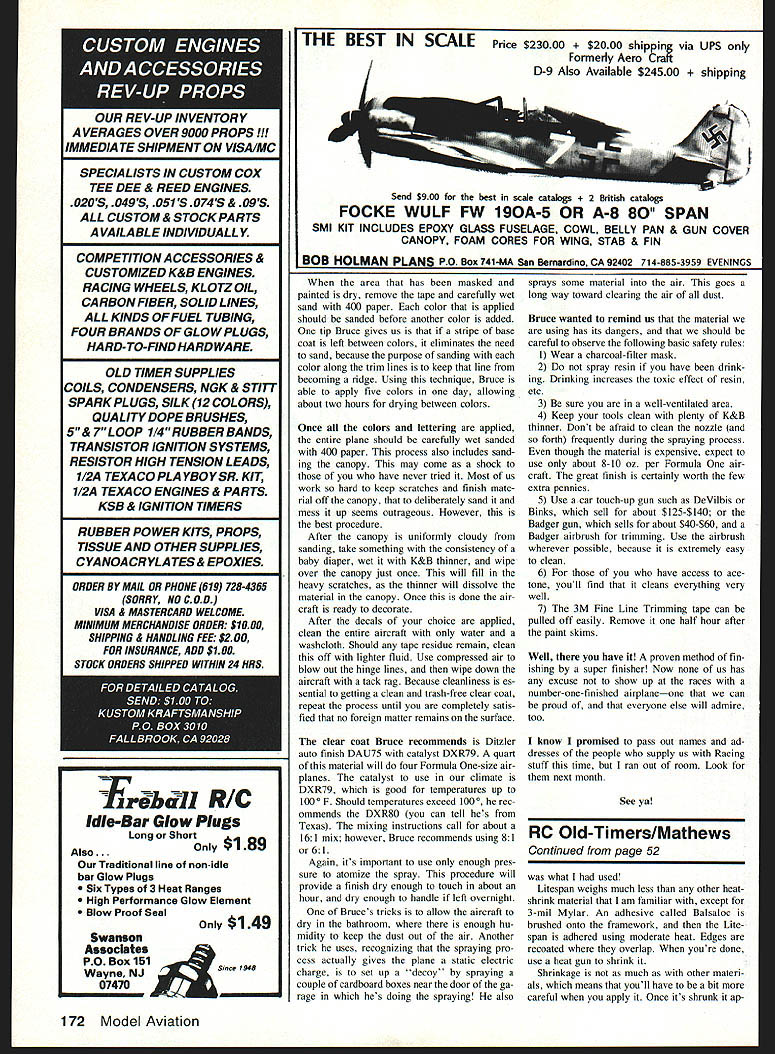
Since many of the British Lympne-type ultralight aircraft have very large, high-aspect-ratio wings but were definitely designed to be flown under continuous power, this group could be another lode of excellent choices. This includes such planes as the Bristol Brownie, Supermarine Sparrow, BEC Wren, Halton Minus, DH Hummingbird, etc.
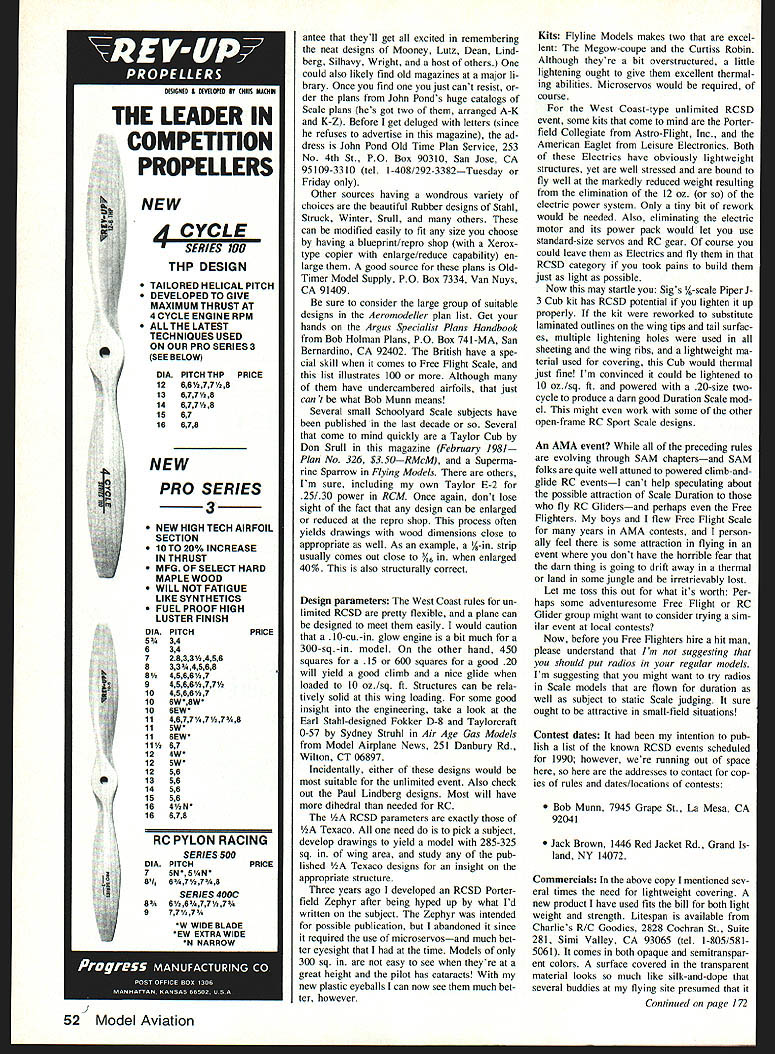
Obviously many U.S. designs—particularly those using Continental A-40 power such as the Taylor E-2, Porterfield Zephyr, etc., and those using Bristol Cherub, Aeronca, or converted auto or motorcycle engines—are all excellent for either event. Frankly, the potential choices are just mind-boggling.
Sources: During the fifties and sixties, the model magazines published literally hundreds of 1/2A scale free-flight designs, many of which are eminently suitable for either event. The RCSD concept is well within the skill range of modern builders and pilots and the models are cheap to build. If you have any interest in this sort of flying, start looking through the vintage plans and the prototype books. See you at a contest.
Kits
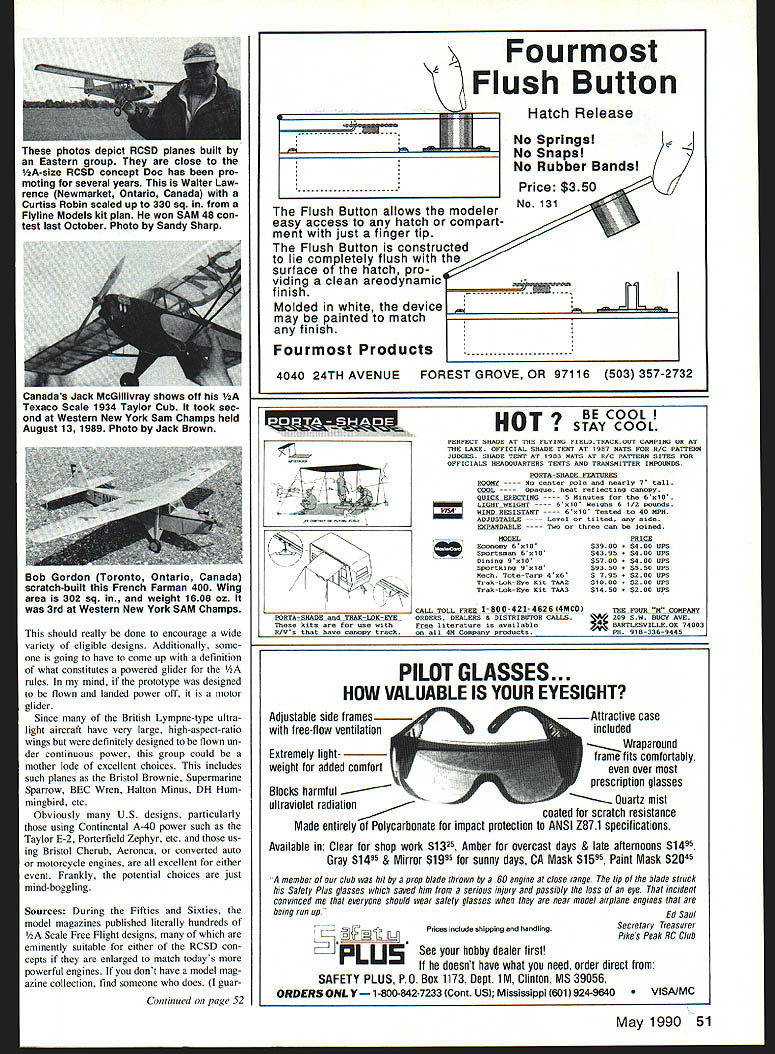
- Flyline Models makes two that are excellent: the Megow-coupe and the Curtiss Robin. Although they're a bit overstructured, a little lightening ought to give them excellent thermaling abilities. Microservos would be required, of course.
- For the West Coast-type unlimited RCSD event, some kits that come to mind are the Porterfield Collegiate from Astro-Flight, Inc., and the American Eagle from Leisure Electronics. Both of these electrics have obviously lightweight structures, yet are well stressed and are bound to fly well at the markedly reduced weight resulting from elimination of the 12 oz. (or so) electric power system. Only a tiny bit of rework would be needed. Eliminating the electric motor and its power pack would let you use standard-size servos and RC gear. Of course you could leave them as electrics and fly them in that RCSD category if you took pains to build them as light as possible.
- Sig's 1/2-scale Piper J-3 Cub kit has RCSD potential if you lighten it up properly. If the kit were reworked to substitute laminated outlines on the wingtips and tail surfaces, multiple lightening holes used in all the sheeting and the wing ribs, and a lightweight material used for covering, this Cub would thermal just fine. I'm convinced that it could be lightened to about 10 oz./sq. ft. and powered with a .20-size two-cycle to produce a darn good duration scale model. This might even work with some other open-frame RC sport scale designs.
An AMA event?
While all of the preceding rules are evolving through SAM chapters—and SAM folks are well attuned to powered climb-and-glide RC events—I can't help speculating about the possible attraction of scale duration to those who fly RC gliders and perhaps even free flighters. My boys and I flew free-flight scale for many years in AMA contests, and I personally feel there is some attraction in flying in an event where your down time rather than climb is the thing. Many of the old-time designs land in some jungle and are irretrievably lost.
Let me toss this out for what it's worth: perhaps some adventuresome free-flighter and RC glider groups might want to consider trying a similar event at local contests. Now, before you free flighters hit me, please understand that I'm not suggesting you put radios in your regular models. I'm suggesting that you might want to try radios in scale models that are flown for duration as well as subject to static scale judging. It ought to be attractive in small-field situations.
Contest dates / Contacts
I had intended to publish a list of the known RCSD events scheduled for 1990; however, we're running out of space here. For copies of rules and dates/locations of contests, contact:
- Bob Munn, 7945 Grape St., La Mesa, CA 92041
- Jack Brown, 1446 Red Jacket Rd., Grand Island, NY 14072
Commercials (Materials)
In the above copy I mentioned several times the need for lightweight covering. A new product I have used is Litespan for both light weight and strength. Litespan is available from Zigler's R/C Goodies, 2683 Cochran St., Suite 261, Simi Valley, CA 93065 (Tel. 805/581-5061). It comes in both opaque and transparent colors. A surface cover in the transparent series reduces the amount of finishing required; that's what I used.
Litespan mats less than any other heat-shrink material that I am familiar with, except for 3-mil Mylar. An adhesive called Balsaloc is brushed onto the framework, and then the Litespan is adhered using moderate heat. Edges are recoated where they overlap. When you're done, use a heat gun to shrink it up. Shrinkage is not as much as with other materials, which means you'll have to be a bit more careful when you apply it. Once it's shrunk it approaches well-doped Japanese tissue in tightness.
The material's puncture resistance is excellent, and there's no tendency to rip or tear. Frankly, this material is essentially like a vastly improved MicaFilm in most of its characteristics. It is well suited to smaller Old-Timers, electric models—and certainly RCSD.
On the negative side, Litespan is a bit trickier to use than materials with adhesive built in. It also doesn't add as much torsional strength as some films, and some samples had color-blotch problems.
All in all, Litespan definitely has a place in our area of the hobby, and I recommend it. You might also want to check out the rest of Charlie's product line. They specialize in electric flight, free flight, and RC products.
True confessions
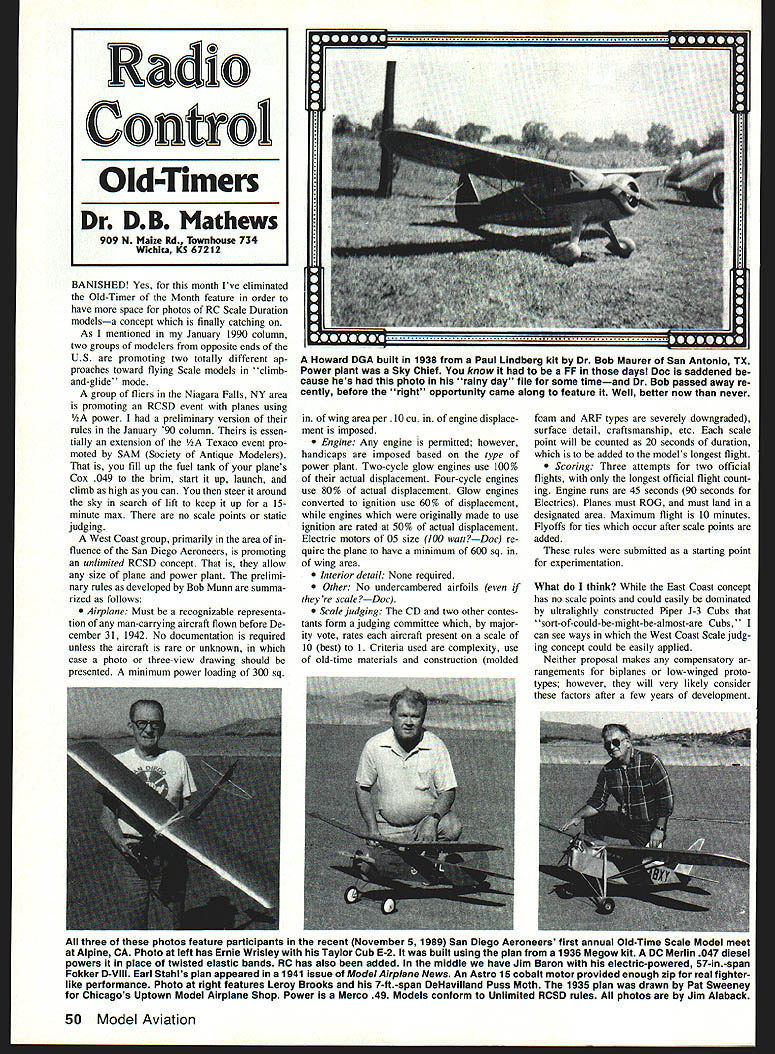
Normally I use short captions with the photos and don't write more about the subjects in the main part of my column. However, this month I just have to say a few extra words about the Howard DGA from Bob Maurer. I have had the photo in my file for several years awaiting just "the right time" to use it. I often do this, since the columns tend to be thematic.
Bob Maurer built the model from a Paul Lindberg kit in 1938. Lindberg had been a prolific designer for several magazines, particularly Flying Aces. The popularity of those designs led Paul into the kit business for a short—and apparently unsuccessful—time. Maurer powered his with a Sky Chief (a cheap Denny) but never flew it. Too bad there wasn't an RCSD event back then! It certainly would have been reassuring to know the model wasn't going to crash or fly away.
Bob went on to medical school and served in the U.S. Army, settling in San Antonio after the war in 1946 as one of only two anesthesiologists. A long and successful career followed. Dr. Maurer remained active in modeling and is well loved in the San Antonio area for his generosity and support of the local clubs.
The sad part of the story is that Bob passed away before I got around to publishing the picture. In his memory a shelter has been erected at the club field. Bob Maurer represents what makes our hobby so attractive. He was involved and supportive, with no interest in national recognition or any desire for fame. He simply loved modeling and modelers. He will be missed by many of us.
Transcribed from original scans by AI. Minor OCR errors may remain.

