
Radio Control: Old-Timers
Dr. D. B. Mathews 909 N. Maize Rd., Townhouse 734 Wichita, KS 67212
Here's another blast on RCSD (RC Scale Duration), as highlighted in my last (May 1990) column. This month I'd like to start off with several quotes for my readers to consider:
- "For several years many of us with an interest in Old-Timer Radio Assist have speculated among ourselves about a Flying Scale event for Old-Timers. We have wondered how well the SAM rules could be applied to scale models. Essentially the concept would be Free Flight scale models with RC-assist to simplify retrieval, prolong in-sight thermaling and, of course, stimulate participation. This area promises a great deal of potential fun and a challenging new dimension." Source: Taylor E-2 construction article author, September 1980, RCM.
- "Essentially Free Flight scale models having good flight characteristics, radio assist to simplify retrieval where spaces are too small for conventional Free Flight. For practical purposes, oversized Free Flight scale models with radios. The writer predicts this type of model will take off like nothing else since the RC Old-Timer concept first emerged." Source: RC Old-Timers column, January 1981, Model Aviation. Gene Wallick, editor.
- "SAM 13's Gas Lines has observations on the subject of Old-Timer Flying Scale. Half-A, Texaco Scale, RC seems to be arriving as an event. People inclined to find it entertaining track various restrictions being tried out in the name of equality — such things as type engine (undercambered versus flat-bottomed airfoils), wing loading, maximum prop size, etc., ad nauseam. It blows the mind so-called Old-Timers never understood. Preamble: SAM, far removed, ever-diminishing circles pointing out the obvious — the qualified, prepared competitor will win regardless of restrictions." Source: letter from Bob Aberle; Bill Darkow, SAM Speaks.
- "SAM 48A rules state the model shall be a replica of a reciprocating-engine-powered man-carrying aircraft pre-1943. Checked out several pre-1943 gas-powered scale models and found in some cases changes made to enhance flight performance; plans showed such things as increased dihedral, considerably larger tail surfaces. Question: which direction to take? Will the term replica be taken to mean exact scale to the original three-view?" [Continued discussion in SAM and Old-Timer forums.]
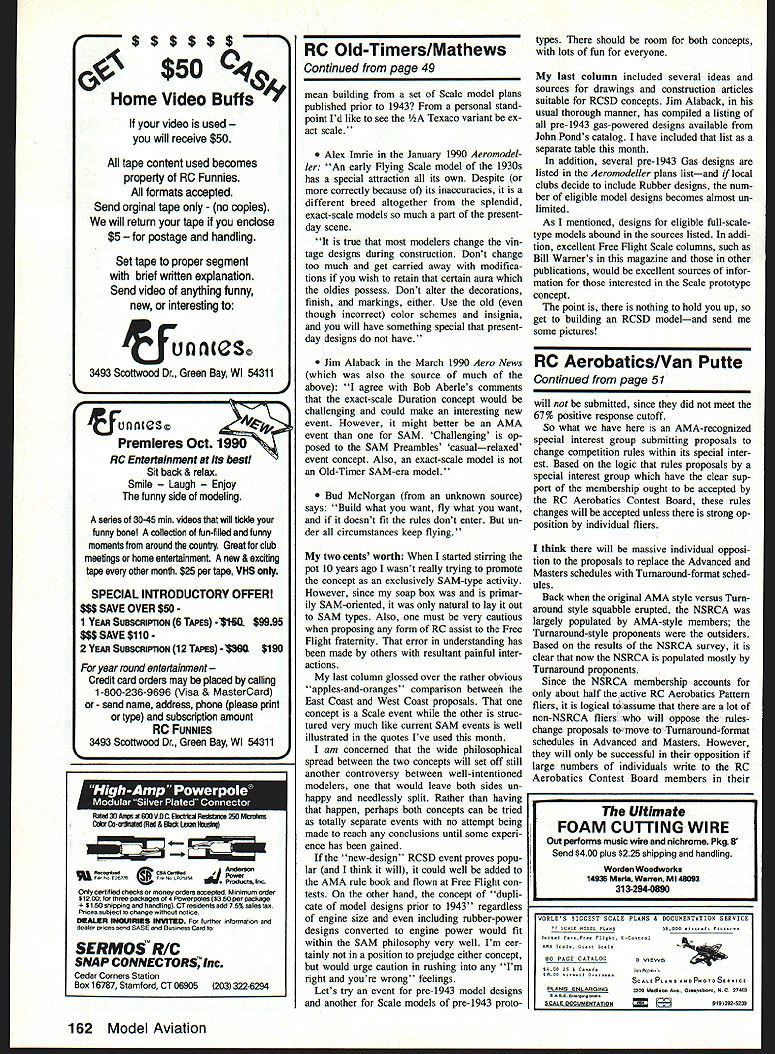
Pre-1943 Gas-Powered Scale Model Plans
By Jim Alaback
Plans for many of these old scale models are available from John Pond Old-Time Plan Service:
- John Pond Old-Time Plan Service
- 253 No. 4th St., P.O. Box 90310, San Jose, CA 95109-3310
- Tel: 408-292-3382 (Tues. or Fri.)
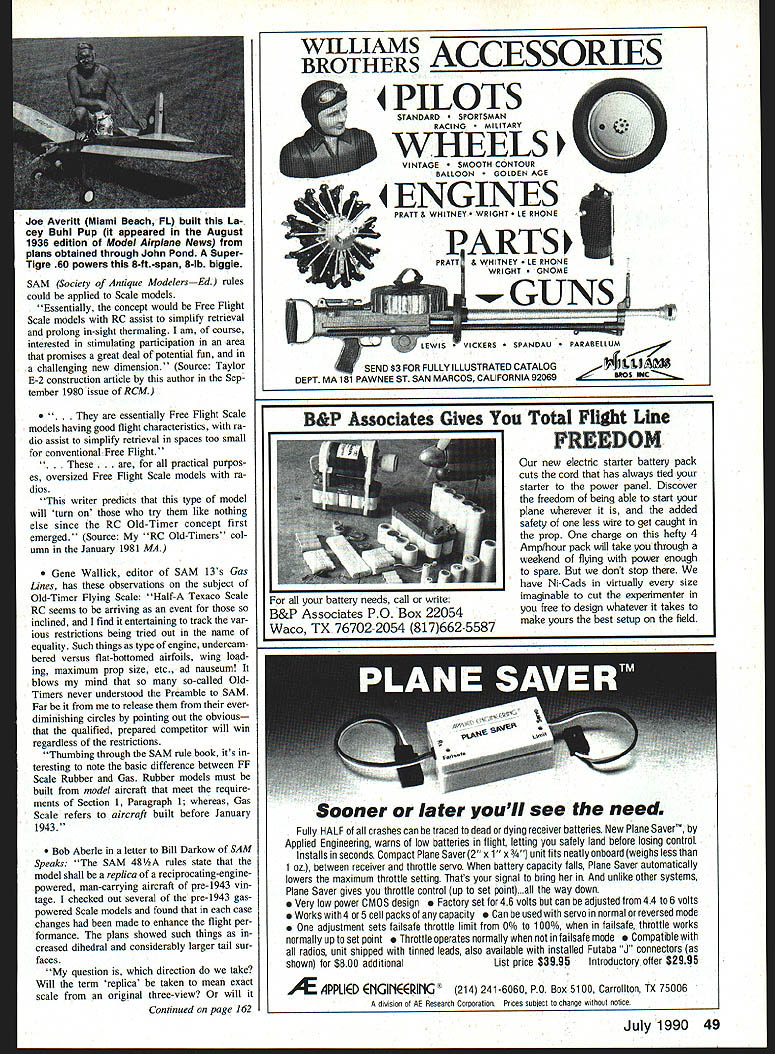
Jim Alaback notes that SAM (Society of Antique Modelers) rules could be applied to scale models. The basic concept under discussion is Free Flight scale models with RC assist to simplify retrieval and prolong in-sight thermaling. In practice these tend to be oversized Free Flight scale models fitted with radios, and the idea promises a great deal of fun and a new challenge.
Gene Wallick and others have observed that a Half-A Texaco Scale RC event seems to be arriving for those so inclined. Debate centers on various restrictions intended to create equality (engine type, airfoil, wing loading, prop size, etc.). Some worry that excessive restrictions miss the point that the qualified, prepared competitor will usually prevail.
A look at the SAM rule book shows differences between Free Flight Scale and Gas Scale: rubber models must meet Section 1, Paragraph 1 requirements, while Gas Scale refers to aircraft built before January 1943. Bob Aberle has pointed out that SAM 48A requires models to be replicas of reciprocating-engine-powered, man-carrying aircraft of pre-1943 vintage. Some pre-1943 plans show changes for improved flight performance (increased dihedral, larger tail surfaces), prompting the question: how strictly should "replica" be interpreted — exact scale from the original three-view, or allowed modifications for flight?
Alex Imrie (January 1990, Aeromodeller) commented that early 1930s Flying Scale models have a special attraction because of their inaccuracies; these "oldies" have an aura different from modern exact-scale models. He advises not to change vintage designs too much if you wish to retain that character — including original decorations, finishes, and markings.
Jim Alaback (March 1990, Aero News) agrees that an exact-scale Duration concept would be challenging and could make an interesting event. He suggests it might be better as an AMA event than a SAM event because "challenging" runs counter to the SAM Preamble's "casual—relaxed" concept, and because exact-scale models are not strictly SAM-era Old-Timers.
Bud McNorgan (source unknown) offers pragmatic advice: "Build what you want, fly what you want, and if it doesn't fit the rules don't enter. But under all circumstances keep flying."
My two cents’ worth: When I started promoting the RCSD concept about 10 years ago I didn't intend it as an exclusively SAM-type activity. Since my soapbox has been primarily SAM-oriented, I naturally addressed SAM readers, but one must be cautious when suggesting RC assist to the Free Flight community — misunderstandings have led to painful interactions in the past.
My last column glossed over the obvious "apples-and-oranges" comparison between the East Coast and West Coast proposals. One concept is a Scale event while the other is structured much like current SAM events. The philosophical spread between the two concepts could spark controversy and split well-intentioned modelers. Rather than forcing a single answer, perhaps both concepts should be tried as totally separate events, with no rush to judgment until experience is gained.
If the "new-design" RCSD event proves popular (and I think it will), it could be added to the AMA rule book and even to Free Flight contests. Conversely, a duplicate-model concept that adheres to pre-1943 requirements (including engine size and possibly rubber-powered designs converted to engines) would fit well within the SAM philosophy.
My recommendation: try an event for pre-1943 model designs and another for Scale models of pre-1943 prototypes. There should be room for both, with lots of fun for everyone.
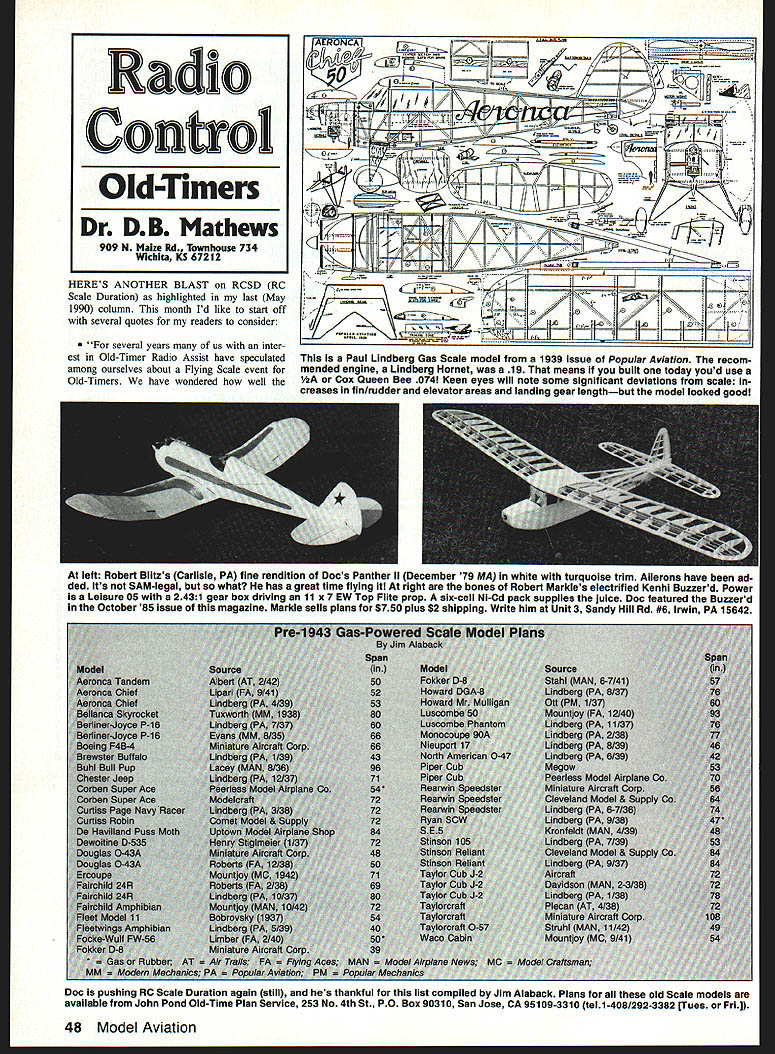
My last column included ideas and sources for drawings and construction articles suitable for RCSD concepts. Jim Alaback has compiled a listing of all pre-1943 gas-powered designs available from John Pond's catalog; I included that list as a separate table in the magazine. Several pre-1943 Gas designs are also listed in the Aeromodeller plans list. If local clubs include rubber designs, the number of eligible models becomes almost unlimited.
Additionally, Free Flight Scale columns — such as Bill Warner's — and other publications are excellent sources of information for those interested in Scale prototype concepts.
The point is: nothing is holding you up. Get to building an RCSD model — and send me some pictures!
Transcribed from original scans by AI. Minor OCR errors may remain.

