
Radio Control: Old-Timers
Dr. D. B. Mathews 909 N. Maize Rd., Townhouse 734 Wichita, KS 67212
Alive and well
Fifteen years ago, when I developed the now-classic Kloud King for publication (MA, July ’75 — Full-Size Plan No. 103), I assumed the plane’s original designer, Mickey De Angelis, was deceased — nothing had been seen of him in the modeling world since the post‑WWII era. Fourteen years later (’89), I learned through John Delagrange (a member of the very active SAM‑100 group in the Lancaster, PA area) that Mickey is alive and well and back into modeling.
Isn’t it interesting how often designers and fliers from the pre‑1942 era, who had dropped out of the hobby for years, have been drawn back by the advent of SAM‑type activities? (SAM = Society of Antique Modelers — R/McM.)
Mickey De Angelis designs
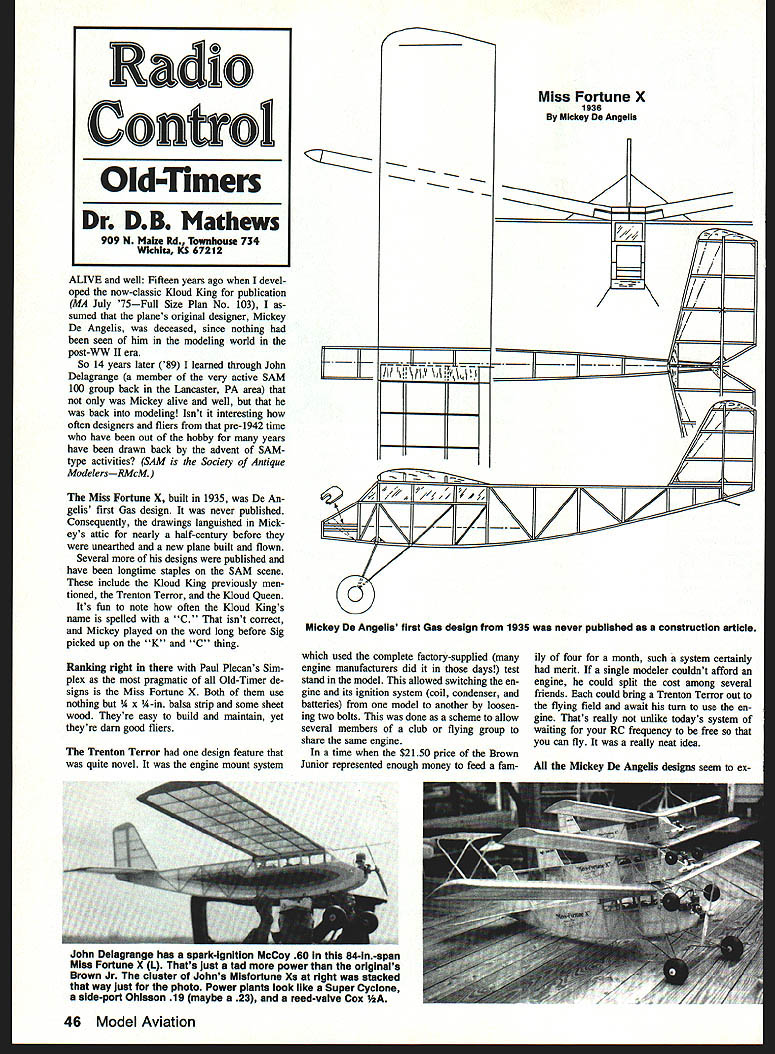
Mickey’s Miss Fortune X, built in 1935, was his first gas design and was never published. The drawings languished in his attic for nearly a half‑century before being unearthed and a new plane built and flown. Several of his published designs have become longtime staples on the SAM scene, including the Kloud King, the Trenton Terror, and the Kloud Queen.
It’s fun to note how often the Kloud King’s name is misspelled with a “C.” That isn’t correct — Mickey played on the word long before Sig picked up on the “K” and “C” thing.
Ranked with Paul Plecan’s Simplex as among the most pragmatic Old‑Timer designs, the Miss Fortune X and Simplex use nothing more than 1/4 x 1/4‑in. balsa strip and some sheet wood. They’re easy to build and maintain, yet they’re excellent fliers. Mickey’s approach uses a minimum number of formers and curved pieces; this delightful simplicity in no way detracts from performance. It’s little wonder his designs are favorites of the SAM “fly it whether or not it’s competitive” devotees.
Trenton Terror and the engine‑mount system
The Trenton Terror had a novel design feature: it used the complete factory‑supplied engine test stand as the engine mount. Many engine manufacturers supplied such test stands in those days. This arrangement allowed switching the engine and its ignition system (coil, condenser, and batteries) from one model to another by loosening two bolts, so several club members could share a single engine.
At a time when the $21.50 price of a Brown Jr. represented enough money to feed a family of four for a month, that sharing scheme had real merit. If one modeler couldn’t afford an engine, he could split the cost among friends, each bringing a Trenton Terror to the field and awaiting his turn — not unlike today’s habit of waiting for an RC frequency to be free.
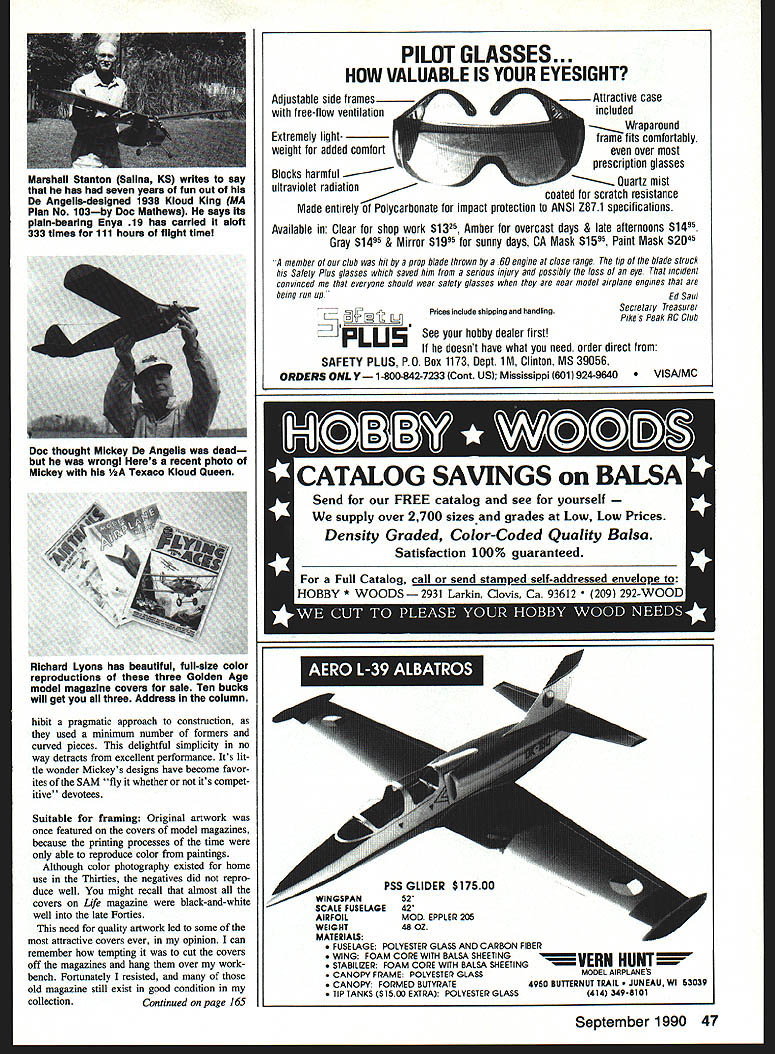
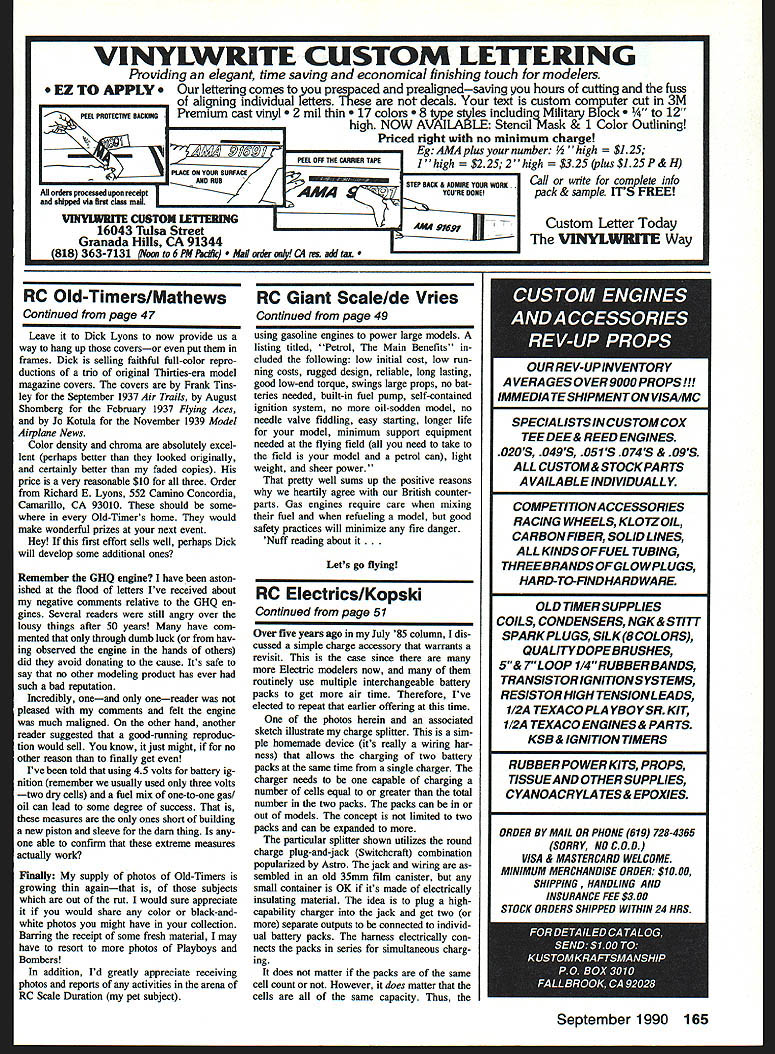
John Delagrange, for example, has a spark‑ignition McCoy 60 on an 84‑in.‑span Miss Fortune X — a bit more power than the originals. Power plants of the era often looked like Super Cyclone side‑port, Ohlsson 19 (maybe 23), reed‑valve types, and Brown Jr. clusters were common.
Suitable for framing — magazine cover reproductions
Original artwork once regularly graced model magazine covers because 1930s printing processes reproduced color best from paintings. Although color photography existed, negatives did not reproduce well, and many popular magazines (you may recall Life) had black‑and‑white covers well into the late 1940s. This need for painted covers produced some of the most attractive magazine art ever.
Dick Lyons is now selling faithful full‑color reproductions of three original 1930s model magazine covers. The reproductions are excellent in color density and chroma — perhaps even better than the originals as they looked originally, certainly better than my faded copies. The three covers are:
- Frank Tinsley — Air Trails, September 1937
- August Shomberg — Flying Aces, February 1937
- Jo Kotula — Model Airplane News, November 1939
Price: $10 for all three. Order from Richard E. Lyons, 552 Camino Concordia, Camarillo, CA 93010. These reproductions should be in every Old‑Timer’s home and would make wonderful event prizes. If demand is good, perhaps Dick will produce additional titles.
The GHO engine — reader reactions
I’ve been astonished by the flood of letters about my negative comments on GHO engines. Several readers remain angry about those poor engines even after 50 years. Many said they avoided buying one only through dumb luck or from seeing others try them. It’s safe to say no other modeling product has had such a bad reputation.
One reader felt my remarks were malicious; another suggested a good‑running reproduction might sell — perhaps as a way to finally get even. I’ve been told that using 4.5 volts for battery ignition (we usually used only three volts — two dry cells) and a fuel mix of 1:1 gas/oil can produce some degree of success, short of building a new piston and sleeve. Can anyone confirm that these extreme measures actually work?
Photos and reports wanted
My supply of photos of Old‑Timers that are “out of the rut” is growing thin. Please share any color or black‑and‑white photos you have. Barring more fresh material, I may have to resort to more photos of Playboys and Bombers!
I’d also greatly appreciate receiving photos and reports of any activities in the area of RC Scale Duration (my pet subject).
Transcribed from original scans by AI. Minor OCR errors may remain.

