
RADIO CONTROL
Old-Timers
Dee B. Mathews
IS UTOPIA in Texas? Imagine, if you will, a city four miles wide by three deep with all the houses, utility poles, and trees removed, leaving nothing but streets and street signs. Such an utopia is Pyramid Acres, on the far west fringes of Fort Worth.
We attended the Labor Day Contest at Pyramid Acres. I can flatly say this is the finest flying site for free flight and RC assist that I have ever seen! All model retrieval is by road, rarely requiring more than a 100-yard walk. And the thermals are absolutely unreal.
Any one interested in free flight, whether AMA or SAM, should make every effort to be in Fort Worth next Labor Day weekend. The Planesmen run a super contest, trophies are Texas-size, and hospitality is pure southern.
Considering the presence of Hurricane Anita a few hundred miles south of us, we were pleasantly surprised to find light winds in Fort Worth. Would you believe Mike Fedor won Unlimited Rubber at 1067 seconds while flying a penny plane?
Thermals were monstrous. Lift extended in all directions as far as one could see the models. Mike Birdwell's Cumulus actually gained altitude while doing consecutive inside loops! Bill Baker had his Quaker up over 40 minutes trying to get down without resorting to spinning. Mike Birdwell beat out Bruce Norman in 30-second Antique, 1559 to 1515 seconds. Unbelievable!
A Lesson Relearned:
Back in the "bad old days" we all spent more time range checking our relay-escapement systems than we did flying them. As the equipment became more reliable I reached the point where I no longer bothered to range check. Well folks, I have relearned!
I re-installed a flight pack into one of my Old Timers after it had been pranged in a 1/4A project. After 20 seconds of my first official, the shut-off activated, and the model was in full up elevator, with the stick in down! A cracked crystal from the crash had resulted in a limited range situation. Believe me, in-flight range checks are not recommended.
I share this, since I haven't noted much range checking by any one lately. I now turn both switches on at the car, carry the fuselage to the flight line, then range check as I remove the transmitter from the car. If others are flying on my frequency I do wait!
I got the model down by staying off the controls. It stalled but did not spin due to wash-out. I have also gone back to placing my name and phone number on the models.
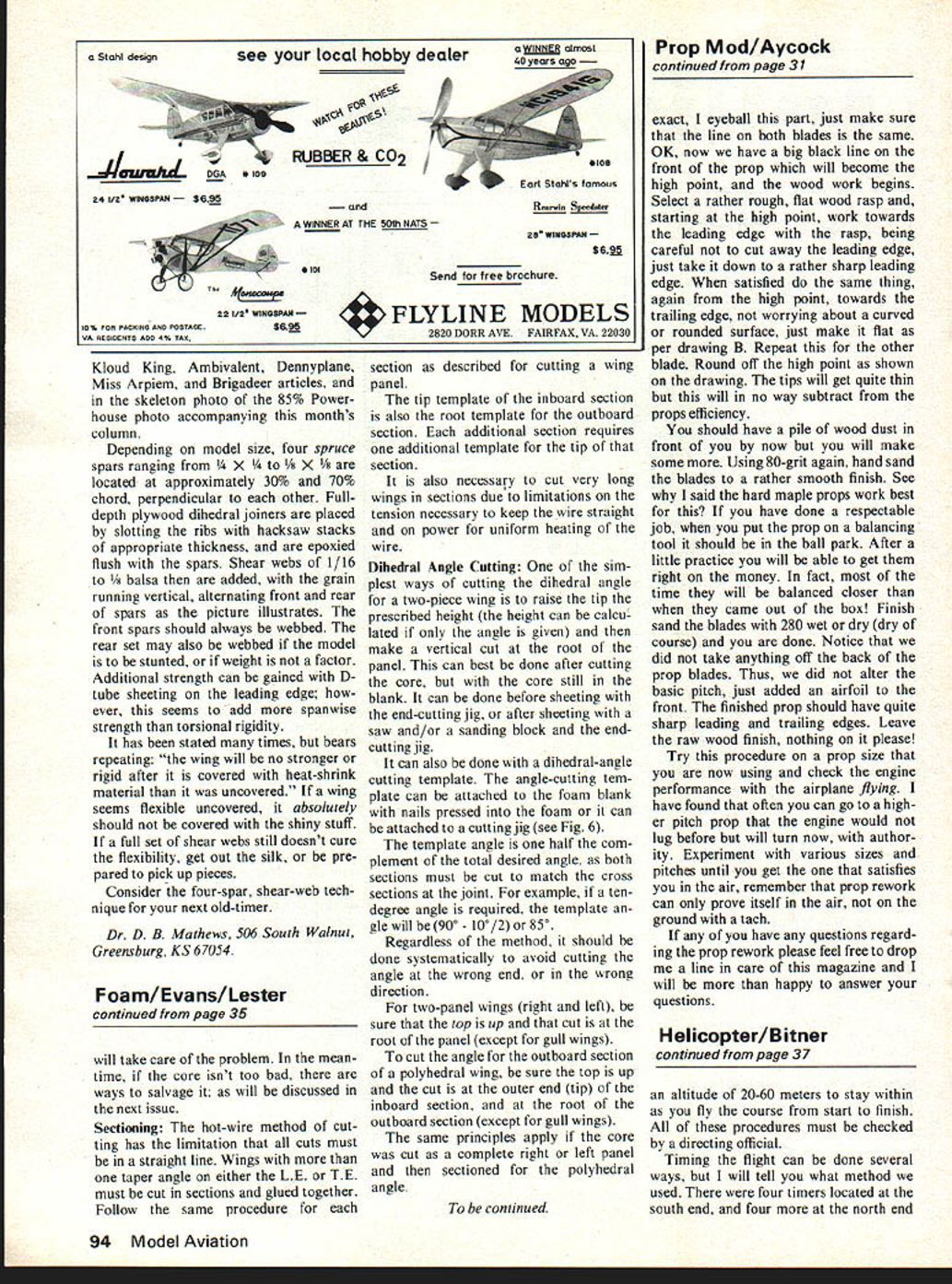
P & W ribs: Gene Walloch is producing wing and stab rib kits for 15 old-timer designs. All that is really required to build from these kits is the plans and strip wood. Gene's line-up includes such favorites as the Scientific Mercury, Comet Sailplane, and the original Berkley Buccaneer. The wood quality is good. The band-sawing requires a little sanding but is accurate. Send a S.S.A.E. to P & W Model Service, P.O. Box 925, Monrovia, CA 91016 for a complete list.
On spinning Webs and Such: The majority of old-timer designs use wing spars of considerable depth relative to the airfoil. Exceptions do exist, of course, notably in the multi-spar approach of Chet Lanzo. But common practice was the use of one or two deep spars on the bottom side with none on the top. This trend may have been associated with the wide use of silk or double layers of bamboo paper for covering and their associated stiffening of the structure. Another factor undoubtedly was nitrate dope, which does not continue to tighten for weeks on end, as do the newer butyrate dopes. Butyrate dope has only been around since the mid 1950's, when we were forced to use it when the glow plug came along. How many of you recall such attempts at fuel-proof finishes as "STA" and "HEP"?
Still another possible reason for the use of 1/8 x 1/2 spars and such may be a degeneration in the quality of balsa wood; perhaps the stuff didn't stress relieve so much back then. A final possibility of course might be that the designers didn't know any better. Whatever the reason or reasons, one fact has become glaringly apparent as we have gotten into RC assist. The wing has a strong tendency to fall off at the most inopportune times.
As we revive the grand old designs of 40 years ago, add radio, cover the wings with plastic film, and submit them to flight stresses their designers only considered in a crash situation, it is apparent that modification to the wing structure is of paramount importance. If you have never had the "thrill" of losing a wing panel while spiralling out of a boomer, don't feel left out. I've done it often enough. I'd like to share what I've found to be a reliable solution. It is simple to build, adds tremendous strength, and resists warping well while fitting in the framework of the SAM preamble.
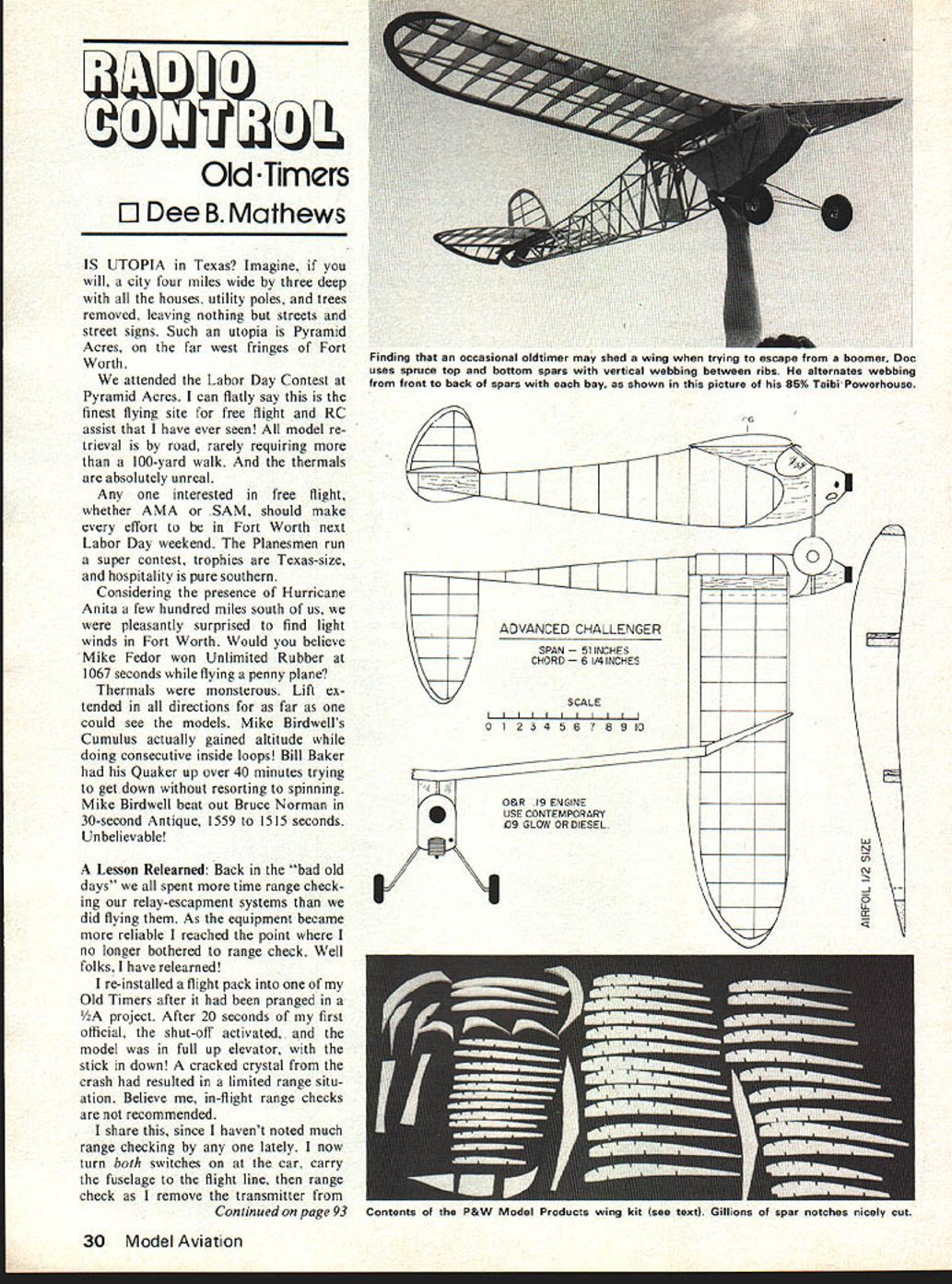
Borrowing heavily from George Fuller of England whose free flight Dixielander series has been published and kitted under more disguises than Willie the Actor ever had, stirring in lessons learned from the RC glider people, and generally stealing anything useful, I've been using the four-spar, shear-web wing exclusively for several years. The concept appears in my Kloud King, Ambivalent, Dennyplane, Miss Arpiem, and Brigadier articles, and in the skeleton photo of the 85% Powerhouse photo accompanying this month's column.
Depending on model size, four spruce spars ranging from 1/4 x 1/4 to 5/8 x 1/8 are located at approximately 30% and 70% chord, perpendicular to each other. Full-depth plywood dihedral joiners are placed by slotting the ribs with hack-saw stacks of appropriate thickness, and are epoxied flush with the spars. Shear webs of 1/16 to 1/8 balsa then are added, with the grain running vertical, alternating front and rear of spars as the picture illustrates. The front spars should always be webbed. The rear set may also be webbed if the model is to be stunted, or if weight is not a factor. Additional strength can be gained with D-tube sheeting on the leading edge; however, this seems to add more spanwise strength than torsional rigidity.
It has been stated many times, but bears repeating: "the wing will be no stronger or rigid after it is covered with heat-shrink material than it was uncovered." If a wing seems flexible uncovered, it absolutely should not be covered with the shiny stuff. If a full set of shear webs still doesn't cure the flexibility, get out the silk, or be prepared to pick up pieces.
Consider the four-spar, shear-web technique for your next old-timer.
Dr. D. B. Mathews, 506 South Walnut, Greensburg, KS 67054.
Transcribed from original scans by AI. Minor OCR errors may remain.

