
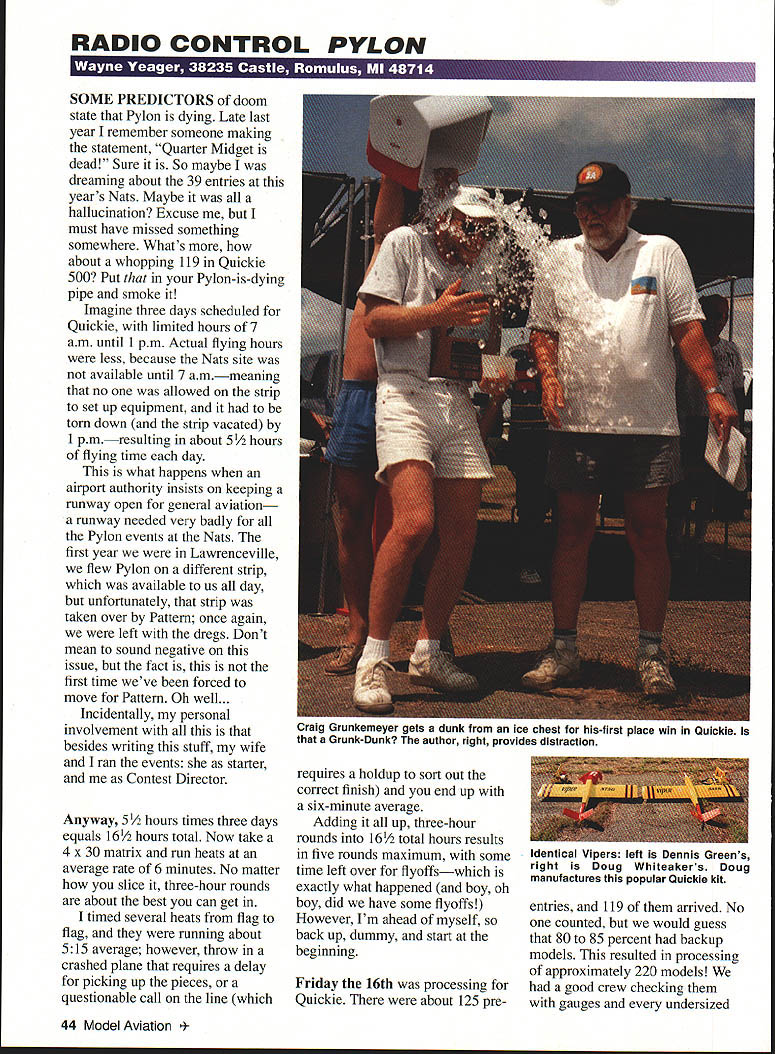
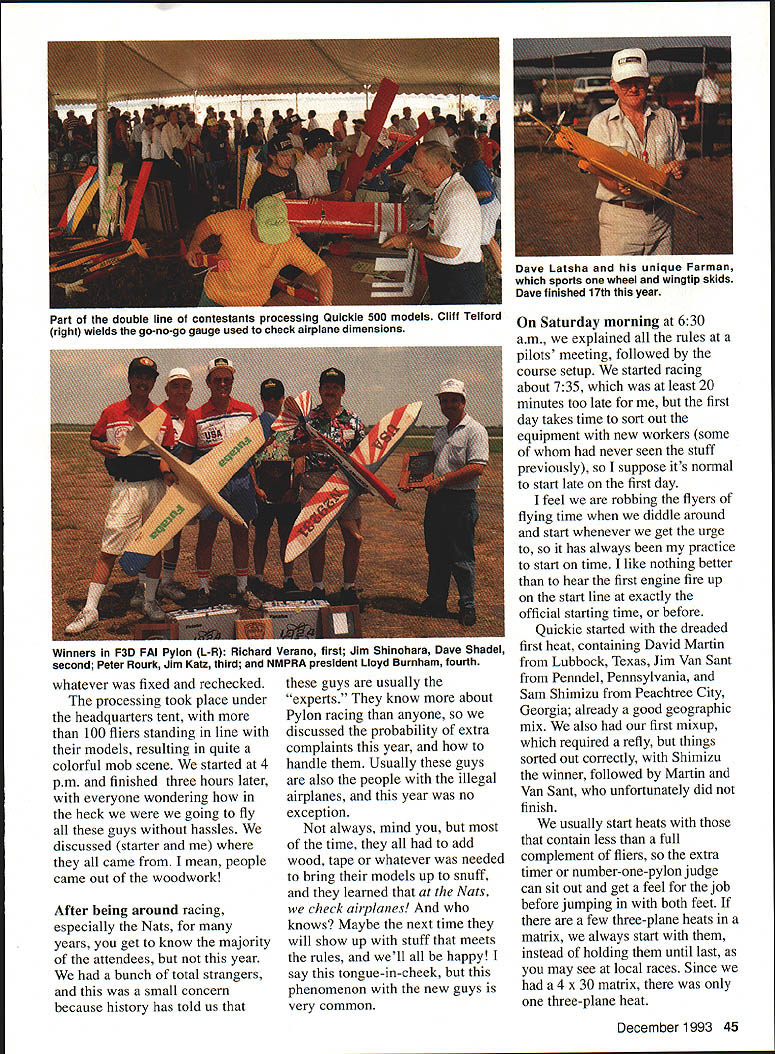
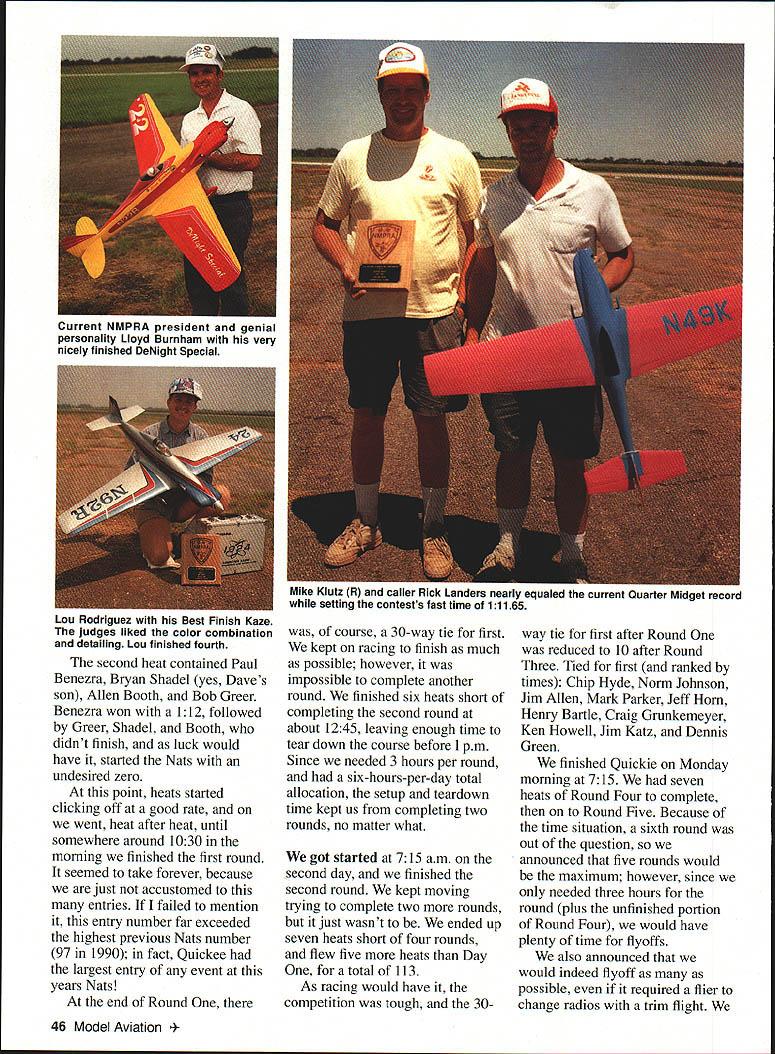
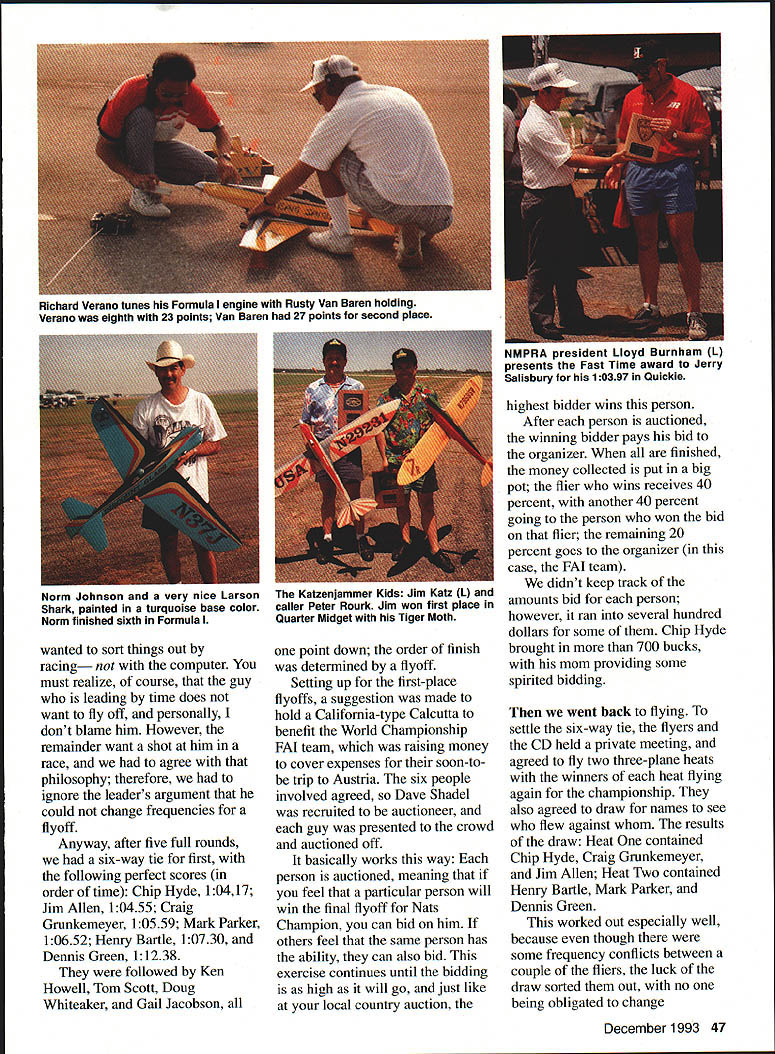
RADIO CONTROL PYLON
Wayne Yeager, 38235 Castle, Romulus, MI 48714
Some predictors of doom state that pylon is dying. Late last year someone declared, "Quarter Midget is dead!" Sure. Maybe I was dreaming about the 39 entries at this year's Nats. Maybe it was all a hallucination. Excuse me—I must have missed something somewhere. What's more, how about a whopping 119 in Quickie 500? Put that "Pylon-is-dying" pipe down and smoke it!
Imagine three days scheduled for Quickie, with limited hours of 7 a.m. until 1 p.m. Actual flying hours were less, because the Nats site was not available until 7 a.m.—meaning no one was allowed on the strip to set up equipment, and it had to be torn down and the strip vacated by 1 p.m.—resulting in about 5½ hours of flying time each day. This is what happens when an airport authority insists on keeping a runway open for general aviation—a runway needed badly for all the pylon events at the Nats.
My wife and I ran the Quickie events: she as starter, and I as Contest Director. The constraints made it tough: 5½ hours × three days = 16½ hours total. With a 4 × 30 matrix and heats averaging about six minutes (5:15 without interruptions, but crashed planes and line disputes push that to roughly six), three-hour rounds are about the best you can get. That math gives five rounds maximum, with some time left over for flyoffs—which is exactly what happened.
Quickie 500 — Processing
Friday the 16th was processing for Quickie. There were about 125 pre-entries and 119 arrived. We guessed 80–85% had backup models, which resulted in processing roughly 220 models. A good crew checked them with gauges; every undersized whatever was fixed and rechecked.
Processing took place under the headquarters tent, with more than 100 fliers standing in line with their models—quite a colorful mob scene. We started at 4 p.m. and finished three hours later, with everyone wondering how we were going to fly all these guys without hassles. We had a bunch of total strangers among the entrants—many of whom, historically, are the "experts" who know more about Pylon racing than anyone and sometimes show up with illegal airplanes. Most of them had to add wood, tape, or other fixes to bring their models up to snuff, and they learned that at the Nats we check airplanes.
Quickie 500 — Racing
Saturday morning at 6:30 a.m. we held the pilots' meeting and then set up the course. We started racing about 7:35—about 20 minutes late—because first days take time to sort out new workers and equipment. Quickie started with the dreaded first heat (David Martin, Jim Van Sant, Sam Shimizu), which required a refly; Shimizu won, followed by Martin (Van Sant did not finish).
We usually start heats that contain fewer than a full complement to let extra workers get a feel for the job. With a 4 × 30 matrix there was only one three‑plane heat. Heats clicked off at a good rate and we finished Round One around 10:30 a.m. After Round One there was a 30‑way tie for first. With our time allocation, we finished six heats short of completing Round Two before we had to tear down the course for the day.
Day Two we started at 7:15 a.m. and finished Round Two, then continued but ended seven heats short of four rounds. We flew five more heats than Day One for a total of 113 heats by the end of Day Two.
After three rounds the 30‑way tie for first had been reduced to 10 fliers, tied for first and ranked by best times:
- Chip Hyde
- Norm Johnson
- Jim Allen
- Mark Parker
- Jeff Horn
- Henry Bartle
- Craig Grunkemeyer
- Ken Howell
- Jim Katz
- Dennis Green
We finished Quickie on Monday morning at 7:15. Because of the time situation a sixth round was out of the question, so five rounds was the maximum; we announced that we would use available time for flyoffs and would fly off as many ties as possible—even if a flier had to change radios with a trim flight. We wanted to sort things out by racing, not by computer.
After five full rounds there was a six‑way tie for first, with perfect scores and these best times (in order of time):
- Chip Hyde — 1:04.17
- Jim Allen — 1:04.55
- Craig Grunkemeyer — 1:05.59
- Mark Parker — 1:06.52
- Henry Bartle — 1:07.30
- Dennis Green — 1:12.38
They were followed by Ken Howell, Tom Scott, Doug Whiteaker, and Gail Jacobson, all one point down; the order of finish among them was to be determined by flyoff.
Quickie 500 — Calcutta and Flyoffs
To raise money for the World Championship FAI team heading to Austria, we held a California‑type Calcutta for the six finalists. Each finalist was auctioned; the winner of each auction paid into a pot. The payout split was 40% to the winning flier, 40% to the person who bought that flier, and 20% to the organizer (the FAI team). Chip Hyde brought in more than $700 (his mom provided spirited bidding). Craig Grunkemeyer earned $660 for his split of the Calcutta; the FAI team received an additional $330.
To settle the six‑way tie the fliers and CD agreed on two three‑plane heats, with the winners of each heat meeting for the championship. The draw resulted in:
- Heat One: Chip Hyde, Craig Grunkemeyer, Jim Allen — Craig Grunkemeyer won.
- Heat Two: Henry Bartle, Mark Parker, Dennis Green — Henry Bartle won.
Final: Craig Grunkemeyer vs. Henry Bartle. After ten laps Bartle led until the final lap when he pulled his stick a fraction too soon and cut short of pylon one. Grunkemeyer finished clean and cruised to first place—another Nats win in Quickie 500.
Quickie 500 — Awards and Notes
- Fast Time: Jerry Salisbury — 1:03.97 (followed closely by Lyle Larson at 1:04.02). NMPRA sponsored the Fast Time trophy; Lloyd Burnham presented it to Salisbury.
- Best Junior: David Wright — finished 16th, best time 1:11.21.
- Best Senior: Bob Malik — finished 20th, best time 1:16.06.
- Coolness Award: John Fike — he accidentally fouled his transmitter antenna with his whirling prop, lost the prop, shut down, replaced it and restarted—all before the flag dropped.
Paul Page (computer scoring) produced individual heat cards and overall score sheets plus a personal card for each contestant showing overall placing, total points, heat scores/times, and best time converted to mph, knots, and kph. Passing these out in reverse order became a bit of a spectacle with so many contestants, but the competitors responded well and kept things moving.
---
QUARTER MIDGET
Our Quarter Midget entry was a nice 39. Only a few planes had to be brought up to minimum requirements. We set up a 4 × 10 matrix with one three‑plane heat.
Heat One featured Steve Baker, Phil Zuidema, and Mike Condon. Condon lost his plane at takeoff (his only entry), Baker didn't finish either, and Zuidema coasted to an easy win. Other notable heats included Rick Moreland setting a 1:17 in one heat.
After Round One there was the usual tie for first, with the following ranked by times:
- Craig Grunkemeyer
- Dub Jett
- Rick Moreland
- Jim Katz
- J.P. Hanway
- Phil Zuidema
- Joe Dodd
- Ron Gray
- Carl Simms
- Peter Rourk
During Round Two Dub Jett suffered a disaster: while closely following another plane he hit some turbulent air and his plane came apart—returning to being "a kit." He'd actually picked up the wrong plane at pushoff and didn't see his own plane crash. His second‑place legend ended abruptly.
After Round Two the tie for first had been reduced to:
- J.P. Hanway (1:14)
- Carl Simms (1:21.33)
- Joe Dodd (1:21.67)
Grunkemeyer, Katz, Moreland, Tallman, Salisbury, and Matney were tied for fourth.
After Round Three J.P. Hanway held first place alone with a perfect score. Several flyers chased him, but J.P. kept a cool head and looked like the Nats winner.
Round Five was announced as the last, with some time reserved for flyoffs. Jim Katz won his heat, leaving him one point from a perfect score. Dodd and Hanway fell behind with cuts. The final crucial heat was J.P. Hanway vs. Craig Grunkemeyer. Grunkemeyer won the heat with a 1:13.40; J.P. cut a pylon and was knocked out of first.
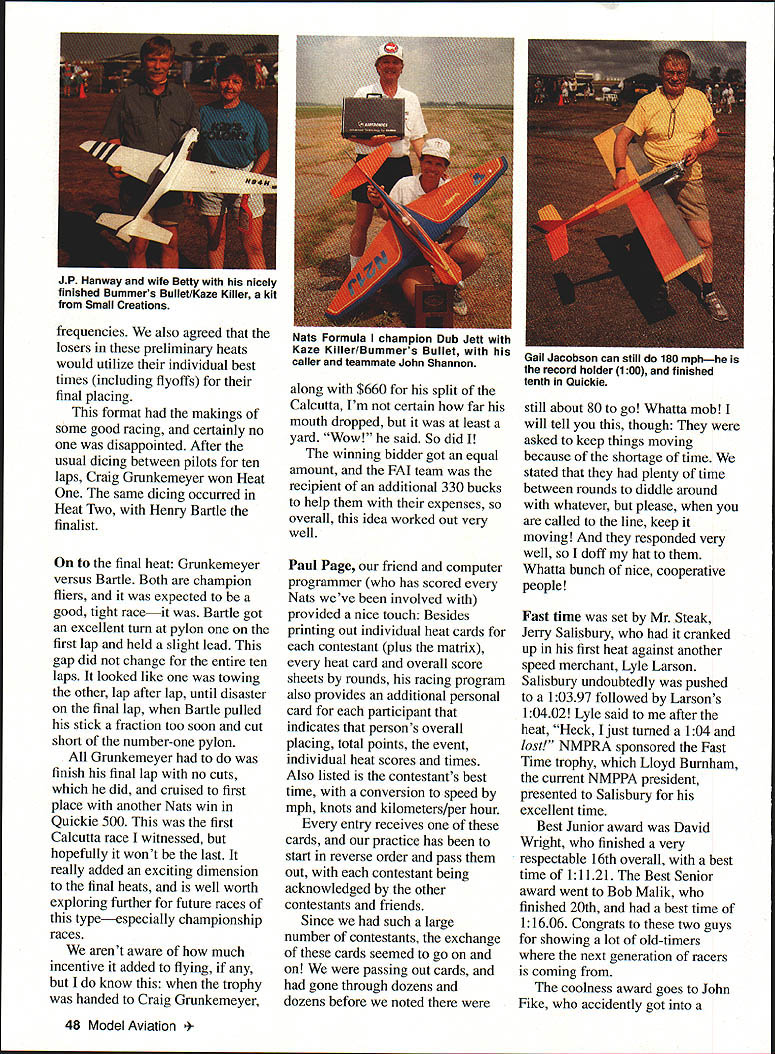
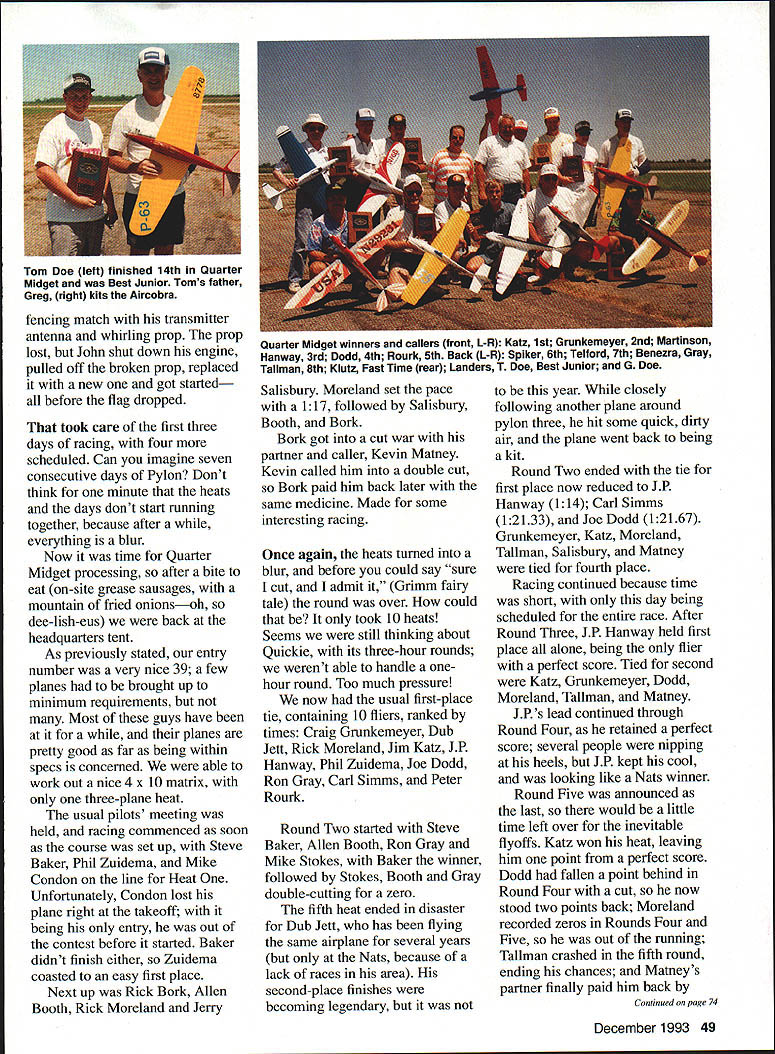
This left Grunkemeyer and Katz tied with 19 points each; Hanway and Dodd tied for third with 18 points each. We started flyoffs with the third‑place guys and J.P. redeemed himself by beating Dodd. For first place, Katz (with caller Peter Rourk—the "Katzenjammer Kids," as side judge Judy Mealy called them) beat Grunkemeyer for the '93 Nats Quarter Midget championship.
Quarter Midget awards and notes:
- Best Time: Mike Klutz — 1:11.65 (very close to the AMA record of 1:11.20 set by Paul Benezra in 1990).
- Best Junior: Tom Doe (son of Greg) — finished 14th, best time 1:27.
- A laugh: Grunkemeger entertained workers by shouting the wrong name while calling turns: "Joe... I mean Ed!" while calling for his usual partner.
---
F3D (FAI Pylon)
F3D is an international class we fly at the Nats even though entries are usually low. This year the entry was 13. We set up a 3 × 5 matrix (two two‑plane heats and three three‑plane heats). F3D is primarily scored by clock, so contestants race the clock for points rather than head‑to‑head.
Early fast times included:
- Richard Verano — 1:10.83
- Dave Shadel — 1:10.87
- Mike Helsel — 1:13.10
- Dub Jett — 1:13.91
Round Two featured a very fast 1:06 by Dave Shadel and a 1:07 by Verano, moving Shadel into contention. Dub Jett had another mishap: after starting an engine he realized another plane that looked like his had been launched and dove out of the way, causing his own plane to plow into the runway—ending his day.
After the rounds and flyoffs the final standings were:
- Richard Verano — 274.52 points (this total equates to an average of 1:08.33)
- Dave Shadel — 276.22 points (Shadel also recorded a new AMA single‑lap record of 1:06.27)
- Dub Jett
- Mike Helsel
- Jim Katz
Congrats to Verano for the overall win and to Dave Shadel for the new single‑lap record.
---
FORMULA I
Formula I drew 37 contestants and is always a show of beautiful, museum‑quality ships. We processed the planes under the headquarters tent and judged for takeoff order, finish smoothness, paint quality, construction quality, and thoroughness of finish (including the undersides). The Best Finish award went to Lou Rodriguez for his outstanding Kaze.
We ran a 4 × 10 matrix with three three‑plane heats. Heat One was Fog Tanner, Dave Layman, and Clark Wade; Layman won with a 1:13. After Round One the leaders were:
- Mike Heisel — 1:07.49
- Dub Jett
- Rusty Van Baren
- Richard Verano
- Dave Layman
(and others close behind)
Rain forced suspension on the first day with six heats still to go; we lost at least two rounds and had to push hard on the second day to make up time. Heisel cut a pylon in Round Four, which moved Dub Jett into first with all wins and a time of 1:07.77; Rusty Van Baren was also doing well with a 1:12.19. Verano, Shadel, Rodriguez and Hyde were close behind.
We ultimately announced seven rounds to conclude the contest. Dub Jett ended up undefeated with all wins and took the Nats title—no flyoffs required. Rusty Van Baren finished second (one point back). Dave Shadel and Lou Rodriguez tied for third and were sent to a flyoff; Shadel won that flyoff to take third and Rodriguez placed fourth.
Formula I awards and notes:
- Fast Time: Richard Verano — 1:07.22
- Best Senior: Bryan Shadel (son of Dave Shadel) — finished 12th, best time 1:22
---
CONCLUSION
After seven days of heat and humidity, the Nats were over. We had remarkably little lost flying due to weather overall. Our workers volunteered their time and spent their own money to make this happen; they must be applauded for their perseverance. I'm grateful for these people—what would we do without them? There wouldn't be any racing! Ever stop to think about that?
Transcribed from original scans by AI. Minor OCR errors may remain.

