
Pylon Racing
Jerry Christensen
PYLON RACING, the most maligned form of RC flying, is on the upturn. After years of being told that pylon is "too fast," "too expensive," and "too this or that," by writers both uninformed and uninvolved, the flyers are finding racing airplanes are stable, easy to fly and only as expensive as you choose to make them.
It's true they have fast speeds, but as speeds have increased, so have safety measures. After all speed and racing are synonymous — why shouldn't they be fast? The people involved in racing are aware of the potential dangers and have on their own continually worked toward improving the safety aspect. The record speaks for itself. Pylon has one of the best safety records for any form of RC flying.
As to cost it's comparable to pattern flying. If you choose to have all your work done for you, the cost can be high. If, on the other hand, you are willing to do your own thing, the cost is quite low. I know flyers that have used the same airplane for two or three years and still have been very competitive. The model Larry Leonard used to win the Nationals a few years back was two years old at the time and still went through one more season before being retired due to old age. Pylon racing had the largest influx of new competitors ever in 1974 and hopefully will continue to grow as more modelers learn the truth in the statement made years ago by Jerry Nelson, when the whole thing was getting started, "pylon is easy, all you have to do is go fast and turn left."
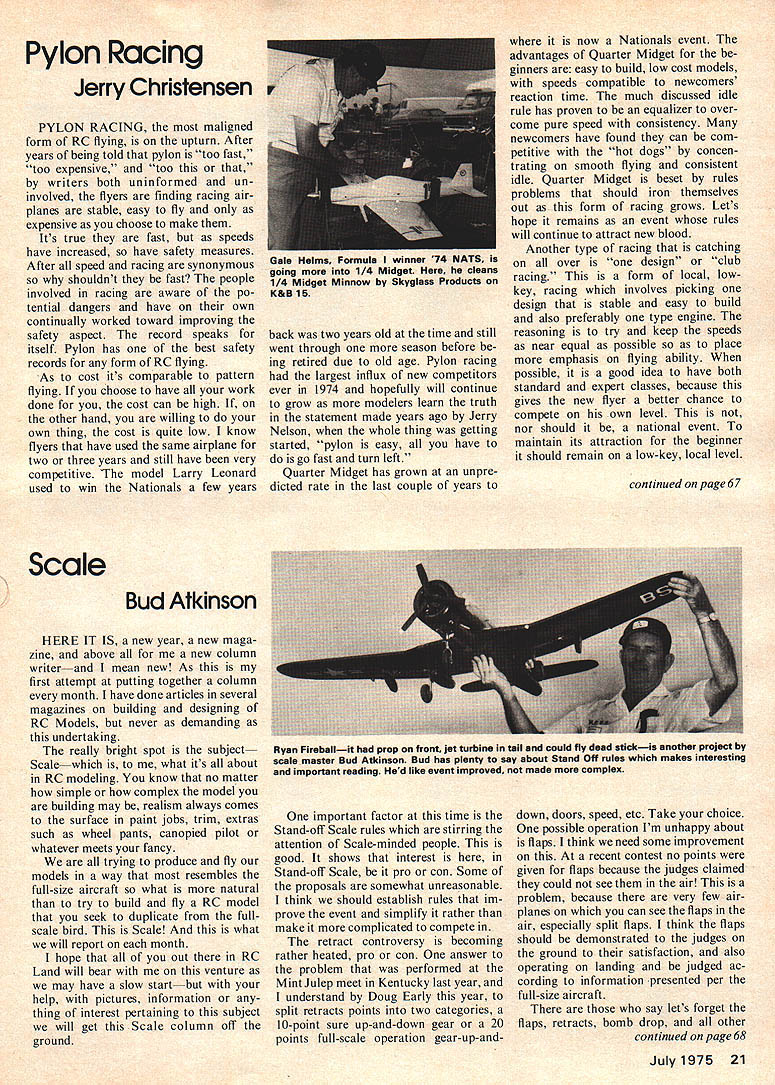
Quarter Midget has grown at an unpredicted rate in the last couple of years to where it is now a Nationals event. The advantages of Quarter Midget for the beginners are: easy to build, low cost models; with speeds compatible to newcomers' reaction time. The much discussed idle rule has proven to be an equalizer to overcome pure speed with consistency. Many newcomers have found they can be competitive with the "hot dogs" by concentrating on smooth flying and consistent idle. Quarter Midget is beset by rules problems that should iron themselves out as this form of racing grows. Let's hope it remains an event whose rules will continue to attract new blood.
Another type of racing that is catching on all over is "one design" or "club racing." This is a form of local, low-key, racing which involves picking one design that is stable and easy to build and also preferably one type engine. The reasoning is to try and keep the speeds as near equal as possible so as to place more emphasis on flying ability. When possible, it is a good idea to have both standard and expert classes, because this gives the new flyer a better chance to compete on his own level. This is not, nor should it be, a national event. To maintain its attraction for the beginner it should remain on a low-key, local level.
RC Pylon Racing
It's fun, can be very competitive, and certainly a good training ground for other forms of racing.
Formula One is the glamor boy of racing. It is also the type that has received most of the "bad ink" from its detractors. Formula One racers are more time consuming to build because of appearance points; they also are some of the most stable airplanes flown. They were the first form of national racing, thus went through the longest period of development, both in model design and rules. This has reached a point where you can fly any place in the country and still have the same rules. The models are fast, because of this, stability has been a necessary factor in design. Newcomers are amazed at how easy the ships are to fly; they only go where you point them.
The trick for starting out in Formula One is to fly a little high and a little wide, while learning and concentrate on smoothness. As skill is developed the flyer will automatically fly lower and closer to the pylons. If an attempt is made to get tight on the pylons at the start the flyer will not have the required smoothness which frequently develops into "instant trash." The need for exotic engines is highly over-rated. I have seen out-of-the-box engines perform very well. It is important to have a good front-end fit, also good piston, and liner fit or good ring fit. These things are easy to learn or can be handled at reasonable cost by some of the engine men.
Radical port changes are not necessary or usually even desirable. Let's face it, the manufacturer is more knowledgeable on port timing than the average flyer. What is important, more so than engine rework, is a good prop. A good average engine with an excellent prop will go faster than an exotic engine with an average prop.
I wish it was possible to say "this is how you make or pick a good prop." Unfortunately, the state of the art is such that this cannot be done. Some props work well out of the box, most require re-work. The only way to find the answer is to experiment, try various pitches, blade shapes, diameters, airfoils, etc. I only know of a very few really good men in racing. They became proficient by constant experimenting and even the best can't be sure a prop is good until they fly it.
Whatever the form, give racing a try. It can be frustrating, but it does make the adrenaline flow and the rewards are gratifying. You find other competitors willing to help. Most of the top men in this sport will be more than willing to help you go faster. You have to ask for help, however, because they can't be expected to come to you. Ask Kent Nogay or Terry Prather how to carve props (they are two of the best) and they will show you what they are using and tell you how they carved them. They want you to go fast, then they will try their hardest to beat you in a race. That's what it's all about. Fly fast, turn left. Have fun, be a sportsman first, and then try to beat the socks off the competition.
Transcribed from original scans by AI. Minor OCR errors may remain.

