
Radio Control: Pylon Racing
Dave Lane
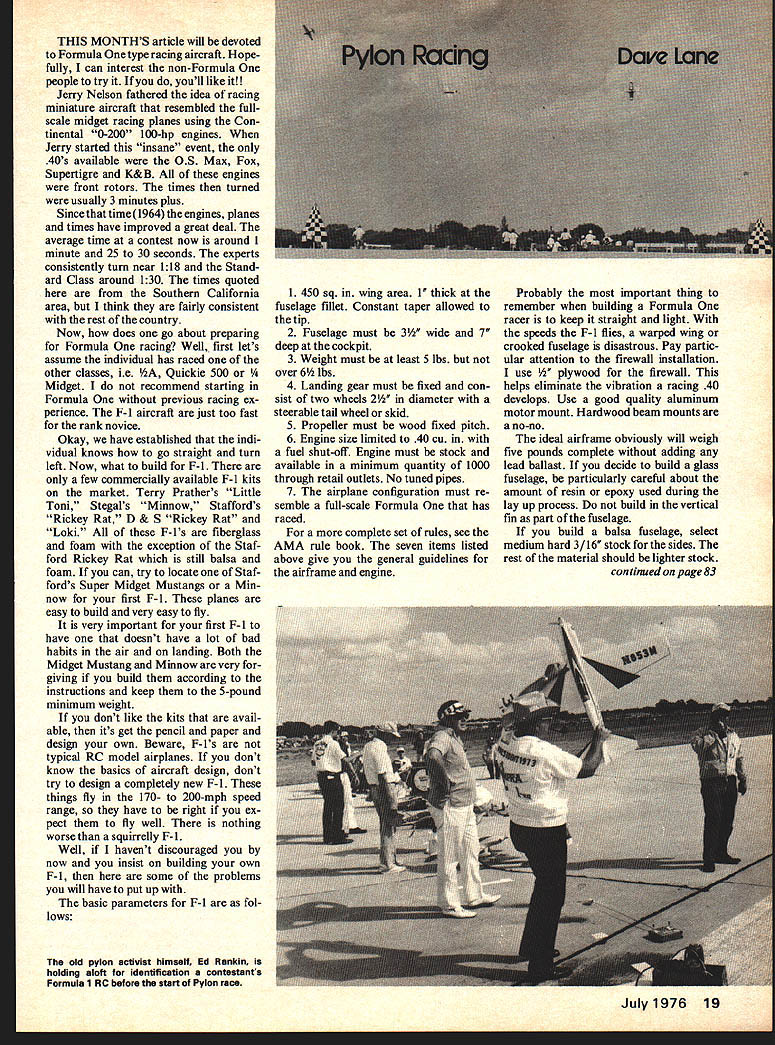
THIS MONTH'S article will be devoted to Formula One type racing aircraft. Hopefully, I can interest the non-Formula One people to try it. If you do, you'll like it!!
Jerry Nelson fathered the idea of racing miniature aircraft that resembled the full-scale midget racing planes using the Continental "0-200", 100-hp engines. When Jerry started this "insane" event, the only .40's available were the O.S., Max, Fox, Supertigre and K&B. All of these engines were front-rotor engines. The times then turned were usually 3 minutes plus.
Since that time (1964) the engines, planes and times have improved a great deal. The average time at a contest now is around 1 minute and 25 to 30 seconds. The experts consistently turn near 1:18 and the Standard Class around 1:30. The times quoted here are from the Southern California area, but I think they are fairly consistent with the rest of the country.
Now, how does one go about preparing for Formula One racing? Well, first let's assume the individual has raced one of the other classes, i.e. 1/2A, Quickie 500 or Midget. I do not recommend starting in Formula One without previous racing experience. The F-1 aircraft are just too fast for the rank novice.
Okay, we have established that the individual knows how to go straight and turn left. Now, what to build for F-1. There are only a few commercially available F-1 kits on the market. Terry Prather's "Little Toni," Stegal's "Minnow," Stafford's "Rickey Rat," D & S "Rickey Rat" and "Loki." All of these F-1's are fiberglass and foam with the exception of the Stafford Rickey Rat which is still balsa and foam. If you can, try to locate one of Stafford's Super Midget Mustangs or a Minnow for your first F-1. These planes are easy to build and very easy to fly.
It is very important for your first F-1 to have one that doesn't have a lot of bad habits in the air and on landing. Both the Midget Mustang and Minnow are very forgiving if you build them according to the instructions and keep them to the 5-pound minimum weight.
If you don't like the kits that are available, then it's the pencil and paper and design your own. Beware, F-1's are not typical RC model airplanes. If you don't know the basics of aircraft design, don't try to design a completely new F-1. These things fly in the 170- to 200-mph speed range, so they have to be right if you expect them to fly well. There is nothing worse than a squirrely F-1.
Well, if I haven't discouraged you by now and you insist on building your own F-1, then here are some of the problems you will have to put up with.
The basic parameters for F-1 are as follows:
- 450 sq. in. wing area. 1" thick at the fuselage fillet. Constant taper allowed to the tip.
- Fuselage must be 3-1/2" wide and 7" deep at the cockpit.
- Weight must be at least 5 lbs. but not over 6-1/2 lbs.
- Landing gear must be fixed and consist of two wheels 2" in diameter with a steerable tail wheel or skid.
- Propeller must be wood fixed pitch.
- Engine size limited to .40 cu. in. with a fuel shut-off. Engine must be stock and available in a minimum quantity of 1000 through retail outlets. No tuned pipes.
- The airplane configuration must resemble a full-scale Formula One that has raced.
For a more complete set of rules, see the AMA rule book. The seven items listed above give you the general guidelines for the airframe and engine.
Probably the most important thing to remember when building a Formula One racer is to keep it straight and light. With the specs the F-1 flies, a warped wing or crooked fuselage is disastrous. Pay particular attention to the firewall installation. I use 1/2" plywood for the firewall. This helps eliminate the vibration a racing .40 develops. Use a good quality aluminum motor mount. Hardwood beam mounts are a no-no.
The ideal airframe obviously will weigh five pounds complete without adding any lead ballast. If you decide to build a glass fuselage, be particularly careful about the amount of resin or epoxy used during the lay-up process. Do not build in the vertical fin as part of the fuselage.
If you build a balsa fuselage, select medium hard 3/16" stock for the sides. The rest of the material should be lighter stock. Keep the tail light by using 1/4" medium stock and sand as much away as possible and still maintain a reasonable airfoil.
The wing skins should be 3/32" medium hard to hard. Be sure to use either celastic or fiberglass tape to reinforce the wing center-section joint. Use a good contact cement on the wing skins. Be careful here that you allow the cement to dry for at least 30 minutes before attaching the wing skins to the foam core. If you put the skins on the foam before the contact cement dries, the foam will melt. Build in about 1-1/2° of wash-out in the wing tips.
Be sure that the moveable surfaces are solid (no slop in the hinges or pushrods and torque rods). Before you mount the wing, stab and engine permanently, make sure the incidence angles measure 0° to the thrust line of the fuselage.
Now comes the fun part! What engine are you going to use? Actually, you had better decide before you finish the fuselage so it will fit (small detail). You have a selection of several to choose from. Supertigre, K&B, H.P., O.S. and Fox. The most popular engines in use are the K&B and Supertigre. These engines are rear rotor, rear exhaust and Schnuerle-ported with ball bearings front and rear. They develop around 1-1/2 hp at 20,000 rpm. Use only racing fuel in these engines for break-in and racing. K&B makes a standard racing fuel with 40% nitro that works very well. Check with the local F-1 pilots in your area and ask them what fuel works the best for that locale. Humidity, temperature and altitude all have a major impact on the fuel used.
Another major item for F-1 is the prop. For openers, start with a 9D-8P Top Flite racing prop. You will probably trim the diameter down to about 8-3/4" or so. Be sure to balance the prop as precisely as possible. Another prop that seems to work well is the Rev-up series "400". Check around with the local racers and see what they are using. If there isn't anyone in your local area, just experiment with various props in the 8-1/2" to 9" D and 7" to 8-1/2" P.
A general rule of thumb that I use when trimming an F-1 is, when the plane is flying hands off, it would crash at turn one about 50 feet to the right of the pylon. This helps to keep the plane on course without fighting the controls. Remember, before your helper releases the plane for take-off, he holds about 1/2 up stick and 1/2 right rudder to keep the plane straight on take-off. Keep the control surface throws to a minimum. That's all for this month! Keep 'em flying, go fast and turn left!
(My address is: 4477 136th, Hawthorne, CA 90250.)
be enough and that simple ribbons are sufficient. They'd rather leave the trophies to the novice since just winning a meet of this type is satisfaction enough.
Fast things? Note the picture of Richard Brasher's "Motivator." That's a K&B 40 sitting up front. This plane and Tony Guest's "Shrike" were the most impressive at the Special Pro meet with speeds in excess of 120 mph on every flight. The difference was that the Supertigre on Tony's plane will break but Rich's K&B is running considerably under its design limit and doesn't even blow plugs. This time it was the horsepower machine coming out on top. Next time?
You'll notice in the picture of the winners at this meet that none of them were exactly kids. Two of them are over 30. To all the kids with quick reaction times we say "humbug," experience seemed to be more important than lightning reflexes. Also observe that Tom Zon is smoking a pipe. I was circle marshal in one match where Tom's opponent wrapped his lines around Tom's pipe and, since a pipe is to Tom as spinach is to Popeye, alas, he lost the match and his plug flamed out! I wear my watch on my right wrist and had lines caught on it once. It's not funny when it happens and points out the potential danger in getting lines caught on watches, pipes and sunglasses or worse yet, your prescription glasses.
The Combat Advisory Committee has recommended minor changes in Fast Combat but Slow Combat probably will have a very major overhaul. The main problem is that it is not slow! How to slow things down without becoming overly Mickey Mouse is the problem facing the Committee and ultimately the Contest Board, in consideration about to be given for AMA 1978-79 rules. In the latest MACA Newsletter Howard Rush claims that 120 mph is possible for a Slow Combat ship and, no doubt it would be, if you built a tight, clean ship and put the tank on the top and booby-trapped the fuselage. A fuel regulator or special venting is needed to keep the engine from going rich once you've become airborne. By restricting the uni-flow vent
Transcribed from original scans by AI. Minor OCR errors may remain.

