
Radio Control: Pylon Racing
Bill Hager
HAPPY New Year! By all indications, 1985 should be a great year for pylon racing. Quarter Midget is making a comeback, Formula One is just as strong as ever, and so is Q-500. I have also received several inquiries on FAI.
I have read many articles on props and recently received some very interesting information from a fellow flier who does very well in racing. He wishes to remain anonymous, but what he writes is so interesting that I am going to pass it on to you.
Anonymous flier's prop-testing method
Just read your article about what props you have used relative to your geographic location (January 1984 issue). In this discussion, I will use prop names and sizes only as reference points, as I am a firm believer that what works for one won't work for another, even if the planes are identical in all respects. After about two or three years of asking "Why won't this prop do the same as the one I just took off?" and being very envious of those who passed me all the time, I just sat down and started thinking of the problem and how to solve it, as a good Quality Control Manager should do. My initial thoughts were:
- Flying experience counts (if you can't fly the plane where it belongs, then why not start working on the problem there).
- Building expertise is needed (well-built planes go faster).
- The prop is very important (assuming you have a competitive engine).
Well, I spent all winter building them right and spent a lot of time practicing, and all at once things started falling in place. I had not done anything except balance and make sure the props had the same pitch on both sides. The first year's end result was about a 20-second drop in time on Q-500 and a 15-second drop in time on Formula I.
I knew then I could go faster. But I still had the problem of "Why does this prop do so much better than that one?" So, the following winter was spent making props. I had a good pitch gauge and had collected so many different props that everyone went the other way when they saw them coming. My main concentration was on props of Zinger and Rev-Up and the sizes that related to Q-500 and Formula I — and also the props that I knew did what (but not why).
The big thing was to test them. It was winter, and I wasn't about to go out in that cold to test props. Besides, what would it tell me that I couldn't find out indoors? So this is what I did. I found an electric motor from an old Singer sewing machine and used it because it had the proper shaft size. I put the prop drive of a K&B .40 on it and used a light-dimmer switch to control the rpm.
Boy, did that sucker turn the prop! The first time I put a Rev-Up 9-7 on it and turned it on, I had an instant clean basement and nothing left on the walls!
After the airflow problem was corrected (via the open-door policy), I then knew what rpm each prop would turn with respect to its actual pitch. (Note: one pitch gauge only means something to the person who uses it, as all pitch gauges are not equal.) So then I set out to plot pitch vs. rpm. Well, that didn't tell me much; at least not the next step — true balance props. If I remember right, about 20 of them. This was done, and the rpm was then checked again.
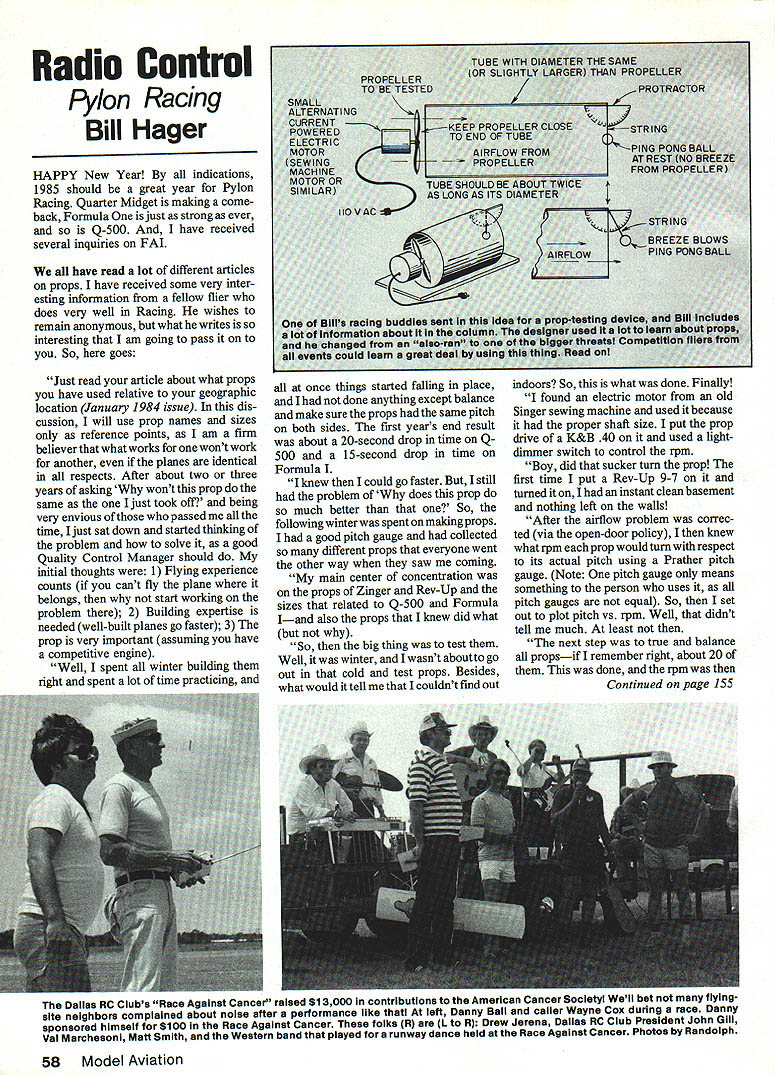
While testing props, I noticed that some seemed to have more airflow behind them than others. So I checked the pitch to see if that was it. What I found didn't seem right; a lower-pitch prop running the same rpm as a higher-pitch prop of equal diameter shouldn't have more airflow than the other. So I started thinking: how could I measure the difference without saying it's the wood? The system used was easy to make and simple to come by.
A round cardboard tube from a roll of Dupont Mylar was just right. It had a 10-inch diameter and was cut three feet long. In one end of it, a slot was cut to hold a protractor. Then, using a Ping-Pong ball (lightweight, league size), a hole was drilled in it and a thread was hot-stuffed in. The ball was then suspended from the protractor by the thread and hung down to the center of the tube. I had trouble getting the motor in the center of the tube, so I made a wooden mount, attached it to my workbench, and slid the tube up to it so the prop was even with the front of the tube.
Then I was really set to do some tests, because at a given rpm I could test the flow of the prop. Boy! Did I find out a lot!
Props that had the same diameter, the same pitch, and the same motor rpm were not even close in airflow when I checked the angle the Ping-Pong ball reached. I found as much as a 15° difference in the ball locations. I wasn't interested in the scientific explanation; I was more interested in finding a prop equal to the one I knew got low times when I raced with it.
I knew I had a strong engine, so with a little math using existing rpm vs. known engine rpm, a constant was calculated such that when a prop on the stand turned a certain rpm, I could expect a certain rpm on the engine. Later field tests proved this constant could be used.
The one thing this method taught me is that no two props are the same, and no matter how much effort you put into modifying them, it will not change them much. But the most important thing is that you will be able to identify them before you leave your workshop. Also, you will know which were the practice props and which were the "go-fast" props. These are the important items. Using this method, when you make a change you will see the result of it right then.
Take two 9-7 Rev-Up props. Both have the same rpm. Not balanced, they might have as much as a 10° difference in airflow. When checking the pitch, you may find one prop is lower on one blade than the other prop. True it up, and check the airflow. It will more than likely increase. Balance the prop and retest, and you might find more airflow, along with an increase in rpm. So now the prop that was the worst is as good as the best in rpm and airflow. After doing this to a number of props, you will begin to see a definite pattern taking place. You will soon be able to identify props of identical rpm and pitch, and they can be referenced back to that prop which makes you go fast.
I have spoken of Q-500-type props, as that seems the place to start and also where all the questions come from.
I guess what I'm trying to say is that if you have a sound base to start from, such as a prop that you know makes you go fast, then any changes in pitch, diameter, or rpm will have more meaning to you.
I have found that the guy who gets the most rpm usually wins the "tach race" and just sounds good running by himself after everyone else has finished the race.
This piece of equipment has been used on every prop I have used both in Q-500 and Formula I, and the result was my going from an "also-ran" to being "one of the ones to beat."
Sure, flying experience helps—but it isn't acquired from one weekend to the next. That's how fast the results of the prop work were noted, and it all goes back to being able to take a prop out of the box and knowing it is the closest thing to the one you had on before. Did you ever hear those guys who say, "That was the only good prop I had"—and sure enough, it was, because they just didn't go as fast the next time out. Well, I have heard it many times, and I just look in my flight box and chuckle to myself.
The list of information that can be obtained from using this device is extensive. It depends on how deeply you want to get into it, but in closing I will list a few of the things I have investigated:
- Airflow versus pitch
- Prop design differences
- Diameter versus airflow and pitch
- Prop trueness
- Thickness versus rpm and tip flutter
- Expected rpm
- "Engine going over the hill"
- Tip washout
- Practice versus racing props
- If nothing else, a better understanding of props
This is really great stuff, eh? See you next month.
Bill Hager 706 Glen Haven Dr. Conroe, TX 77385
Transcribed from original scans by AI. Minor OCR errors may remain.

