
Radio Control: Pylon Racing
Bill Hager
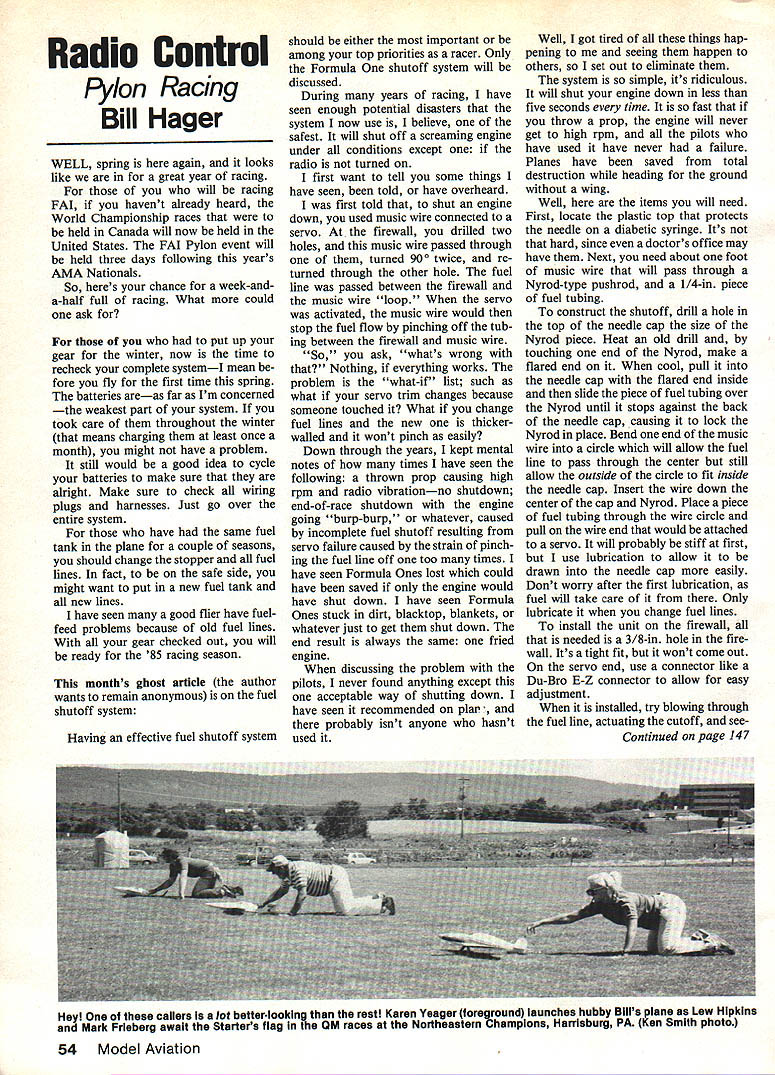
Well, spring is here again, and it looks like we are in for a great year of racing.
For those of you who will be racing FAI, if you haven't already heard, the World Championship races that were to be held in Canada will now be held in the United States. The FAI Pylon event will be held three days following this year's AMA Nationals. So, here's your chance for a week-and-a-half full of racing. What more could one ask for?
For those of you who had to put up your gear for the winter, now is the time to recheck your complete system — I mean before you fly for the first time this spring. The batteries are, as far as I'm concerned, the weakest part of your system. If you took care of them throughout the winter (that means charging them at least once a month), you might not have a problem.
It still would be a good idea to cycle your batteries to make sure that they are all right. Make sure to check all wiring, plugs and harnesses. Just go over the entire system.
For those who have had the same fuel tank in the plane for a couple of seasons, you should change the stopper and all fuel lines. In fact, to be on the safe side, you might want to put in a new fuel tank and all new lines.
I have seen many a good flier have fuel-feed problems because of old fuel lines. With all your gear checked out, you will be ready for the '85 racing season.
Fuel Shutoff System (anonymous)
Having an effective fuel shutoff system should be either the most important or be among your top priorities as a racer. Only the Formula One shutoff system will be discussed.
During many years of racing, I have seen enough potential disasters that the system I now use is, I believe, one of the safest. It will shut off a screaming engine under all conditions except one: if the radio is not turned on.
I first want to tell you some things I have seen, been told, or have overheard.
I was first told that, to shut an engine down, you used music wire connected to a servo. At the firewall you drilled two holes, and this music wire was passed through one of them, turned 90° twice, and re‑turned through the other hole. The fuel line was passed between the firewall and the music wire "loop." When the servo was activated, the music wire would then stop the fuel flow by pinching off the tubing between the firewall and music wire.
So, you ask, "What's wrong with that?" Nothing, if everything works. The problem is the "what-if" list; such as what if your servo trim changes because someone touched it? What if you change fuel lines and the new one is thicker-walled and won't pinch easily?
Down through the years, I kept mental notes of how many times I have seen the following: a thrown prop causing high rpm and radio vibration — no shutdown; end-of-race shutdown with the engine going "burp-burp," or whatever, caused by incomplete fuel shutoff resulting from servo failure caused by the strain of pinching the fuel line off one too many times. I have seen Formula Ones lost which could have been saved if only the engine would have shut down. I have seen Formula Ones stuck in dirt, blacktop, blankets, or whatever just to get them shut down. The end result is always the same: one fried engine.
When discussing the problem with the pilots, I never found anything except this one acceptable way of shutting down. I have seen it recommended on plans, and there probably isn't anyone who hasn't used it.
Well, I got tired of all these things happening to me and seeing them happen to others, so I set out to eliminate them.
The system is so simple, it's ridiculous. It will shut your engine down in less than five seconds every time. It is so fast that if you throw a prop, the engine will never get to high rpm, and all the pilots who have used it have never had a failure. Planes have been saved from total destruction while heading for the ground without a wing.
Here are the items you will need:
- The plastic top (needle cap) that protects the needle on a diabetic syringe.
- About one foot of music wire.
- A Nylrod-type pushrod.
- A 1/4-inch piece of fuel tubing.
- A Du-Bro E-Z connector (or similar) for the servo end.
Installation steps:
- Drill a hole in the top of the needle cap the size of the Nylrod piece.
- Heat an old drill and, by touching one end of the Nylrod, make a flared end on it. When cool, pull the needle cap with the flared end inside and then slide the 1/4-inch piece of fuel tubing over the Nylrod until it stops against the back of the needle cap, causing it to lock the Nylrod in place.
- Bend one end of the music wire into a circle that will allow the fuel line to pass through the center but still allow the outside of the circle to fit inside the needle cap.
- Insert the wire down the center of the cap and Nylrod. Place a piece of fuel tubing through the wire circle and pull the wire end that would be attached to the servo. It will probably be stiff at first; use lubrication to allow it to be drawn into the needle cap more easily. Only lubricate on initial installation — fuel will lubricate it after that.
- To install the unit on the firewall, drill a 3/8-inch hole in the firewall. It's a tight fit, but it won't come out. On the servo end, use a connector like a Du-Bro E-Z connector to allow for easy adjustment.
- When it is installed, try blowing through the fuel line and actuating the cutoff to see how fast it cuts the airflow off. You will find that the tubing will not need to be completely inside the hole in order to stop the airflow. Also note that there is no servo strain and, when released to a flow position, the fuel tubing "pops" out of the hole. When activated with the engine running, all you hear is one quick "burp."
One last word: install it on your fifth channel or a toggle switch. Putting this system on the control stick that is normally used for throttle and rudder will definitely cause some exciting moments — such as possible engine shutdown after you release or move your rudder stick position by mistake. This shutdown system works now — not halfway or on the end of your servo throw.
As I said before, this system was designed to eliminate problems. Why not give it a try?
If you read my columns, you are either very interested in racing, or you are already racing. So, why not support the group of people who are the heartbeat of Pylon Racing? Join the National Miniature Pylon Racing Association (NMPRA). Dues are only $13 per year for non-flying members and $18 for flying members. For information or to pay dues, write to Phil Bussell, 4803 Fallon Pl., Dallas, TX 75227.
Want to see your club get written up in this column? Why not send me information about your club's racing or about a contest? Send some black-and-white pictures, too, and I will see what I can do. (I can even use color prints!) I can't write about things I don't know exist! See you next month.
Bill Hager 706 Glenhaven Dr. Conroe, TX 77385
Transcribed from original scans by AI. Minor OCR errors may remain.

