
Radio Control: Pylon Racing
Bill Hager
ACTIVITY! I have just received a letter from Darwin Barrie of Scottsdale, Arizona. This has been an area which, for the past several years, has not had much racing, but it looks as though this is now changing. As of February 22–23, 1986 there will be a Formula One race with Darwin as CD and Biesemeyer Tool Co., Phoenix Pylon Racing Association, and The Arizona Model Aviators as sponsors. I will be waiting for the results of this one, guys.
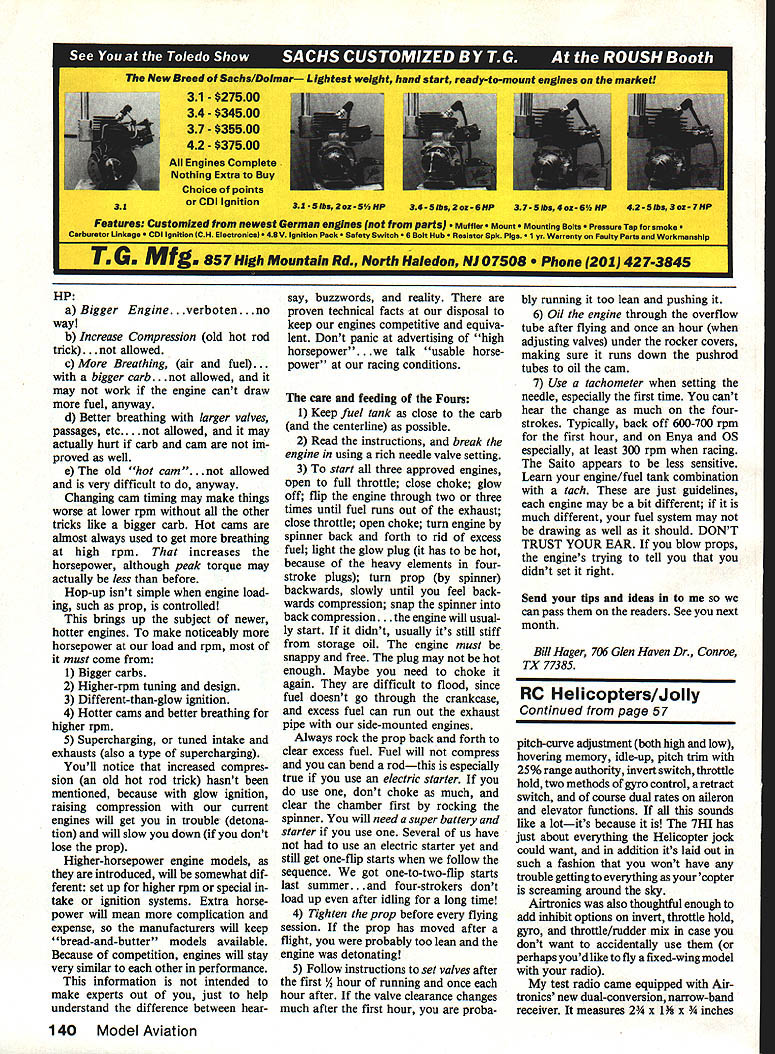
It seems as though there is an increasing amount of 1/4-scale pylon racing in the Northeast. I find that quite a few of the people I raced with while living in Ohio are now racing quarter scale, and in ’85 they started using four-stroke engines with, I might add, much success.
From the QSPRA newsletter comes the following on four-stroke engines:
FOUR-STROKING IT
There is a lot of information being published about four-strokes. We'll try to clarify technical points such as power, torque, horsepower, rpm, thrust, etc. None of these have changed their meaning compared to the two-strokes—it's just the way in which they are developed by a four-stroke that's different. If horsepower is 1.6 at 17,000 rpm, it is still 1.6 hp even if it is now being developed at only 11,000 rpm! The thing that changes is the picture—and adds to the confusion—what is being done with that HP.
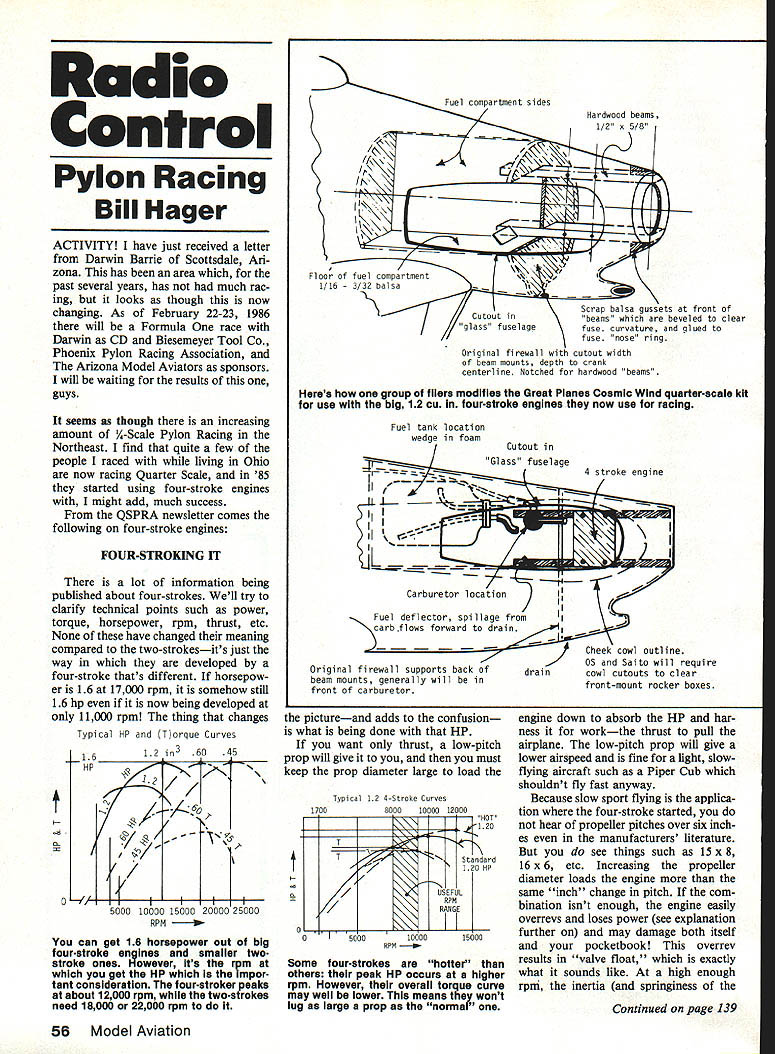
You can get 1.6 horsepower out of big four-stroke engines and smaller two-stroke ones. However, it's the rpm at which you get the HP which is the important consideration. The four-stroker peaks at about 12,000 rpm, while the two-strokes need 18,000 or 22,000 rpm to do it.
If you want only thrust, a low-pitch prop will give it to you, and then you must keep the prop diameter large to load the engine down to absorb the HP and harness it for work—the thrust to pull the airplane. The low-pitch prop will give a lower airspeed and is fine for a light, slow-flying aircraft such as a Piper Cub which shouldn't fly fast anyway.
Because slow sport flying is the application where the four-stroke started, you do not hear of propeller pitches over six inches even in the manufacturers' literature. But you do see things such as 15 x 8, 16 x 6, etc. Increasing the propeller diameter loads the engine more than the same "inch" change in pitch. If the combination isn't enough, the engine easily overrevs and loses power (see explanation further on) and may damage both itself and your pocketbook! Its overrev results in "valve float," which is exactly what it sounds like. At a high enough rpm, the inertia (and springiness) of the valve train reaches the point valves don't follow the cam and may hit the piston. A 14 x 10 prop, in its resulting rpm combination, will keep well away since engines will run from the mid 8,000s on the ground to 10,000+ in the air (diving). The three approved engines all have redlines well past 12,000 rpm.
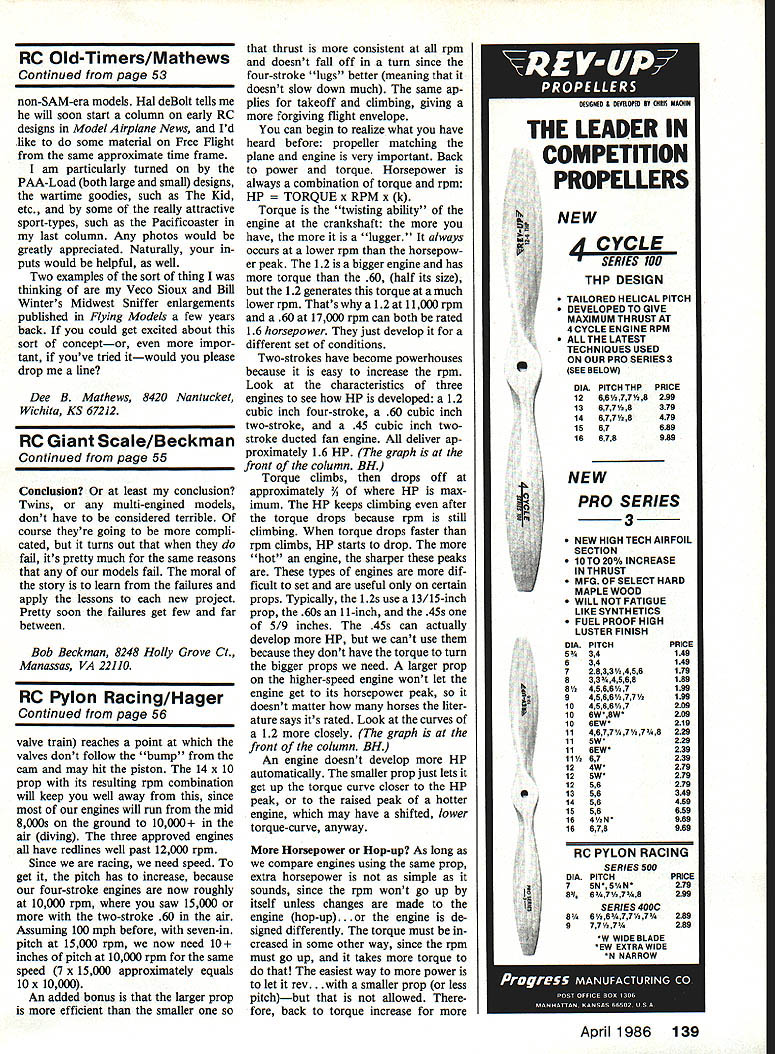
Some four-strokes are "hotter" than others: their peak HP occurs at a higher rpm. However, their overall torque curve may well be lower. This means they won't lug as large a prop as the "normal" one.
RC Pylon Racing — Hager (continued)
Since we are racing, we need speed. To get it, the pitch has to increase, because our four-stroke engines are now roughly at 10,000 rpm, where you saw 15,000 or more with the two-stroke .60 in the air. Assuming 100 mph before, with seven-inch pitch at 15,000 rpm, we now need 10-inch pitch at 10,000 rpm (7 x 15,000 approximately equals 10 x 10,000).
An added bonus is that the larger prop is more efficient than the smaller one so that thrust is more consistent at all rpm and doesn't fall off in a turn since the four-stroke "lugs" better (meaning that it doesn't slow down much). The same applies for takeoff and climbing, giving a more forgiving flight envelope.
You can begin to realize what you have heard before: propeller matching the plane and engine is very important. Back to power and torque. Horsepower is always a combination of torque and rpm: HP = TORQUE x RPM x (k).
Torque is the "twisting ability" of the engine at the crankshaft; the more you have, the more it is a "lugger." It always occurs at a lower rpm than the horsepower peak. The 1.2 is a bigger engine and has more torque than the .60 (half its size), but the 1.2 generates this torque at a much lower rpm. That's why a 1.2 at 11,000 rpm and a .60 at 17,000 rpm can both be rated 1.6 horsepower. They just develop it for a different set of conditions.
Two-strokes have become powerhouses because it is easy to increase the rpm. Look at the characteristics of three engines to see how HP is developed: a 1.2 cubic-inch four-stroke, a .60 cubic-inch two-stroke, and a .45 cubic-inch two-stroke ducted-fan engine. All deliver approximately 1.6 HP. (The graph is at the front of the column. BH.)
Torque climbs, then drops off at approximately 5/6 where HP is maximum. The HP keeps climbing even after the torque drops because rpm is still climbing. When torque drops faster than rpm climbs, HP starts to drop. The more "hot" an engine, the sharper the peak on the curve. These types of engines are more difficult to set and are useful only on certain props. Typically, the 1.2s use a 13–15 inch prop, the .60s an 11-inch, and the .45s one of 5–9 inches. The .45s can actually develop more HP, but we can't use them because they don't have the torque to turn the bigger props we need. A larger prop on the higher-speed engine won't let the engine get to its horsepower peak, so it doesn't matter how many horses the literature says it's rated. Look at the curves of a 1.2 more closely. (The graph is at the front of the column. BH.)
An engine doesn't develop more HP automatically. The smaller prop just lets it get up the torque curve closer to the HP peak, or to the raised peak of a hotter engine, which may have a shifted, lower torque curve, anyway.
More Horsepower or Hop-up? As long as we compare engines using the same prop, extra horsepower is not as simple as it sounds, since that rpm won't go up by itself unless changes are made to the engine (hop-up)... or the engine is designed differently. The torque must be increased in some other way, since the rpm must go up, and it takes more torque to do that! The easiest way to do more power is to let it rev... with a smaller prop (or less pitch)—but that is not allowed. Therefore, back to torque increase for more HP:
- Bigger engine... verboten... no way.
- Increase compression (old hot rod trick)... not allowed.
- More breathing (air and fuel) with a bigger carb... not allowed, and it may not work if the engine can't draw more fuel, anyway.
- Better breathing with larger valves, passages, etc... not allowed, and it may actually hurt if carb and cam are not improved as well.
- The old "hot cam"... not allowed and is very difficult to do, anyway.
Changing cam timing may make things worse at lower rpm without all the other tricks like a bigger carb. Hot cams are almost always used to get more breathing at high rpm. That increases the horsepower, although peak torque may actually be less than before.
Hop-up isn't simple when engine loading, such as prop, is controlled!
This brings up the subject of newer, hotter engines. To make noticeably more horsepower at our load and rpm, most of it must come from:
- Bigger carbs.
- Higher-rpm tuning and design.
- Different-than-glow ignition.
- Hotter cams and better breathing for higher rpm.
- Supercharging, or tuned intake and exhausts (also a type of supercharging).
You'll notice that increased compression (an old hot rod trick) has been mentioned, because with glow ignition, raising compression with our current engines will get you in trouble (detonation) and will slow you down (if you don't lose the prop).
Higher-horsepower engine models, as they are introduced, will be somewhat different; set up for higher rpm or special intake or ignition systems. Extra horsepower will mean more complication and expense, so the manufacturers will keep "bread-and-butter" models available. Because of competition, engines will stay very similar to each other in performance.
This information is not intended to make experts out of you, just to help understand the difference between hearsay, buzzwords, and reality. There are proven technical facts at our disposal to keep our engines competitive and equivalent. Don't panic at advertising of "high horsepower"... we talk "usable horsepower" at our racing conditions.
The care and feeding of the fours
- Keep the fuel tank as close to the carb (and the centerline) as possible.
- Read the instructions, and break the engine in using a rich needle-valve setting.
- To start all three approved engines: open to full throttle; close choke; glow off; flip the engine through two or three times until fuel runs out of the exhaust; close throttle; open choke; turn engine by spinner back and forth to rid of excess fuel; light the glow plug (it has to be hot, because of the heavy elements in four-stroke plugs); turn prop (by spinner) backwards, slowly until you feel backwards compression; snap the spinner into back compression—the engine will usually start. If it didn't, usually it's still stiff from storage oil. The engine must be snappy and free. The plug may not be hot enough. Maybe you need to choke it again. They are difficult to flood, since fuel doesn't go through the crankcase, and excess fuel can run out the exhaust pipe with our side-mounted engines.
Always rock the prop back and forth to clear excess fuel. Fuel will not compress and you can bend a rod—this is especially true if you use an electric starter. If you do use one, don't choke as much, and clear the chamber first by rocking the spinner. You will need a super battery and starter if you use one. Several of us have not had to use an electric starter yet and still get one-flip starts when we follow the sequence. We got one-to-two-flip starts last summer... and four-strokers don't load up even after idling for a long time!
- Tighten the prop before every flying session. If the prop has moved after a flight, you were probably too lean and the engine was detonating!
- Follow instructions to set valves after the first 1/2 hour of running and once each hour after. If the valve clearance changes much after the first hour, you are probably running it too lean and pushing it.
- Oil the engine through the overflow tube after flying and once an hour (when adjusting valves) under the rocker covers, making sure it runs down the pushrod tubes to the oil galley.
- Use a tachometer when setting the needle, especially the first time. You can hear the changes at each notch on the four-strokes. Typically, back off 600–700 rpm for the first hour, and on Enya and OS especially, at least 300 rpm when racing. The Saito appears to be less sensitive. Learn your engine/fuel/tank combination with a tach. These are guidelines; each engine may be a bit different. If it is much different, your fuel system may not be drawing as well as it should. DON'T TRUST YOUR EAR. If you blow props, the engine's trying to tell you that you didn't set it right.
Send your tips and ideas in to me so we can pass them on to the readers. See you next month.
Bill Hager 706 Glen Haven Dr., Conroe, TX 77385.
Transcribed from original scans by AI. Minor OCR errors may remain.

