
Radio Control: Pylon Racing
Bill Hager
As I write this, it is still snowing and very cold in most of the United States—even here in Texas. However, by the time you read this, the 1986 racing season will be just getting started, and it looks like another full year of racing is in store for us from 1/4A all the way up to Quarter Scale.
The last couple of years I have written about a race in Smyrna, Tennessee, usually put on in the early spring. These folks put on a fine race, and a lot of people from all over usually come to it. This year's race will be held April 26–27, with Quarter Midget, Formula One, and Sport Pylon. Contact Greg Doe, 407 Pony Drive, Smyrna, TN 37167 for further information.
The NMPRA is trying to put together a Q500 National Championship race for the end of the 1986 racing season. A good idea; however, as has been the case in the past, the main obstacle is that every area uses its own rules. Even though a group of NMPRA members spent over a year trying to put together a workable set of rules that everyone would use, the end result is that there are still more different sets of rules than there are days in a year. The situation seems not to matter to the majority of fliers.
There are thousands of people racing some type of Q500 racer. For the most part, all of you are happy the way things are—flying in your area or even just in your club races.
It is my opinion that a National Championship Q500 race, or having Q500 racing at the Nationals, will only add another racing event for the seasoned racer who is already traveling to pylon events for Quarter Scale, Quarter Midget, FAI, or Formula One. It won't draw new fliers.
For the most part, the average Q500 flier will not venture far from his area to compete. Much to everyone's surprise, promoting this event on a national scale may only take away from our existing, very competitive racing events.
This has already been proven in other areas. Example: on the West Coast, their Q500 racers are going almost as fast as the Formula Ones—and guess who is flying them? People who used to fly Quarter Midget and Formula One. They got tired of those events and wanted something easier. The catch is that now they have made Q500 racing in their area every bit as tough as Formula One. Yes, a newcomer can still buy a stock engine and a simple kit and come out and race—but he will get blown away by the seasoned pilot flying with blueprinted engines and special, reworked props.
Even in the Texas area there are fliers working very hard on Q500 racers for the 1986 season. No, not new fliers—I mean old-timers: Formula One and Quarter Midget fliers. As I said, Q500 is taking away from other events, not really bringing in new fliers at all.
A final note to fliers in those areas who use a tuned pipe or tuned muffler to keep the noise level down: who do you think you're kidding? Why not just use a muffler? Come on, guys, this is supposed to be a novice event. Enough of my standing on the soapbox for this month.
Letter from Al Richt (Scott Depot, WV)
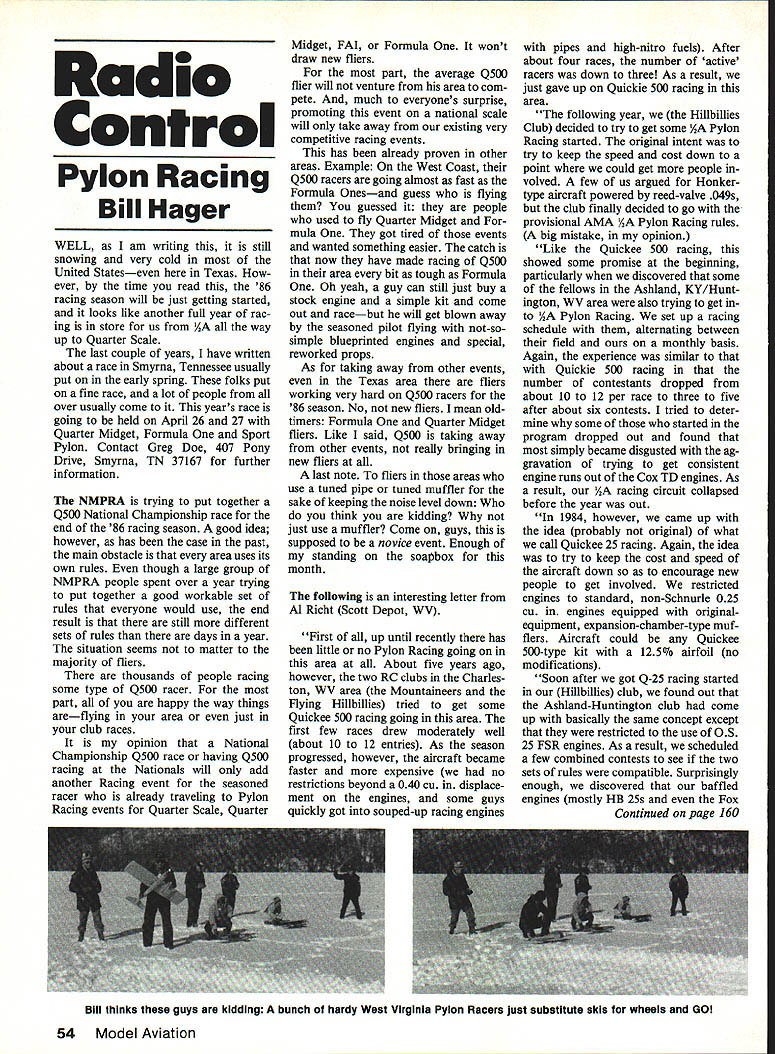
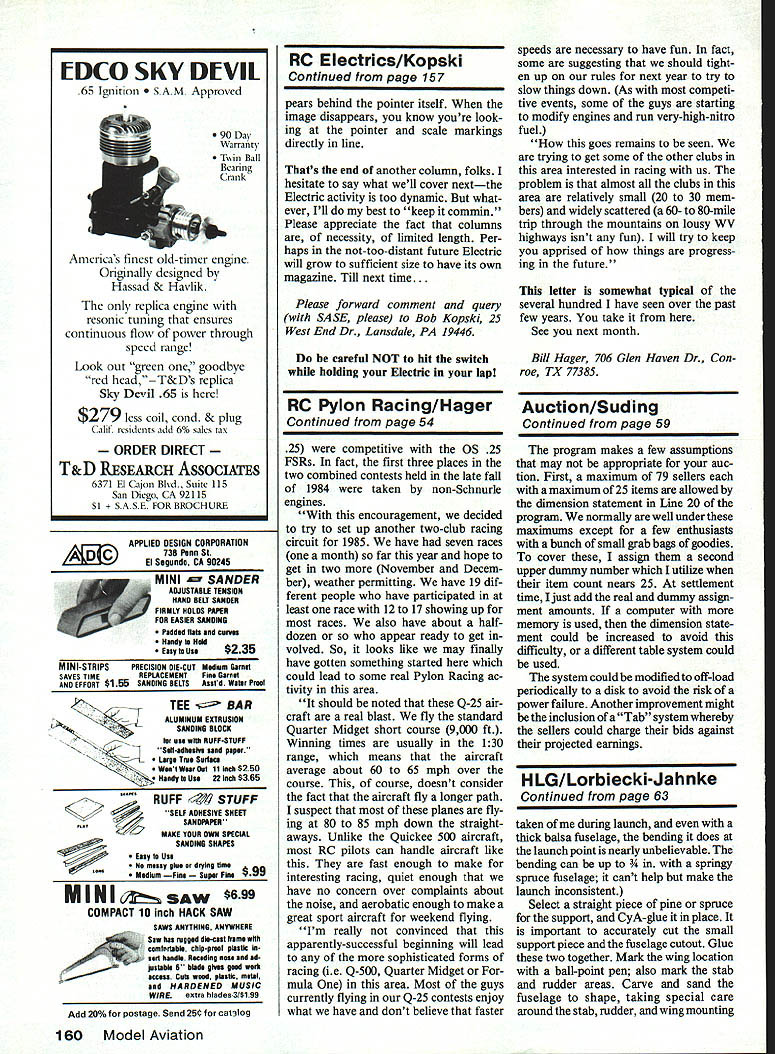
First of all, up until recently there has been little or no pylon racing going on in this area at all. About five years ago, however, the two RC clubs in the Charleston, WV area (the Mountaineers and the Flying Hillbillies) tried to get some Quickee 500 racing going in this area. The first few races drew moderately well (about 10 to 12 entries). As the season progressed, however, the aircraft became faster and more expensive (we had no restrictions beyond a 0.40 cu. in. engine displacement), and some guys quickly got into souped-up racing engines with pipes and high-nitro fuels. After about four races, the number of active racers was down to three. As a result, we just gave up on Quickee 500 racing in this area.
The following year, we (the Hillbillies Club) decided to try to get some 1/2A pylon racing started. The original intent was to try to keep the speed and cost down to a point where we could get more people involved. A few of us argued for Honker-type aircraft powered by reed-valve .049s, but the club finally decided to go with the provisional AMA 1/4A pylon racing rules (a big mistake, in my opinion).
Like the Quickee 500 racing, this showed some promise at the beginning, particularly when we discovered that some fellows in the Ashland, KY/Huntington, WV area were also trying to get 1/2A pylon racing set up. We set up a racing schedule with them alternating between their field and ours on a monthly basis. Again, the experience was similar to that with Quickee 500 racing: the number of contestants dropped off from about 10 to 12 per race to three to five after about six contests. I tried to determine why some of those who started in the program dropped out and found that most simply became disgusted with the aggravation of trying to get consistent engine runs out of the Cox TD engines. As a result, our 1/2A racing circuit collapsed before the year was out.
In 1984, however, we came up with the idea (probably not original) of what we call Quickee 25 racing. Again, the idea was to keep speed and cost down and to produce an aircraft that would be both simple and inexpensive. We restricted engines to standard non-Schnurle .025 cu. in. engines equipped with original-equipment expansion-chamber mufflers. Aircraft could be any Quickee 500-type kit with a 12.5% airfoil (no modifications).
Soon after we got Q-25 racing started in our club, we found out that the Ashland-Huntington club had come up with basically the same concept, except that they restricted engines to O.S. .25 FSRs. As a result, we scheduled a few combined contests to see if the two sets of rules were compatible. Surprisingly, our baffled engines (mostly HB .25s and even Fox .25s) were competitive with the O.S. .25 FSRs. In fact, the first three places in the two combined contests held in the late fall of 1984 were taken by non-Schnurle engines.
With this encouragement, we decided to try to set up another two-club racing circuit for 1985. We have had seven races (one a month) so far this year and hope to get in two more (November and December), weather permitting. We have 19 different people who have participated in at least one race, with 12 to 17 showing up for most races. We also have about a half-dozen who appear ready to get involved. So it looks like we may finally have something started here that could lead to real pylon racing activity in this area.
It should be noted that these Q-25 aircraft are a real blast. We fly the standard Quarter Midget short course (about 9,000 ft.). Winning times are usually in the 1:30 range, which means the aircraft average about 60 to 65 mph over the course. This, of course, doesn't consider the fact that the aircraft fly a longer path; I suspect most of these planes are flying 80 to 85 mph down the straightaways. Unlike the Quickee 500 aircraft, most RC pilots can handle aircraft like this. They are fast enough to make for interesting racing, quiet enough that we have no concern over complaints about noise, and aerobatic enough to make a great sport aircraft for weekend flying.
I'm really not convinced that this apparently successful beginning will lead to any of the more sophisticated forms of racing (i.e., Q-500, Quarter Midget, or Formula One) in this area. Most of the guys currently flying in our Q-25 contests enjoy what we have and don't believe faster speeds are necessary to have fun. In fact, some are suggesting we should tighten up our rules for next year to try to slow things down. (As with most competitive events, some of the guys are starting to modify engines and run very-high-nitro fuel.)
How this goes remains to be seen. We are trying to get some of the other clubs in this area interested in racing with us. The problem is that almost all the clubs in this area are relatively small (20 to 30 members) and widely scattered (a 60- to 80-mile trip through the mountains or a lousy West Virginia highway isn't any fun). I will try to keep you apprised of how things are progressing in the future.
This letter is somewhat typical of the several hundred I have seen over the past few years. You have it from here.
See you next month.
Bill Hager 706 Glen Haven Dr. Conroe, TX 77385
Transcribed from original scans by AI. Minor OCR errors may remain.

