
Radio Control: Pylon Racing
Bill Hager
Roots
From time to time I receive letters asking about pylon racing. So, let's look back to the beginning and see what radio control (RC) pylon racing is all about.
The urge to race dates back to early civilization, with foot and chariot races held during the Greek and Roman periods. The risk, excitement, and challenge of racing are basic to human nature. Racing appeals to many because it offers an objective method of determining the winner — first to cross the finish line or the shortest elapsed time from start to finish. There is little subjectivity in judging the outcome of a race. Presently, we enjoy races involving boats, automobiles, horses, and even turtles. Just about anything that moves can be used in a race.
Races involving aircraft began shortly after the advent of powered flight by the Wright brothers. Likewise, racing soon started in model aviation — first with rubber-powered free-flight planes and later with control-line team and Rat Race events. The ability to precisely control a model in three dimensions provided the impetus for RC pylon racing as we know it today. In fact, the first suggestion of RC pylon racing was made at the 1948 Nationals at Olathe, KS. The initial rules were presented to the AMA RC Committee in 1956. The first AMA pylon event was flown in 1957 and won by Howard Bonner with a semi-scale Bonzo. Two years later a finalized version of the rules was adopted by the AMA, and RC pylon racing was born.
Early pylon racing was flown over a two-pylon course with the pilot standing in the middle. The planes flew one at a time. The winner was determined by the plane posting the shortest elapsed time, which was calculated to the highest speed. (This was actually "closed-course speed" rather than a true "racing" event.) This early form of pylon racing had no aircraft design restrictions, and low-drag flying-wing or delta models dominated the event.
In the mid-1960s there was a strong feeling to race scale-type aircraft, similar to the full-size Goodyear midget racers flown in the late 1940s, simultaneously over a triangle-shaped course. Originally flown as an exhibition at the 1965 and 1966 Nationals, the "Goodyear" model event became official at the 1967 Nats in Los Angeles. It soon became very popular, and current RC pylon racing has developed into five classes or events separated by aircraft requirements, engine specifications, fuel restrictions, and course length.
The five AMA RC pylon racing events are Formula 1, Quarter Midget, FAI, Sport, and Half-A, with the specific rules for each printed in the AMA Official Model Aircraft Regulations book. Quickie 500, or Formula 500 as it is sometimes called, is a popular variation of Sport Pylon and has largely replaced that event. Formula 1, FAI, and Quarter Midget retain the scalelike aircraft requirement.
How RC Pylon Racing is flown
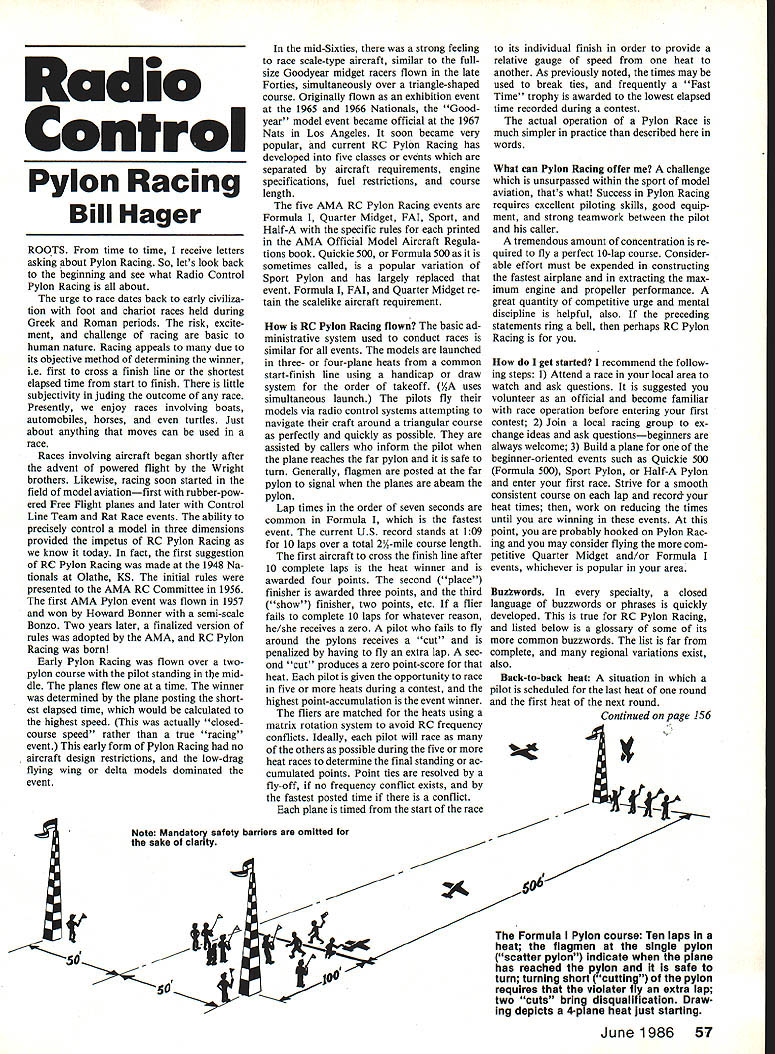
The basic administrative system used to conduct races is similar for all events. The models are launched in three- or four-plane heats from a common start-finish line using a handicap or draw system for the order of takeoff. (FAI uses simultaneous launch.) The pilots fly their models via radio control, attempting to navigate their craft around a triangular course as perfectly and quickly as possible. They are assisted by callers who inform the pilot when the plane reaches the far pylon and it is safe to turn. Generally, flagmen are posted at the far pylon to signal when the planes are abeam the pylon.
Lap times in the order of seven seconds are common in Formula 1, which is the fastest event. The current U.S. record stands at 1:09 for 10 laps over a total 2 1/2-mile course length. The first aircraft to cross the finish line after 10 complete laps is the heat winner and is awarded four points. The second-place finisher receives three points, the third ("show") finisher two points, etc. If a flier fails to complete 10 laps for whatever reason, he or she receives zero. A pilot who fails to fly around the pylons receives a "cut" and is penalized by having to fly an extra lap. A second "cut" produces a zero-point score for that heat. Each pilot is given the opportunity to race in five heats during a contest, and the highest point accumulation in the event is the winner.
Fliers are matched for the heats using a matrix rotation system to avoid RC frequency conflicts. Ideally, each pilot will race as many of the others as possible during the five heat races to determine final standings and accumulated points. Point ties are resolved by a fly-off if no frequency conflict exists, or by the fastest posted time if there is a conflict.
Each plane is timed from the start of the race to its individual finish to provide a relative gauge of speed from one heat to another. As noted, the times may be used to break ties, and frequently a "Fast Time" trophy is awarded to the lowest elapsed time recorded during a contest.
The actual operation of a pylon race is much simpler in practice than it may seem when described in words.
What pylon racing offers
Pylon racing offers a challenge unsurpassed within the sport of model aviation. Success requires excellent piloting skills, good equipment, and strong teamwork between the pilot and his or her caller.
A tremendous amount of concentration is required to fly a perfect 10-lap course. Considerable effort must be expended in constructing the fastest airplane and in extracting maximum engine and propeller performance. A great quantity of competitive urge and mental discipline is helpful as well. If the preceding statements ring a bell, then perhaps RC pylon racing is for you.
How to get started
- Attend a race in your local area to watch and ask questions. It is suggested you volunteer as an official and become familiar with the operation before entering your first contest.
- Join a local racing group to exchange ideas and ask questions — beginners are always welcome.
- Build a plane for one of the beginner-centered events such as Quickie 500 (Formula 500), Sport Pylon, or Half-A Pylon and enter your first race. Strive for a smooth, consistent course on each lap and record your heat times; then work on reducing the times until you are winning in the class events. At this point you are probably hooked on pylon racing and may consider flying the more competitive Quarter Midget and/or Formula events, whichever is popular in your area.
Buzzwords
Back-to-back heat
A situation in which a pilot is scheduled for the last heat of one round and the first heat of the next round.
Cut judge
A course official tasked with determining when planes turn inside the pylon and thus receive a "cut."
Double-cut
A frequent cause of a zero-point score, in which a pilot cuts two pylons in succession. Also termed "two-cut."
Freebie
A heat in which a lone pilot is scheduled due to frequency conflicts and/or scratches by other contestants.
Goose-eggs
The dreaded zero-point score, which may be obtained for an infinite number of reasons.
Grudge race
A heat between two equally matched pilots with a long-term rivalry.
Handicap judging
The judging of Formula 1 aircraft for scale fidelity, workmanship, and appearance to determine the order of takeoff.
Lap-counter
A course official who counts the laps and generally displays this information to the pilot/caller via flip cards. Accumulated times are also displayed; one lap-counter is assigned to each pilot.
Matrix
A system of matching pilots into heat races by radio frequency. The heat makeup is rotated from round to round.
Racehorse start
A starting procedure in which all planes are launched simultaneously.
Ready box
An area located outside the safety zone in which the pilots and planes are assembled into heats. The fueling/defueling station is located here for events using a standard fuel mixture.
Safety zone
A zone around the pylon course in which no personnel are permitted during the conduct of a race. The distances for different events are prescribed in the AMA rule book.
Safety inspection
A mandatory aircraft inspection to check for proper radio installation and structural integrity.
Starter
The most important course official who flags the start and determines the finish order of every heat. The starter also coordinates all actions on the pylon course, including safety.
Trick
Any advantage, real or imagined, derived from a special prop shape, fuel ingredient, aircraft design, engine rework, etc.
Turkey
Self-explanatory.
What is the NMPRA?
The National Miniature Pylon Racing Association (NMPRA) is a special-interest group composed of RC pylon racing enthusiasts throughout the U.S., Canada, and Mexico. The organization is dedicated to the promotion and betterment of RC pylon racing. It dates back to 1965 when the first set of Goodyear (now Formula I) racing rules were proposed.
The NMPRA works with the Academy of Model Aeronautics to formulate rules and regulations governing the flying of radio-controlled miniature pylon racers. It also organizes and sponsors annual championship races in both the Quarter Midget and Formula I classes. In addition, the NMPRA maintains accumulated point standings for each member flying these events in sanctioned contests and awards trophies and district prizes to the Top Ten Formula I and Quarter Midget champions.
The NMPRA publishes a monthly News Release that disseminates racing information including race schedules, race reports, product reviews, rule proposals, and technical discussions. Selected classified advertisements are also printed to serve the special needs of the pylon racer.
The NMPRA annually elects officers by popular ballot for the positions of President, Quarter Midget Executive Vice-President, regional Vice-Presidents, and Associate Vice-Presidents for the Formula I and Quarter Midget classes, respectively. There are seven regional districts in the U.S. and Canada, each with a Vice-President and Associate Vice-President. These district officers promote pylon racing, report district events, and maintain point standings for each member. Each Vice-President also recommends the top 20% of Formula I point standees in his district to qualify for the annual Formula I Championship Race. Presently there are no qualifications for the Quarter Midget Championship Race.
If you are interested in pylon racing, I recommend you join the NMPRA. Membership is open to all AMA members. Nominal dues are U.S. $22 and include the monthly News Release subscription, an embroidered patch, and a membership card. An individual racing number and area letter code are assigned to each member so he or she may identify racing aircraft accordingly. Dues for non-U.S. members are $25 per year. To join the NMPRA, send dues to:
Bruce Richmond 18816 Belbrook Ln. Dallas, TX 75252
See you at the races.
Bill Hager 706 Glen Haven Dr. Conroe, TX 77385
Transcribed from original scans by AI. Minor OCR errors may remain.

