
Radio Control: Pylon Racing
By Bill Hager
Slip-It — a new lubricant
I just received a sample of a new product called Slip-It. It claims to be a space-age, permanent lubricant. This is not a product review column, but when something new comes up that I think will help the pylon racer, I try to pass it on.
Slip-It is a clear liquid that looks like water. When applied to a bearing surface or hinge, it really works. It slicks up a surface — somewhat like Teflon — and appears to be long-lasting. I was finishing a Q500 and, before installing the hinges, put a very small amount at the hinge. It helped keep the epoxy from sticking and improved the hinge operation. It looks as though it will have many uses in reducing friction.
Phoenix Formula One Classic (February 22–23, 1986)
On February 22 and 23, 1986, the Phoenix Pylon Racing Association, in conjunction with the Arizona Model Aviators and Bresemeyer Manufacturing Company, held the first-ever Phoenix F-1 Classic. This was the first F-1 race in Arizona since the mid-seventies and the first in the Phoenix area.
The Phoenix Pylon Racing Association (PPRA) is a chartered AMA club made up of pylon enthusiasts in the Phoenix metro area. The PPRA is primarily concerned with Q-500 racing and is part of the California circuit.
On Friday, February 21, many fliers began arriving to test-fly and acquaint themselves with the field. The Arizona Model Aviators' field in Mesa, AZ (a suburb of Phoenix) was the site of the recent International Scale Masters meet. The field features a main runway 600 x 85 feet and an auxiliary runway 400 x 85 feet. I heard comments like, "I'm not sure if I can fly on this field — I'm not used to so much space," and "I've never been to such an open field where the hotel is less than 10 minutes away." The only real obstacles are large saguaro cacti in the adjoining desert which must be considered on overextended landing approaches. They were not a factor for this event, although the saguaros did reach up and damage a couple planes at the Scale Masters.
After three course moves, a final course was developed which proved excellent. The course was at an angle to the main runway and allowed the entire main runway to be used for landing. Saturday dawned bright and clear with cool temperatures and visibility estimated at 75 miles. A light breeze prevailed most of the day. At the end of registration, 25 fliers had committed to fly. The frequencies were very scattered and allowed an excellent matrix. Duplication was unavoidable in nine of the rounds, but only one incident of two fliers meeting three times occurred.
Scale judging took place and flying began at 11:15 a.m. on Saturday. Dave Shadel won Best Show with Kaze. It is interesting to see the reactions of local modelers who have never seen an F-1 racer — they are amazed at the finishes on these models and the professional approach the modelers take to the hobby.
Four rounds were flown Saturday. Dave Shadel set the pace early with a fast round time of 1:12.27. Several excellent heats took place in the first two rounds. Cuts took their toll and negated many efforts. There was only one major crash on Saturday and one ground collision. Gary Parise of California suffered a scorched fuselage and a melted pilot figure when his plane caught fire after breaking the prop on takeoff and going off into the brush. Gary got the fire out with only moderate damage. (Two months later this could easily have developed into a brush fire.)
Sunday was warm and calm. Flying began at 9:00 a.m. At the end of Saturday's four rounds, Henry Bartle, Lyle Larson, Richard Oliver and Dave Shadel held perfect scores. Since Bartle, Larson and Shadel were all on channel RC56, it looked as if it was going to be Oliver against each of them, one at a time. Several other fliers had a chance at Shadel, but his consistency and perfect flying kept him unchallenged at this meet. The real battle was for second place.
Oliver had the best shot at Shadel but ran his engine too rich. Oliver then flew against Larson in consecutive rounds; they were closely matched. Larson cut out in the first heat and blew a plug the next round, leaving Oliver clear to cruise to second. Bartle finished next in third.
Bartle and Oliver were to meet in round nine. A finish by Oliver would have secured an easy second. Oliver was clearly faster, but his plane suddenly became uncontrollable, spun, and Bartle cruised in, setting up a flyoff for second and third with Oliver. It's too bad Bartle and Shadel were on the same frequency — with the luck he was having, I think Bartle could have beaten Dave. Four out of five rounds Bartle dodged bullets to take heats. For example, Bartle got off rich and could see his flight path two laps later. An easy 140 heat didn't matter — everybody else cut twice and was disqualified.
The flyoff was set. Oliver had his backup in fine condition and Bartle was waiting for another stroke of luck. He got it: on lap four Oliver's crankshaft broke threads.
Standings
- Dave Shadel — Plane: Kaze; Engine: X-40; Radio: Kraft
- Henry Bartle — Plane: Tony; Engine: X-40; Radio: Airtronics
- Richard Oliver — Plane: Tony; Engine: X-40; Radio: Airtronics
- Scott Manning — Plane: Tony; Engine: X-40; Radio: Airtronics
- Lyle Larson — Plane: Tony; Engine: X-40; Radio: Airtronics
- Ted Burns — Plane: Tony; Engine: X-40; Radio: JR/Novak
- Paul Stenberg — Plane: Denight; Engine: X-40; Radio: K&B
Also attending the meet were Gary Heithold (Springdale, AR) and Ron Mendel (Salt Lake City, UT). We hope for increased attendance next year. Fliers from cold, far-away places are more than welcome and will have an enjoyable time here — especially you Texans, to keep the rivalry going.
Thanks to all who made this a success and to sponsors Bill Bresemeyer Tool Co. and Paul Stenberg of Paul's Flying Stuff. It's good to see this area start racing again.
Oregon pylon racing — one-design Super Sport program
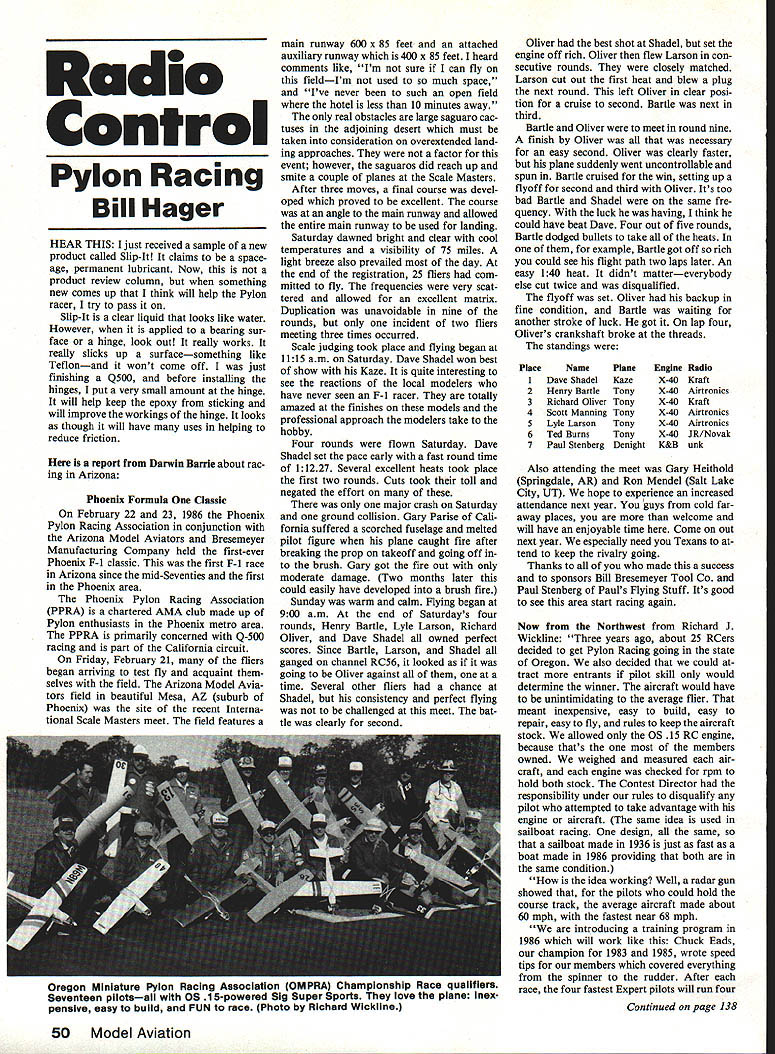
Three years ago about 25 RCers decided to get pylon racing going in the state of Oregon. We also decided that we could attract more entrants if pilot skill alone would determine the winner. The aircraft would have to be inexpensive, easy to build, easy to repair, easy to fly, and rules would keep the aircraft stock. We allowed only the OS .15 RC engine because most members owned that engine. We weighed and measured each aircraft, and each engine was checked for rpm to ensure it was stock. The Contest Director has the responsibility under our rules to disqualify any pilot who attempts to take advantage with his engine or aircraft. (The same idea is used in sailboat racing: one design, all the same, so that a sailboat made in 1936 is just as fast as one made in 1986, providing both are in the same condition.)
How is the idea working? A radar gun showed that, for pilots who could hold the course track, the average aircraft made about 60 mph, with the fastest near 68 mph.
We are introducing a training program in 1986 which will work like this: Chuck Eads, our champion for 1983 and 1985, wrote speed tips for our members which covered everything from the spinner to the rudder. After each race, the four fastest Expert pilots will run four Standard-class pilots' aircraft to get the best time possible. Then the Standard-class pilot will run his best time with the Expert pilot coaching. The training and published results will prove we are stock and that pilot skill determines the winner.
Compare the above with other pylon events where you have over $200 in the engine and aircraft. Our engine and aircraft cost less than $100. Our speeds are over two minutes per heat, against theirs at a little over one minute. That means repairs — of which we have had several — are simpler and our aircraft just keep on flying. We found one club that had built some 20 Formula S-500s, but only two were in flying condition for the first race. The Formula 500 is a trainer!
Championships and results
The third-year Championships was held in September 1985 at Corvallis, OR. Seventeen pilots of the Expert and Standard class had qualified for the Championships. We set aside money from each race and, with the championship fees, nearly $1,000 in prizes awaited the best pilots. The weather was great!
Five rounds later, Chuck Eads (Roseburg, OR) won the Championships with 20 points. Jim Trump took second place, and David Denison took third. Only one second separated Jim's and David's average times for five races. The Standard class was won by David Schrum, with Leo Barker second and Glen Miller third. The Championship is determined using a pilot's two best wins in the circuit races added to the Championship race.
The 1986 OMPRA winner was again Chuck Eads; second place was Jim Trump. Third place went to Buddy Schesinger, who barely beat David Denison. Standard class saw Glen Miller first, David Schrum second, and Leo Barker third.
Presentations were made so Chuck Eads could race in Washington the next day. We all headed for a good dinner, R and R, and camaraderie. Who will win the Super Sport race next year? Yes! All this around the simple, unintimidating, easy-to-fly Sig Super Sport. From out of the grass comes the flashing pylon heats of the great Sig Super Sport!
What about your area? Putting on a pylon race is easy and a good way for your local club to make some extra money. I will write more on this in a future article. Send me pictures and results of your contest and I will see what I can do to get them in this column.
See you next month!
Bill Hager 706 Glen Haven Dr. Conroe, TX 77385
Transcribed from original scans by AI. Minor OCR errors may remain.

