
Radio Control: Pylon Racing
Bill Hager
For some reason, the Supertigre X-40 pylon racing engine has been a little hard to come by lately—especially for newcomers to racing who don't yet know all the ropes. No one is trying to keep it a secret; here are some sources.
Suppliers
- Ritch's Hobbies
4104 Lark Lane, Houston, TX 77025 Phone: (713) 661-5458 (They carry new, stock Supertigre X-40 engines, a complete line of kits, and racing supplies.)
- Performance Specialties (Dave Shadel)
P.O. Box 4003, Carlsbad, CA 92008 Phone: (619) 729-1658 (Dave Shadel builds ready-to-race custom engines, carries accessories, and will custom-build a Formula One racer.)
Contest Reports
UPRC (United Pylon Racing Circuit) — report by Ernie Nikodem
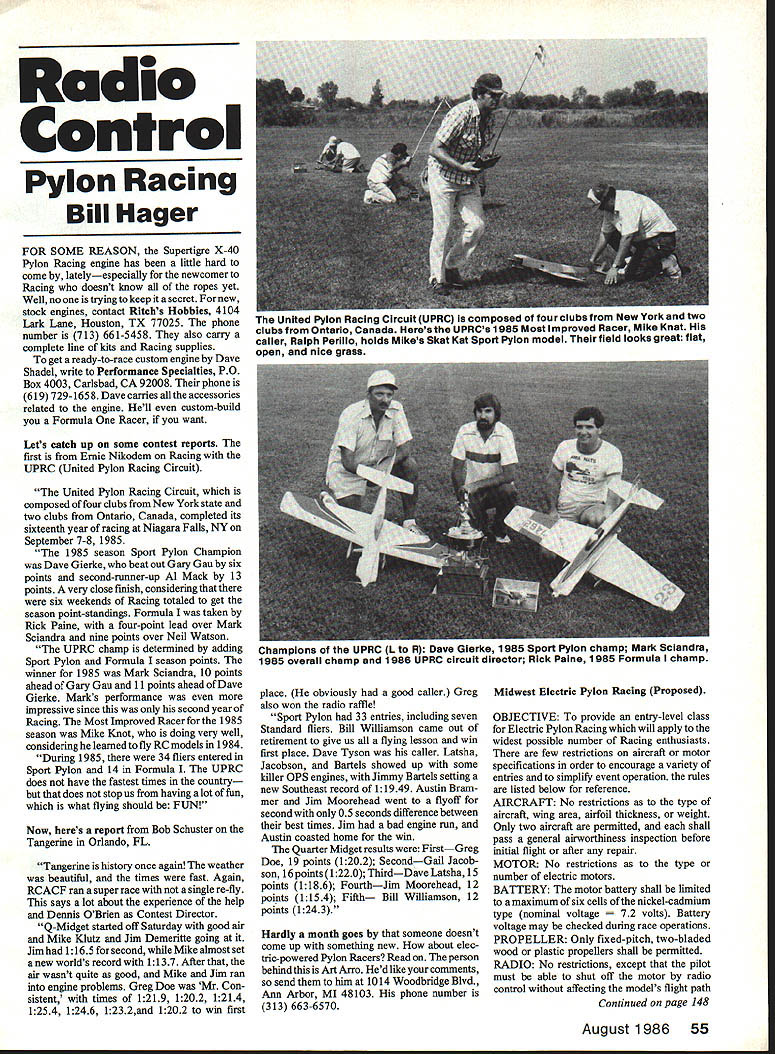
The United Pylon Racing Circuit, composed of four clubs from New York state and two clubs from Ontario, Canada, completed its sixteenth year of racing at Niagara Falls, NY on September 7–8, 1985.
- Sport Pylon Champion (1985): Dave Gierke — beat Gary Gau by six points; Al Mack was third, 13 points behind.
- Formula I Champion: Rick Paine — four points ahead of Mark Sciandra; nine points ahead of Neil Watson.
- Overall UPRC Champion (Sport Pylon + Formula I season points): Mark Sciandra — 10 points ahead of Gary Gau and 11 points ahead of Dave Gierke. This was Mark's second year of racing.
- Most Improved Racer (1985): Mike Knat — notable progress after learning to fly RC models in 1984.
- Participation (1985): 34 fliers in Sport Pylon; 14 in Formula I.
Note: The UPRC may not have the fastest times in the country, but the emphasis is on having fun — which is what flying should be.
Tangerine (Orlando, FL) — report by Bob Schuster
Tangerine is history once again! The weather was beautiful, and the times were fast. RCACF ran a super race with a single re-fly.
Q-Midget started off Saturday with good air. Mike Klutz and Jim Demeritte went at it. Jim posted 1:16.5; Mike nearly set a new world record with 1:13.7. After that the air wasn't quite as good and both ran into engine problems. Greg Doe, Mr. Consistent, posted times of 1:21.9, 1:20.2, 1:21.4, 1:25.4, 1:24.6, 1:23.2, and 1:20.2 to win first place. Greg, obviously a good caller, also won the radio raffle.
Sport Pylon had 33 entries, including seven Standard fliers. Bill Williamson came out of retirement to win first place and give everyone a flying lesson. Dave Tyson was caller. Latsha Jacobson and Jimmy Bartels showed up with some killer OPS engines; Jimmy Bartels set a new Southeast record of 1:19.49. Austin Brammer and Jim Moorehead went to a flyoff for second with only 0.5 seconds difference between their best times. Jim had a bad engine run, and Austin coasted home for the win.
Quarter Midget results:
- Greg Doe — 19 points (1:20.2)
- Gall Jacobson — 16 points (1:22.0)
- Dave Latsha — 15 points (1:18.6)
- Jim Moorehead — 12 points (1:15.4)
- Bill Williamson — 12 points (1:24.3)
Midwest Electric Pylon Racing (Proposed) — Art Arro
Art Arro is proposing an entry-level class for electric pylon racing. He welcomes comments: 1014 Woodbridge Blvd., Ann Arbor, MI 48103. Phone: (313) 663-6570.
Objective
To provide an entry-level class for electric pylon racing applicable to the widest possible number of racing enthusiasts. Few restrictions on aircraft or motor specifications are included to encourage variety and simplify event operation. The rules below are a first cut and subject to change based on feedback.
Aircraft
- No restrictions as to type of aircraft, wing area, airfoil, thickness, or weight.
- Only two aircraft are permitted per entrant.
- Each aircraft must pass a general airworthiness inspection before initial flight and after any repair.
Motor
- No restrictions as to the type or number of electric motors.
Battery
- Motor battery limited to a maximum of six cells of the nickel-cadmium type (nominal voltage = 7.2 volts).
- Battery voltage may be checked during race operations.
Propeller
- Only fixed-pitch, two-bladed wood or plastic propellers are permitted.
Radio
- No restrictions, except the pilot must be able to shut off the motor by radio control without affecting the model's flight path (i.e., separate channel for motor cutoff).
Race Procedures / Scoring
- As specified in current rules for Formula I, except:
- Course length: Q-M Short Course layout (1.705 miles for 10 laps).
- Each race is started by simultaneous hand-launch.
Note
- The six-cell (7.2 V) battery size was chosen to permit fast charging from a 12 V source and to help equalize performance differences between various motors.
- The goal is to standardize to seven cells (8.4 V) as similar events are flown in other regions; this is subject to change.
Recommended Equipment
- Aircraft (kits):
- Barbarian, Hummingbird (J.M. GlasCraft)
- Lightning (Electric Motor Design)
- Fast Eddy (Hobby-Horse)
- Wasp (Leisure Electronics)
- Oh-My-Gosh (Model Builder plans)
- Motors:
- Challenger .05, Super Ferrite .05 (Astro Flight)
- LT50 Competition Wind (Leisure Electronics)
- Batteries:
- Sanyo or SR
The rules were drafted to permit a wide variety of motors and aircraft types. The response and event entries will determine the final version. Please take a few minutes to read the rules and submit comments.
Notes
Don't forget this year's Nats at Lake Charles, LA — historically a perfect site.
Next month I'll have some helpful tips to improve your flying. See you then.
Bill Hager 706 Glen Haven Dr., Conroe, TX 77385.
Transcribed from original scans by AI. Minor OCR errors may remain.

