
Radio Control
Pylon Racing
Bill Hager
I want to report that I just got back from a race in Dallas, TX, which was put on by the Dallas RC Club. This group has not lost its touch, as proven by the two days of fine racing that we all enjoyed. There were 28 entries in Formula I. Thanks, guys, for a great one!
Fred French got it all together for this one, followed by Bruce Richmond, Bruce Hobbs, Chris Stubbs, Terry Rollins, and Richard Oliver. Ed Rankin flew his fastest time ever of 1:13.04 for the meet's Fast Time.
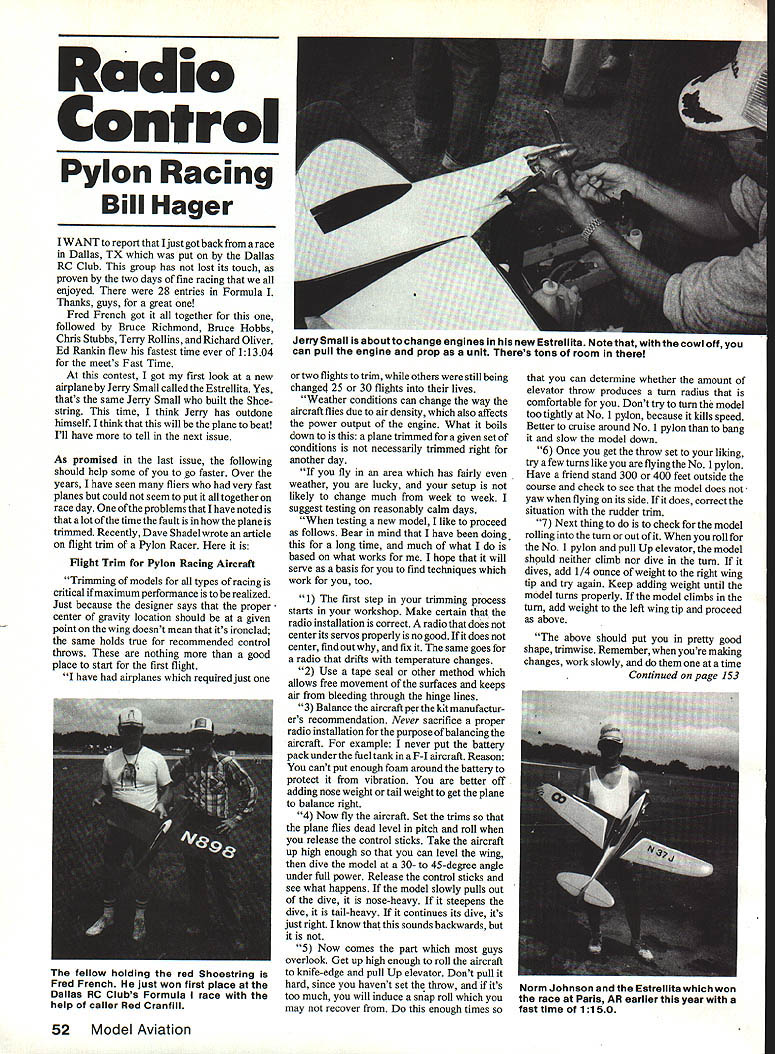
At this contest, I got my first look at a new airplane by Jerry Small called the Estrellita. Yes, that's the same Jerry Small who built the Shoestring. This time, I think Jerry has outdone himself. I think that this will be the plane to beat! I'll have more to tell in the next issue.
As promised in the last issue, the following should help some of you to go faster. Over the years, I have seen many fliers who had very fast planes but could not seem to put it all together on race day. One of the problems that I have noted is that a lot of the time the fault is in how the plane is trimmed. Recently, Dave Shadel wrote an article on flight trim of a Pylon Racer. Here it is:
Flight Trim for Pylon Racing Aircraft
Trimming of models for all types of racing is critical if maximum performance is to be realized. Just because the designer says that the proper center of gravity location should be at a given point on the wing doesn't mean that it's ironclad; the same holds true for recommended control throws. These are nothing more than a good place to start for the first flight.
I have had airplanes which required just one or two flights to trim, while others were still being changed 25 or 30 flights into their lives.
Weather conditions can change the way the aircraft flies due to air density, which also affects the power output of the engine. What it boils down to is: a plane trimmed for a given set of conditions is not necessarily trimmed right for another day.
If you fly in an area which has fairly even weather, you are lucky, and your setup is not likely to change much from week to week. I suggest testing on reasonably calm days.
When testing a new model, I like to proceed as follows. Bear in mind that I have been doing this for a long time, and much of what I do is based on what works for me. I hope that it will serve as a basis for you to find techniques which work for you, too.
- The first step in your trimming process starts in your workshop. Make certain that the radio installation is correct. A radio that does not center its servos properly is no good. If it does not center, find out why, and fix it. The same goes for a radio that drifts with temperature changes.
- Use a tape seal or other method which allows free movement of the surfaces and keeps air from bleeding through the hinge lines.
- Balance the aircraft per the kit manufacturer's recommendation. Never sacrifice a proper radio installation for the purpose of balancing the aircraft. For example: I never put the battery pack under the fuel tank in a F-1 aircraft. Reason: you can't put enough foam around the battery to protect it from vibration. You are better off adding nose weight or tail weight to get the plane to balance right.
- Now fly the aircraft. Set the trims so that the plane flies dead level in pitch and roll when you release the control sticks. Take the aircraft up high enough so that you can level the wing, then drive the model at a 30- to 45-degree angle under full power. Release the control sticks and see what happens. If the model slowly pulls out of the dive, it is nose-heavy. If it steepens the dive, it is tail-heavy. It is just right when it holds the same attitude. I know that this sounds backwards, but it is not.
- Now comes the part which most guys overlook. Get up high enough to roll the aircraft to knife-edge and then pull up elevator. Don't pull hard, since you haven't set the throw, and if it's too much you will induce a snap roll which you may not recover from. Do this enough times so that you can determine whether the amount of elevator throw produces a turn radius that is comfortable for you. Don't try to turn the model too tightly at No. 1 pylon, because it kills speed. Better to cruise around No. 1 pylon than to bang slow into it and slow the model down.
- Once you get the throw set to your liking, try a few turns like flying No. 1 pylon. Have a friend stand 300 or 400 feet outside the course and check to see that the model does not yaw when flying on its side. If it does, correct the situation with the rudder trim.
- Next thing to check is the model rolling out of the turn at No. 1 pylon. Pull up elevator. The model should neither climb nor dive out of the turn. If it dives, add 1/4 ounce of weight to the right wing tip and try again. Keep adding weight until the model turns properly. If the model climbs out of the turn, add weight to the left wing tip. Proceed as above.
The above should put your model in pretty good shape, trimwise. Remember, when you're making changes, work slowly and do them one at a time until you know what's going on. Also, remember that no two aircraft are alike, and all must be treated as individuals.
Finally, please realize that the above suggestions are just that, and what works for me may not work for you; but they are a place to start, and I hope that those who try them will benefit.
Racing is still going strong in Tennessee, as reported by Greg Doer.
Smyrna Air Races
We had a surprise in store for everyone this year: no rain! Several of the contestants were wearing raincoats and carrying umbrellas at the pilots' meeting Saturday morning. I can only guess that they were trying to protect themselves from the sun!
Sixty-five contestants from 15 states accounted for 97 entries in three events. Quarter Midget drew 32 entries, and Formula I had 23. Entries in both classes were up from last year. Sport Pylon was divided into two separate matches with 19 Novices and 23 Experts.
Quarter Midget and half of Formula I were flown Saturday. The balance of F-I and Sport Pylon (Novice and Expert) were flown Sunday.
In QM, a three-way tie after five rounds had to be settled by times, due to a frequency conflict. The top finishers were Moorhead, Jacobson, Brewer, Schabert, Clark, and Bussell.
Best finish went to Norm Johnson. After five rounds of regulation heats, a final face-off was held between Fred French and Dave Pearce. Even though Dave had fast time, Fred managed to win the flyoff. A three-way tie also existed for fourth place between Oliver, Bussell, and McDermott. John provided the excitement in this flyoff as he demolished his beautiful Polecat down the front straightaway.
Sport Pylon provided some of the closest racing of the weekend. Driving the Novices and Experts up helped eliminate the demoralizing feeling that a beginner experiences when he gets his doors blown away flying against the seasoned Experts. The two of us who are always at the top in Sport Pylon were out for this one. Dave Moorhead crashed on a test flight (possible radio failure), and Jim Bartels didn't make the contest.
1986 continued the tradition of Pylon Racing in Tennessee. Another record set this year was the support of 45 people who gave up part or all of their weekend so that the contestants could race. Which brings me to the subject of reaffirming Lyle Larson's comments in last month's newsletter (NMPRA News Release): "Let's try to become better sportsmen so that our sport doesn't die." In 18 years of racing, I've never witnessed a volunteer, unpaid race worker deliberately single out a contestant to either call cuts or let cuts go unreported. It's difficult to understand why we can't accept that a race official is a human being capable of making an honest mistake. In fact, it's a contradiction to me that, as contestants, we can cut, midair, and make any number of other more stupid mistakes, while we are totally intolerant of any mistake by an official. And, we don't even mention the prima donnas who think they're incapable of cutting!
Don't misunderstand; I'm not saying you shouldn't be able to ask questions. No CD should object to a polite inquiry about some ruling on a call. As a matter of fact, many mistakes are corrected because the contestants check the results or question a call. But, once a final decision is made, accept the results. It's okay to even politely register a complaint. Sometimes this will lead to an improvement in the procedure which might eliminate a future problem. Just remember to keep sportsmanship in our sport.
Results: Smyrna Air Races April 26-27, 1986
- Sport Pylon—Novice:
1) B. West, 1:30.8 2) B. Serotta, 1:41.7 3) S. Johnson, 1:37.3 4) J. Wathey, 1:58.1 5) J. Morton, 1:43.2
- Sport Pylon—Expert:
1) K. Heatlie, 1:21.6 2) D. Whitaker, 1:22.3 3) G. Jacobson, 1:21.3 4) S. Kovach, 1:28.7 5) F. French, 1:20.5
- Quarter Midget:
1) J. Moorhead, 1:16.7 2) G. Jacobson, 1:20.7 3) D. Brueshaber, 1:19.8 4) A. Clark, 1:23.9 5) P. Bussell, 1:16.9
- Formula I:
1) F. French, 1:13.6 2) D. Pearce, 1:11.8 3) J. Demeritte, 1:15.4 4) R. Oliver, 1:16.6 5) P. Bussell, 1:14.6
Greg really has some good points on sportsmanship. Hope to see you all at this year's Nats.
Bill Hager 706 Glen Haven Dr. Conroe, TX 77385
Transcribed from original scans by AI. Minor OCR errors may remain.

