
Radio Control: Pylon Racing
Bill Hager
Formula One Racing
Let's spend some time on Formula One racing. As most of you know, Formula One is the fastest type of RC pylon racing. The planes are also the best-looking models in R/C, in my opinion.
We have always taken a lot of pride in how they look. While looks don't win races (or at least I don't think they should), with today's level of competition they can have an effect. In Formula One racing, the planes are judged for appearance, scale, and workmanship. For the most part with today's planes, it is mostly appearance — a beauty contest — with the best plane taking off first, and so on through the one which is fourth-best. The fourth plane could be three to four seconds behind number one — which is over half a lap. Wow! Some handicap!
Because people have different ideas about colors and paint schemes, I've seen a plane judged number one at a major contest and subsequently judged second or third at another contest. Judges are people, and beauty is in the eye of the beholder.
So what can be fair? How about a racehorse start? This has been tried in Quarter Midget and, where there is room, in Formula One. This is not the usual way.
There is a better way that the guys in California and here in Texas have been using this year. It's simple: line up your four planes in 1-2-3-4 order. On the first drop of the starter's flag, numbers one and three take off. On the second drop of the flag, numbers two and four go. It works great, and we have been using it all this year. In my area, we don't scale-judge our planes. Our planes are the best-looking, and no one takes a shortcut on workmanship.
Over the years I have heard a lot of comments on pylon racing. One that sticks in my mind is how great the finishes are on the planes, and "Boy! I couldn't do that." I wonder how many of you aren't flying Formula One for this very reason. Well, this may be your chance — try it, and you just might like it.
California report (Henry Bartle)
Hi, racers! It's me again. Six down, and six races to go. What a year we are having in Formula One. We have more people flying this year (65 people) than since 1977, when we had a total of 91 fliers. We also have a new National Champion, Dave Shadel. He now has three more points than has ever been compiled before, with a total of 523.3. Congratulations, Dave, for a great year. I doubt if anyone can even come close to him.
The San Luis Obispo race was held on May 17–18 with 54 contestants. What an event! It was called the California State Championship, and it should be a world-class flier to win this one. Dave Shadel had a flawless performance the weekend and the fast time of 1:08.12. He had one close race with Brian Richmond. Brian led the first three laps, went long on Pylon One, and Dave passed him in the turn. Brian passed Dave down the straights — where did the horsepower come from? What a dog fight! On lap eight Brian went long again; that's where Shadel passed him, winning with a time of 1:10.3; Brian's was 1:10.63.
One person who surprised everyone was Gary Long, a Q500 flier for years who just moved up to Formula One this year. Flying an old Polecat, he did a great job all weekend. Gary Long and Gary Hover tied for second; their flyoff was as exciting as anyone has ever seen. A racehorse start put Long out in front at Pylon One. Long led Hover around the first four laps. Hover, trying to make a move on Long out of Pylon One, encountered wake turbulence and went skyward. Long cruised to the win and second place overall.
A few names past SLO were Bob Smith and Jeff Bertken — glad to see him back again. Everyone flying Formula should try to make the SLO meet next year; it's the premiere Formula event in the United States. A quick look at the stats for the SLO race was interesting: 15 contestants were under 1:15.0 and 21 were under 1:20.0. It looks like everyone has horsepower; it is just down to flying ability — as it should be.
Tom Wiggins and the SLO fliers are the greatest, with about 90% of the club members helping. The barbecue they put on Saturday night included halves of chicken, steak, beans, and an excellent salad. What a feast!
Now, let's get to the Calcutta. If you have never been to SLO, this is how it works. The 13 fastest pilots are put on the auction block. The spectators and pilots then bid to purchase the pilot (or pilots) they believe will win. Three heats are flown, with the winner from each heat advancing to the main event. The person with the fastest time (Dave Shadel, 1:08.12) automatically qualifies for the final.
The three heat-winners and Dave Shadel went to the starting line to race for $1,960 in cash. Whoever wins splits the prize 50% to the person who "bought" the pilot, 40% to the pilot, and 10% to the host club. Tom Christopher was the auctioneer, and he did an excellent job. He also started the bidding and, in several cases, almost outbid a few wives for their husbands. A quote from one wife was, "Next time you bid, Tom, he'll be all yours."
The people who qualified were:
- Dave Shadel, 1:08.12
- Brian Richmond, 1:10.63
- Dub Jett, 1:11.64
- Gary Hover, 1:12.32
- Bernie Workman, 1:13.65
- Paul Stenberg, 1:13.97
- Jeff Bertken, 1:14.05
- Tony Huber, 1:14.14
- Emil Ghapgharan, 1:14.20
- Lee Van Der Hey, 1:14.34
- Ron Schorr, 1:14.37
- Chuck Wahl, 1:14.51
- Henry Bartle, 1:14.72 (by the skin of my teeth)
Jeff Bertken, Ron Schorr, and Dub Jett were out there giving their hearts. The showdown was set. They all lined up, and the flag dropped. Jeff Bertken was first to Pylon One followed by Dave Shadel. It was Bertken in the lead at the end of lap one, with Shadel and Jett right behind. On lap two, Bertken went long. From then on, it was all Shadel, winning with a time of 1:10.52.
Texas racing
Next, we go racing in Texas. The 1986 racing season is off to a fast start, with several racers who have been working very hard for years finally winning their first races. The first race was a two-day affair in Paris, AR. There cannot be any way to express enough thanks for the fine hospitality that Gary Heidhold and his family put forth for the racers.
On the first day of racing, Norm Johnson won and Dick Rich set fast time of 1:14.81. On the second day, Rich and "Eddie" Oliver won their first race ever. What a great accomplishment, since they have been working very hard to achieve. Phil Bussell set fast time of 1:14.15 to win the Fast Time trophy for the meet. There were 22 entries at this meet.
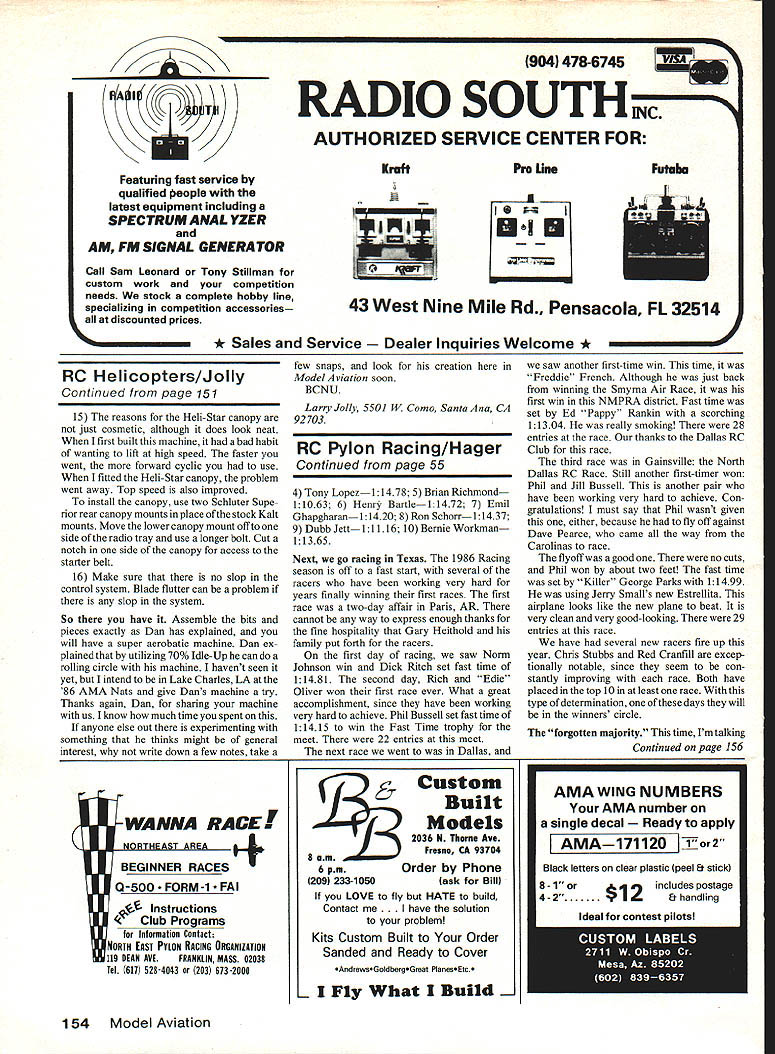
The next race we went to was in Dallas, and we saw another first-time win. This time it was "Freddie" French. Although he was just back from winning the Smyrna Air Race, it was his first win in this MPR/MA district. Fast time was set by Ed "Pappy" Rankin with a scorching 1:13.04 — he was really smoking! There were 28 entries at the race. Our thanks to the Dallas RC Club for this race.
The next race was in Gainesville: the North Dallas RC Race. Still another first-timer won. This is another pair who have been working very hard to achieve. Congratulations! I must say that Phil won't give up this time, either, because he had to fly off against Dave Pierce, who came all the way from the Carolinas to race.
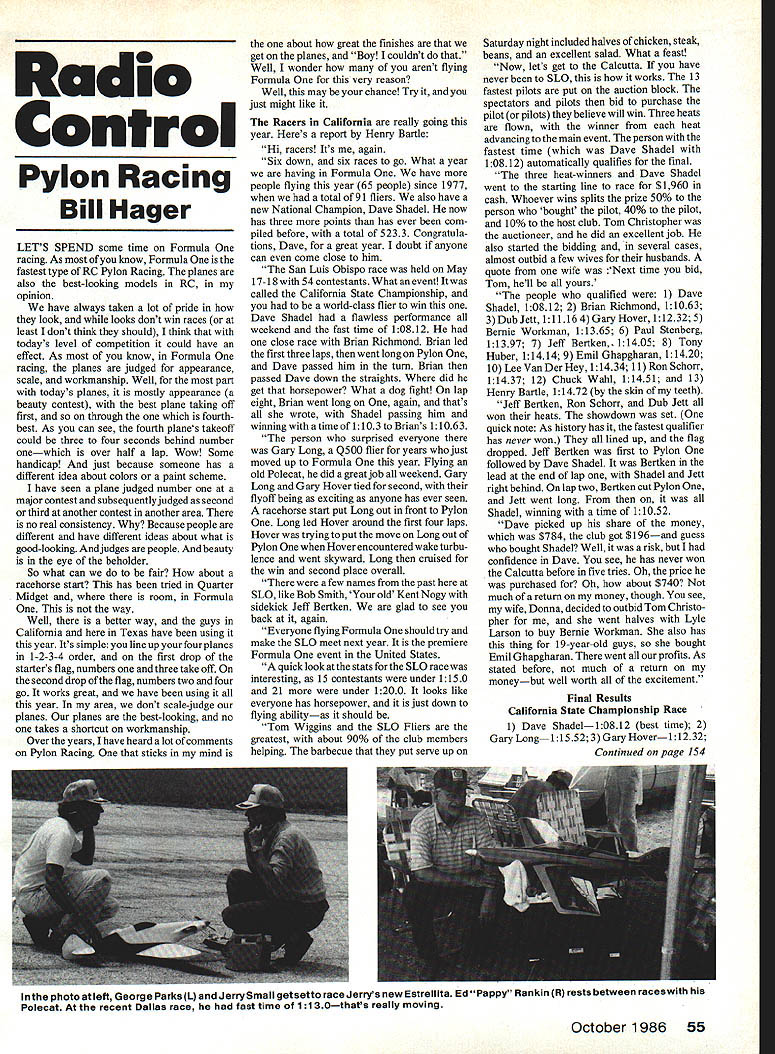
The flyoff was a good one. There were no cuts, and Phil won by about two feet! The fast time was set by "Killer" George Parks with 1:14.99. He was using Jerry Small's new Estrella. This airplane looks like the new plane to beat. It is very clean and very good-looking. There were 29 entries at this race.
We have had several new racers fire up this year. Chris Stubbs and Red Carnell are exceptionally notable, since they seem to be constantly improving with each race. Both have placed in the top 10 in at least one race. With this type of determination, one of these days they will be in the winners' circle.
The clubs and volunteers
The "forgotten majority" — the clubs which put on the races — are very dedicated to the modeling community. We, as racers, owe them a big vote of thanks, for without them we would not have any races.
Again, to the people who sit and watch the corners and to the flagmen and to the timers: a great big "Thanks."
Closing
Well, that's all for this month. See you at the races.
Bill Hager 706 Glen Haven Dr. Conroe, TX 77385.
Transcribed from original scans by AI. Minor OCR errors may remain.

