
Radio Control: Pylon Racing
Bill Hager
I'm getting ready to attend the U.S. FAI Pylon team-selection races at Smyrna, TN. From what I'm hearing through the grapevine, this should be quite a race. You will get a full report next month.
From across the Big Pond comes Club 20 Racing. The event is quite popular in England. It is not unlike our Quarter Midget with bigger engines and no landing gear. Hand-launching means you can fly almost anywhere. They have an entry-level division using smaller engines.
This event sounds interesting, so I will have more on it this winter.
Tips from Dave Shadel
Here are some helpful hints from Dave Shadel. While most of his tips are slanted to Formula One, they will also help in other racing events and, for that matter, even in sport flying.
"Achieving maximum performance under varying weather conditions can be both frustrating and time-consuming if you don't know where to begin. The following has worked well for me in the past few years in Formula One and can be loosely applied to most any event where maximum performance is desired. I hope that you can benefit by following these guidelines:
- Propeller. Props running in hot (90°F and above) and humid (70% and higher) conditions should usually have less pitch and thin blades. To prevent overheating, do not load the engine up with too much prop. For running in hot, dry (humidity 30% or less) air, a longer prop with more pitch and a thick airfoil section works well. At the Reno Nats in 1984, none of the sea-level props worked. We had to increase pitch by nearly one inch and the blade thickness by about 50%. We never did have good first-lap times but managed to get a reasonable top end. Flying at an elevation of over 5,000 feet is something I'm glad I don't have to do very often.
- Engine. I am set to fly in air that's reasonably consistent, with contest conditions of 70°–90° with 40%–70% humidity at sea level. When flying at Lake Charles, I would raise the cylinder head .002–.003, possibly drop nitro to 55%, and load the engine lightly. My normal setup for the ST X-40 engine has the head at .014 in., and I usually run 65% nitro in dry conditions; fuel mixtures can go to 75%–plus on the nitro. In events where fuel is restricted, playing with head spacing and props is the only way to increase performance.
"Remember, whatever experiments you undertake should be written down. You will need good gauges for air temperature and humidity. An air-density meter really helps, too. (Check with local drag racers, who use them to set fuel injectors.) Also, a good depth micrometer (for measuring cylinder head clearance) and a dial caliper (for measuring prop thickness) would be big helps to you.
"All of the preceding will get you started. After you figure out the equipment you will be amazed at what you can learn. The rewards are there. All it takes is time."
For those of you who complain about the cost of Formula One engines, Dave Shadel (who is just about the winningest racer around) won this year's AMA Nats F-1 event with an engine that had over 114 runs on it. Dave says he won't even race an engine until it gets about 30 runs on it. He maintains that the best way to get those 30 runs is to fly it 30 times. Think about it, guys.
Soap-box time
Q500 racing is going strong everywhere. Well — not quite. It seems as though here in Texas we are having a problem. And, for that matter, it looks like the Southeast is having a problem, too, judging by what I read in a recent newsletter from that area.
Here's a comment from the SEMPRA newsletter: "The rules are too loose; allowing a variety of engines, reworked props, tuned pipes, and on and on. These rules, or the lack of rules, allow the more experienced flier a great advantage. The new guy has enough trouble just flying. He does not need tuned pipes or the cost of a new engine every couple of races."
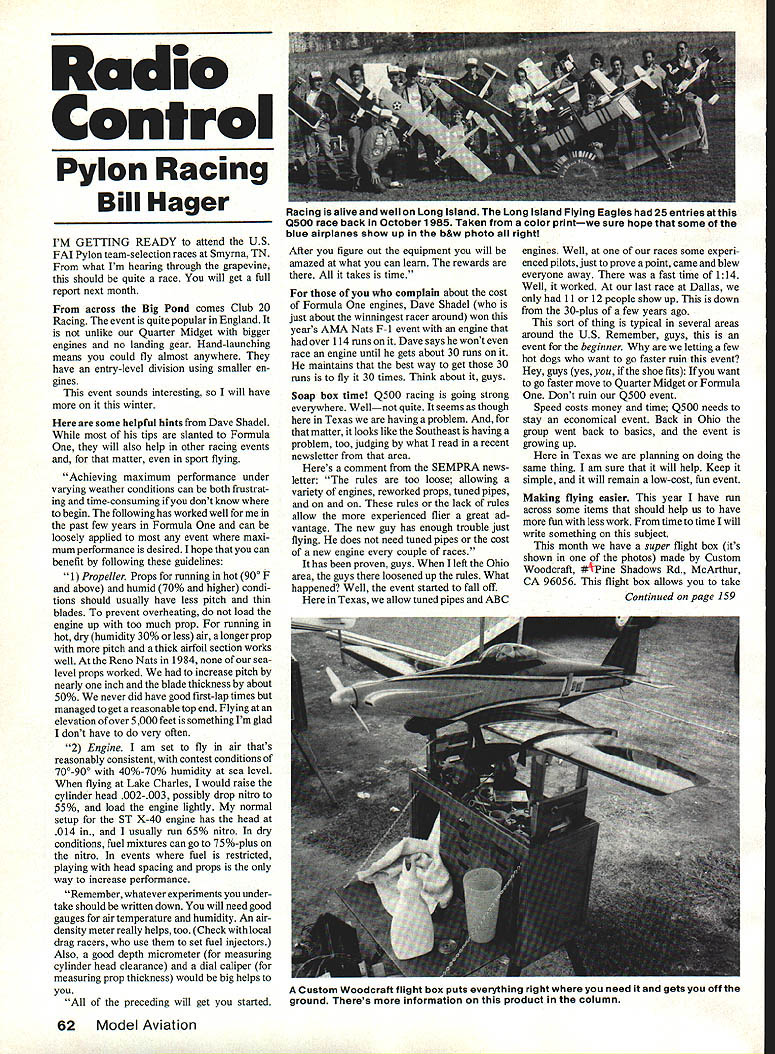
It has been proven, guys. When I left the Ohio area, the guys there loosened up the rules. What happened? Well, the event started to fall off in Texas, and they began to allow tuned pipes and ABC engines. Races with some experienced pilots just proved the point, and they came in and blew everyone away — fast time 1:14. Well, it worked. At our last race at Dallas, we only had 11 or 12 people show up. This is down from the 30-plus of a few years ago.
This sort of thing is typical in several areas around the U.S. Remember, guys, this is an event for the beginner. Why are we letting a few hot dogs who want to go faster ruin this event? Hey, guys — yes, you, if the shoe fits — if you want to go faster, move to Quarter Midget or Formula One. Don't ruin Q500. Speed costs money and time. Q500 needs to stay economical. Back in Ohio the guys went back to basics, and the event is growing again. Texas is planning on doing the same thing, and I am sure it will help. Keep it simple; it will remain low-cost and fun.
Making flying easier
This year I have run across some items that should help us have more fun with less work. From time to time I will write something on this subject.
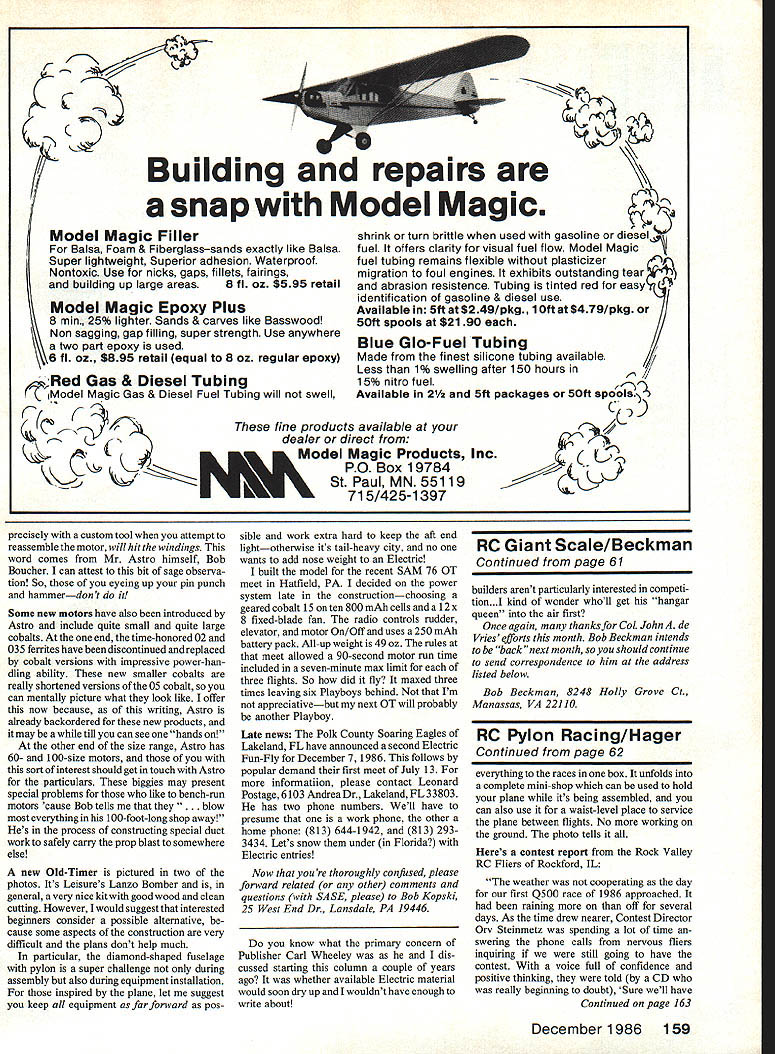
This month we have a super flight box (it's shown in one of the photos) made by Custom Woodcraft, Pine Shadows Rd., McArthur, CA 96056. This flight box allows you to take everything to the races in one box. It unfolds into a complete mini-shop which can be used to hold your plane while it is being assembled and can also be used for a waist-level place to service the plane between flights. No more working on the ground. The photo tells it all.
Contest report — Rock Valley RC Fliers, Rockford, IL
"The weather was not cooperating as the day of our first Q500 race of 1986 approached. It had been raining on and off for several days. As the time drew near, Contest Director Orv Steinmetz was spending a lot of time answering the many phone calls from nervous fliers wondering if we were still going to have the contest. With a voice full of confidence and positive thinking he assured everyone we would go ahead with the contest.
"Well, Mother Nature did cooperate, but because of all the rainy days the field hadn't been mowed, and the grass (as reported by Paul Zaleskas after an extra trip to the field the previous day) was at least four inches long.
So, after a panic call to Fay Harris for a quick mow job, the field was in good shape for the contest. (Thanks, Fay.)
By the time I got to the field, the clouds had disappeared. I just got the course laid out and the engine compartment in place when Fay came and mowed the grass good and short.
Fifteen fliers were on hand to start racing, and in the fourth heat of the first round yours truly mid‑aired Jeff Falo. It is uncharacteristic of Jeff — his right wing was damaged, making it somewhat difficult for him to complete the heat. (Sorry about that, No. 1.)
Even though it was quite windy (which caused some real thrills), everyone seemed to have a good time. After all the dust had settled and the engines ceased their roaring, it ended as follows:
- Bob Bentley
- Bob Lechner
- Dan Kane
- Dave Smith
- Danny Kane, Jr.
My thanks to all the club members (and nonmembers) who helped make this contest a success.
That's it for this month. See you at the races.
Bill Hager 706 Glen Haven Dr. Conroe, TX 77385
Transcribed from original scans by AI. Minor OCR errors may remain.

