
Radio Control: Pylon Racing
By Bill Hager
It has been a good many years since anyone in our country has put out a sincere effort to compete in FAI Pylon. In 1985 we had a World Championships in conjunction with the Nats. Our guys just kind of halfheartedly tried to compete and didn't do very well. But through it all there sparked some interest to compete on a world level. Besides, most of the pylon racers that I know don't want to get beat. So, with this in mind, let's move to 1986.
Background
At the 1986 Lake Charles Nats we had an FAI Pylon event. The turnout was very low. But, if you remember my Nats report, I commented that I thought the top guns were holding back — they didn't want to show the competition what they were doing.
I predicted a very good turnout and a very competitive race at the team finals at Smyrna, TN on October 27–28, 1986. Well, I wasn't disappointed.
These team finals selected our three-man cadre to represent the U.S. at the Pylon World Championships, scheduled for April 16–20, 1987 at RAAF Laverton Airforce Base near Melbourne, Australia.
The Meet — Smyrna Airport, Smyrna, TN
The site of the team finals was Smyrna Airport. The Contest Director was Greg Doe. Greg has been host of many races, including the NMPRA Championships and that year's NMPRA Q500 Championships, so we had the best talent available on the organizational end of the meet.
The weather man was even nice to us, providing temperatures in the nineties both days and just one short shower on Saturday.
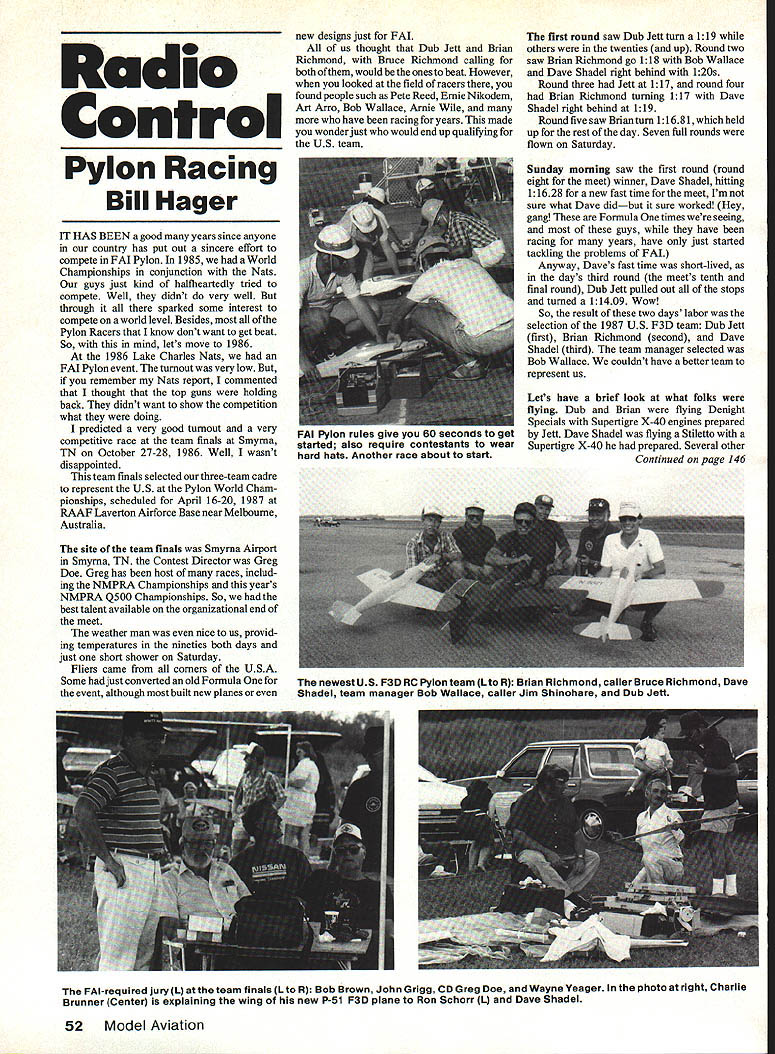
Fliers came from all corners of the U.S.A. Some had just converted an old Formula One for the event, although most built new planes or even new designs just for FAI.
All of us thought that Dub Jett and Brian Richmond, with Bruce Richmond calling for both of them, would be the ones to beat. However, when you looked at the field you found people such as Pete Reed, Ernie Nikodem, Art Arro, Bob Wallace, Arnie Wile, and many more who have been racing for years. This made you wonder just who would end up qualifying for the U.S. team.
Race Summary
The first round saw Dub Jett turn a 1:19 while others were in the twenties (and up). Round two saw Brian Richmond go 1:18 with Bob Wallace and Dave Shadel right behind with 1:20s. Round three had Jett at 1:17, and round four had Brian Richmond turning 1:17 with Dave Shadel right behind at 1:19. Round five saw Brian turn 1:16.81, which held up for the rest of the day. Seven full rounds were flown Saturday.
Sunday morning (round eight for the meet) saw Dave Shadel hit 1:16.28 for a new fast time for the meet. I'm not sure what Dave did—but it sure worked! (Hey, gang — these are Formula One times we're seeing, and most of these guys, while they have been racing for many years, have only just started tackling the problems of FAI.)
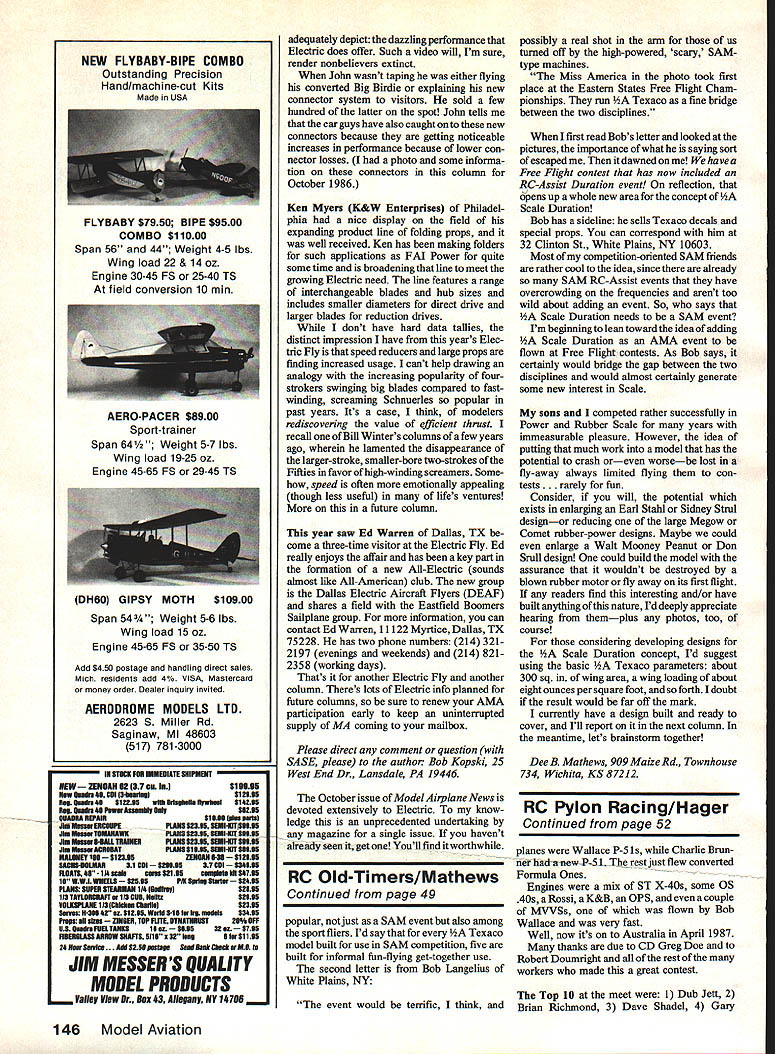
Anyway, Dave's fast time was short-lived. In the day's third round (the meet's tenth and final round), Dub Jett pulled out all the stops and turned a 1:14.09. The result of these two days' labor was the selection of the 1987 U.S. F3D team: Dub Jett (first), Brian Richmond (second), and Dave Shadel (third). The team manager selected was Bob Wallace. We couldn't have a better team to represent us.
Aircraft and Engines
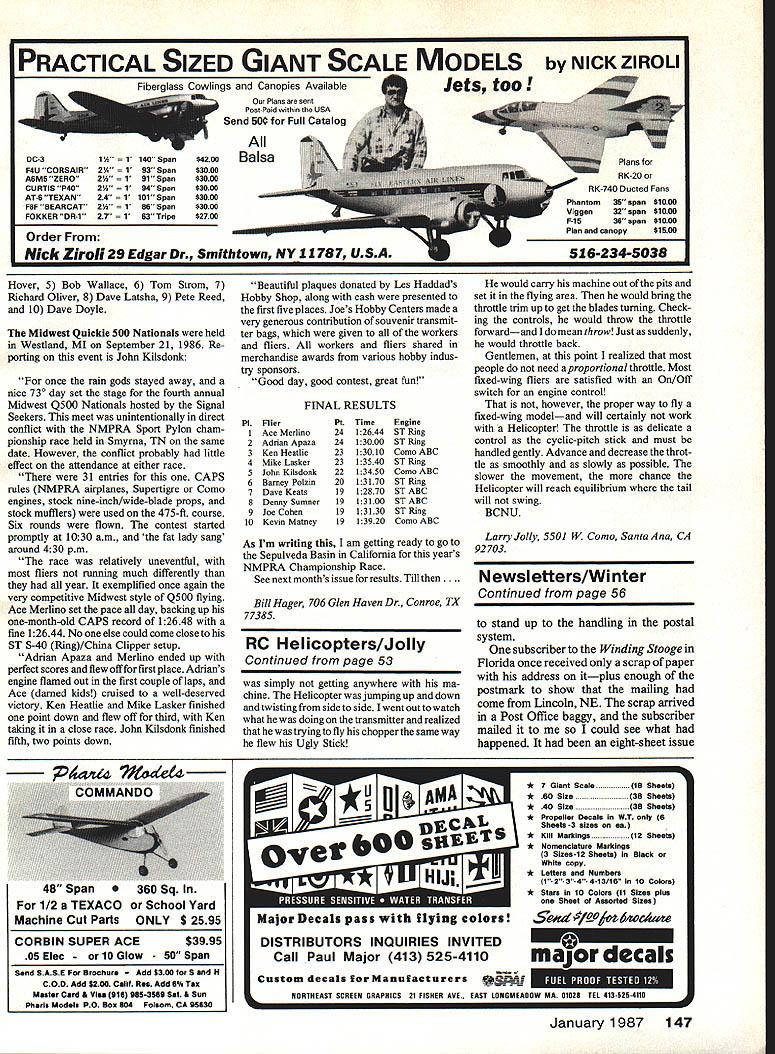
Let's have a brief look at what folks were flying. Dub and Brian were flying Denight Specials with Supertigre X-40 engines prepared by Jeff Jett. Dave Shadel was flying a Stiletto with a Supertigre X-40 he had prepared. Several other planes were Wallace P-51s; Charlie Brunner had a new P-51. The rest flew converted Formula Ones.
Engines were a mix of Supertigre X-40s, some OS .40s, a Rossi, a K&B, an OPS, and even a couple of MVVSs, one of which was flown by Bob Wallace and was very fast.
Many thanks are due to CD Greg Doe, to Robert Dougan, and to all of the rest of the many workers who made this a great contest. Now it's on to Australia in April 1987.
Top 10 at the Meet
- Dub Jett
- Brian Richmond
- Dave Shadel
- Gary Hover
- Bob Wallace
- Tom Strom
- Richard Oliver
- Dave Latsha
- Pete Reed
- Dave Doyle
Transcribed from original scans by AI. Minor OCR errors may remain.

