
Radio Control: Pylon Racing
Bill Hager
First, I need to make a correction. The Contest Director for this year's NMPRA (National Miniature Pylon Racing Association) Championships was Doug Whiteaker with Glen Sheppard as assistant — not Greg Doe as I reported in the January issue.
NMPRA Sport Pylon Championship Race — September 20–21, 1986
Expert:
- R. Moreland
- R. Schuster
- T. Bogut
- M. Brown
- J. Solko
Novice:
- S. Johnson
- J. Salisbury
- G. Wright
- F. Schwartz
- M. Franklin
Midwinter checks and maintenance
Well, here we are about midwinter, and for most of you — unless you fly in the snow — you will have four or five months to build that new plane (or planes) for the '87 season. Some suggestions that will help out next spring when you test that new plane or when you get out last season's equipment for the '87 season follow:
- Batteries. This is very important. At least once a month charge all of your RC system batteries — and I mean the complete system. If you have one of the units like Ace R/C's Digipace II which will cycle your system completely, by all means use it, as it is the best way to go. But whatever you use, keep your radio's batteries charged.
- Radio problems. If you had any such problems at the end of the last season, don't wait until spring to get them fixed. Do it now, when the dealer or repair center has plenty of time to do a good job. I'm not implying they won't do a good job in the spring, but why not make it easier on both them and you? Send the radio in now.
- The plane. You flew it all summer, didn't you? I once had a Quarter Midget that I had flown for two years with no problems. When checking it over for the third season, I found a cracked wing. Check all stress points. Inspect around the firewall to be sure it is not getting fuel-soaked. Also check the landing gear area, the tail surfaces, the wing hold-down blocks, etc.
For fuel-soaked areas, something I have found that works to dry it out is a dry-cleaning compound found in most grocery stores called CRD-2. Just spray it on and it will look like snow; then wipe it off and it takes the oil with it. You might have to repeat the process a few times depending on how badly the area was oil-soaked.
- The fuel tank. I have found the best policy is to pull the tank at the end of the season and, in the spring, put in a new tank — or at least put new fuel tubing inside and outside of the old tank.
- Engines. It's probable that all of us have, at one time or another, unpacked an engine we haven't used for a while only to find that it didn't run as well as when we packed it away. When storing an engine, make sure all of the fuel is out of it. The methyl alcohol used in model fuel draws water vapor out of the air, and the water will certainly rust any exposed steel or iron parts in your engine.
I always make sure there is no fuel remaining in my engine, then I saturate it inside and out with motor oil — just about any kind will do. Then I wrap the engine in a rag and put it in an old engine box. Some people prefer to use a Zip‑Loc bag for this purpose, but I don't agree with this practice. If you don't get all of the moisture out of the engine, the rag and the air in the bag will seal the moisture in the bag, too, and it will do damage.
A word of caution: don't use WD‑40 to "protect" your engine. WD‑40 is good for loosening rusted or corroded parts, but it will not protect things from rust. If you don't believe this, just spray some WD‑40 on a piece of steel and leave it in a damp area for a few days. You will find some rust on the steel since the WD‑40 acts as a cleaning solvent but not as a protective film on metal.
I think that all of us who have been flying for a while have taken a plane out to fly in the spring that was OK when we put it away in the fall, or we've taken the radio out of a plane during the winter and put it into a new plane we've built. Then, when we get out in the spring to fly, everything goes well for a couple of flights and then — suddenly we don't have it! Well, there goes "old reliable" or the new bird we just spent so much time building.
With today's very reliable radios, most of the crashes we have are due to pilot error or to something mechanical going wrong. So, with just a small amount of work we can put the odds on our side for a trouble-free season. A little care right now will really pay off later.
Q500 Racing — letter from Art Arro (Michigan/Ohio area)
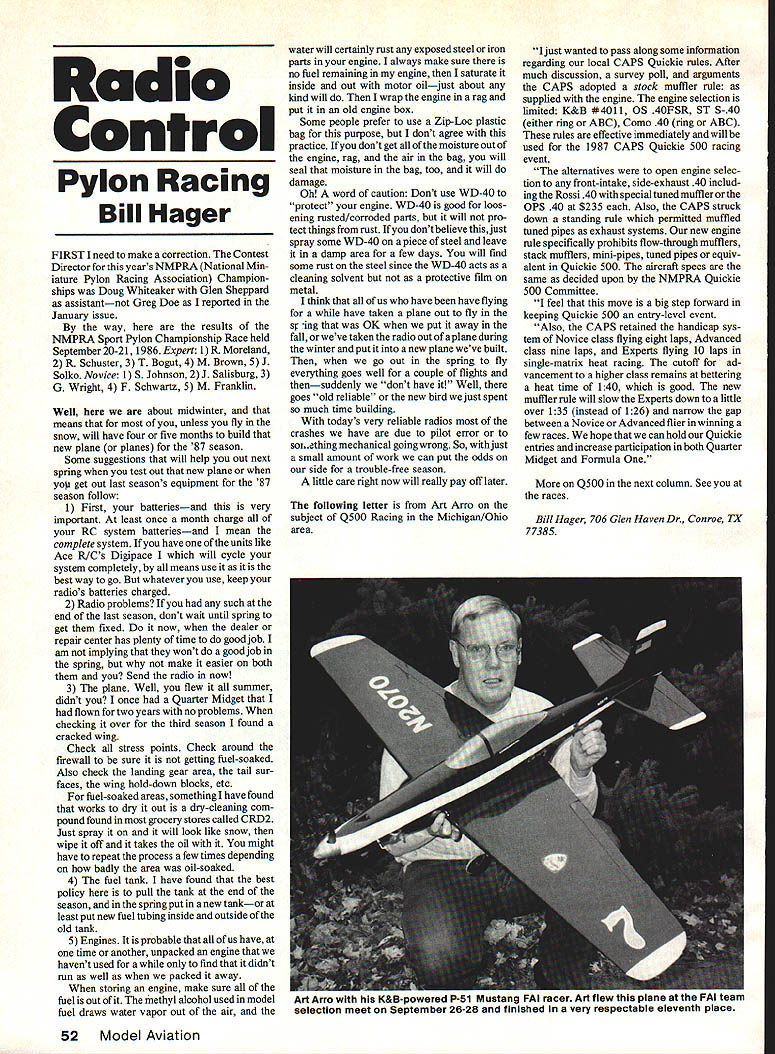
The following letter is from Art Arro on the subject of Q500 Racing in the Michigan/Ohio area.
I just wanted to pass along some information regarding our local CAPS Quickie rules. After much discussion, a survey poll, and arguments, the CAPS adopted a stock muffler rule: a muffler supplied with the engine. The engine selection is limited: K&B #4011, OS .40FP, ST .40 (either ring or ABC), Como .40 (ring or ABC). These rules are effective immediately and will be used for the 1987 CAPS Quickie 500 racing event.
The alternatives were to open engine selection to any front‑intake, side‑exhaust .40 including the Rossi .40 with special tuned muffler and the OPS .40 at $235 each. Also, the CAPS struck down a standing rule which permitted muffled tuned pipes as exhaust systems. Our new engine rule specifically prohibits flow‑through mufflers, tuned pipes, mufflers with stacks, mini‑pipes, tuned pipes or equivalents.
I feel that this move is a big step forward in keeping Quickie 500 an entry‑level event. Also, the CAPS retained the handicap system: Novice class flying eight laps, Advanced class nine laps, Experts flying 10 laps in single‑matrix heat racing. Cutoff advancement to a higher class remains at bettering the heat time of 1:40, which is good. The new muffler rule will slow the Experts down to a little over 1:35 (instead of 1:26) and narrow the gap between a Novice or Advanced flier in winning a few races. We hope that we can hold our Quickie entries and increase participation in both Quarter Midget and Formula One.
More on Q500 in the next column. See you at the races.
Bill Hager 706 Glen Haven Dr. Conroe, TX 77385
Transcribed from original scans by AI. Minor OCR errors may remain.

