
Radio Control: Pylon Racing
Bill Hager
Most of you who read this column regularly know that in 1986 we selected an FAI Pylon team that will represent the U.S.A. at Melbourne, Australia in April of 1987 at the World Championships. Your 1987 team is truly the finest RC Pylon Racing team ever assembled by any country. A 1-2-3 finish by our team is a very distinct possibility. But to make this a first-class effort, the team could use some help.
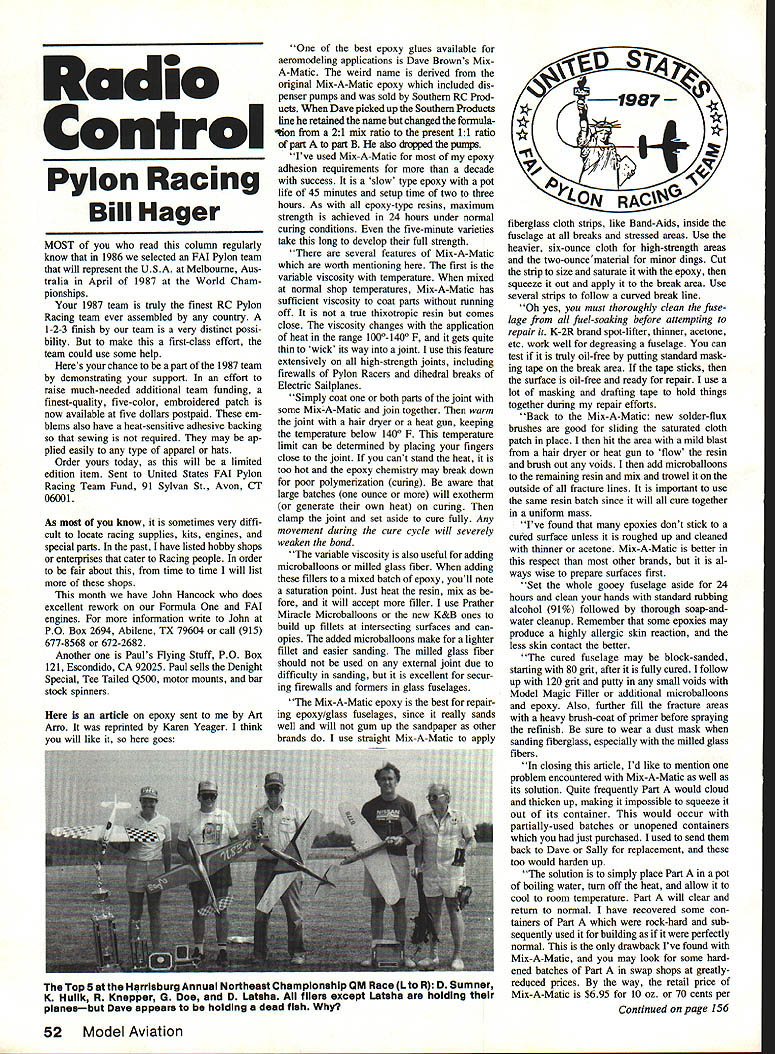
Here’s your chance to be a part of the 1987 team by demonstrating your support. In an effort to raise much-needed additional team funding, a finest-quality, five-color, embroidered patch is now available for five dollars postpaid. These emblems also have heat-sensitive adhesive backing; sewing is not required. They may be applied easily to any type of apparel or hats. Order yours today; this will be a limited edition item.
Send orders to:
- United States FAI Pylon Racing Team Fund
91 Sylvan St. Avon, CT 06001
As most of you know, it is sometimes very difficult to locate racing supplies, kits, engines, and special parts. In the past I have listed hobby shops or enterprises that cater to racing people. In order to be fair about this, from time to time I will list more of these shops.
This month we have:
- John Hancock — does excellent rework on Formula One and FAI engines.
Contact: P.O. Box 2694, Abilene, TX 79604. Phone: (915) 677-8568 or (915) 672-2682.
- Paul’s Flying Stuff — sells Denight Special, Tee-Tailed Q500, motor mounts, bar-stock spinners.
Contact: P.O. Box 121, Escondido, CA 92025.
Epoxy (from Art Arro, reprinted by Karen Yeager)
One of the best epoxy glues available for aeromodeling applications is Dave Brown’s Mix-A-Matic. The name comes from the original Mix-A-Matic epoxy, which included dispenser pumps and was sold by Southern RC Products. When Dave picked up the Southern Products line he retained the name but changed the formula from a 2:1 mix ratio to the present 1:1 ratio of Part A to Part B. He also dropped the pumps.
I’ve used Mix-A-Matic for most of my epoxy adhesion requirements for more than a decade with success. It is a “slow” type epoxy with a pot life of 45 minutes and a setup time of two to three hours. As with all epoxy-type resins, maximum strength is achieved in 24 hours under normal curing conditions. Even the five-minute varieties take this long to develop their full strength.
There are several features of Mix-A-Matic worth mentioning. The first is variable viscosity with temperature. When mixed at normal shop temperatures, Mix-A-Matic has sufficient viscosity to coat parts without running off. It is not a true thixotropic resin but comes close. The viscosity changes with the application of heat in the range 100–140°F, and it gets quite thin to “wick” its way into a joint. I use this feature extensively on all high-strength joints, including firewalls of pylon racers and dihedral breaks of electric sailplanes.
Simply coat one or both parts of the joint with some Mix-A-Matic and join together. Then warm the joint with a hair dryer or a heat gun, keeping the temperature below 140°F. You can check the temperature by placing your fingers close to the joint: if you can’t stand the heat, it is too hot and the epoxy chemistry may break down (or polymerize) on curing. Be aware that large batches (one ounce or more) will exotherm (generate their own heat) on curing. Then clamp the joint and set aside to cure fully. Any movement during the cure cycle will severely weaken the bond.
The variable viscosity is also useful for adding microballoons or milled glass fiber. When adding these fillers to a mixed batch of epoxy, you’ll note a saturation point. Just heat the resin mix before adding filler so it will accept more filler. I use Prather Miracle Microballoons or the new K&B ones. Use milled glass fiber for fillets at intersecting surfaces and corners. The added microballoons make for a lighter fillet and are easier sanding. Milled glass fiber should be used on external joints due to difficulty sanding; it is excellent for securing firewalls and formers in glass fuselages.
Mix-A-Matic epoxy is best for repairing epoxy/glass fuselages since it really sands well and will not gum up sandpaper like other brands. Use straight Mix-A-Matic to apply fiberglass cloth strips, like bandages, inside the fuselage at all breaks and stressed areas. Use the heavier six-ounce cloth for high-strength areas and the two-ounce material for minor dings. Cut the strip to size, saturate it with epoxy, squeeze out excess and apply to the break area. Use several strips to follow a curved break line.
You must thoroughly clean the fuselage from all fuel-soaking before attempting to repair it. K-2R brand spot-lifter, thinner, acetone, etc., work well for degreasing a fuselage. You can test for being truly oil-free by putting standard masking tape on the break area; if the tape sticks, the surface is oil-free and ready for repair. Use a lot of masking and drafting tape to hold things together during repair efforts.
New solder-flux brushes are good for sliding a saturated cloth patch into place. A mild blast from a hair dryer or heat gun will “flow” the resin and brush out any voids. I then add microballoons to the remaining resin, mix, and trowel it on the outside of all fracture lines. It is important to use the same resin batch since it will all cure together in a uniform mass.
I’ve found that many epoxies don’t stick to a cured surface unless it is roughed up and cleaned with thinner or acetone. Mix-A-Matic is better in this respect than most other brands, but it is always wise to prepare surfaces first.
Set the whole gooey fuselage aside for 24 hours and clean your hands with standard rubbing alcohol (91%) followed by thorough soap-and-water cleanup. Remember that some epoxies may produce a highly allergic skin reaction; seek medical advice if this occurs.
The cured fuselage may be block-sanded, starting with 80 grit, after it is fully cured. I follow up with 120 grit and putty in any small voids. Model Magic Filler or any good finishing filler works well for final shaping and sanding. Use a final skim coat of primer before spraying the final finish. Be sure to wear a dust mask when sanding fiberglass, especially with milled glass fibers.
One more procedure to mention with Mix-A-Matic: quite frequently Part A would cloud out and thicken up, making it difficult to mix at room temperature. This would occur with old partially-used bottles or unmarked containers which had excess thinners, etc. I used to send them back to Dave or Sally for replacement; they handled it.
The solution is to simply place Part A in a pot of boiling water, turn off the heat, and allow it to cool to room temperature. Part A will clear and return to normal. I have recovered some containers of Part A which were rock-hard and subsequently used them for building as if they were perfect. This is the only drawback I’ve found with Mix-A-Matic, and you may look for some hardened batches of Part A in swap shops at greatly reduced prices.
By the way, the retail price of Mix-A-Matic is $6.95 for 10 oz. (or for smaller containers), which is cheaper than some other popular “slow-cure” epoxies.
I hope this article will help you in your winter building efforts. If you have any helpful ideas or hints, why not share them? Send them directly to me.
See you next month.
Bill Hager 706 Glen Haven Dr. Conroe, TX 77385
Transcribed from original scans by AI. Minor OCR errors may remain.

