
Pylon Racing
Dave Lane
A COUPLE of issues back I made a statement to the effect that Quarter Midgets had to have a steerable nose wheel or tail wheel. I have been corrected by a couple of Quarter Midget people as to the fact that the rules do not state that the third wheel has to be steerable, only that the airplane be controllable on the ground. It is nice to know that at least some of you guys out there are reading the column. I would like to hear from more of you racers in the model world and let me know what you would like to see in this column.
Racing Rules
QMRC published the following rules in their April newsletter:
- Objective. To provide closed-course racing for the sport flier and novice racing enthusiast.
- General. All AMA and FCC regulations covering the RC flier, his plane and equipment shall be applicable to this event, except as noted herein. The contestant shall be allowed an unlimited number of entries provided all of his back-up airplanes are on the same frequency as his number one model. Alternate models will be used only if the first is not flyable. The contestant may not return to his first plane until it has been checked by the CD. Consideration for the safety of spectators, contestants and contest personnel is of the utmost importance.
- Model Aircraft Requirements. Models entered in this event shall be semi-scale replicas of propeller-driven aircraft that have competed in closed course, speed record attempts, or cross-country racing and be recognizable in all three views, front, side and top. No deltas and/or tailless type aircraft shall be allowed. In the case of unusual or little-known designs, the flier shall produce, if requested by the CD, documentation consisting of photos and a 3-view drawing from a reliable source, such as the manufacturer, model or aviation magazines, books, or commercially available 3-views to verify that such a plane or special design did exist.
- Engines. Total displacement shall be not over 2.50 cc (or .1524 cu. in.). Engine(s) shall be stock RC types (no reworking) of which at least 1000 shall be available through normal retail channels in the U.S. The carburetor, whether included with the engine, or one which is specifically cataloged for the particular engine by another manufacturer, shall also be one of which 1000 is available through normal retail channels in the U.S. No crankcase, exhaust, muffler, or other type of pressure shall be applied to the fuel tank(s). (No pressure of any type, other than atmospheric, shall be applied.) No diesel engines will be allowed.
- Mufflers. Only commercially available mufflers shall be utilized if so required and specified in advance by CD. No tuned pipes.
- Accessories. Items such as wheels, spinners and general hardware shall be commercially available through normal retail channels and be available in quantities of 1000 or more.
- Propellers. Two-bladed fixed propellers, commercially available through normal outlets, shall be used. Material may be removed from one blade for reason of balance only. The other blade must remain unaltered.
- Spinners or Prop Nuts. A rounded spinner or AMA prop nut shall be used.
- Fuselage. At the widest point, the basic fuselage must be at least 2 1/4 in. wide, measured within the wing chord area. At the deepest point the fuselage must be at least 5 in. deep (including windshield, canopy or headrest). These points need not coincide.
- Landing Gear(s). Landing gear shall be non-retractable and wheels must be free rolling. A tail skid, if utilized, shall point to the rear of the aircraft. No brakes allowed. Minimum wheel diameter shall be 1 1/2 in.
- Wing(s). No minimum span required; thickness shall be 7/8 in. measured outside fuselage wing fillets and progressing in a straight line taper to the tip. Wing area shall be a minimum of 300 sq. in. A biplane shall be not less than 5/8 in. upper wing thickness, measured on a line projected vertically from fuselage side, as in a top view, at the point of fuselage and wing intersection. Lower wing shall be
be less than 1/2 in. thick at projected root; projected area is not less than 2/3 of upper wing area.
- Weight. Ready-to-fly weight, less fuel, shall be 2 1/2 lbs. minimum and 4 lbs. maximum.
- Materials and Workmanship. Materials and workmanship shall be of a satisfactory standard and so as not to be a safety hazard. The CD and/or race starter shall be empowered to disqualify any unsafe or damaged aircraft.
- Racing Numbers (Optional). Racing numbers shall be at least 1 1/2 in. high and placed in scale racing positions.
- Registration Numbers. Registration numbers shall be at least 1 1/2 in. high and shall consist of the last 2 or 3 numbers of the entrant's AMA number and placed on the upper right and lower left wing panels. The letter N will precede the registration number and the initial of the entrant's last name shall follow the registration number. Alternate registration numbers of at least 1 in. high may be placed on both sides of the fuselage.
- Starting Time. Contestants will have a maximum of 1 1/2 minutes to start engines. If after 1 1/2 minutes have elapsed, an engine has not started, or quits, a zero is given for that heat.
- Idle Requirements. Engine idle before a race shall be spot checked to the satisfaction of the CD.
Those being checked shall, upon signal from the starter, throttle back their engines for 10 seconds. If the engine quits or fails to idle to the satisfaction of official observers, the pilot is disqualified for that heat. No restarts allowed.
- Fuel. Fuel shall be commercially available, contain not over 15% nitro, and shall be supplied and/or specified by the hosting group.
18a. Engine. There must be at least 1,000 made and they must be available to any modeler. Cost will not exceed $60.00.
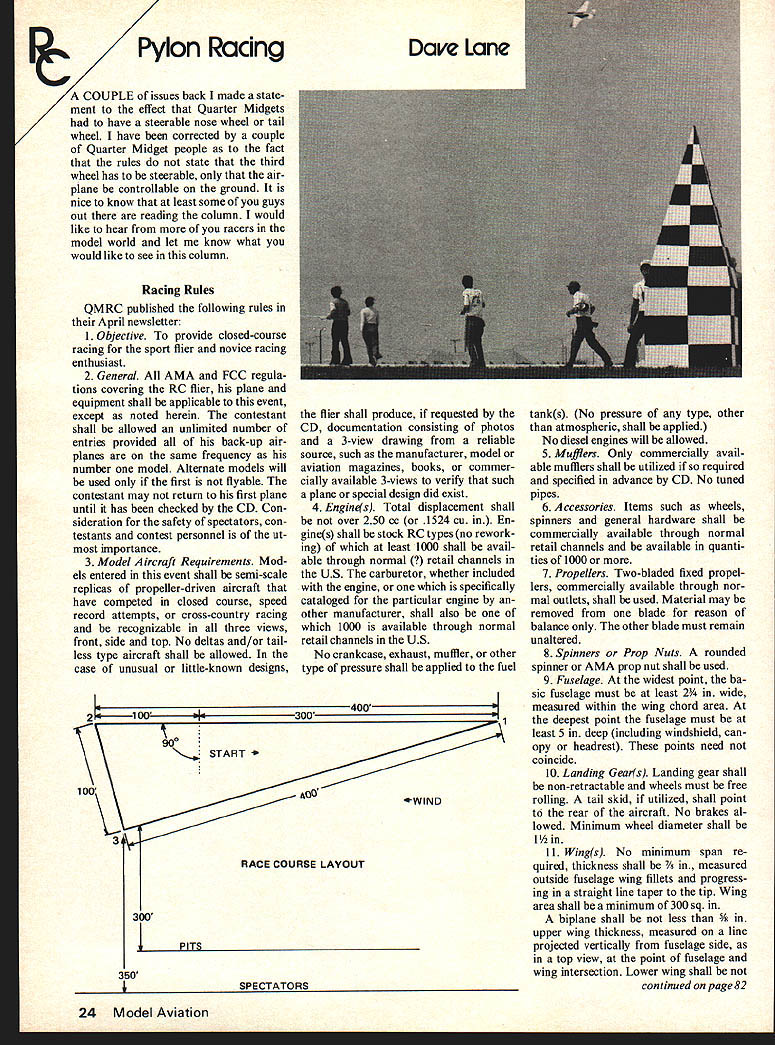
- Race Procedure and Scoring. Starting position shall be by drawing lots. Each aircraft shall be held aloft before each heat by the three pylon judges to take note of their color and type. Pilots shall fly 10 laps only. After completion of each heat, the pylon judges and starter will note any cuts and score the race in the following manner. Four (4) points for first, 3 for second, 2 for third and 1 for fourth. For a dead-stick landing (engine quits prior to wheels touching ground) delete 1/2 point from acquired score. If a pilot cuts 1 pylon and still finishes the race, only 1 point is awarded. Two (2) cuts result in a zero for the heat! Planes finishing without cuts will be given full point award; i.e., first across the finish line with 1 cut will be awarded only 1 point. Second to finish, no cuts, will receive 4 points, etc.
Transcribed from original scans by AI. Minor OCR errors may remain.

