
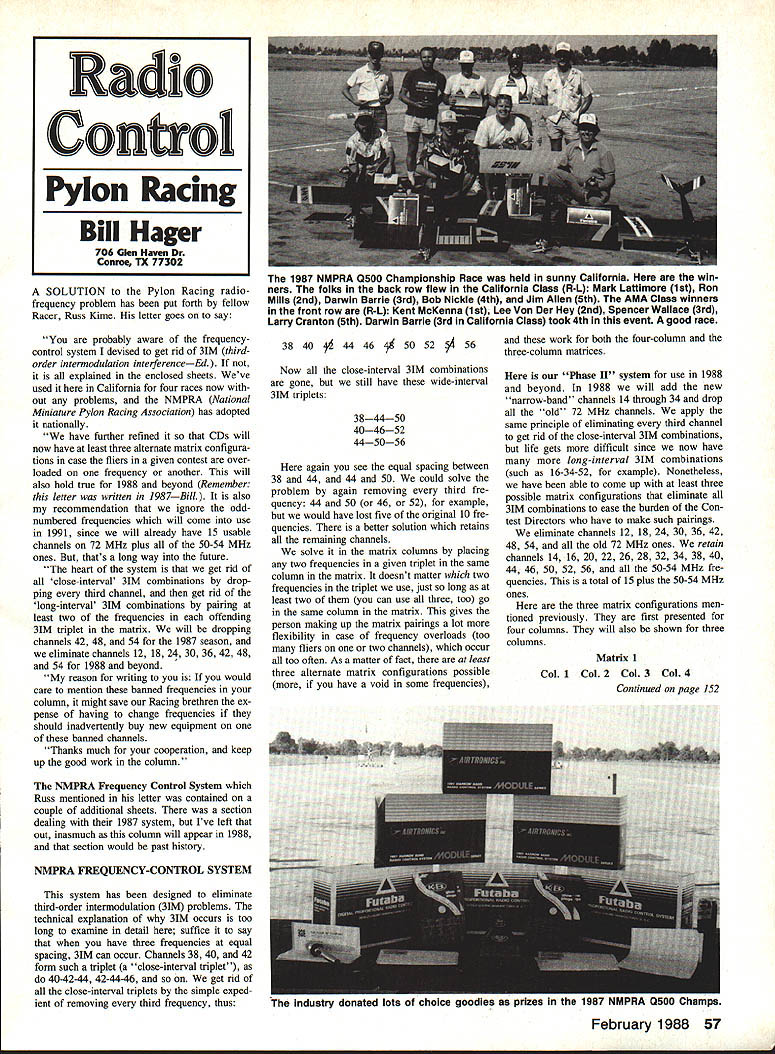
Radio Control: Pylon Racing
Bill Hager 706 Glen Haven Dr. Conroe, TX 77302
Letter from Russ Kime
A solution to the Pylon Racing radio-frequency problem has been put forth by fellow racer Russ Kime. His letter says:
"You are probably aware of the frequency-control system I devised to get rid of 3IM (third-order intermodulation interference). If not, it is all explained in the enclosed sheets. We've used it here in California for four races now without any problems, and the NMPRA (National Miniature Pylon Racing Association) has adopted it nationally.
"We have further refined it so that Contest Directors (CDs) will now have at least three alternate matrix configurations in case the fliers in a given contest are overloaded on one frequency or another. This will also hold true for 1988 and beyond. (Remember: this letter was written in 1987.) It is also my recommendation that we ignore the odd-numbered frequencies which will come into use in 1991, since we will already have 15 usable channels on 72 MHz plus all of the 50–54 MHz ones. But that's a long way into the future.
"The heart of the system is that we get rid of all 'close-interval' 3IM combinations by dropping every third channel, and then get rid of the 'long-interval' 3IM combinations by pairing at least two of the frequencies in each offending 3IM triplet in the matrix. We will be dropping channels 42, 48, and 54 for the 1987 season, and we eliminate channels 12, 18, 24, 30, 36, 42, 48, and 54 for 1988 and beyond.
"My reason for writing to you is: If you would care to mention these banned frequencies in your column, it might save our racing brethren the expense of having to change frequencies if they should inadvertently buy new equipment on one of these banned channels.
"Thanks much for your cooperation, and keep up the good work in the column."
NMPRA Frequency-Control System
This system has been designed to eliminate third-order intermodulation (3IM) problems. The technical explanation of why 3IM occurs is too long to examine in detail here; suffice it to say that when you have three frequencies at equal spacing, 3IM can occur. Channels 38, 40, and 42 form such a triplet (a "close-interval triplet"), as do 40–42–44, 42–44–46, and so on. We get rid of all the close-interval triplets by the simple expedient of removing every third frequency; thus:
38 40 42 44 46 48 50 52 54 56
Now all the close-interval 3IM combinations are gone, but we still have these wide-interval 3IM triplets:
- 38—44—50
- 40—46—52
- 44—50—56
Here you see the equal spacing between 38 and 44 and 44 and 50. We could solve the problem by again removing every third frequency (for example 44 and 50, or 46, or 52), but we would have lost five of the original 10 frequencies. There is a better solution which retains all the remaining channels.
We solve it in the matrix columns by placing any two frequencies in a given triplet in the same column in the matrix. It doesn't matter which two frequencies in the triplet we use, just so long as at least two of them (you can use all three, too) are in the same column in the matrix. This gives the person making up the matrix pairings a lot more flexibility in case of frequency overloads (too many fliers on one or two channels), which occur all too often. As a matter of fact, there are at least three alternate matrix configurations possible (more, if you have a void in some frequencies), and these work for both the four-column and the three-column matrices.
Phase II (1988 and beyond)
In 1988 we will add the new "narrow-band" channels 14 through 34 and drop all the "old" 72 MHz channels. We apply the same principle of eliminating every third channel to get rid of the close-interval 3IM combinations, but life gets more difficult since we now have many more long-interval 3IM combinations (such as 16–34–52, for example). Nonetheless, we have been able to come up with at least three possible matrix configurations that eliminate third-order intermodulation as well as ease the burden of the Contest Directors who have to make such pairings.
We eliminate channels 12, 18, 24, 30, 36, 42, 48, and 54. We retain channels 14, 16, 20, 22, 26, 28, 32, 34, 38, 40, 44, 46, 50, 52, 56, plus the 50–54 MHz frequencies. This is a total of 15 (plus the 50–54 MHz ones).
Matrix Configurations
The three matrix configurations below are presented first for four columns. They also work for three-column matrices.
Matrix 1
- Col. 1: 14, 20, 30, 44
- Col. 2: 16, 22, 40, 46
- Col. 3: 26, 32, 50, 56
- Col. 4: 28, 34, 52
Matrix 2
- Col. 1: 14, 16, 30, 44
- Col. 2: 20, 22, 36, 50
- Col. 3: 26, 28, 42, 56
- Col. 4: 32, 34, 48
Matrix 3 (courtesy of Owen S. Black, Carmichael, CA)
- Col. 1: 14, 26, 36, 44
- Col. 2: 16, 28, 38, 46
- Col. 3: 20, 30, 40, 50
- Col. 4: 22, 32, 42, 52
In all of these matrix configurations, drop in the 50–54 MHz frequencies into any two available columns.
If anyone else can figure out further alternate configurations without going nuts, please let Russ Kime know.
Lockport, NY — Race Report
"The weather was cool and sunny, and the humidity was low. Some people felt cool at the races, but the engines thought the weather was the greatest.
"The UPRC (United Pylon Racing Circuit) Formula One record heat time fell no less than six times. The old record belonged to Neil Watson (1:19.3), and he bettered that time in three heats, the best of which was 1:13.6. Mark Sciandra bettered the old record twice. His best time was 1:18.6. Al Mack, in a heat with Neil Watson, was able to hang onto Neil's tail and not let go, racking up a 1:14.1. A tip of the old UPRC top hat to these top guns of the UPRC. We predicted that someone—actually someone in the UPRC—would break the 1:15 barrier this year—and it has been done.
"The day was also a little unique in that there were almost no mishaps in the Sport event (although there were five crashes in Formula One)."
Race Results
Sport Pylon (Expert Class):
- Dick Cowan — 1:38.7
- Rick Paine — 1:41.9
- Ken Gehres — 1:54.1
- Dave Gierke — 1:44.4
- Al Mack — 1:45.5
Sport Pylon (Standard Class):
- Marlene Nikodem — 2:07.7
- Gary Gaul — 2:12.5
- Clarence Ragland — 2:39.5
- Kevin Cuomo — 2:32.8
Formula One combined results (FAI):
- Mark Sciandra — 1:18.6
- Rick Paine — 1:29.3
- Neil Watson — 1:31.6
- Al Mack — 1:41.1
- Ed Smith — 1:39.1
See you at the races!
Transcribed from original scans by AI. Minor OCR errors may remain.

