
Radio Control: Pylon Racing
Bill Hager 4 Holly Springs Dr. Conroe, TX 77302
THE YEAR of the Q500? It looks to me like it might be. Boy, I wonder if the old bearded Glen Spickler ever thought this type of racing would grow like it has. For those who don't remember, Glen designed and kitted the Spickler Q500 Pylon Racer. This plane was designed to be a low-cost, fun-to-build, fun-to-fly pylon racer — just the thing for club races; low-key, low-cost racing for those who wanted to race but didn't want to get as involved as the Formula One pilot.
These days Q500 has a good set of rules — and even a spot at the Nationals, though I'm not sure it was intended to get this big. Remember, guys: it was supposed to be a low-key event! When you bring it to the Nats... well, we'll see. I hope for the best, because there are a lot of people flying this neat event.
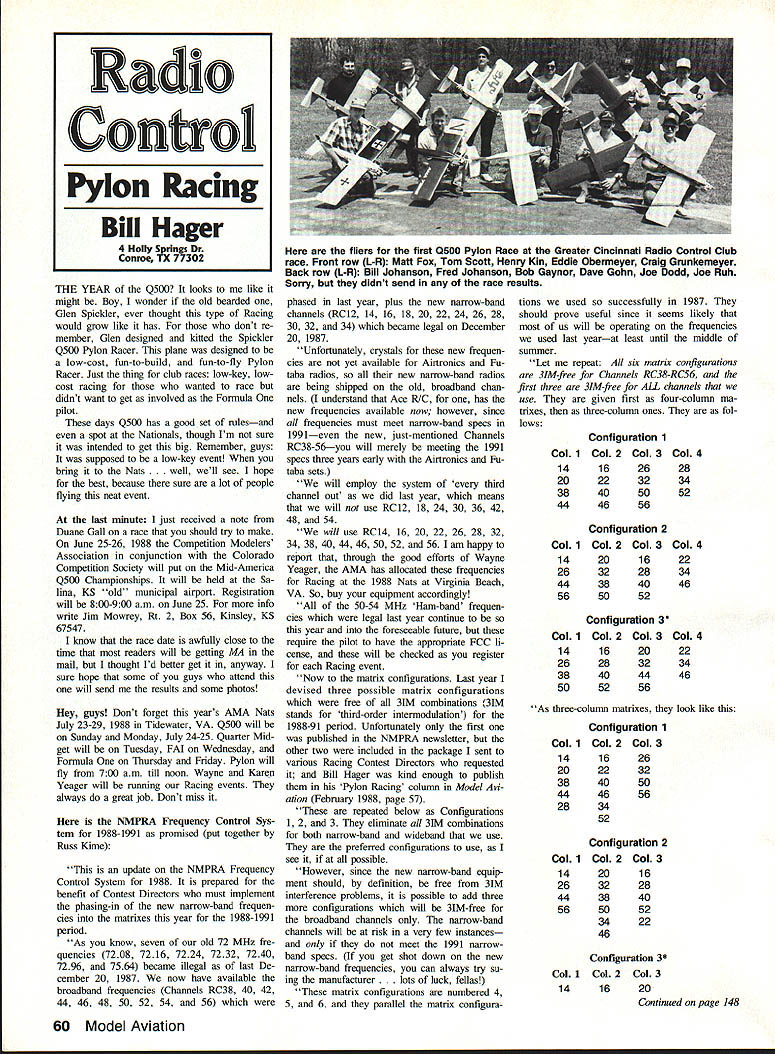
At the last minute: I just received a note from Duane Gall on a race that you should try to make. On June 25–26, 1988 the Competition Modelers' Association, in conjunction with the Colorado Competition Society, will put on the Mid-America Q500 Championships. It will be held at the Salina, KS old municipal airport. Registration will be 8:00–9:00 a.m. on June 25. For more info write Jim Mowrey, Rt. 2, Box 56, Kinsley, KS 67547.
I know that the race date is awfully close to the time that most readers will be getting MA in the mail, but I thought I'd better get it in anyway. I sure hope that some of you who attend this one will send me the results and some photos!
Hey, guys! Don't forget this year's AMA Nats: July 23–29, 1988 in Tidewater, VA. Q500 will be on Sunday and Monday, July 24–25. Quarter Mids will be on Tuesday, FAI on Wednesday, Formula on Thursday, and Pylon will fly 7:00 a.m. till noon. Wayne and Karen Yeager will be running the racing events; they always do a great job. Don't miss it.
NMPRA Frequency Control System (1988–1991) — Russ Kime
This is an update on the NMPRA Frequency Control System for 1988, prepared for the benefit of Contest Directors who must implement the phasing-in of the new narrow-band frequencies into the matrices for the 1988–1991 period.
As you know, seven of our old 72 MHz frequencies (72.08, 72.16, 72.24, 72.32, 72.40, 72.96 and 75.64) became illegal as of December 20, 1987. We now have available the broadband frequencies (Channels RC38, 40, 42, 44, 46, 48, 50, 52, 54 and 56) which were phased in last year, plus the new narrow-band channels (RC12, 14, 16, 18, 20, 22, 24, 26, 28, 30, 32, 34) which became legal on December 20, 1987.
Unfortunately, crystals for these new frequencies are not yet available for Airtronics and Futaba radios, so all their new narrow-band radios are being shipped on the old, broadband channels. I understand that Ace R/C, for one, has the new frequencies available now; however, since all frequencies must meet narrow-band specs in 1991 — even the new channels RC38–RC56 — you will merely be meeting the 1991 specs three years early with the Airtronics and Futaba sets.
We will employ the system of "every third channel out" as we did last year, which means that we will not use RC12, 18, 24, 30, 36, 42, 48, 54.
We will use RC14, 16, 20, 22, 26, 28, 32, 34, and RC38, 40, 44, 46, 50, 52, 56.
These configurations eliminate all 31M combinations for both narrow-band and wideband use and are the preferred configurations to use if at all possible.
Since the new narrow-band equipment should, by definition, be free from 31M interference problems, it is possible to add three more configurations which will be 31M-free for the broadband channels only. The narrow-band channels will be at risk in very few instances — and only if they do not meet the 1991 narrow-band specs. (If you get shot down on the new narrow-band frequencies, you can always try suing the manufacturer... lots of luck, fellas!)
These matrix configurations are numbered 4, 5 and 6, and they parallel the matrix configurations we used successfully in 1987. They should prove useful since it seems likely that most of us will be operating on the frequencies we used last year — at least until the middle of summer.
Let me repeat: All six matrix configurations are 31M-free for Channels RC38–RC56, and the first three are 31M-free for all channels.
The three-channel matrices look like this:
Configuration 1 (four-column) Col. 1 Col. 2 Col. 3 Col. 4 14 16 26 28 20 22 30 32 34 38 40 44 46 50 52 56
Configuration 2 (four-column) Col. 1 Col. 2 Col. 3 Col. 4 12 14 26 28 16 20 32 34 38 40 44 46 50 52 54 56
Configuration 3* (four-column) Col. 1 Col. 2 Col. 3 Col. 4 12 14 20 22 16 18 28 30 32 34 38 40 44 46 50 52
*As three-column matrices, they look like this:
Configuration 1 (three-column) Col. 1 Col. 2 Col. 3 14 16 26 20 22 30 34 38 40 46 50 52
Configuration 2 (three-column) Col. 1 Col. 2 Col. 3 12 14 16 20 22 28 34 38 40 50 52 54
Configuration 3* (three-column) Col. 1 Col. 2 Col. 3 12 14 20 16 18 22 28 30 32 34 38 40
These eliminate all 31M combinations for both narrow-band and wideband that we use. They are the preferred configurations to use if at all possible.
It is possible to add three more configurations (Configurations 4, 5 and 6) which will be 31M-free for the broadband channels only. They parallel the matrix configurations used successfully in 1987 and should prove useful since it seems likely most of us will be operating on the frequencies used last year — at least until the middle of summer.
(16 and 52 go into either Col. 1 or Col. 2.) (26 and 38 can go into either Col. 3 or Col. 4, while 32 and 44 go into whichever of the two latter columns did not receive 26/38.)
Note to Contest Directors
In Configurations 4, 5 and 6 the following frequencies must be paired in the same column of the matrix. If you group them together before starting to make up the matrix, it will simplify your work:
- 38 with 26
- 40 with 28
- 44 with 32
- 46 with 34
- 50 with 14
- 52 with 16
- 56 with 20
Send me your contest results, pictures, and flying/building ideas so that I can pass them on.
Support the organization which stands for Pylon Racing. Join the NMPRA.
- Dues: $13/year for a nonflying member
- Dues: $22/year for a flying member
- Dues: $25/year for any foreign members
Send the money to: Ron Schorr 5224 Teesdale North Hollywood, CA 91607
You must also include your AMA number and which event(s) you fly in.
See you at the races!
P.S. Please note my new address. It's listed at the top of my column.
Transcribed from original scans by AI. Minor OCR errors may remain.

