
Radio Control: Pylon Racing
Bill Hager 4 Holly Springs Dr. Conroe, TX 77302
Midseason remarks
Well, here we are just about midway through the '88 pylon racing season with plenty of racing for Q500, Formula One, and Quarter Midget. There's also lots of home-brew type contests put on by a large majority of AMA clubs that most of us don't even know about. Let's look at some race reports from around the country; but first, a few comments from yours truly.
Why Pylon Racing? There are hundreds, maybe thousands, of pylon races of some type being held every year. People just love to race. There is a little competitive blood in everyone.
Some of you are just as happy flying around the club field and maybe racing a friend once in a while. A large majority of you might enter club races, racing trainer-type planes or whatever.
When I lived in Ohio we used to race rubber-powered planes indoors during the winter. Anyhow, by now you should be getting the picture. Be it Quarter Midget, Formula One, FAI, Q500, or whatever, people just like to race.
What does the racer get for his troubles? Why does he go to all the trouble to compete? What are the rewards? Well, how about recognition — just knowing that on a given day he or she was better than his or her friends?
I've been racing for almost 20 years now, and I don't think I've won enough money or merchandise to cover the cost of one Formula One plane... and I've won lots of contests. The point is that we race because we enjoy it. About the only thing we have for the "trouble" is some recognition.
I've been writing this Pylon Racing column for quite a while now, and no, I don't travel around the country gathering contest data. I'd have to be a retired millionaire to do that.
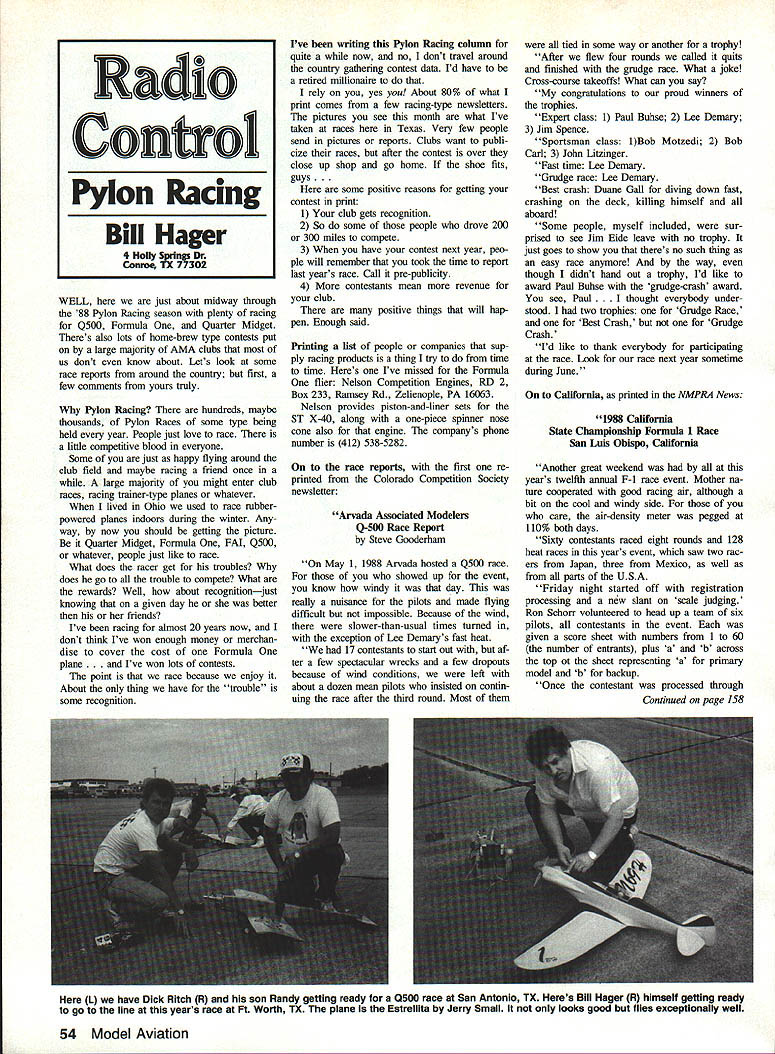
I rely on you, yes you! About 80% of what I print comes from a few racing-type newsletters. The pictures you see this month are what I've taken at races here in Texas. Very few people send in pictures or reports. Clubs want to publicize their races, but after the contest is over they close up shop and go home. If the shoe fits, guys...
Here are some positive reasons for getting your contest in print:
- Your club gets recognition.
- So do some of those people who drove 200 or 300 miles to compete.
- When you have your contest next year, people will remember that you took the time to report last year's race. Call it pre-publicity.
- More contestants mean more revenue for your club.
Suppliers
Printing a list of people or companies that supply racing products is a thing I try to do from time to time. Here's one I've missed for the Formula One flier:
- Nelson Competition Engines, RD 2, Box 233, Ramsey Rd., Zelienople, PA 16063. Nelson provides piston-and-liner sets for the ST X-40, along with a one-piece spinner nose cone also for that engine. The company's phone number is (412) 538-5282.
Race reports
On to the race reports, with the first one reprinted from the Colorado Competition Society newsletter.
Arvada Associated Modelers Q-500 Race Report
by Steve Gooderham
On May 1, 1988 Arvada hosted a Q500 race. For those of you who showed up for the event, you know how windy it was that day. This was really a nuisance for the pilots and made flying difficult but not impossible. Because of the wind, there were slower-than-usual times turned up, with the exception of Lee Demary's fast heat.
We had 17 contestants to start out with, but after a few spectacular wrecks and a few dropouts because of wind conditions, we were left with about a dozen mean pilots who insisted on continuing the race after the third round. Most of them were all tied in some way or another for a trophy!
After we flew four rounds we called it quits and finished with the grudge race. What a joke! Cross-course takeoffs! What can I say—congratulations to our proud winners of the trophies:
- Expert class:
- Paul Buhse
- Lee Demary
- Jim Spence
- Sportsman class:
- Bob Motzedi
- Bob Carl
- John Litzinger
- Fast time: Lee Demary
- Grudge race: Lee Demary
- Best crash: Duane Gail for diving down fast, crashing on the deck, killing himself and all aboard!
Some people, myself included, were surprised to see Jim Eide leave with no trophy. It just goes to show that there's no such thing as an easy race anymore. And by the way, even though I didn't hand out a trophy, I'd like to award Paul Buhse with the "grudge-crash" award. You see, Paul... I thought everybody understood. I had two trophies; one for "Grudge Race" and one for "Best Crash," but not one for "Grudge Crash."
I'd like to thank everybody for participating at the race. Look for our race next year sometime during June.
1988 California State Championship Formula 1 Race
San Luis Obispo, California
Another great weekend was had by all at this year's twelfth annual F-1 race event. Mother Nature cooperated — good racing air although a bit cool and windy. An air-density meter pegged at 110% both days. Sixty contestants raced eight rounds and 128 heat races. This year's event saw two racers from Japan, three from Mexico, as well as racers from all parts of the U.S.A.
Friday night started off with registration processing and a new slant on scale judging. Ron Schorr volunteered to head up a team of six pilots, all contestants in the event. Each was given a score sheet with numbers from 1 to 60 across the top of the sheet representing "a" for primary model and "b" for backup. Once the contestants were processed through registration, he or she was given two cards which were numbered with their contestant number on both (one with "a" and one with "b"). The cards were placed under the respective model by the contestant.
The judges then viewed each aircraft, getting no closer than standing over it, and rated each in no more than 30 seconds (most took less time). Periodically the judges would caucus, add their scores, and average them to the nearest 0.1 point, and there you have it.
The only change I might recommend would be disregarding one high and one low score, then averaging the remaining four scores, thereby eliminating any controversy about judging your own aircraft.
The procedure went very well. It was quick with only the minimum gripes. Try it sometime; you may like it.
On with the race. Dave Shadel started off with a zero in Round 1, the result of an aileron servo failure which was detected before the heat. Now there's a good plug for checking all controls before each flight!
With the great air, many racers set personal best times (including yours truly) in Round 2 with a 1:09.24. That time turned out to be Fast Time for the day. By the end of Saturday's flying, only two people had perfect scores: Larry Laub and Gary Hover. Close behind, however, was a group of three who were one point down, and several who were two points down.
Sunday started off with Round 6. Times were again extremely fast, with several 1:10s and 1:11s being posted. In Round 7 Bob Smith set a new fast time for the contest of 1:09.08! Round 8 saw little change to the final results.
Following this year's race once again was the final Calcutta, pitting the 13 fastest pilots against each other. We were all treated to two final rounds, since everyone double-cut in the first—except for Lee Vonderhey, who planted his borrowed racer around turn three. The final round saw Bob Smith and Dave Shadel wing-slap each other, allowing the eventual winner, Bob Dible, to scoot home for the flag. Bob Dible was bought by Bob Smith, by the way, for $70 (very interesting).
Thanks to the great planning of CD Jim Sneed and key workers like starter Wayne Scuri, the event went extremely well. Looking forward to next year!
Here are the race results (listed as points / best time):
- Gary Hover (32 / 1:09.24 — flyoff)
- Larry Laub (32 / 1:10.89 — flyoff)
- Mike Hensel (30 / 1:11.61 — flyoff)
- Ron Mendel (30 / 1:18.09 — flyoff)
- Gary Long (28 / 1:15.38 — flyoff)
- Ed Rothenberger (28 / 1:14.12 — flyoff)
- Dave Shadel (27 / 1:10.87)
- Lyle Larson (27 / 1:11.59)
- Scott Manning (27 / 1:12.91)
- Mark Lattimore (27 / 1:17.11)
- Chuck Brown (27 / 1:23.32)
- Bob Smith (26 / 1:09.08 — fast time)
- Bob Dible (winner's share)
Best finish went to Lyle Larson. Calcutta winner Bob Dible received $672.50 (winner's share).
Send stuff like contest reports, helpful hints, photos, or ideas to me. I'll do my best to get them into print in Model Aviation.
Please note that I've got a new address!
Transcribed from original scans by AI. Minor OCR errors may remain.

