
Radio Control: Pylon Racing
Dave Lane
I ATTENDED THE Valley Flyers Formula One Race at Sepulveda Basin in July and observed some very competitive racing. Whit Stockwell showed up with his Prather Lil Toni and walked off with all the marbles. Not bad after not flying since the Nats in 1975. Same racer used at the '75 Nats too.
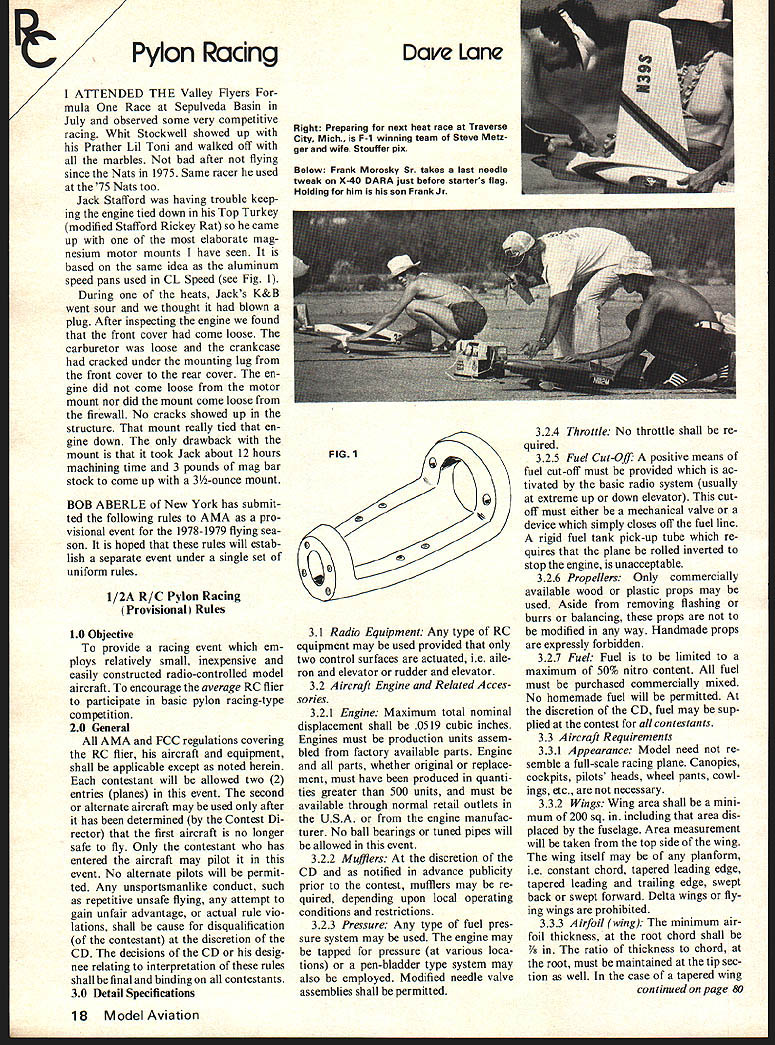
Jack Stafford was having trouble keeping the engine tied down in his Top Turkey (modified Stafford Rickey Rat) so he came up with one of the most elaborate magnesium motor mounts I have seen. It is based on the same idea as the aluminum speed pans used in CL Speed (see Fig. 1).
During one of the heats, Jack's K&B went sour and we thought it had blown a plug. After inspecting the engine we found that the front cover had come loose. The carburetor was loose and the crankcase had cracked under the mounting lug from the front cover to the rear cover. The engine did not come loose from the motor mount nor did the mount come loose from the firewall. No cracks showed up in the structure. That mount really tied that engine down. The only drawback with the mount is that it took Jack about 12 hours machining time and 3 pounds of mag bar stock to come up with a 3-1/2-ounce mount.
BOB ABERLE of New York has submitted the following rules to AMA as a provisional event for the 1978-1979 flying season. It is hoped these rules will establish a separate event under a single set of uniform rules.
1/2A R/C Pylon Racing (Provisional) Rules
1.0 Objective
To provide a racing event which employs relatively small, inexpensive and easily constructed radio-controlled model aircraft. To encourage the average R/C flier to participate in basic pylon racing-type competition.
2.0 General
All AMA and FCC regulations covering the R/C flier, his aircraft and equipment, shall be applicable except as noted herein. Each contestant will be allowed two (2) entries (planes) in this event. The second or alternate aircraft may be used only after it has been determined by the Contest Director that the first aircraft is no longer safe to fly. Only the contestant who has entered the aircraft may pilot it in this event. No alternate pilots will be permitted. Any unsportsmanlike conduct, such as repetitive unsafe flying, any attempt to gain unfair advantage, or actual violations, shall be cause for disqualification of the contestant, at the discretion of the CD. The decisions of the CD or his designee relating to interpretation of these rules shall be final and binding on all contestants.
3.0 Detail Specifications
3.1 Radio Equipment: Any type of R/C equipment may be used provided that only two control surfaces are actuated, i.e., aileron and elevator or rudder and elevator.
3.2 Aircraft Engine and Related Accessories
3.2.1 Engine: Maximum total nominal displacement shall be .0519 cubic inches. Engines must be production units assembled from factory available parts. Engine parts, whether original or replacement, must have been produced in quantities greater than 500 units and must be available through normal retail outlets in the U.S.A. or from the engine manufacturer. No ball bearings or tuned pipes will be allowed in this event.
3.2.2 Mufflers: At the discretion of the CD and as notified in advance publicity prior to the contest, mufflers may be required, depending upon local operating conditions and restrictions.
3.2.3 Pressure: Any type of fuel pressure system may be used. The engine may be tapped for pressure at various locations or a pen-bladder type system may also be employed. Modified needle valve assemblies shall be permitted.
3.2.4 Throttle: No throttle shall be required.
3.2.5 Fuel Cut-Off: A positive means of fuel cut-off must be provided which is activated by the basic radio system (usually at extreme up or down elevator). This cut-off must either be a mechanical valve or a device which simply closes off the fuel line. A rigid fuel tank pick-up tube which requires that the plane be rolled inverted to stop the engine is unacceptable.
3.2.6 Propellers: Only commercially available wood or plastic props may be used. Aside from removing flashing or burrs and balancing, props are not to be modified in any way. Handmade props are expressly forbidden.
3.2.7 Fuel: Fuel is to be limited to a maximum of 50% nitro content. All fuel must be purchased commercially mixed. No homemade fuel will be permitted. At the discretion of the CD, fuel may be supplied at the contest for all contestants.
3.3 Aircraft Requirements
3.3.1 Appearance: Model need not resemble a full-scale racing plane. Canopies, cockpits, pilots' heads, wheel pants, cowlings, etc., are not necessary.
3.3.2 Wings: Wing area shall be a minimum of 200 sq. in., including that area displaced by the fuselage. Area measurements will be taken from the top side of the wing. The wing itself may be of any planform, i.e., constant chord, tapered leading edge, tapered trailing edge, swept back or swept forward. Delta wings or forward swept wings are prohibited.
3.3.3 Airfoil (wing): The minimum airfoil thickness, at the root chord shall be 3/8 in. The ratio of thickness to chord, at the root, must be maintained at the tip section as well. In the case of a tapered wing planform, the tip section will be proportionately thinner.
3.3.4 Weight
Weight, less fuel, but including all equipment necessary for flight, shall be no less than 20 ounces nor more than 32 ounces.
3.3.5 Fuselage
No minimum cross-section area will be required. However, in the interest of safety, the CD may disqualify any entry which in his opinion does not appear structurally sound or airworthy.
3.3.6 Landing Gear
Landing gears or wheels are not necessary.
3.3.7 Identification Markings
I.D. markings will consist simply of the contestant's AMA number, or as an alternate, the letter N followed by the last two or three digits of the AMA number, followed by the first letter of the contestant's last name. Location and size of the I.D. is not important.
4.0 Operation of the Race
4.1 Number of Planes per Race
A maximum of four (4) aircraft will be flown in each heat.
4.2 Type of Launching
Unless advertised in advance, all launching will be by hand and by an assistant or helper of the contestant. No contestant shall launch his/her own aircraft. Launches will be as close to simultaneous as possible. Launches are not to be staggered at intervals.
4.3 Number of Laps
Each race will consist of ten (10) complete laps of the racing course.
4.4 Cut Pylon
If a pylon is cut by a contestant, that lap will not be counted. If two pylons are cut, the contestant will receive no score for that heat, and shall pull out of the race until the heat is over.
4.5 Altitude
No minimum altitude is required during racing.
4.6 Engine Start-up
Engines must be started within a maximum time of two (2) minutes after the signal to start is given. Any contestant not ready to race when the starting flag is dropped shall draw a zero for that heat.
4.7 Rotation of the Race
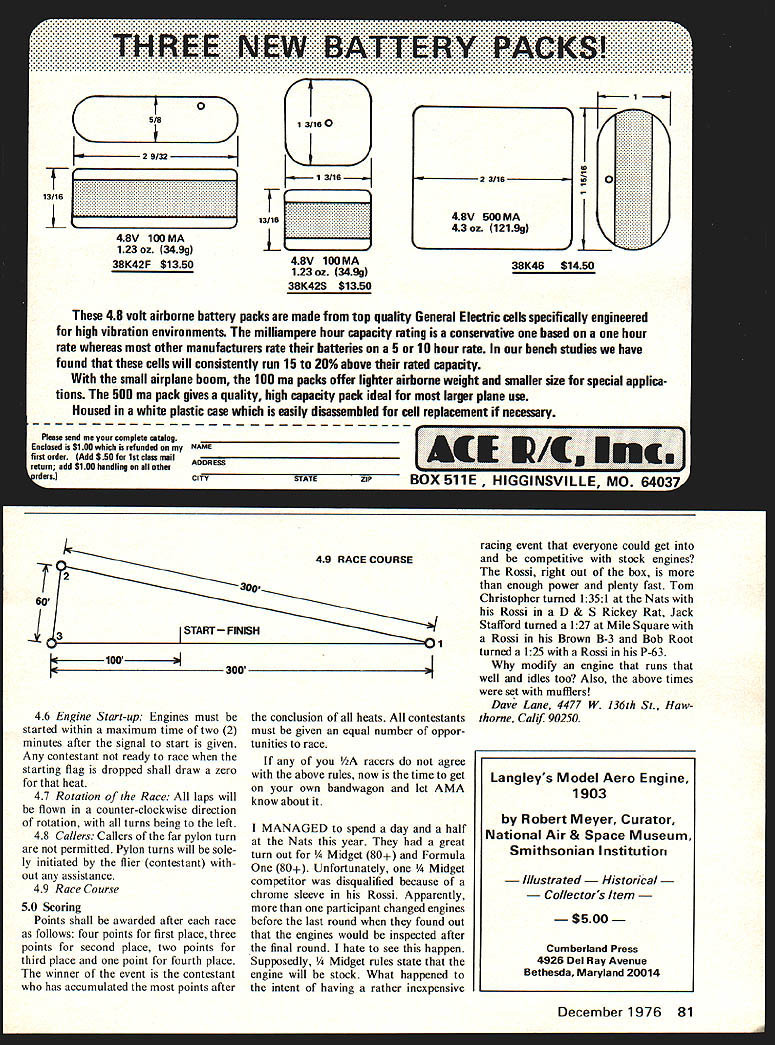
All laps will be flown in a counter-clockwise direction of rotation, with all turns being to the left.
4.8 Callers
Callers of the far pylon turn are not permitted. Pylon turns will be solely initiated by the flier (contestant) without any assistance.
4.9 Race Course
5.0 Scoring
Points shall be awarded after each race as follows: four points for first place, three points for second place, two points for third place and one point for fourth place. The winner of the event is the contestant who has accumulated the most points after the conclusion of all heats. All contestants must be given an equal number of opportunities to race.
If any of you 1/2A racers do not agree with the above rules, now is the time to get on your own bandwagon and let AMA know about it.
I managed to spend a day and a half at the Nats this year. They had a great turn out for 1/2 Midget (80+) and Formula One (80+). Unfortunately, one 1/2 Midget competitor was disqualified because of a chrome sleeve in his Rossi. Apparently, more than one participant changed engines before the last round when they found out that the engines would be inspected after the final round. I hate to see this happen. Supposedly, 1/4 Midget rules state that the engine will be stock. What happened to the intent of having a rather inexpensive racing event that everyone could get into and be competitive with stock engines? The Rossi, right out of the box, is more than enough power and plenty fast. Tom Christopher turned 1:35.1 at the Nats with his Rossi in a D & S Rickey Rat. Jack Stafford turned a 1:27 at Mile Square with a Rossi in his Brown B-3 and Bob Root turned a 1:25 with a Rossi in his P-63.
Why modify an engine that runs that well and idles too? Also, the above times were set with mufflers!
Dave Lane, 4477 W. 136th St., Hawthorne, Calif. 90250.
Transcribed from original scans by AI. Minor OCR errors may remain.

