
Radio Control: Pylon Racing
Bill Hager 4 Holly Springs Dr. Conroe, TX 77302
Availability
I've received quite a few letters this summer wanting to know where to get a certain kit or engine rework, etc. You will find an updated list at the end of the article.
Needle valve tips
Are you having trouble with your needle valve? You need to break in your new needle valve. Consider the following:
- Support the needle where it exits the fuselage. A rubber grommet works well; it must be a tight fit.
- Most racing engines use a needle valve assembly with a jam nut on the spray bar to grip the needle. As you run in a new engine and carb, you will need to readjust the jam nut occasionally to maintain a solid grip.
- Needle threads wear where the needle is generally set for running (due to adjusting and engine vibration). The needle should not need to be moved more than about one turn for normal engine setting. If you must adjust it more than this, check for other problems: fuel system leaks or loose bolts on the cylinder head or crankcase backplate.
- Once you have broken in (worn in) a needle valve, do not remove the needle from the assembly. Breaking in produces a wear spot in the needle that is slightly smaller than the rest of the body. If you must replace the needle, loosen the jam nut before taking out the old needle; otherwise you can damage the threads in the jam nut's collet.
Engine removal and vibration
- When removing an engine from your plane, remove the mounting bolts and loosen the carb clamp screw. There should then be enough movement to slide the carb out of the engine and remove it from the fuselage.
- Engine vibration is very hard on everything in your plane and can cause problems with your needle valve. If you have severe vibration, find and correct the problem right away.
15th Annual Silver Cup — Quarter Midget Pylon Race
LaSalle, MI — August 20–21, 1988 Contest Director: Rex Knepper Report submitted by John Kilsdonk
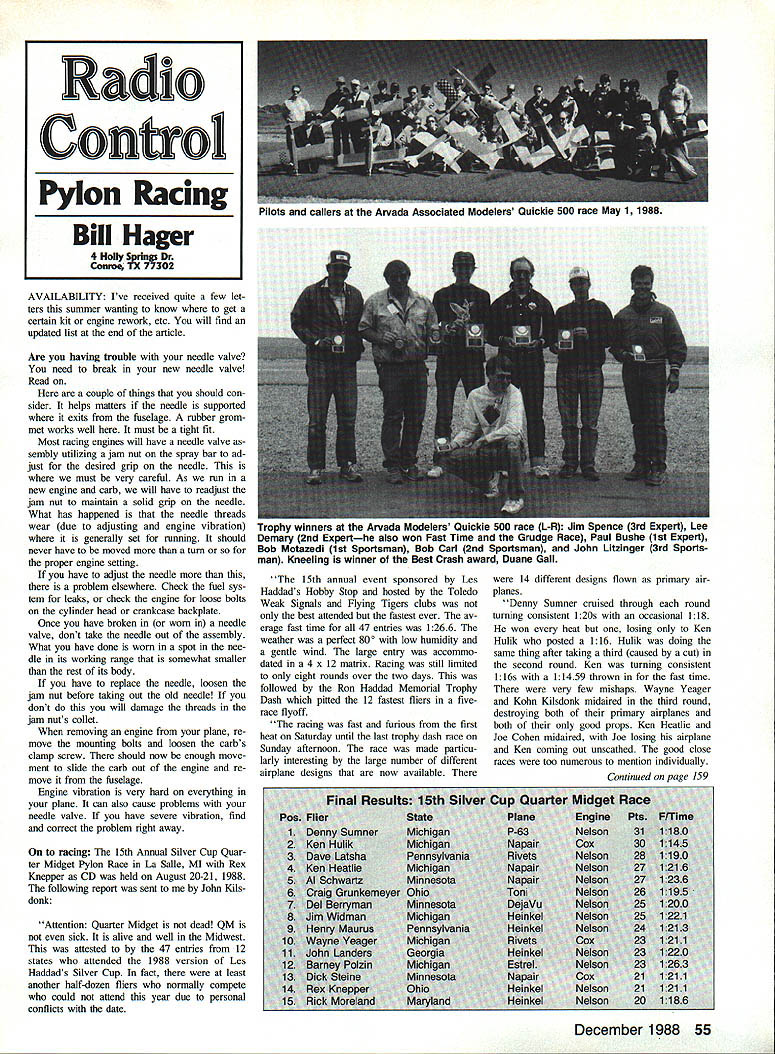
The Midwest mustered 47 entries from 12 states for the 1988 Silver Cup, sponsored by Les Haddad’s Hobby Stop and hosted by the Toledo Weak Signals and Flying Tigers clubs. At least another half-dozen fliers who normally compete could not attend this year due to personal conflicts. The event was the best attended and fastest ever; the average fast time for the 47 entries was 1:26.7. Weather was ideal — about 80°F, low humidity, and a gentle wind. The large entry was accommodated by a 4 × 12 matrix.
Racing was limited to eight rounds over two days, followed by the Ron Haddad Memorial Trophy Dash, which pitted the 12 fastest fliers in a five-race flyoff. Racing was fast and furious from the first heat Saturday until the last trophy-dash race Sunday afternoon. The race was made particularly interesting by the large number of different airplane designs now available — 14 different designs were flown in the primary class.
Denny Sumner cruised through the rounds, turning consistent 1:20s with occasional 1:18s, and won every heat but one. Ken Hulik posted a 1:16 and turned consistent 1:16s with a 1:14.59 fast time. There were very few mishaps: Wayne Yeager and John Kilsdonk mid-aired in the third round, destroying both primary airplanes but only damaging props. Ken Heatlie and Joe Cohen also mid-aired; Joe lost his airplane, while Ken came out unscathed. There were many good, close races too numerous to mention individually.
Four-and-a-half rounds were completed on Saturday. Saturday night featured the annual steak party with NY strips, corn on the cob, and all of the fixin's. The remaining three-and-a-half rounds were completed on Sunday, followed by the Trophy Dash.
Final results and highlights
- Final tabulation:
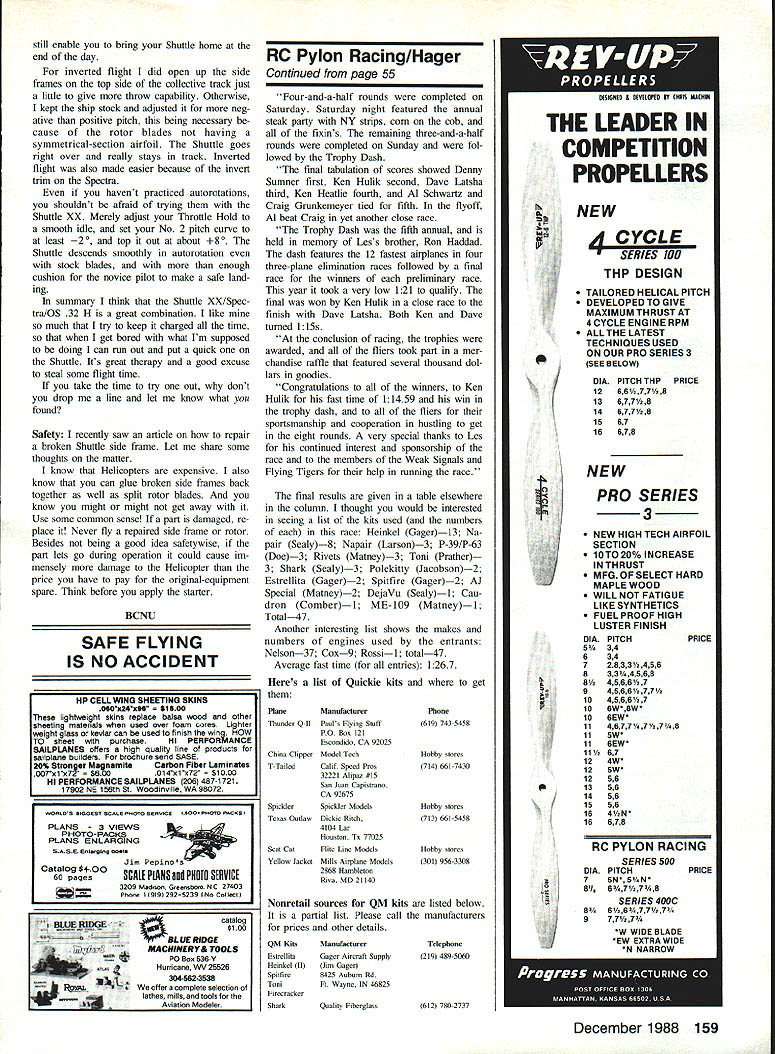
- Denny Sumner
- Ken Hulik
- Dave Latsha
- Ken Heatlie
- Al Schwartz (tie)
- Craig Gunkemyer (tie)
- In the flyoff, Al Schwartz beat Craig Gunkemyer in a close race.
- The Trophy Dash (held in memory of Ron Haddad) was a dash for the 12 fastest airplanes in four three-plane elimination races followed by a final race for the preliminary winners. This year it took a 1:21 to qualify. The final was won by Ken Hulik in a close finish over Dave Latsha; both Ken and Dave turned 1:15s.
- Ken Hulik posted the fast time of the meet at 1:14.59.
- At the conclusion of racing, trophies were awarded and all fliers participated in a merchandise raffle featuring several thousand dollars in prizes.
Kits used (primary class)
- Heinkel (Gager) — 13
- Napoli (Sealy) — 8
- Napoli (Larson) — 3
- P-39 (Prather) — 3
- Shark (Sealy) — 3
- Polleticky (Jacobson) — 2
- Estrellita (Gager) — 2
- Spitfire (Gager) — 2
- Al Special (Matney) — 2
- Deja Vu (Sealy) — 1
- Caudron (Comber) — 1
- ME-109 (Matney) — 1
- Total — 47
Engines used
- Nelson — 37
- Cox — 9
- Rossi — 1
- Total — 47
Average fast time (all entries): 1:26.7
A special thanks to Les Haddad for his continued interest and sponsorship of this event, and to the members of the Weak Signals and Flying Tigers for their help in running the race.
Transcribed from original scans by AI. Minor OCR errors may remain.

