
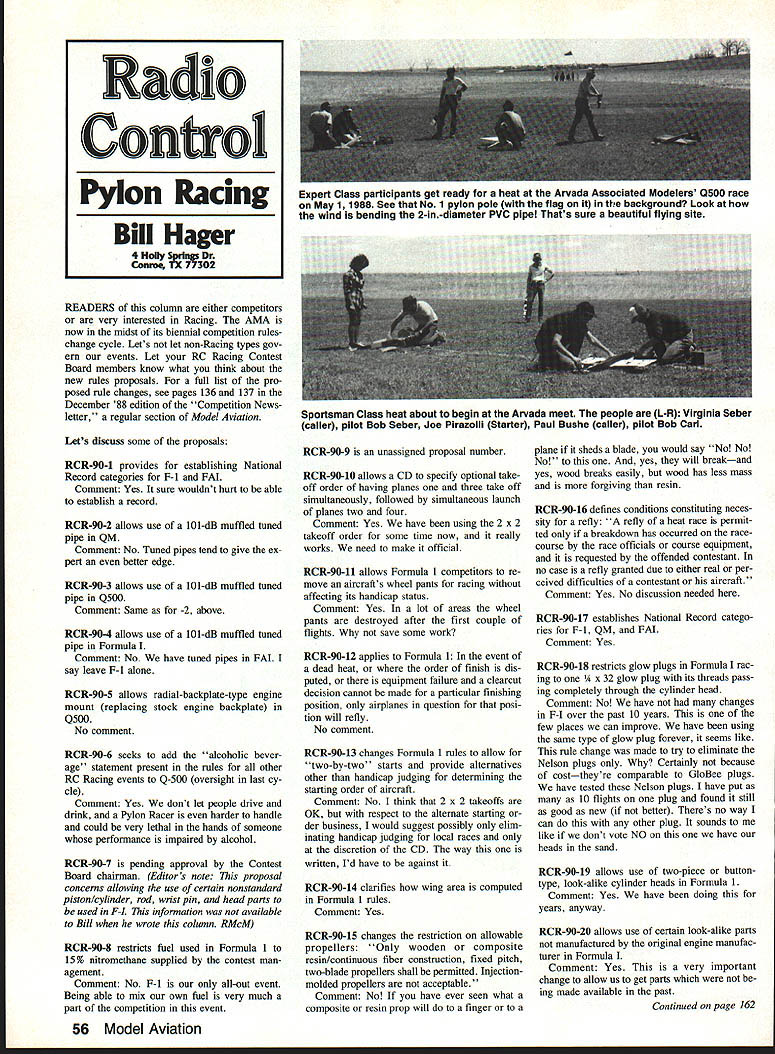
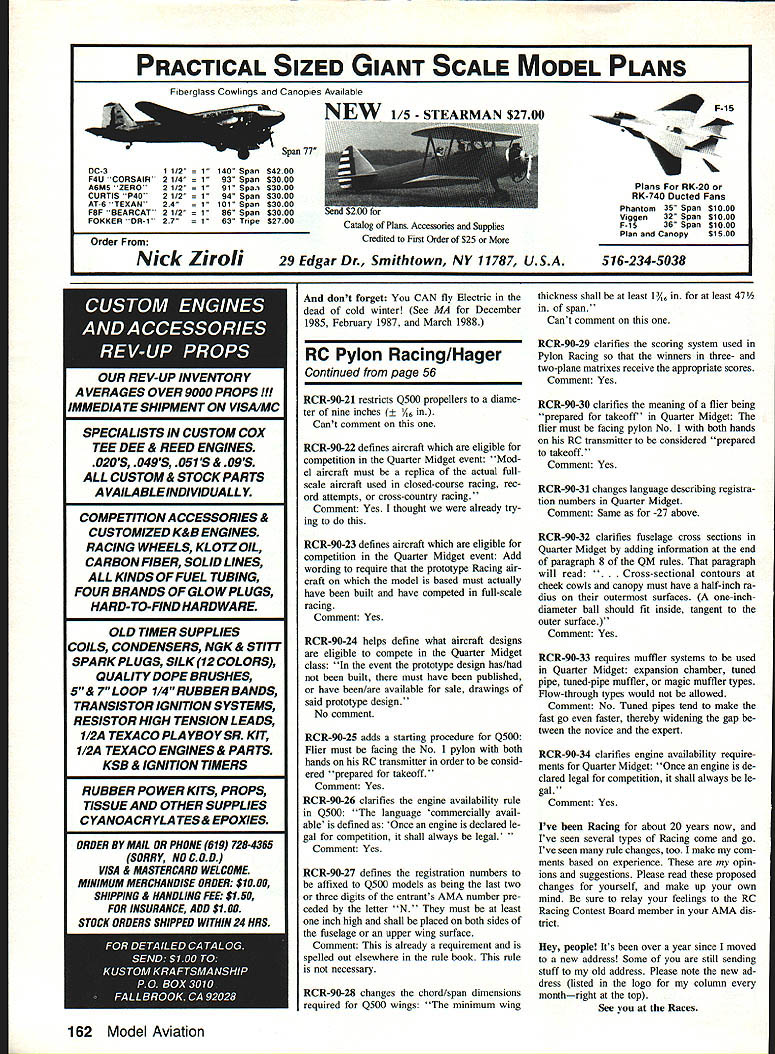
Radio Control: Pylon Racing
By Bill Hager
4 Holly Springs Dr. Conroe, TX 77302
Readers of this column are either competitors or are very interested in racing. The AMA is now in the midst of its biennial competition rules-change cycle. Let's not let non-racing types govern our events. Let your RC Racing Contest Board members know what you think about the new rules proposals.
For a full list of the proposed rule changes, see pages 136 and 137 in the December '88 edition of the "Competition Newsletter," a regular section of Model Aviation.
Proposed rule-change discussion
- RCR-90-1 — Provides for establishing National Record categories for F-1 and FAI.
Comment: Yes. It sure wouldn't hurt to be able to establish a record.
- RCR-90-2 — Allows use of a 101-dB muffled tuned pipe in QM.
Comment: No. Tuned pipes tend to give the expert an even better edge.
- RCR-90-3 — Allows use of a 101-dB muffled tuned pipe in Q500.
Comment: Same as for -2 above.
- RCR-90-4 — Allows use of a 101-dB muffled tuned pipe in Formula I.
Comment: No. We have tuned pipes in FAI. I say leave F-1 alone.
- RCR-90-5 — Allows radial-backplate-type engine mount (replacing stock engine backplate) in Q500.
Comment: No comment.
- RCR-90-6 — Seeks to add the "alcoholic beverage" statement present in the rules for all other RC racing events to Q-500 (oversight in last cycle).
Comment: Yes. We don't let people drive and drink, and a pylon racer is even harder to handle and could be very lethal in the hands of someone whose performance is impaired by alcohol.
- RCR-90-7 — Pending approval by the Contest Board chairman.
(Editor's note: This proposal concerns allowing the use of certain nonstandard piston/cylinder, rod, wrist pin, and head parts to be used in F-1. This information was not available to Bill when he wrote this column. — RMcM)
- RCR-90-8 — Restricts fuel used in Formula 1 to 15% nitromethane supplied by the contest management.
Comment: No. F-1 is our only all-out event. Being able to mix our own fuel is very much a part of the competition in this event.
- RCR-90-9 — Unassigned proposal number.
Comment: No comment.
- RCR-90-10 — Allows a CD to specify optional take-off order of having planes one and three take off simultaneously, followed by simultaneous launch of planes two and four.
Comment: Yes. We have been using the 2 x 2 takeoff order for some time now, and it really works. We need to make it official.
- RCR-90-11 — Allows Formula 1 competitors to remove aircraft wheel pants for racing without affecting handicap status.
Comment: Yes. In a lot of areas the wheel pants are destroyed after the first couple of flights. Why not save some work?
- RCR-90-12 — Applies to Formula 1: In the event of a dead heat, or where the order of finish is disputed, or there is equipment failure and a clear-cut decision cannot be made for a particular finishing position, only airplanes in question for that position will refly.
Comment: No comment.
- RCR-90-13 — Changes Formula 1 rules to allow "two-by-two" starts and provide alternatives other than handicap judging for determining the starting order of aircraft.
Comment: No. I think that 2 x 2 takeoffs are OK, but with respect to the alternate starting order business, I would suggest possibly only eliminating handicap judging for local races and only at the discretion of the CD. The way this one is written, I'd have to be against it.
- RCR-90-14 — Clarifies how wing area is computed in Formula 1 rules.
Comment: Yes.
- RCR-90-15 — Changes the restriction on allowable propellers: "Only wooden or composite resin/continuous fiber construction fixed-pitch, two-blade propellers shall be permitted. Injection-molded propellers are not acceptable."
Comment: No! If you have ever seen what a composite or resin prop will do to a finger or to a plane if it sheds a blade, you would say "No! No! No!" to this one. Yes, they will break—and yes, wood breaks easily, but wood has less mass and is more forgiving than resin.
- RCR-90-16 — Defines conditions constituting necessity for a refly: "A refly of a heat race is permitted only if a breakdown has occurred on the race course by the race officials or course equipment, and it is requested by the offended contestant. In no case is a refly granted due to either real or perceived difficulties of a contestant or his aircraft."
Comment: Yes. No discussion needed here.
- RCR-90-17 — Establishes National Record categories for F-1, QM, and FAI.
Comment: Yes.
- RCR-90-18 — Restricts glow plugs in Formula I racing to one 1/4 x 32 glow plug with its threads passing completely through the cylinder head.
Comment: Yes. We have not had many changes in F-1 over the past 10 years. This is one of the few places we can improve. We have been using the same type of glow plug forever. It seems like this rule change was made to try to eliminate Nelson plugs only. Why? Certainly not because they're comparable to GloBee plugs. We have tested Nelson plugs and have put 10 flights on one plug and found it still good as new. There's no way I can vote no on this one.
- RCR-90-19 — Allows use of two-piece button-type look-alike cylinder heads in Formula 1.
Comment: Yes. We have been doing this for years anyway.
- RCR-90-20 — Allows use of certain look-alike parts not manufactured by the original engine manufacturer in Formula 1.
Comment: Yes. This is a very important change to allow us to get parts which were not being made available in the past.
RC Pylon Racing / Hager
Continued from page 56
- RCR-90-21 — Restricts Q500 propellers to a diameter of nine inches (± 1/6 in.).
Comment: Can't comment on this one.
- RCR-90-22 — Defines aircraft which are eligible for competition in the Quarter Midget event: "Models must be a replica of the actual full-scale aircraft used in closed-course racing, record attempts, or cross-country racing."
Comment: Yes. I thought we were already trying to do this.
- RCR-90-23 — Defines aircraft which are eligible for competition in the Quarter Midget event: Add wording to require that the prototype racing aircraft on which the model is based must actually have been built and have competed in full-scale racing.
Comment: Yes.
- RCR-90-24 — Helps define what aircraft designs are eligible to compete in the Quarter Midget class: "In the event the prototype design has not been built, there must have been published, or have been/are available for sale, drawings of said prototype design."
Comment: No comment.
- RCR-90-25 — Adds a starting procedure for Q500: "Flier must be facing the No. 1 pylon with both hands on his RC transmitter in order to be considered 'prepared for takeoff.'"
Comment: Yes.
- RCR-90-26 — Clarifies the engine availability rule in Q500: "The language 'commercially available' is defined as: 'Once an engine is declared legal for competition, it shall always be legal.'"
Comment: Yes.
- RCR-90-27 — Defines the registration numbers to be affixed to Q500 models as being the last two or three digits of the entrant's AMA number preceded by the letter "N". They must be at least one inch high and shall be placed on both sides of the fuselage or on an upper wing surface.
Comment: This is already a requirement and is spelled out elsewhere in the rule book. This rule is not necessary.
- RCR-90-28 — Changes the chord/span dimensions required for Q500 wings: "The minimum wing thickness shall be at least 13/16 in. for at least 47% of span."
Comment: Can't comment on this one.
- RCR-90-29 — Clarifies the scoring system used in Pylon Racing so that the winners in three- and two-plane matrices receive the appropriate scores.
Comment: Yes.
- RCR-90-30 — Clarifies the meaning of a flier being "prepared for takeoff" in Quarter Midget: The flier must be facing pylon No. 1 with both hands on his RC transmitter to be considered "prepared for takeoff."
Comment: Yes.
- RCR-90-31 — Changes language describing registration numbers in Quarter Midget.
Comment: Same as for -27 above.
- RCR-90-32 — Clarifies fuselage cross sections in Quarter Midget by adding information at the end of paragraph 8 of the QM rules. That paragraph read: "Cross-sectional contours at cheek cowl and canopy must have a half-inch radius on their outermost surfaces." (A one-inch diameter ball should fit inside, tangent to the outer surface.)
Comment: Yes.
- RCR-90-33 — Requires muffler systems to be used in Quarter Midget: expansion chamber, tuned pipe, pintle, tuned-pipe muffler, or magic muffler types. The flow-through system would not be allowed.
Comment: No. Tuned pipes tend to make the engines go even faster, thereby widening the gap between the novice and the expert.
- RCR-90-34 — Clarifies engine availability requirements for Quarter Midget: "Once an engine is declared legal for competition, it shall always be legal."
Comment: Yes.
I've been racing for about 20 years now, and I've seen several types of racing come and go. I've seen many rule changes. I make my comments as a competitor. Please read these proposed changes for yourself, and make up your own mind. Be sure to relay your feelings to the RC Racing Contest Board member in your AMA district.
Hey, people! It's been over a year since I moved to a new address. Some of you are still sending stuff to my old address. Please note the new address (listed at the top of my column this month).
See you at the races.
Transcribed from original scans by AI. Minor OCR errors may remain.

