
Radio Control: Pylon Racing
Bill Hager 4 Holly Springs Dr. Conroe, TX 77302
Glass-cloth application (Art Arro)
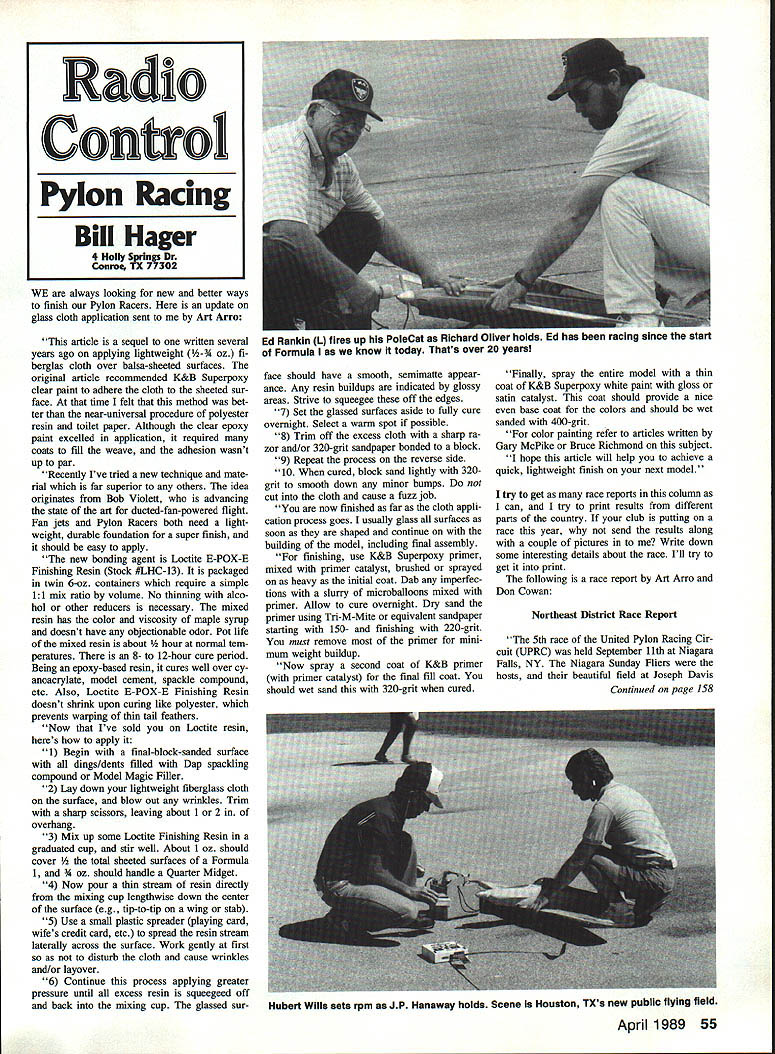
We are always looking for new and better ways to finish our pylon racers. The following is an update on applying lightweight (1/2–3/4 oz.) fiberglass cloth over balsa-sheeted surfaces, sent to me by Art Arro. This is a sequel to an article written several years ago which recommended K&B Superpoxy clear paint to adhere the cloth. At that time that method was preferable to the near-universal polyester-resin-and-toilet-paper approach, but it required many coats to fill the weave and adhesion wasn’t always ideal.
Bob Violett originated the idea of using a different bonding agent while advancing ducted-fan–powered flight. Fan jets and pylon racers both need a lightweight, durable foundation and a super finish that is easy to apply. The new bonding agent Art recommends is Loctite E-POX-E Finishing Resin (Stock #LHC-13).
- Packaged in twin 6-oz. containers; mix 1:1 by volume.
- No thinning with alcohol or reducers necessary.
- Mixed resin has the color/viscosity of maple syrup and no objectionable odor.
- Pot life (mixed): about 1/2 hour at normal temperature.
- Cure period: about 8–12 hours.
- Being epoxy-based, it bonds well over cyanoacrylate, model cement, spackle compound, etc.
- Unlike polyester, it does not shrink on curing, reducing the chance of warping thin tail surfaces.
Now for the application technique:
- Begin with a final block-sanded surface. Fill all dings/dents with Dap spackling compound or Model Magic Filler.
- Lay down your lightweight fiberglass cloth on the surface and blow out any wrinkles. Trim with sharp scissors, leaving about 1–2 in. of overhang.
- Mix Loctite Finishing Resin in a graduated cup and stir well. About 1 oz. should cover half the total sheeted surfaces of a Formula 1; 4 oz. should handle a Quarter Midget.
- Pour a thin stream of resin directly from the mixing cup lengthwise down the center of the surface (e.g., tip-to-tip on a wing or stab).
- Use a small plastic spreader (playing card, old credit card, etc.) to spread the resin stream laterally across the surface. Work gently at first so as not to disturb the cloth or cause wrinkles/layover.
- Continue spreading, increasing pressure until excess resin is squeegeed off back into the mixing cup. The glassed surface should have a smooth, semimatte appearance. Any resin buildups will be glossy—strive to squeegee these off.
- Set glassed surfaces aside to fully cure overnight. Select a warm spot if possible.
- Trim off excess cloth with a sharp razor and/or 320-grit sandpaper on a bonded block.
- Repeat the process on the reverse side.
- When fully cured, block-sand lightly with 320-grit to smooth minor bumps caused by the cut cloth and to remove fuzz. The cloth-application process is now complete.
After glassing, continue building the model (shaping, assembly, finishing). Recommended finishing procedure:
- Apply K&B Superpoxy primer mixed with primer catalyst, brushed or sprayed on as heavy as the initial coat.
- Dab any imperfections with a slurry of microballoons mixed with primer. Allow to cure overnight.
- Dry-sand primer using Tri-Mite or equivalent sandpaper, starting with 150-grit and finishing with 220-grit. Remove most of the primer to minimize weight buildup.
- Spray a second coat of K&B primer (with catalyst) as the final fill coat. Wet-sand this with 320-grit when cured.
- Spray the entire model with a thin coat of K&B Superpoxy white paint (gloss or satin catalyst). This provides a base for colors; wet-sand with 400-grit.
- For color painting techniques and schemes, see articles by Gary McPike and Bruce Richmond.
I hope this helps you achieve a quick, lightweight, durable finish on your next model.
If your club is putting on a race this year, send results and a couple of pictures, plus interesting details about the race. I’ll try to get them printed.
— Art Arro
RC Pylon Racing — Race Report (Art Arro & Don Cowan)
State Park was used for this event. Both UPRC events, Sport Pylon and Formula 1/FAI (F3D), were flown at the race.
Background and class rules:
- UPRC Sport Pylon resembles AMA Sport Pylon/Formula 500 rules with minor exceptions. Maximum engine displacement is 0.40 cu. in., and minimum wing thickness is 12%. There is no weight specification or constant-chord requirement as in AMA Quickie 500 (Event 42). Both Standard and Expert classes are flown together; the main difference is the use of loop-scavenged (Standard) or Schnuerle-ported (Expert) engines.
- Formula 1/FAI (F3D) were combined in a single race matrix, using Formula 1 scoring and course length. Static judging for takeoff position used “beauty contest” guidelines; some FAI models earned No. 1 takeoff positions.
Turnout and conditions:
- Entries: 24 in Sport, 13 in Formula 1/FAI (F3D). Four fliers in Sport Standard Class. Three strong competitors in Formula 1/FAI. Competitors came from central/western New York and southern Ontario; the Canadians were very competitive.
- Weather: sunny skies with a mild breeze quartering down the race course. A high-altitude haze from western U.S. forest fires produced unusually cool temperatures and diminished daylight.
Sport Pylon:
- Began midmorning with three-plane heats and eight heats per round. Many close races; four fliers broke into the thirties in Sport (times are on a Formula 1 course using Quickie-type models, expansion-chamber mufflers, stock engines, and wide-blade props).
- Dave Kelly set a new UPRC Sport Pylon record at 1:37.05 in a tight race with two Canadians, who also broke the 1:40 barrier. Don Cowan recorded 1:39.0 in another close race. Sport Pylon was flown for five rounds to allow Formula 1/FAI to use remaining daylight.
Awards and thanks:
- Cash-back awards were given to the top three in each event. Many fliers and workers repaired for pizza and refreshments afterward. The UPRC thanks the Niagara Sunday Fliers for an excellent race and welcomes all pylon enthusiasts to UPRC events. The Sport Standard Class is an excellent place to start.
Sport Pylon — Expert Class results
- Dave Kelly — 1:37.05 (new UPRC record)
- Dave Smith — 1:43.4
- Ernie Nikodem — 1:44.7
- Bob Ball — 1:48.1
- Al Baker — 1:48.9
Sport Pylon — Standard Class results
- Marlene Nikodem — 2:15.7 (Fast Time)
- Van R. Glager — 2:25.8
- Cory Paine — 2:40.2
- Jim Carroll — 2:46.0
Formula 1 / FAI (F3D) results
- Ralph Perrillo — 1:21.8 (F1)
- Rick Paine — 1:20.8 (F1)
- Art Arro — 1:24.1 (FAI)
- Dave Smith — 1:24.5 (F1)
- Don Cowan — 1:25.9 (F1)
Transcribed from original scans by AI. Minor OCR errors may remain.

