
Radio Control: Pylon Racing
Bill Hager
4 Holly Springs Dr. Conroe, TX 77302
Frequency update (Russ Kime)
You missed last year's Tangerine Internationals? You missed a good one! Try to work it in your schedule this year, and I don't think you will be sorry.
This is an update on the NMPRA frequency control system for the benefit of Racing Contest Directors who must implement the phasing in of the new narrow-band frequencies into the matrices this year for the 1988–91 period.
As you know, the old 72 MHz frequencies (72.08, 72.16, 72.24, 72.32, 72.40, 72.96, and 75.64) became illegal as of December 20, 1987. We now have available the broadband channels RC38, 40, 42, 44, 46, 48, 50, 52, 54, and 56 (phased in last year), plus the new narrow-band channels RC12, 14, 16, 18, 20, 22, 24, 26, 28, 30, 32, 34 (became legal December 20, 1987).
Unfortunately, crystals for these new low-band frequencies were not yet available from Airtronics and Futaba (this was written last year — RMcM), so many new narrow-band radios were being shipped on the high-band channels. (I understand Ace R/C has the new frequencies available now, but you will have to check this out yourself.) This poses no problem, however, since all channels must meet narrow-band specs in 1991, including channels RC38–56. It is perfectly legal (and desirable) to operate narrow-band equipment on RC38–56 at this time — you will merely be meeting the 1991 specs three years early.
We will again employ the system of “every third channel out” as we did last year, which means we will not use channels RC12, 18, 24, 30, 36, 42, 48, and 54. We will use channels 14, 16, 20, 22, 26, 28, 32, 34, 38, 40, 44, 46, 50, 52, and 56. The AMA has allocated these frequencies for Racing at the 1988 Nats at Virginia Beach, VA. So buy your new equipment accordingly.
All of the 50–54 MHz ham-band frequencies which were legal last year continue to be so this year and into the foreseeable future, but these require the user to have the appropriate FCC license; licenses will be checked as you register for each Racing event. (It is a violation of Federal law to use these frequencies without the proper FCC license. — Ed.)
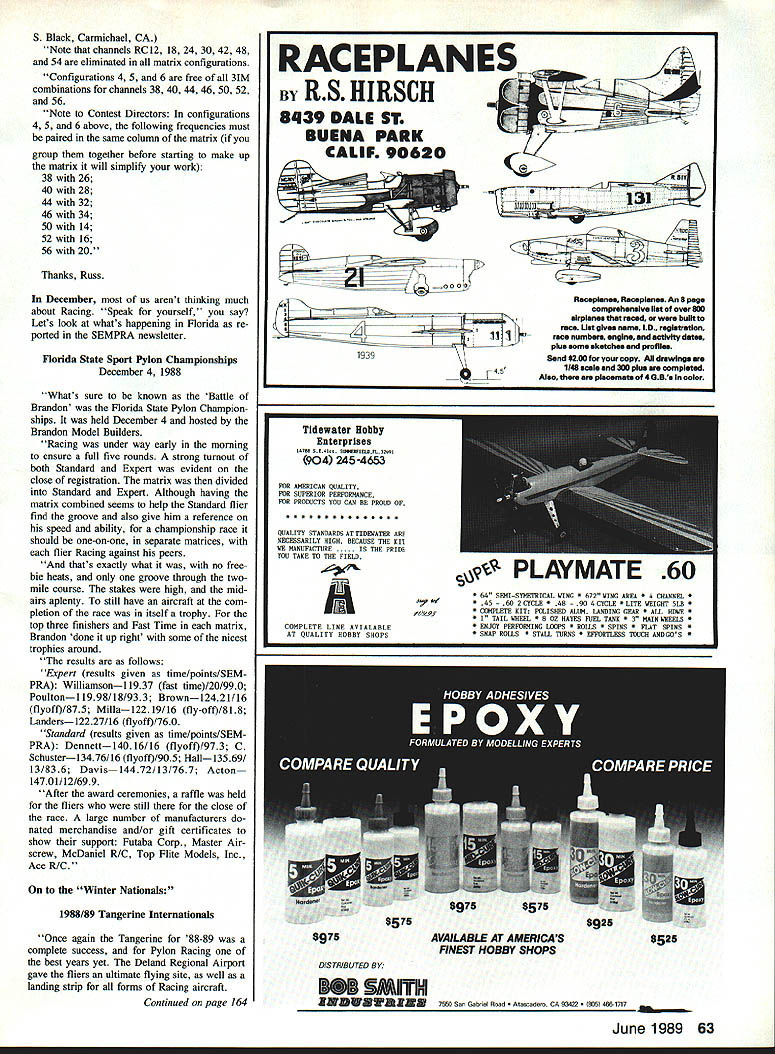
Last year I devised three possible matrix configurations which were free of all 3IM combinations (3IM means third-order intermodulation interference) for the 1988–91 period. Only the first was published in the NMPRA newsletter; the other two were included in the package I sent to various Racing Contest Directors who requested it. These three configurations (1, 2, and 3) eliminate all 3IM combinations for both narrow-band and wideband frequencies that we use and are the preferred configurations to use if at all possible. (Configuration No. 3 courtesy of Owen. — S. Black, Carmichael, CA.)
However, since new narrow-band equipment should by definition be free from 3IM interference problems, it is possible to add three more configurations (4, 5, and 6) which will be 3IM-free for the broadband channels only. The narrow-band channels will be at risk in very few instances, and only if they do not meet the 1991 narrow-band specs. These matrix configurations parallel the matrices we used successfully in 1987 and should prove useful while many continue to operate on last year’s frequencies, at least until mid-summer.
Let me repeat: All six matrix configurations are 3IM-free for channels 38 through 56; the first three are 3IM-free for all channels that we use. Use configuration 1, 2, or 3 if at all possible — they are free from all 3IM combinations for all channels.
Note: channels RC12, 18, 24, 30, 36, 42, 48, and 54 are eliminated in all matrix configurations.
Configurations 4, 5, and 6 are free of all 3IM combinations for channels 38, 40, 44, 46, 50, 52, and 56.
Note to Contest Directors: In configurations 4, 5, and 6, the following frequencies must be paired in the same column of the matrix (group them together before starting to make up the matrix — it will simplify your work):
- 38 with 26
- 40 with 28
- 44 with 32
- 46 with 34
- 50 with 14
- 52 with 16
- 56 with 20
Thanks, Russ.
Summary notes on frequencies
- Broadband channels available: RC38, 40, 42, 44, 46, 48, 50, 52, 54, 56.
- Narrow-band channels available: RC12, 14, 16, 18, 20, 22, 24, 26, 28, 30, 32, 34.
- Channels eliminated from matrices (every third channel out): RC12, 18, 24, 30, 36, 42, 48, 54.
---
Florida State Sport Pylon Championships
December 4, 1988
“What’s sure to be known as the ‘Battle of Brandon’ was the Florida State Pylon Championships,” hosted by the Brandon Model Club.
Racing began early to ensure a full five rounds. A strong turnout in both Standard and Expert classes was evident at registration. The matrix was divided into Standard and Expert for the championship races so that each flier raced against peers — one-on-one, no freebie heats, and only one groove through the two-mile course. Midairs were plentiful; to finish with an aircraft was in itself a trophy. Brandon presented attractive trophies for the top three finishers and Fast Time in each matrix.
Results (as printed; times/points/SEMPRA):
Expert
- Williamson — 119.37 (fast time) / 209.90
- Poulton — 119.98 / 183.93
- Brown — 124.21 / 161.21 (flyoff?) 87.85
- Millas — 122.19 / 76.10
- Landers — 122.27 / 116.76
Standard
- Dennett — 140.16 / 16.16 (flyoff) / 97.33
- C. Schuster — 134.76 / 16 (flyoff) / 90.5
- Hall — 135.69 / 137.83
- Davis — 144.72 / 137.76
- Acton — 147.01 / 126.99
After the awards a raffle was held for fliers present at the close. Many manufacturers donated merchandise and/or gift certificates: Futaba Corp., Master Airscrew, McDaniel R/C, Top Flite Models, Inc., Ace R/C.
---
On to the "Winter Nationals": 1988/89 Tangerine Internationals
Once again the Tangerine for ’88–’89 was a complete success, and for Pylon Racing one of the best years yet. The Deland Regional Airport provided an excellent flying site and a landing strip for all Racing aircraft.
Once the morning fog cleared, the sky produced some of the nicest weather of the year — temperatures in the mid-80s. For those who made the event from out of state, the weather alone made the trip worthwhile.
The Remote Control Association of Central Florida (RCACF) hosted the event and ran it smoothly. There’s a backup for everything and an alternate for everyone — redundancy is the key to reliability.
Saturday morning featured Quarter-Scale Racing, promoted by the Quarter-Scale Pylon Racing Association. These four-stroke-powered giants raced the Formula One course. Quarter Midget racing began Saturday afternoon. Jack Jackson and the RCACF pylon crew ran seven rounds and continued Sunday; fliers and crew unanimously decided Midget would be called at the end of five rounds.
Quarter Midget results
(Results listed as time/points/SEMPRA; some numeric details were indistinct on the scan.)
- Jacobson — 117.64 / 209 / 9.5
- Deene — 116.43 (fast time) / ?
- Benczer — 117.84 / ? / ?
- Lenders — 120.40 / 15 (flyoff) / 83.1
- O’Brien — N/T / 14 / 77.7
- Williamson — 118.60 / 147 / 22?
- Simms — N/T / 11 / 55.8
- Telles — N/T / 10 / 50.4
Sunday morning (New Year’s Day) began the first NMPRA-sanctioned Formula One race of the 1989 season under Contest Director Bill Williamson.
There were many Formula One entries, suggesting an F-1 circuit could be forming in the South-Central-East if the effort continues and sites hold races. Mike Langlois impressed by winning the Pretty Plane event and Best of Show.
RC Pylon Racing (Formula One) results
(Results listed as time/points/SEMPRA)
- Bruce Richmond — 131.53 (fast time) / 24 (flyoff) / 100.0
- Brian Richmond — 113.03 / 24 (flyoff) / 94.8
- McDermott — 117.15 / 17 (flyoff) / 89.6
- Benczer — 121.39 / 17 (flyoff) / 84.4
- Kerlo — 118.27 / 16 / 79.2
- Wilson — 130.01 / 15 / 74.0
- Langlois — 124.84 / 14 / 68.8
- Jacobson — 124.89 / 14 / 63.6
- Schuster — 125.16 / 14 / 58.4
- Walker — 129.20 / 84 / 53.2
Monday saw a flood of Sport Pylon entries. Sport Pylon (SEMPRA style) is arguably the most popular RC Racing event in the Southeast; 49 entries gave RCACF one of the largest turnouts ever.
Five rounds of 15 heats per round meant 75 heats (the text reports 78 heat races due to reflies and flyoffs). Two unavoidable reflies and two flyoffs were handled in about 7½ hours of upper-level heat work — roughly 5.7 minutes per heat. Line bosses Gary Freeman and Doris Tyson (and their crew) completed the work without stopping for lunch.
SEMPR A Expert Sport Pylon results
(Results listed as time/points/SEMPRA)
- Poulton — 125.00 / 20 / ?
- Rice — 129.00 / 19 (flyoff) / 106.5
- Bogut — 122.43 / 19 (flyoff) / 104.3
- Kerlo — 122.55 / 19 (flyoff) / 102.0
- Williamson — 124.22 / 19 (flyoff) / 99.8
- O’Brien — 124.57 / 18 / 97.6
- Jacobson — 127.89 / 18 / 95.3
- B. Schuster — 123.78 / 17 / 93.1
- Katz — 133.42 / 17 / 90.8
- Wilson — 136.76 / 17 / 88.6
SEMPR A Standard Sport Pylon results
(Results listed as time/points/SEMPRA)
- Dennett — 134.88 / 15 (flyoff) / 72.9
- Wetmore — 140.39 / 15 (flyoff) / 70.7
- Reames — 153.23 / 15 (flyoff) / 68.4
- Clyatt — 205.05 / 15 / 66.2
- Hall — 130.75 (fast time) / 62.9
- Acton — 145.97 / 13 / 59.5
- Gibson — 130.48 / 52.?
- T. Lyons — 139.51 / 12 / 50.5
- C. Schuster — 137.32 / 11 / 46.0
- Jaco — 137.31 / 9 / 45.0
A complete UR radio system was donated by Hobby Dynamics, and two bottles of Norvell heat-trim solvent were donated by L&H Industries. These raffle items were given to contestants present for the awards ceremony.
(Note: Numeric times and point details on the scanned page are small and somewhat indistinct in places; names and formats above reflect the printed layout and are reproduced to the best legible extent from the scan.)
---
Additional notes / continued
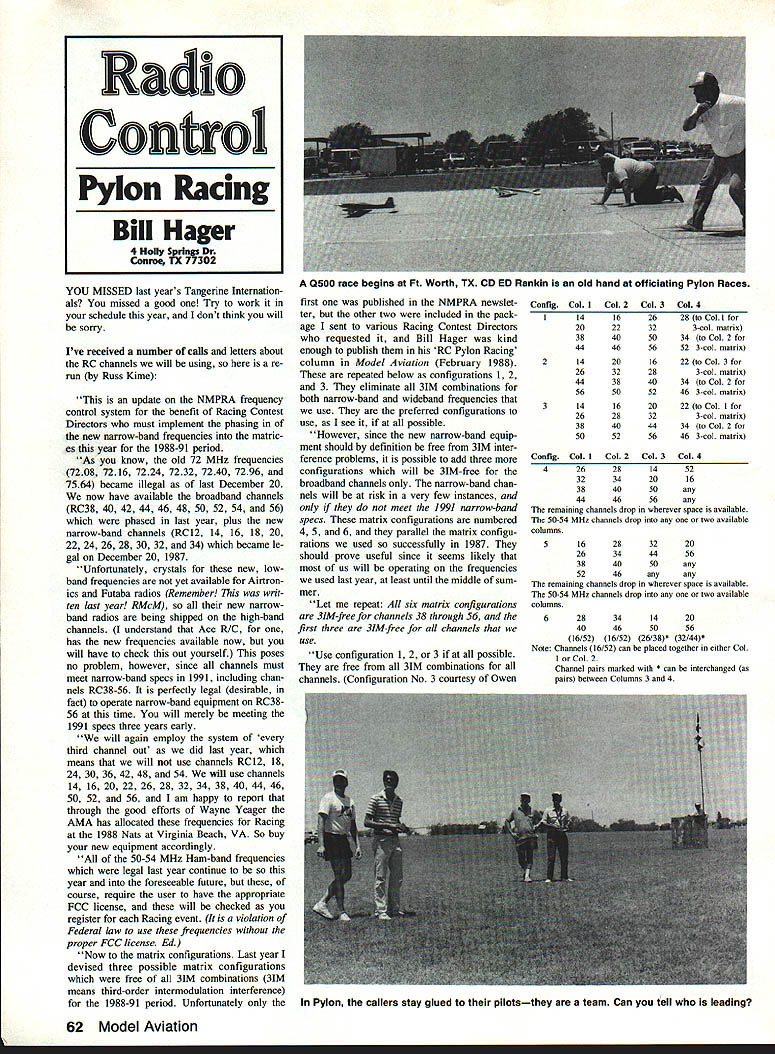
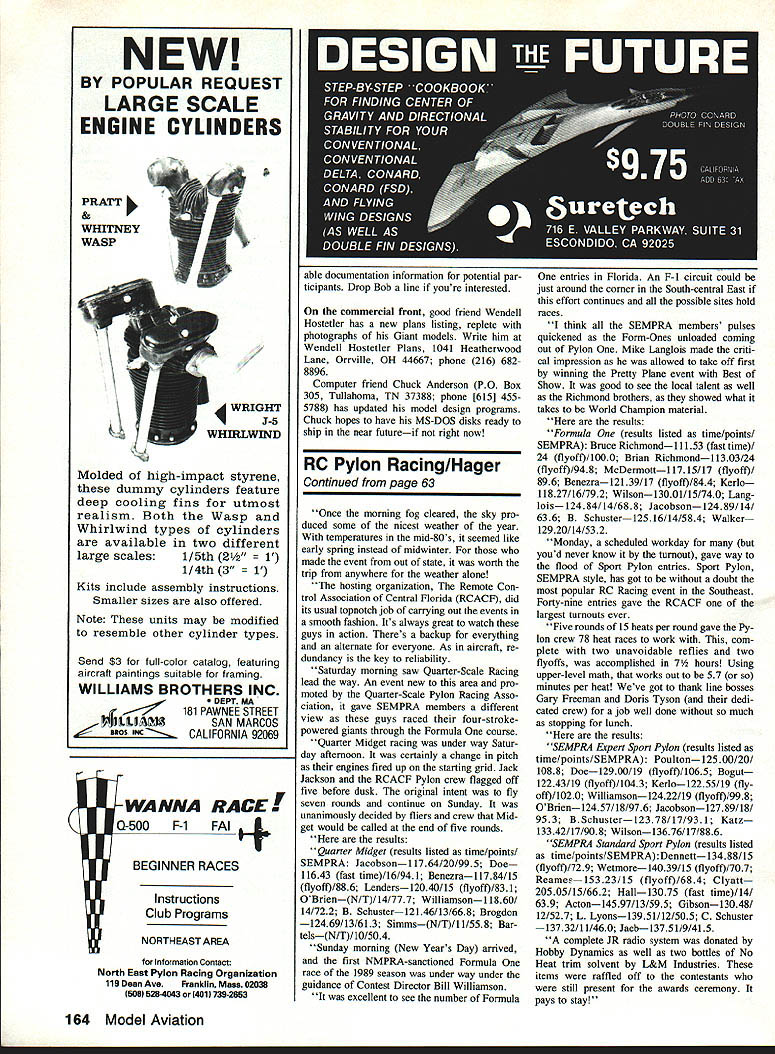
Race begins Ft. Worth, TX. CD Ed Rankin, an old hand officiating pylon races. Pylon callers stay glued to pilots; they can tell the leading position. — S. Black, Carmichael, CA.
Note: channels RC12, 18, 24, 30, 36, 42, 48, 54 are eliminated from matrix configurations.
Configurations 4, 5, and 6 are 3IM-free for channels 38, 40, 44, 46, 50, 52, and 56.
Note to Contest Directors: In configurations 4, 5, and 6 the following frequencies must be paired in the same column/group before starting to make up the matrix:
- 38 with 26
- 40 with 28
- 44 with 32
- 46 with 34
- 50 with 14
- 52 with 16
- 56 with 20
Transcribed from original scans by AI. Minor OCR errors may remain.

