
Radio Control: Pylon Racing
Bill Hager 4 Holly Springs Dr. Conroe, TX 77302
Hi, gang! There are a lot of new items for '89. I just received a computer program from John Wall, 931 Ohio Ave., Lemoyne, PA 17043. This program will put together a matrix that avoids all third-order intermodulation radio interference. The program is one of several put together to help make things easier for contest management. More on this later in the season.
Pete Seabase told me about Quarter-Scale racing in another letter. Pete writes about the Tangerine Quarter-Scale races:
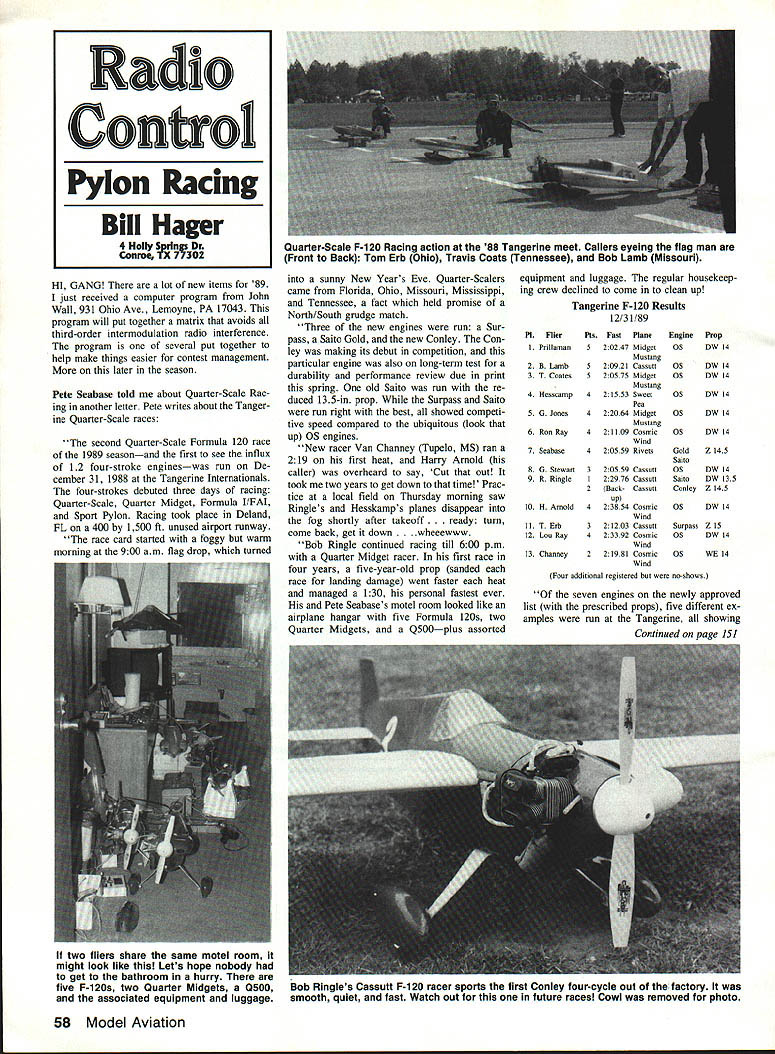
The second Quarter-Scale Formula 120 race of the 1989 season — and the first to see the influx of .120 four-stroke engines — was run on December 31, 1988 at the Tangerine Internationals. The four-strokes debuted during three days of racing: Quarter-Scale, Quarter Midget, Formula 1/FAI, and Sport Pylon Racing took place in DeLand, FL, on a 400 by 1,500 ft. unused airport runway. The race card started with a foggy, warm morning at the 9:00 a.m. flag drop, which turned into a sunny New Year's Eve. Quarter-Scalers came from Florida, Ohio, Missouri, Mississippi, and Tennessee, a fact that held promise of a North/South grudge match.
Three of the new engines were run: a Surpass, a Saito Gold, and the new Conley. The Conley was making its debut in competition, and this particular engine was also on long-term test for durability and a performance review due in print this spring. One older Saito was run with the reduced 13.5-in. prop. While the Surpass and Saito were right up with the best, all showed competitive speed compared to the ubiquitous OS engines.
New racer Van Channey (Tupelo, MS) ran a 2:19 in his first heat, and Harry Arnold (his caller) was overheard to say, "Cut out — it took me two years to get down to that time!" Practice at a local field on Thursday morning saw Ringle's and Hesskamp's planes disappear into the fog shortly after takeoff — ready; turn; come back; get down ... wheeeeewww!
Bob Ringle continued racing till 6:00 p.m. with a Quarter Midget racer. In his first race in four years, a five-year-old prop (sanded for landing damage) went faster each heat and managed a 1:30, his personal fastest ever.
Pete Seabase's motel room looked like an airplane hangar with five Formula 120s, two Quarter Midgets, a Q500-plus, assorted equipment and luggage. The regular housekeeping crew declined to come in to clean up!
Of the seven engines on the newly approved list (with the prescribed props), five different examples were run at the Tangerine, all showing similar capability depending on piloting! The only types missing were the "small" and "big" Enyas. Hope we see what they can do also in the future. Enya lovers, let's see then.
For those wanting to experiment with their favorite engine—or place a once-noncompetitive one into service—remember, we have until roughly next June before possible prop changes may be announced. The old Saito and Enyas like the unloading with their allowed smaller 13.5-in. props. There may be some sleepers out there.
By the same token, if any brand or engine/prop looks like a runaway, it will be loaded down more on the next prop cycle. The engine/prop rulings, along with the aircraft similarity (all designs built have been fast when flown well) should make higher engine/prop power a bit more predictable. Formula 120 was intended to be a flying event by the founders, not a power event. It looks as if the prop-loading rules will keep it that way (regardless of market or manufacturers' changes in engine availability or relative power in the future).
F-120 Event
Summary of Engines and Props Approved for 1989/1990 (All propellers are 10-in. pitch)
- Conley .12 — 14.5
- Enya 120 — 13.5
- Enya 120 R — 14.5
- OS FS 120 — 14.0
- OS Surpass — 15.0
- Saito FA 120 — 13.5
- Saito FA 120 S — 14.5
"The 'quiet challenge' may become vogue. AMA Pattern is encouraging its competitors to get below 98 dBA (bonus points below this number). NMPRA mentioned noise in its December newsletter, and these are the various readings noted at the Tangerine:
Sound Levels
- Type: F-120 — Engine: "Hot" OS — Sound Level (dBA): 95
- Type: F-120 — Engine: Saito — Sound Level (dBA): 94
- Type: F-120 — Engine: Conley — Sound Level (dBA): 92
- Type: Quarter Midget — Engine: Nelson .15 — Sound Level (dBA): 108
- Type: F-1 — Engine: Supertigre .40 — Sound Level (dBA): 110+
- Type: Ducted Fan — Engine: KBV .72 — Sound Level (dBA): 101
(Note: Several old-time racers admitted to needing hearing aids!)
The Tangerine didn't cool or settle the North/South and inter-district rivalry. With hot and closely fought heats, team Memphis rookie Gene Stewart and Ohio's ('87 Tangerine champ) Tom Erb occupied the same line, each with Cassutts... looking forward to a rematch in Tennessee on April 16, and Mississippi on May 27 and 28.
The Quarter-Scale Nationals will be outside of Ohio for the first time since 1980 in Tupelo, MS on Labor Day weekend 1989, the year Formula 120 hits its second decade. There are more engines (and none will become obsolete), eight approved glass/foam kits, over 20 approved plans for scratch builders, and members in over 15 states and three countries. If you want to fly and race the "big ones" call (216) 777-6172 for information. I'm looking forward to hearing from you Quarter-Scale guys.
Here is a tip as copied from the QSPRA (Quarter Scale Pylon Racing Association) newsletter:
The Dreaded Firewall Installation
Most of you old-timers have long ago figured out a technique for putting that pesky firewall in its proper location in a fiberglass fuselage, so you can skip this section. But a newcomer, when faced with the task, breaks out into a cold sweat, hives, and the heebie-jeebies. The following is one approach to the problem:
- After the fuselage has been cleaned of all release agent, sand the nose ring flat and square.
- Zap balsa to the rear of the spinner backplate. Sand balsa down to the diameter of the backplate, and cut outside center of balsa so the engine drive washer will butt up to the backplate in its normal position.
- Position the spinner backplate on the front of the fuselage and Zap in place.
- Slide the engine into the fuselage and bolt on a prop spinner in place.
- Slip the engine mount in and bolt to the engine. At this point you'll have the engine and mount hanging free inside the fuselage and attached to the fuselage only by the spinner backplate glued to the nose.
- Fit a previously fuel-proofed firewall into the fuselage and keep cutting, fitting, and sanding until the firewall buts up to the engine mount and fits the cowl all the way around. Take your time—go slow and get a good fit. Hint: Rub fingertips rapidly back and forth over the outside of the fuselage, and you'll feel where the firewall is tight and is pressing the fiberglass outward. Keep at it until it's tight.
- When everything fits, position the engine where you want it. You do want the cylinder head to come out through the center of the cowl, I presume? Holding the firewall snug against the engine mount—Zap 'em together! Mark the firewall location on the inside of the fuselage with a felt-tipped pen so you'll know where to put the epoxy.
- Undo the engine from the mount. Leave the engine attached to the nose.
- Remove the zapped firewall/mount unit. Keep them glued together, drill four blind-nut holes, install blind nuts, and bolt it all together. Note: Some blind nuts are so long they will go through a 1/4" firewall and touch the mount. Check it out, and add an additional 1/4" plywood piece on the back of the firewall if needed.
- Spread 30-minute epoxy in and on the firewall edge, slip the firewall/mount unit into the fuselage, pull the mount unit into the nose, and settle everything. Let everything set overnight.
- Cut the balsa free from the nose, remove the prop and spinner backplate. Presto! Everything in perfect position.
If you have any ideas to pass on, send them to me. See you next month!
Transcribed from original scans by AI. Minor OCR errors may remain.

