
Radio Control: Pylon Racing
Bill Hager
4 Holly Springs Dr. Conroe, TX 77302
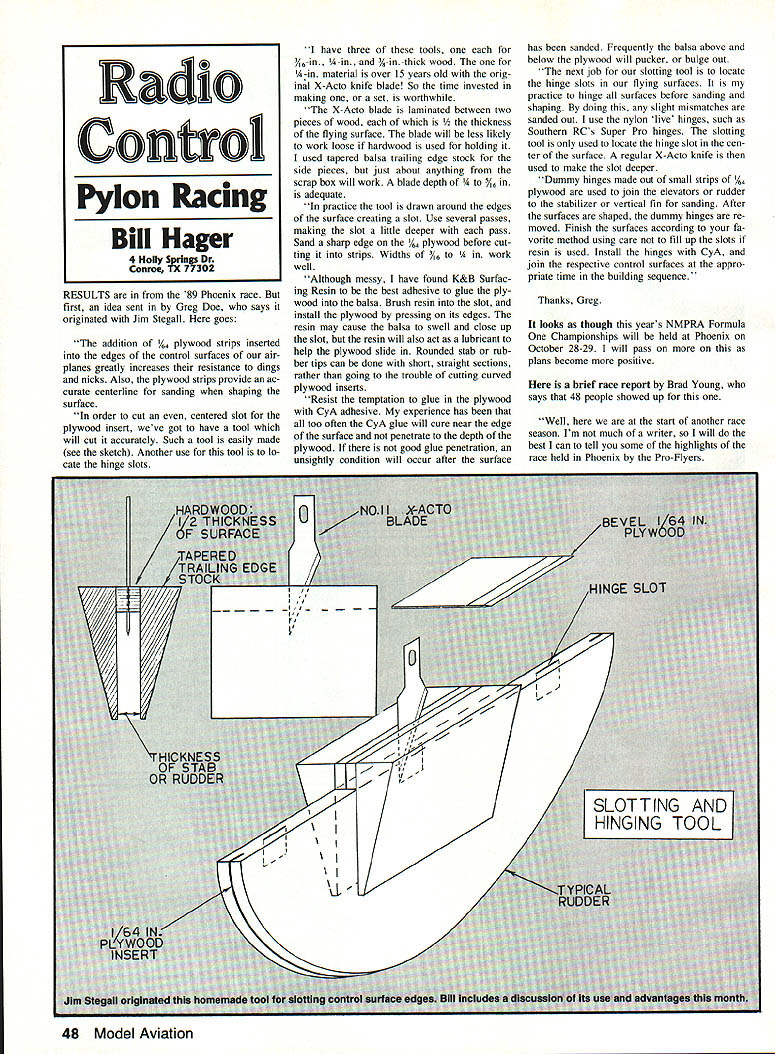
Plywood edge inserts and slotting tool (idea from Greg Doe; originated with Jim Stegall)
The addition of 1/8-inch plywood strips inserted into the edges of control surfaces greatly increases their resistance to dings and nicks and provides an accurate centerline for sanding when shaping the surface.
Tool construction and use
- The slotting tool is easily made by laminating an X‑Acto blade between two pieces of wood. Hardwood for the blade holder is preferred to keep the blade from working loose. Tapered balsa trailing-edge stock or scrap wood will work for the side pieces.
- I keep three tools sized for 3/16-, 1/4-, and 3/8-inch wood. The X‑Acto blade can last many years if installed well.
- Blade depth of about 1/8 to 3/16 inch is adequate.
- To cut the slot, draw the tool around the edge of the surface, using several passes and increasing depth slightly with each pass. Sand a sharp edge on the 1/16-inch plywood before cutting into strips. Plywood widths of about 3/16 to 1/4 inch work well.
- Rounded stab rubber tips can be made with short straight sections rather than cutting curved plywood inserts.
Adhesives and cautions
- K&B Surfacing Resin has proven effective for gluing the plywood into balsa. Brush resin into the slot and press the plywood into place. The resin may swell the balsa and help the plywood slide in.
- Resist using CyA to glue these inserts. CyA often cures near the surface edge without penetrating fully, which can cause puckering or bulging of the balsa after sanding.
Hinge location and dummy hinges
- The slotting tool is also useful for locating hinge slots. I hinge all surfaces before sanding and shaping so that any slight mismatches can be sanded out.
- I use nylon "live" hinges (e.g., Southern R/C’s Super Pro hinges). Use the slotting tool to locate the center of the hinge slot, then deepen the slot with a regular X‑Acto knife.
- Use dummy hinges made from small strips of 1/64-inch plywood to join elevators or rudder to stabilizer/vertical fin for sanding. Remove dummy hinges after shaping.
- Finish surfaces as usual, taking care not to fill the hinge or insert slots. Install the real hinges with CyA at the appropriate point in the building sequence.
Thanks to Greg for the idea.
---
Phoenix '89 — Race report (by Brad Young)
We had scale judging Friday night. Richard Verano won Best of Show with his Denteight. Forty‑eight entrants showed up, a great turnout. Dave Shadel set fast time with a 1:08.90 and never let up all weekend.
Some highlights and mishaps:
- Several new people attended. Tim experienced some bad air, and Mike Otto learned not to buy someone’s old airplane after folding a wing at pylon #1.
- Gary Hoyer lost his Kazi coming out of pylon #1, and I (Bill Hager) lost my Land Nancy in a high‑speed touch‑and‑go at #1.
- After the dust settled, everyone had a good weekend. Thanks to Jim Allen, Mike Delponte, and all who helped run the race.
Results (position / laps / time)
- Dave Shadel — 32 / 1:08.90
- Bruce Richmond — 31 / 1:14.00
- Lyle Lawson — 29 / 1:15.88
- Richard Verano — 28 / 1:16.19
- Brian Richmond — 28 / 1:18.03
- Dub Jett — 27 / 1:15.40
- Mike Helsel — 26 / 1:14.79
- Paul Stenberg — 26 / 1:16.84
- Fred French — 26 / 1:17.40
- Bob Smith — 25 / 1:15.31
Note: The NMPRA Formula One Championships are scheduled for Phoenix on October 28–29. More details will be passed along as plans firm up.
---
Frequency changes and interference issues (by Russ Kime)
It may seem early to plan for the frequency changes coming in 1991, but some advance planning is prudent. We are finishing a transition period of frequency changes this year and next. We need a reasonable, workable system that will last many years.
Background
- Two-and-a-half years ago I designed the frequency channel system we now use in Pylon Racing, using 40 kHz spacing and special matrix configurations to avoid 3M interference. The system has worked but has drawbacks and can be tricky for some contest directors to apply.
- With 50 channels becoming available (RC100 through RC150), we can assign groups of frequencies to specific competition categories and avoid 3M and 2OP combinations within each group.
What changes in 1991
- We will have the full 50 channels (RC100–RC150) spanning 72.010 to 72.990 MHz. These channels are for model aircraft only, but the intervening frequencies will be available to Private Radio Service (PRS) users (paging systems, etc.) at 10 kHz spacing and may operate at high power (up to 300 watts). This creates a significant risk of adjacent‑channel interference, especially in metropolitan areas.
Adjacent-channel interference and equipment solutions
- Narrow‑band receivers that reject adjacent-channel signals about 8.5 kHz away are available and necessary to combat paging-system interspersion. Such equipment is available from manufacturers including Airtronics and Futaba; JR radios have been added to the AMA’s listing of 1991‑certified equipment.
Second‑order product interference (2OP)
- A new concern is "second-order product interference" (2OP). When two channels 23 channel numbers apart are used simultaneously (for example RC12 and RC35), their interaction produces a beat frequency of 460 kHz (20 kHz × 23 = 460 kHz).
- That 460 kHz beat falls nearly on top of the 455 kHz intermediate frequency (I.F.) used in all single‑conversion receivers, which can cause severe receiver desensitization or failure. George Steiner calls this the "460 Spat."
- In areas like Los Angeles, many single‑conversion receivers are vulnerable because their only I.F. is 455 kHz.
Solution to 2OP
- Dual‑conversion receivers use a first I.F. of 10.7 MHz and effectively prevent the 460 kHz beat from reaching the final I.F. stage. Using dual‑conversion receivers will eliminate the 2OP problem.
- If you insist on running a single‑conversion receiver after January 1, 1991, be aware of operators using frequencies 23 channels away from yours.
Conclusion
- Expect both adjacent‑channel interference from PRS/paging systems and 2OP concerns in the new 50‑channel environment.
- Plan now: use narrow‑band and/or dual‑conversion receivers, and organize frequency assignments to avoid problematic combinations. If we wait until the last minute, we risk a system that won't work well for club flying or contests.
Transcribed from original scans by AI. Minor OCR errors may remain.

