
Pylon Racing
Dave Lane
QUITE A FEW of the Formula One pilots in Southern California seem to be unhappy with the way scale judging is being accomplished at various races.
According to the 1976-77 AMA rule book, the aircraft should be lined up wing tip to wing tip and judged in descending order. In California the judges are splitting the aircraft into four groups, one through four. Number one starts first, then number two second, etc. Obviously, when a heat comes up with two or more aircraft with the same handicap number, you have to resort to the toss of a coin.
Scale judging, unfortunately, is a task that must be accomplished in a rather short period of time. Mostly the judging is fair. We have noticed, though, that with the same airplane, one contest will award a one handicap, another will award a two handicap, and one time we saw a three. This would make you wonder if the people doing the judging are familiar with the various Formula One aircraft!
The intent of the fidelity-to-scale rule was to keep the aircraft from becoming "thingies" like FAI or Formula II. Many of today's Formula One aircraft are stretching the fidelity rule to the breaking point. How many full-scale Formula One aircraft do you see with different size cheek cowls on the same plane, super skinny wheels, or a canopy that the pilot can not see out of? Maybe it is time to go back to the three-view and check the airplanes for outline.
If you look at the full-scale planes, it is hard to see the panel lines from 10 feet. On most of the models you can see the mock panel lines easily from 10 feet. Also, some of the simulated rivets on the models would be 3/4-inch in diameter at full scale, yet these are the models that continually pull the best handicap scores.
While I am on the soap box, I think it is time we considered going back to a 12% to 20% nitro fuel. Just think how much longer the glow plugs and engine would last. It is not uncommon, now, to see several engines blown in a weekend of racing. Glow plugs are good for only one race. At the prices of plugs these days and the prices of engines, it would help the ol' pocketbook to use a milder fuel. In fact, the fuel itself would be considerably less expensive. When the day comes that we have to run mufflers on Formula One, then it becomes a whole new ball game with the fuel anyway. Imagine what would happen with a lean run on high nitro with a muffler. Ouch!
I hope the above comments will stir some thinking by you guys out there in Formula One land.
THE BIG ONES.
I attended the Reno Air Races in September this year—and what a show! Unfortunately, the F8F Bearcats did not make the races this year. The RB51 with the Griffin engine had to pull out of the championship race on the fourth lap, so McClain was not able to repeat his Mojave race win. In fact, the four fastest '51s did not finish the championship race. Lefty Gardner won with a stock P-51. Darryl Greenamyer finished second with a stock P-51. Howie Keefe was the only racing-type P-51 left in the race, and he finished third.
Ray Cote was not allowed to race because of a disqualification at Mojave due to an illegal carburetor. The Air Race Committee comes down pretty hard on infractions of the rules. Ray probably won't be allowed to race until 1978.
This left the field open to Vince DeLuca and Judy Wagner in Formula One. Judy Wagner, "The Wagner Solution" (a modified Shoestring), ran away with the Formula One race on Saturday. In the championship race on Sunday, she had to back off and settle for fourth. I believe she pushed too hard on Saturday because her plane was trailing quite a bit of smoke on Sunday.
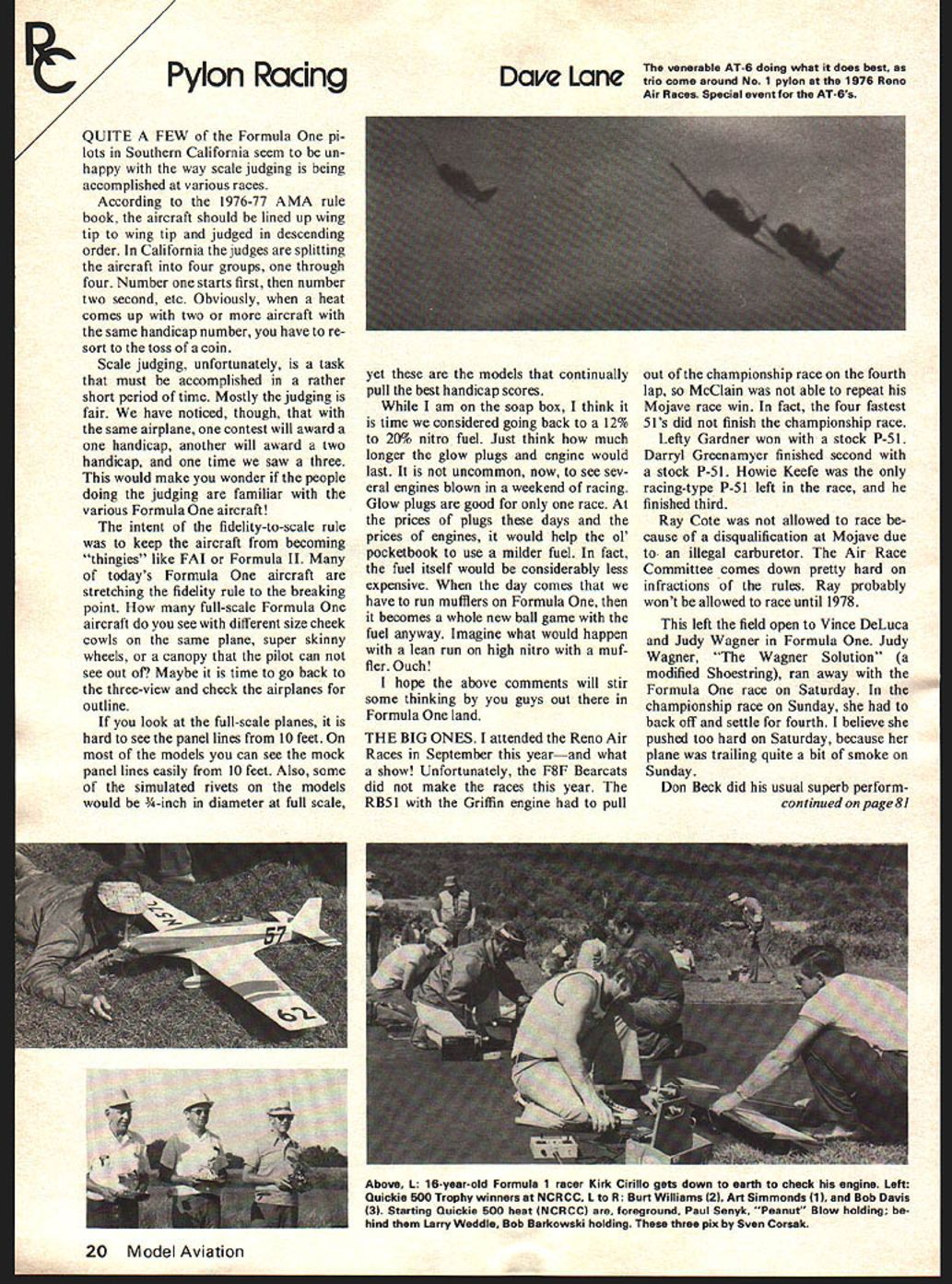
Don Beck did his usual superb performance. Pat Hines was right on his tail with "Sun Dancer." The AT-6/SNJ races were as exciting as ever. These planes and pilots really put on a show. The planes are so evenly matched that it ends up with the one who is willing to fly the lowest and closest to the pylons being the winner.
I was fortunate enough to be able to work on the #1 pylon with Vern Bolt. The #1 pylon is the one common pylon for all classes of racing. This was the same pylon that Washburn hit last year, and the pilots gave #1 a little more room this time. The only incident was when a Racing Biplane ground-looped on takeoff during a qualifying round on Friday—no injuries to the pilot, but the plane was almost totaled.
The overall show at Reno is really something to see. From the start of the day's events to the last race, there is always something going on. The Confederate Air Force put on a "Tora, Tora, Tora," that made you think it was December 7th, 1941 all over again. They use a beautiful B-17, P-39 and P-40 that have been restored to almost perfect condition. The Zeros are revamped AT-6's that look like Zeros and were used in the movie, "Tora, Tora, Tora."
That's all for now—go fast and turn left!
Dave Lane, 4477 136th, Hawthorne, CA 90250.
Transcribed from original scans by AI. Minor OCR errors may remain.

