
Radio Control: Pylon Racing
Bill Hager 4 Holly Springs Dr. Conroe, TX 77302
RC pylon racing in '89 is going full tilt. We have set new records in Formula One, and Q500 is at full speed. This should be a great racing season.
Plan ahead. This year's NMPRA Championship Race (National Miniature Pylon Racing Association — Ed.) will be held on October 28–29 in Phoenix, AZ, and will be hosted by the Pro Fliers, with Jim Allen, CD. These people have plenty of experience for the job. This should be a good one.
In future columns I will write about the new Q500 plane coming out of Ritch's Hobbies. Also, I just purchased a new Futaba radio. I'll let you know how it is working.
Here is a short contest report sent in by Barry Andersen.
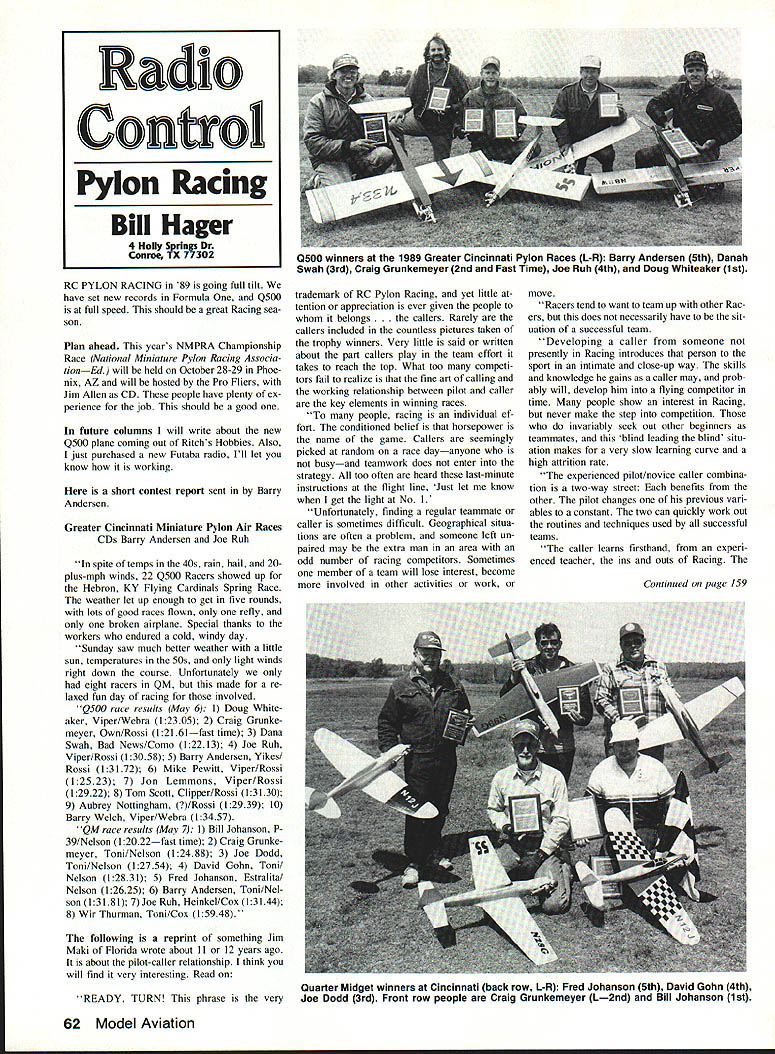
Greater Cincinnati Miniature Pylon Air Races
CDs: Barry Andersen and Joe Ruh
In spite of temps in the 40s, rain, hail, and 20-plus-mph winds, 22 Q500 racers showed up for the Hebron, KY Flying Cardinals Spring Race. The weather let up enough to get in five rounds, with lots of good races flown, only one refly, and only one broken airplane. Special thanks to the workers who endured a cold, windy day.
Sunday saw much better weather with a little sun, temperatures in the 50s, and only light winds right down the course. Unfortunately we only had eight racers in QM, but this made for a relaxed, fun day of racing for those involved.
Q500 race results (May 6)
- Doug Whiteaker, Viper/Webra — 1:23.05
- Craig Grunkemeyer, Own/Rossi — 1:21.61 (fast time)
- Dana Swab, Bad News/Como — 1:22.13
- Joe Ruh, Viper/Rossi — 1:30.58
- Barry Andersen, Yikes/Rossi — 1:31.72
- Mike Pewitt, Viper/Rossi — 1:25.23
- Jon Lemmons, Viper/Rossi — 1:29.22
- Tom Scott, Clipper/Rossi — 1:31.30
- Aubrey Nottingham, ?/Rossi — 1:29.39
- Barry Welch, Viper/Webra — 1:34.57
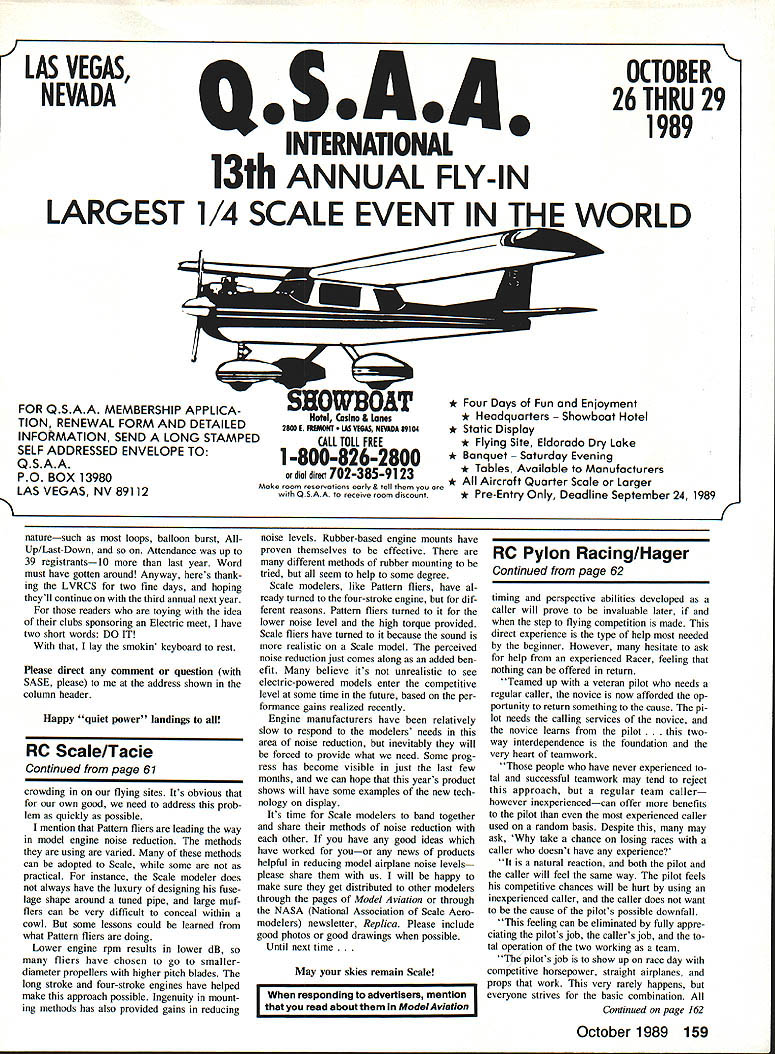
QM race results (May 7)
- Bill Johanson, P-39/Nelson — 1:20.22 (fast time)
- Craig Grunkemeyer, Toni/Nelson — 1:24.88
- Joe Dodd, Toni/Nelson — 1:27.54
- David Gohn, Toni/Nelson — 1:28.31
- Fred Johanson, Estralita/Nelson — 1:26.25
- Barry Andersen, Toni/Nelson — 1:31.81
- Joe Ruh, Heinkel/Cox — 1:31.44
- Wirt Thurman, Toni/Cox — 1:59.48
The following is a reprint of something Jim Maki of Florida wrote about 11 or 12 years ago. It is about the pilot-caller relationship. I think you will find it very interesting. Read on:
"READY, TURN!" This phrase is the very trademark of RC pylon racing, and yet little attention or appreciation is ever given the people to whom it belongs — the callers. Rarely are the callers included in the countless pictures taken of the trophy winners. Very little is said or written about the part callers play in the team effort it takes to reach the top. What too many competitors fail to realize is that the fine art of calling and the working relationship between pilot and caller are the key elements in winning races.
To many people, racing is an individual effort. The conditioned belief is that horsepower is the name of the game. Callers are seemingly picked at random on a race day — anyone who is not busy — and teamwork does not enter into the strategy. All too often are heard these last-minute instructions at the flight line: "Just let me know when I get the light at No. 1."
Unfortunately, finding a regular teammate or caller is sometimes difficult. Geographical situations are often a problem, and someone left unpaired may be the extra man in an area with an odd number of racing competitors. Sometimes one member of a team will lose interest, become more involved in other activities or work, or move. Racers tend to want to team up with other racers, but this does not necessarily produce a successful team.
Developing a caller from someone not presently in racing introduces that person to the sport in an intimate, close-up way. The skills and knowledge he gains as a caller may, and probably will, develop him into a flying competitor in time. Many people who are interested in racing, but never make the step into competition, find they will come out to help other beginners or teammates, and this "blind leading the blind" situation makes for a very slow learning curve and a high attrition rate.
The experienced pilot/novice caller combination is a two-way street. Each benefits from the other. The pilot changes one of his previous variables to a constant. The two can quickly work out the routines and techniques used by all successful teams. The caller learns firsthand, from an experienced teacher, the ins and outs of racing. The timing and perspective abilities developed as a caller will prove to be invaluable later, if and when the step to flying competition is made. This direct experience is the type of help most needed by the beginner. However, many hesitate to ask for help from an experienced racer, feeling that nothing can be offered in return.
Teamed up with a veteran pilot who needs a regular caller, the novice is now afforded the opportunity to return something to the cause. The pilot needs the calling services of the novice, and the novice learns from the pilot. This two-way interdependence is the foundation and the very heart of teamwork.
Those people who have never experienced this successful teamwork may tend to reject the approach, but a regular team caller — however inexperienced — can offer more benefits to the pilot than even the most experienced caller used on a random basis. Despite this, many may ask, "Why take a chance on losing races with a caller who doesn't have any experience?"
It is a natural reaction, and both the pilot and the caller will feel the same way. The pilot feels his competitive chances will be hurt by using an inexperienced caller, and the caller does not want to be the cause of the pilot's possible downfall.
This feeling can be eliminated by fully appreciating the pilot's job, the caller's job, and the total operation of the team. Much can be accomplished in a short time if two teammates will spend some time working together before race day. The caller has to show up sober, and that does not always happen, either. Assuming the best, however, the work of winning as a team now begins.
Consistency is the big factor in winning races, and this is one where two sets of eyes and two memories are better than one. Something missed by the pilot may be picked up by the caller. Redundancy is a big benefit of teamwork.
Successful teams go through a checklist procedure. Years of experience make this a memory operation, but for a novice caller a written checklist should be used. Taped to the line box, it will take a load off the caller's mind and not add much weight to the box. Prior to leaving for the ready line, the caller will confirm two basic things with his teammate:
- That the plane is fueled.
- That a tested, new glow plug has been installed.
Every now and then a new glow plug will come through open-circuited or damaged. Some time prior to installing it in the engine, smart fliers visually check the element and make sure it glows when attached to a battery. Bad glow plugs, batteries, and glow-plug clips have been discovered this way. The time to find them is before getting out to the flight line.
During the walk to the flight line, many pilots and callers will go over the same basic strategy for that particular heat. The form of that strategy will vary, depending on who is in the heat and the pilot standings at that stage of the race.
While the planes are being identified, the caller should be making a mental note of not only his own light and position, but also the colors and positions of the other planes in the heat. Four-plane heats are the maximum, so this exercise in memory is not that great a task. Good bridge players can keep track of 52 cards over a period of half an hour, so even a not-so-smart pylon caller should be able to remember four colors and positions for two minutes.
The ability of a caller to pick up cuts during a race is perhaps his biggest asset to the pilot. The caller should be able to immediately identify the signals which belong both to his pilot and to the competition. The entire strategy of a heat can change as a result of cuts and the caller's knowing to whom those cuts belong — and knowing about it right away.
By the same token, this is valuable information to the competition. A smart caller will let his pilot know he has cut without alerting the competition to this fact as well. Tapping the pilot on the shoulder, or better yet kicking him in the rear, is a silent way of letting him know he has a cut.
After the planes are identified, but prior to starting the engine, the caller should confirm these additional things:
- That the radio is on — both transmitter and receiver.
- That the radio works, and all control surfaces move properly.
Once the race is under way, the caller earns his keep. Both pilot and caller should talk to each other as much as possible. The caller provides information that will improve the course and update the pilot on cuts and other aspects of the progress of the heat. The pilot asks for any information that he wants and constantly acknowledges any input from the caller. It is very noisy out there, and the caller must know he is being heard by the pilot.
The type of information given the pilot is also important. Things happen very quickly during a race, and there is not a lot of time for a long conversation. "Wow! Tom and Dick are having a super close race of second place, but we're ahead of them by a bunch" is not useful to the pilot. It is important to the caller, since cuts by Tom and Dick are likely and should be watched for, but all the pilot needs to hear is, "We're half a lap out front, no cuts."
The pilot's job is to listen to his caller and fly the airplane. Some pilots do not listen to their callers. We could name them by name, but you would not know who they are because they never win any races. In a working team, the pilot flies the plane, and the caller flies the pilot.
Some callers try to fly the plane, and this is wrong also. The pilot should know somewhat where the course lies and where the pylons are located. Callers that are constantly having to give heading and attitude commands are really verbally flying the plane. This means two people are tied up doing the same job and not much else is going to get done ... like winning.
If the pilot is merely trustworthy locating the course, the caller should provide him with helpful information, not flying commands: "Out, out, out more..." Not so helpful. "Bring it down... down some more... out more, still more. Now back in. Ready, turn." This is not helping the pilot. It is quicker and far more useful to simply say, "You're too tight to one and climbing. Ready, turn."
If the pilot continues making the mistake, make suggestions like, "You keep going to one too tight; try rolling out of three sooner."
Locating the No. 1 pylon and being able to turn right on it is a matter of pilot and caller working together. Every pilot's reaction time is different, and the caller gets to know his pilot; the lead can be adjusted accordingly. The caller evaluates the turn by watching the light and the plane. If the plane is turning after the light, the lead is increased little by little, until the plane is turning WITH the light.
The caller and pilot must work together, so the caller should talk to his pilot and let him know what is going on. "We were long that time, and I'm going to shorten it up next lap, so don't push me." This lets the pilot know what to expect.
The time for the caller to check for cuts is while the plane is making its way back from the No. 1 pylon. The plane generally flies over the lap board, so it becomes a matter of momentarily dropping the line of sight. The time to check for cuts at No. 1 is on the way back to the pylon. Some callers check for cuts at No. 1 right after the turn is made. If none appear, they assume the turn was good. This can be a mistake, since it can take half a lap to see the cut take effect.
Sometimes the best thing a caller can do for a pilot's course is to simply talk to the pilot and calm him down. If he is excited and the caller is excited, then the plane is going to get excited and fly in an accelerated way. The caller should talk reassuringly and try to calm down a shaken pilot: "Settle down, you're flying a little wide."
Once the heat is over, the caller stays with the pilot and keeps him out of harm's way until the plane has landed. The pilot is watching his plane, so it is up to the caller to keep him from walking into holes in the course or other pilots, or tripping over open communication-system wires and other obstacles. The caller should also let the pilot know the runway situation, whether it is clear or not, and if not, where the plane is and where obstacles are located.
Between heats, pilot and caller should talk over any mistakes being made or changes that would result in an improvement. The ability to take criticism is important on the part of both the pilot and the caller. If the plane needs improvement, it should be said. If the calling lacks something, the problem should be defined. This give-and-take will improve both pilot and caller in their respective duties and make the team as a unit stronger.
Keep those hints and ideas coming so we can pass them on.
See you next month.
Transcribed from original scans by AI. Minor OCR errors may remain.

