
Radio Control: Pylon Racing
Bill Hager 4 Holly Springs Dr. Conroe, TX 77302
Sponsors
The U.S. Pylon Racing team wants to thank these great sponsors and supporters:
- AMA
- Airtronics
- Cashall Components Corp.
- Futaba
- Hobbico
- Dub Jett
- Kraft Midwest
- MACS Products
- NMPRA
- Performance Specialties
- Powermaster Products, Inc.
- R/C Modeler magazine
- Robart Mfg. Co.
- Rocket City RK Specialties
- SR Batteries
- Jim Shinohara
- Sig Mfg. Co.
- Sullivan Products
- Tru-Turn
Support them—they support you!
NMPRA Championship Race
RACING is over for the summer. The Formula One flier sets his sights on the NMPRA (National Miniature Pylon Racing Association) Championship Race. This year we'll go to Phoenix, AZ for our race on October 28–29, 1989.
Only those who qualify are invited to attend. How do you qualify?
- Finish in the top 20% of your district, or
- Finish in the top 10 at the AMA Nationals, or
- Be a past Championship Race winner, or
- Be an officer in the NMPRA.
I'm putting the finishing touches on my two Midget Mustangs for this race. I'll let you know how it turns out.
Noise reduction — Duane Gall
I've heard a lot about noise reduction this year. Here is an article by Duane Gall that I thought you might find interesting.
"The legendary Doctor Faustus ('Faust' to his bierstube buddies) never had it so good. You may recall Faust as the fellow who sold his soul to the Devil in exchange for wealth and fame on earth. Well, yours truly seems to have talked himself into a similar deal.
After pushing the idea of running muffled tuned pipes in Q500, I was authorized by the club to use experimental setups at our contests this year to see how quiet they actually were and how much advantage or disadvantage the use of a pipe would bring. Now, not only do I have to scramble to get a plane built and test flown before the season starts, I also get to do R&D and comparison work on top of that! Oh, well... here are some preliminary results:"
Test conditions
- Date: March 26
- Weather: 65°F, dry
- Fuel: 12%–15% "sport" (random mix). Leftover fuel from last fall: Cool Power and Blue Flame.
Engines tested
- Picco .40 — front intake, side-exhaust, ABC with carb, Q500 special. Brand-new, bench run 5–10 minutes, Super Tigre standard long plug used; installed on Scat Cat Racer.
- Rossi .40 — front intake, side-exhaust, ABC with Super Tigre Mag IV carb (technically illegal for Q500, comparable Q500 engine). Well broken in, K&B standard long plug used; installed on Scat Cat Racer.
- Rossi .40 — front intake, side-exhaust, ABC with Super Tigre Mag IV carb (technically illegal for Q500, comparable Q500 engine). Well broken in, K&B standard long plug used; installed on MK Blue Angel .40 pattern plane.
Pipe and headers
- Pipe: MACS #1240, stock (purchased 1987 as part of a package cataloged for Super Tigre S.40).
- "Headers":
- Picco standard pipe header for side-exhaust, stock.
- MACS offset pipe header for side-mount engine, low-wing configuration, stock.
Prop and RPM
- Prop: Zinger 9×7
RPM results:
- Picco — header only: 14,000 rpm; with pipe: 16,200 rpm.
- Rossi — header only: 14,500 rpm; with pipe: 14,800–14,900 rpm.
Follow-up (April 2)
- Airframe: Scat Cat, Picco (same as above but with no .008-in. gasket in head remaining).
- Weather: 60°F, extremely windy.
- Prop: 9×7 Rev-Up.
- Pipe: Picco #7023 (approximately 3/8" longer than MACS pipe above).
RPM: header only — 16,000–16,100 rpm; with pipe — 15,200 rpm.
Comments
The Picco Q500 engine uses upper-end parts (piston, cylinder liner, conrod, wrist pin) with the same catalog numbers as used on the rear-intake marine/FAI/Pattern versions. The liner has approximately 180° of exhaust duration, which puts it in the "piped" sleeve category, and the above results show it. While the Rossi gets very little boost from the pipe, the Picco gets plenty. (I have heard that the Webb engines run much better with a pipe, but I haven't tested one of those yet. Anybody got one they'd like to loan for testing?)
On the other hand, the stock Picco pipe appears long enough to not only not help the engine, but actually detune it and hold it back. Somewhere between the stock MACS pipe length and the stock Picco pipe length, I predict, is a length which will make the Picco exactly equal to the Rossi, at least in terms of ground rpm.
"If we should decide in the future to handicap engine/pipe combinations to keep them equal, it should be easy enough to find the right length for each engine. On the other hand, if we decide to specify just one minimum length, or specify stock (unit) pipes only, or go with an 'anything goes' pipe rule of some kind, I predict an overall increase in the speed of the event with Piccos (and perhaps Webras) dominating.
"The noise reduction is impressive. I now own a dB meter (if you can't beat 'em, join 'em), which I didn't get a chance to use in doing the above tests. However, a host of witnesses will verify that the pipe greatly reduced the 'irritation factor' of the engines—and as readers of this newsletter know, I think that's far more important than dB. On the windy day (April 2), the engine was scarcely audible in the air. I actually had to land it to hear it run (which is bad!).
"Incidentally, Picco owners should note one important fact about their engines: the more rpm, the better! Mine surprised me on its first run by out-turning a rear-intake Picco on my bench prop—it was happy at 24,000, just a little rich. That's what that wide exhaust timing does for an engine. A few of our Racers used Piccos last year but didn't quite equal the Rossis. As far as I know, all used either 9×7 or 9×6 props and were around 16,000 rpm on the ground.
"Maybe the answer is to use a ridiculously small prop—say an 8×6 or even an 8×4—and try for a ground rpm closer to 20,000. If the rule won't hurt the upper-end parts, which are designed for 26,500, Bob Sobeer reports good results with an 8×6 with narrow Rev-Up, turning about 16,500. He has a large selection of Rev-Ups available for sale if you want to experiment.
"And if you think an 8-inch propeller disc won't pull the airplane, just remember in Quarter Midget not so long ago when anything under a 7×5 was considered too small. We're now at 5×4-1/2."
Quarter Midget — Eastern States Championships
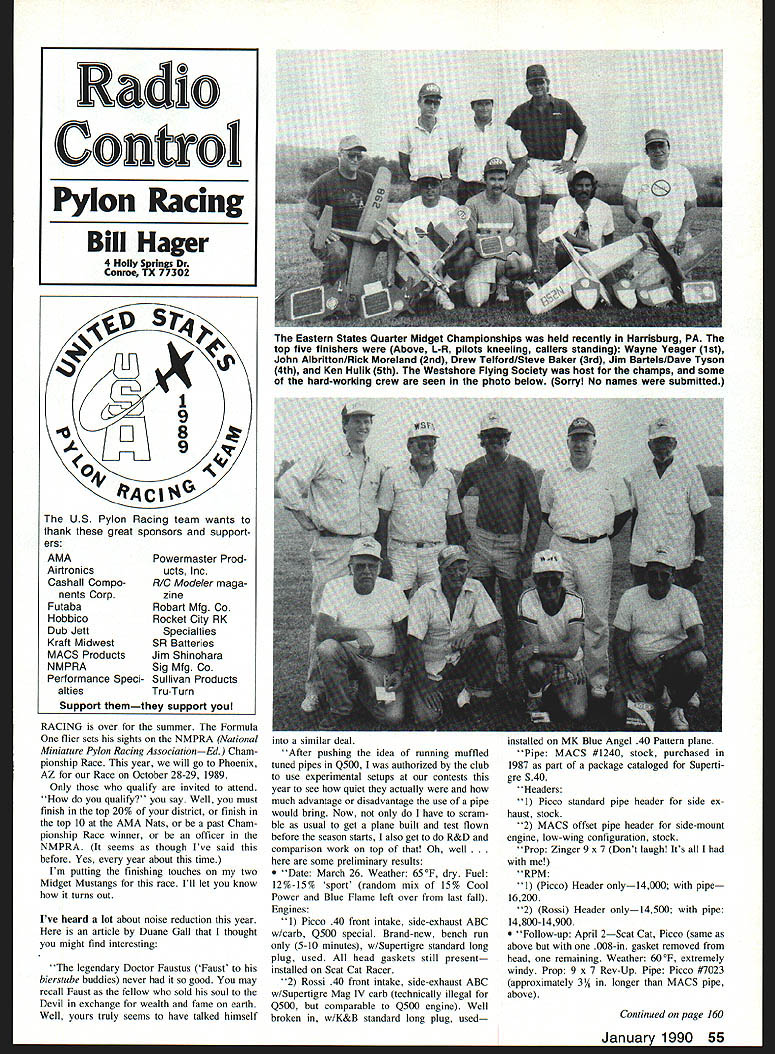
I don't get much from you readers on Quarter Midget. Here is a report by Dave Tyson on the Eastern States Quarter Midget Championships:
Following the annual Saturday night steak party organized by Harold Massman, Sunday arrived holding its own set of surprises.
Wayne Yeager and his famous caller (wife Karen) had added to their pit crew in the last year. (Fortunately their beautiful baby girl looks like Karen!) This addition proved to be lucky, as they had a perfect score Sunday morning. Tied with Rick Moreland, they were destined to battle it out all day and finish first and second respectively (both a point down) in a flyoff for first.
Third and fourth places were decided between Steve Baker (third) and recent transplant to Florida Jimmy Bartels (fourth) in a flyoff. It's about time some Harrisburg hardware returned to Florida.
And then time stood still....
Harrisburg gives trophies through fifth place. This fact set up a flyoff that will never be forgotten. Tied for fifth place were Dave Latsha, Jake Jacobson, Ken Hulik and Neil Rehm.
The flag dropped, and then it was formation flying for the tightest 10 laps I've ever witnessed. I was calling for Jake and assumed he had...
Transcribed from original scans by AI. Minor OCR errors may remain.

