
Radio Control: Pylon Racing
Bill Hager 4 Holly Springs Dr. Conroe, TX 77302
WHAT is in store for us in 1990?
For Formula One there has been an engine shortage the last few years, but 1990 could change that. Dave Shadel and Henry Nelson are making a .40 for Formula One and for FAI. These engines will be ready to run out of the box. The FAI version will even include a tuned pipe. The bolt pattern will be the same as for the Super Tigre X-40, and even though the case will be a little larger it should bolt right into what you have now, provided that you are using an X-40.
These engines should be out sometime in March. Get your orders in now. Call Dave Shadel at 1-619-729-1658, or Henry Nelson at 1-412-538-5282.
I hope to pass on more helpful hints and ideas. Please send any tips so I can pass them along. By popular demand I will print a list of people who supply racing goods this month. I will also finish publishing the NMPRA's "Pylon Race Procedure Guide." Please refer to last month's column for the first part.
I don't think anyone should run or work a pylon race without reading this contest procedure guide for RC pylon.
Contest Procedure Guide for RC Pylon Racing
(Continued from March 1990 column)
Transmitter Impound Area
A transmitter impound area should be provided near the Ready Area where all contestants must impound their transmitters between heats. A contestant not doing so can be disqualified from the contest. The transmitter impound should be manned by someone who will confirm that all transmitters are off and all antennas are removed, when possible. Transmitters should only be released when the contestant is in the back-up position to fly.
Race Setup
The purpose of this section is to serve as a guide toward organizing aircraft, frequencies, and handicaps to arrive at reasonably equitable series of heat races. Methods of selecting and recording can be tailored to suit local preferences and forms. The important thing is to ensure frequency groups do not conflict and that list groups are readily available and easily interpreted throughout the event.
When handicapping and grouping contestants, divide the total number of contestants in the class by four to get the ideal number of contestants in each of four frequency groups for four-plane races. Adjust to whole numbers as needed (for example, with 26 entries: Group 1 and Group 2: 7 cards; Group 3 and Group 4: 6 cards). If frequencies work out, this will produce six four-plane heats and one two-plane heat in the first round.
Scoring:
- 4 points for first
- 3 points for second
- 2 points for third
- 1 point for fourth
- 0 points for DNF, DNS, or double cut
Use the NMPRA Frequency Control System (Exhibit "A") for setting up heat races.
Ready Area
In addition to the aircraft on the starting line, aircraft should be called to a Back-up/Ready Line in front of the registration desk. The Ready Line should not be on the course between the No. 2 and No. 3 pylons (see safety section). The Pit Boss could also be Transmitter Boss if the impound and Ready areas are adjacent. The Pit Boss should get the heat cards from the registration desk and call the contestants to the Back-up Line over the PA system. A contestant will be called again when his heat moves to the Ready Line, and it is the responsibility of the contestant to be in the Ready Line by the time his heat moves to the Starting Line. An efficient contest will turn around heats in six minutes or less from the start of one heat to the start of the next.
Starter
The Starter should have a stopwatch, a green and a red flag, and a hard hat. The Starter is the head of the flight line and is expected to be fully backed up by the Contest Director (CD) in all decisions. The Starter and the CD should be two separate people to provide backup and a second opinion in the event of a dispute.
The Starter should stand to the left of the Starting Line, closest to the No. 1 pylon. When all aircraft are lined up from left to right on the Starting Line for a heat, the Starter should have each contestant, starting with the No. 1 position, hold up his aircraft above his head for identification with the Flagman at the No. 1 pylon. Show top, bottom, and sides of the aircraft and identify plates. When all planes are identified, the Starter should remind the contestants to turn radio systems off and announce the beginning of the starting period.
The Starter should notify contestants of the amount of time left in the starting period (for example by flag motions at preset intervals). If all engines are started before the starting period ends, the Starter should check each pilot and then flag the aircraft off as quickly as possible, in approximately one-half-second intervals. The Starter should start the stopwatch as he drops the first flag.
If one or more contestants have difficulty starting, the Starter should still flag off the aircraft in sequence when the starting period has elapsed. If an aircraft is blatantly late before it receives its flag, the contestant is disqualified in that heat.
If an aircraft is damaged during a heat and continues flying, the Starter may disqualify the contestant if, in his opinion, the aircraft is unsafe. If this enforcement may occur, contestants must be notified at the pilot's briefing. A contestant so notified must land immediately after being personally notified. If disqualified for unsafe flying, or after receiving two cuts during a heat, the contestant must pull out of the race immediately and will be automatically disqualified for his next heat. The disqualified pilot should not hand his aircraft to anyone until the protest committee has had an opportunity to examine it.
The Starter has sole authority to disqualify a contestant for unsafe flying; his decision is final. The Starter should flag each aircraft as it crosses the finish line on its last lap and stop his stopwatch when the first aircraft finishes to serve as a backup to the lap counters' watches. The Starter may disqualify any contestant who lands his aircraft between the No. 2 and No. 3 pylons.
Course Layout and Laps
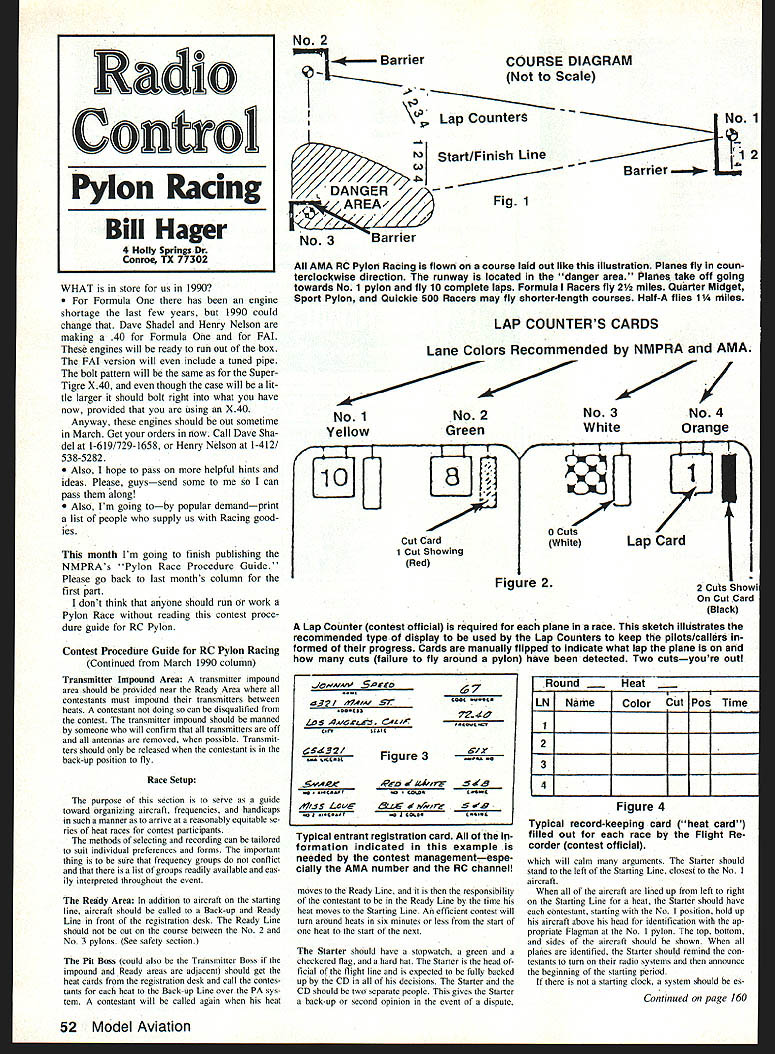
All AMA RC Pylon Racing is flown on a course where planes fly in a counterclockwise direction. The runway is located in the "danger area." Planes take off going towards the No. 1 pylon and fly 10 complete laps unless class rules specify otherwise.
Typical race distances:
- Formula I Racers: 2½ miles
- Quarter Midget, Sport Pylon, Quickie 500: shorter-length courses as specified by class rules
- Half-A: 1¼ miles
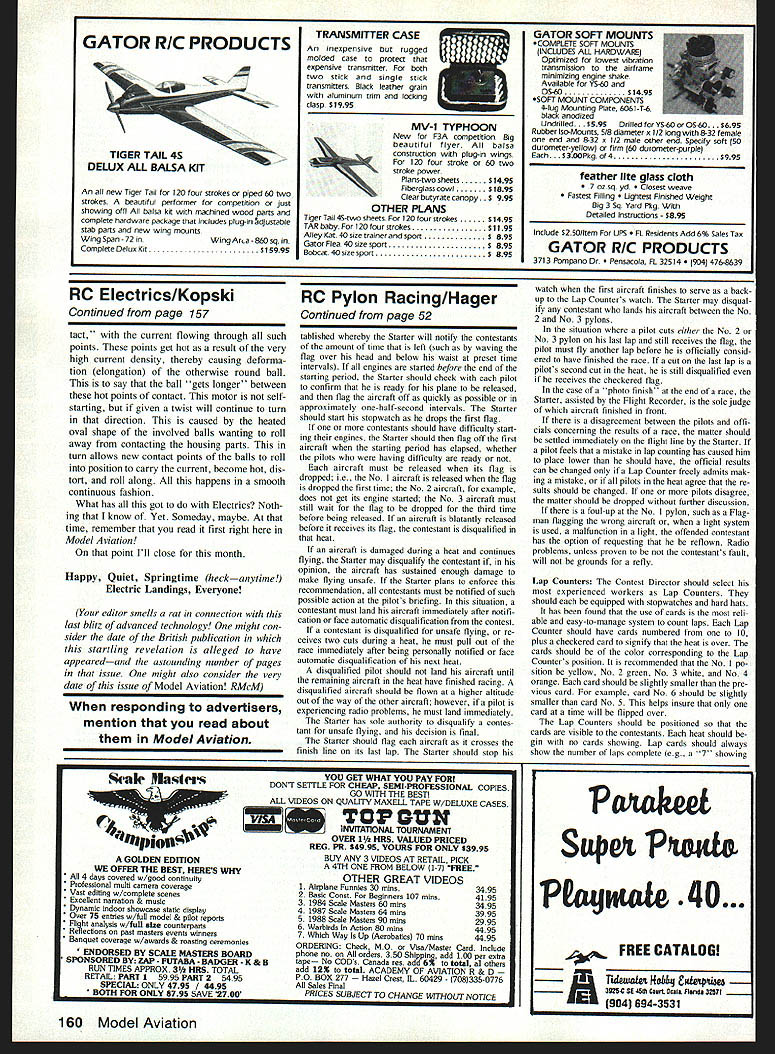
A Lap Counter (contest official) is required for each plane in a race. Cards are manually flipped to indicate what lap the plane is on and how many cuts (failure to fly around a pylon) have been detected. Two cuts — you're out!
Lane colors recommended by NMPRA and AMA:
- No. 1: Yellow
- No. 2: Green
- No. 3: White
- No. 4: Orange
Lap counter display: use a call card system numbered for lap progression and a flip card system for cuts. Flip cards should be arranged so only one card at a time will be flipped. Each card should be slightly smaller than the pylon, mounted so it is clearly visible to contestants. Position Lap Counters so their cards are visible.
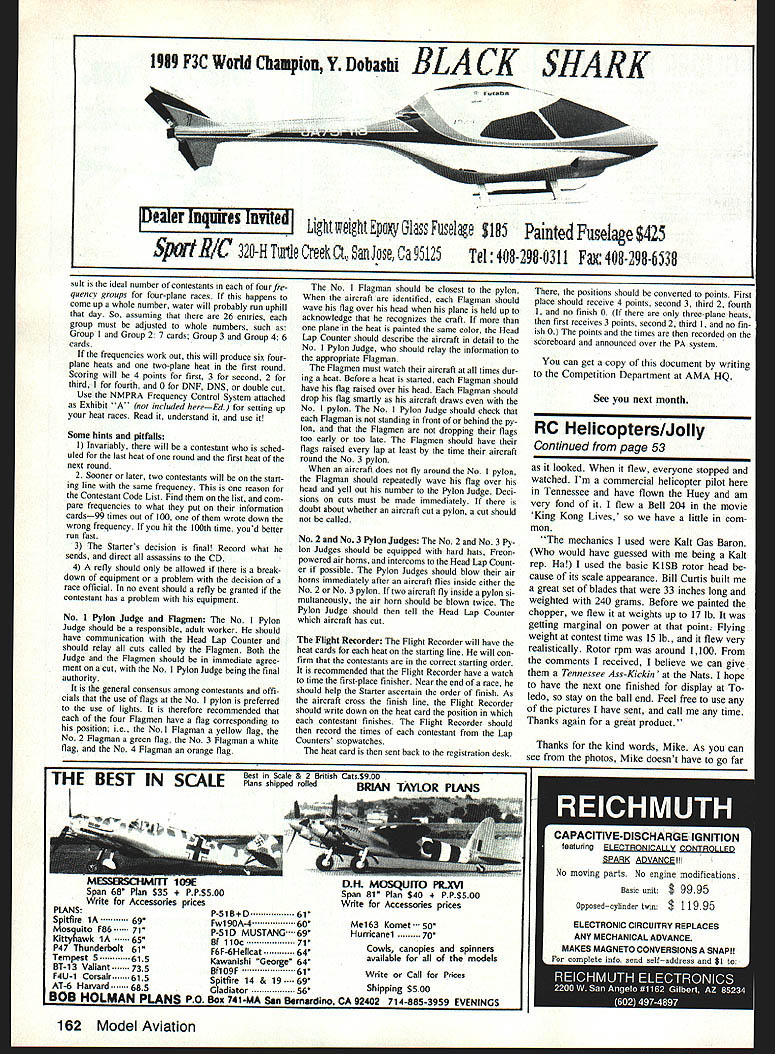
The Lap Counters should be equipped with stopwatches and heat cards. Each heat should be recorded on a heat card by the Flight Recorder so disputes can be settled quickly and accurately.
Registration and Inspection
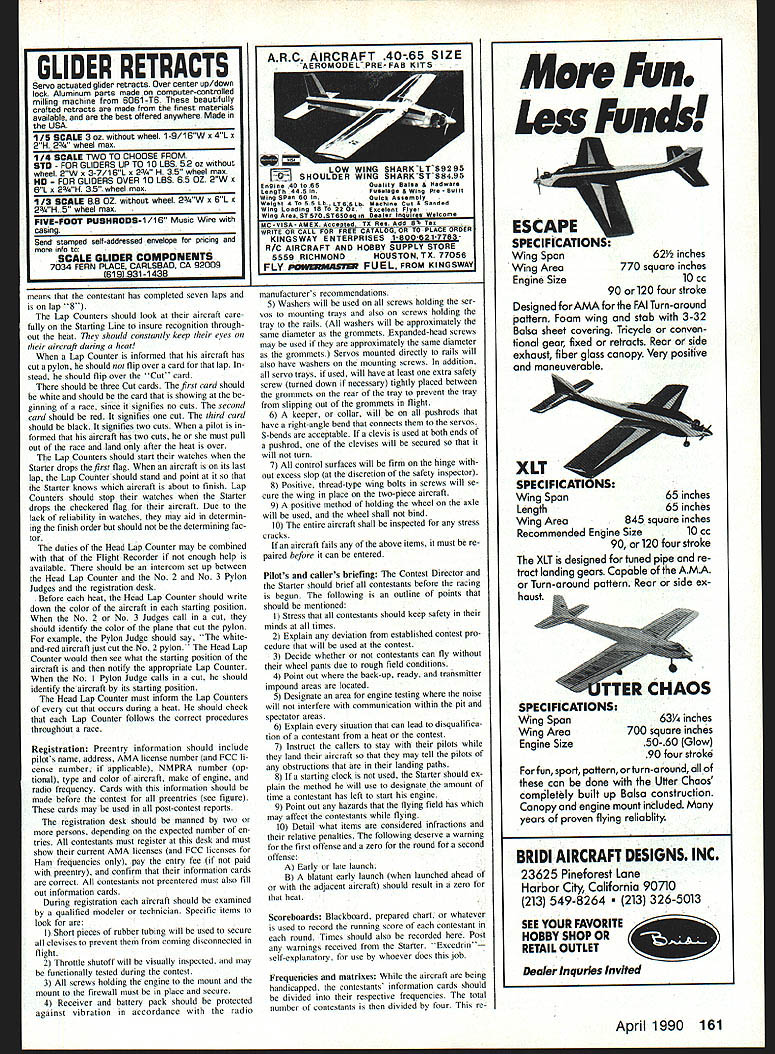
Preentry information should include: pilot's name, address, AMA license number (and FCC license number if applicable), NMPRA number (optional), type and color of aircraft, make of engine and radio frequency, and choice of starting position. The contestant should sign a statement that the information is correct. Registration procedures may vary at local contests.
The registration desk should be manned by two or more people depending on the number of entries. All contestants must register and show current AMA license cards (and FCC license if on amateur frequencies). Contestants may pre-enter (pay fee if not paid with entry) and confirm their information cards are correct. All contestants not preentered must fill out registration cards.
During inspection each aircraft should be examined by a qualified modeler or technician. Specific items to look for are:
- Short pieces of rubber tubing will be used to secure all clevises to prevent them from coming disconnected in flight.
- Throttle shutoff will be visually inspected and may be functionally tested during the contestant's flight.
- All screws holding the engine to the mount and the mount to the firewall must be in place and secure.
- Receiver and battery pack should be protected against vibration per the radio manufacturer's recommendations.
- Washers will be used on all screws holding the servos to the mounting trays and on screws holding the servos to the rails. (All washers should be approximately the same diameter as the grommets. Expanded-head screws may be used if approximately the same diameter as the grommets.) Servos mounted directly to the rails will also have washers on the mounting screws. All servo trays fitted to the wings will be sealed and their wires routed so they do not chafe on control surfaces. Keepers or collars on clevises are recommended to prevent linkage separation.
- All control surfaces will be firm on the hinge with no excess slop (at the discretion of the safety inspector).
- Positive threaded-type wing bolts or screws will secure the wing in place on two-piece aircraft.
- A positive method of holding the wheel on the axle will be used, and the wheel shall not bind.
- The entire aircraft shall be inspected for any stress cracks.
If an aircraft fails any of the above items, it must be repaired before it can be entered.
Pilot's and Caller's Briefing
The Contest Director and the Starter should brief all contestants before the race begins. Items to cover include:
- Stress that all contestants should keep safety in mind at all times.
- Explain any deviation from established contest procedure that will be used at the contest.
- Decide whether contestants can fly without wheel pants due to rough field conditions.
- Point out where the Back-up, Ready, and Transmitter Impound areas are located.
- Designate an area for engine testing where noise will not interfere with communication in the pit and spectator areas.
- Explain every situation that can lead to disqualification or a contest stoppage and how it will be penalized.
- Instruct callers to stay with their pilots while they and their aircraft are racing.
- Explain that the judges will make the final decision on cuts and other infractions.
Scoreboards
Use a blackboard, prepared chart, or other means to record the running score of contestants in each round; record times as well. Post scoreboards in a conspicuous place so contestants and spectators can readily see them. The recorder should be someone other than the Starter.
Frequencies and Matrices
While the aircraft are being handicapped, contestants' information cards should be filled out in their respective frequencies. Use frequency groups to avoid conflicts. Adjust group sizes to whole numbers as needed. Be prepared for last-heat/first-heat overlaps on the schedule.
A re-fly should only be allowed if there is a breakdown of equipment or a problem with the decision of a race official. A re-fly should not be granted for a contestant's equipment problems.
Some Hints and Pitfalls
- There will often be a contestant scheduled for the last heat of one round and the first heat of the next round.
- Sooner or later two contestants will be on the starting line with the same frequency. Consult the Contestant Code List and compare frequencies to the information cards—usually one was written down incorrectly. If both are correct, remedy the conflict quickly.
- The Starter's decision is final. Record what he says and direct all assistants to the CD.
- A re-fly should only be allowed for an equipment breakdown or an official's error, not for a contestant's equipment problem.
No. 1 Pylon Judge and Flagmen
The No. 1 Pylon Judge should be a responsible, adult worker. He should have communication with the Head Lap Counter and should relay all cuts called by the Flagmen. Both the Judge and the Flagmen should be in immediate proximity to the cut, with the No. 1 Pylon Judge being the final authority.
Use flags at the No. 1 pylon rather than lights. Each of the four Flagmen should have a flag corresponding to his position: No. 1 — yellow; No. 2 — green; No. 3 — white; No. 4 — orange. The No. 1 Flagman should be closest to the pylon. When aircraft are identified, each Flagman should wave his flag over his head when his plane is held up to acknowledge recognition. If more than one plane in the heat is painted the same color, the Head Lap Counter should describe the aircraft in detail to the No. 1 Pylon Judge, who should relay the information to the appropriate Flagman.
Flagmen must watch their aircraft at all times during a heat. Before a heat starts, each Flagman should have his flag raised above his head and stop his flag smartly as his aircraft draws even with the No. 1 pylon. The No. 1 Pylon Judge should ensure Flagmen are positioned correctly and not dropping flags too early or too late. Flags should be raised every lap at least by the time the aircraft round the No. 3 pylon.
When an aircraft does not fly around the No. 1 pylon, the Flagman should repeatedly wave his flag overhead and yell out his number to the Pylon Judge. Decisions on cuts must be made immediately. If there is doubt, a cut should not be called.
No. 2 and No. 3 Pylon Judges
The No. 2 and No. 3 Pylon Judges should be equipped with hand flares, Freon-powered air horns, and intercoms to the Head Lap Counter, if possible. The Pylon Judges should blow their air horns immediately after an aircraft flies inside either the No. 2 or No. 3 pylon. If two aircraft fly inside a pylon simultaneously, the air horn should be blown; the No. 1 Pylon Judge should then tell the Head Lap Counter which aircraft has cut.
The Flight Recorder
The Flight Recorder will have the heat cards for each heat on the starting line and will confirm that contestants are in the correct starting order. It is recommended the Flight Recorder have a watch to time the first-place finisher. Near the end of a race, he should help the Starter ascertain the order of finish. As aircraft cross the finish line, the Flight Recorder should write down on the heat card the position in which each contestant finishes and record the times of each contestant from the Counter's stopwatch. The heat card is then sent back to the registration desk.
Transcribed from original scans by AI. Minor OCR errors may remain.

