
Radio Control: Pylon Racing
Bill Hager 4 Holly Springs Dr. Conroe, TX 77302
New FAI and Formula One Engine
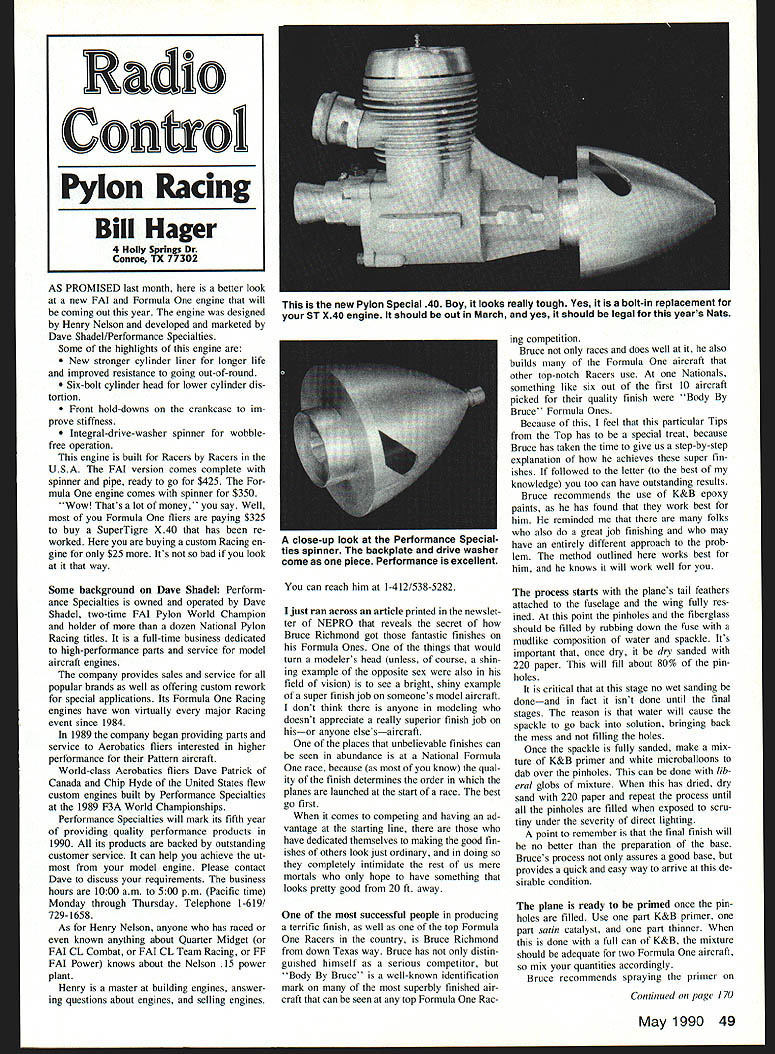
As promised last month, here is a closer look at a new FAI and Formula One engine being released this year. The engine was designed by Henry Nelson and developed and marketed by Dave Shadel/Performance Specialties.
Highlights:
- New stronger cylinder liner for longer life and improved resistance to going out-of-round.
- Six-bolt cylinder head for lower cylinder distortion.
- Front hold-downs on the crankcase to improve stiffness.
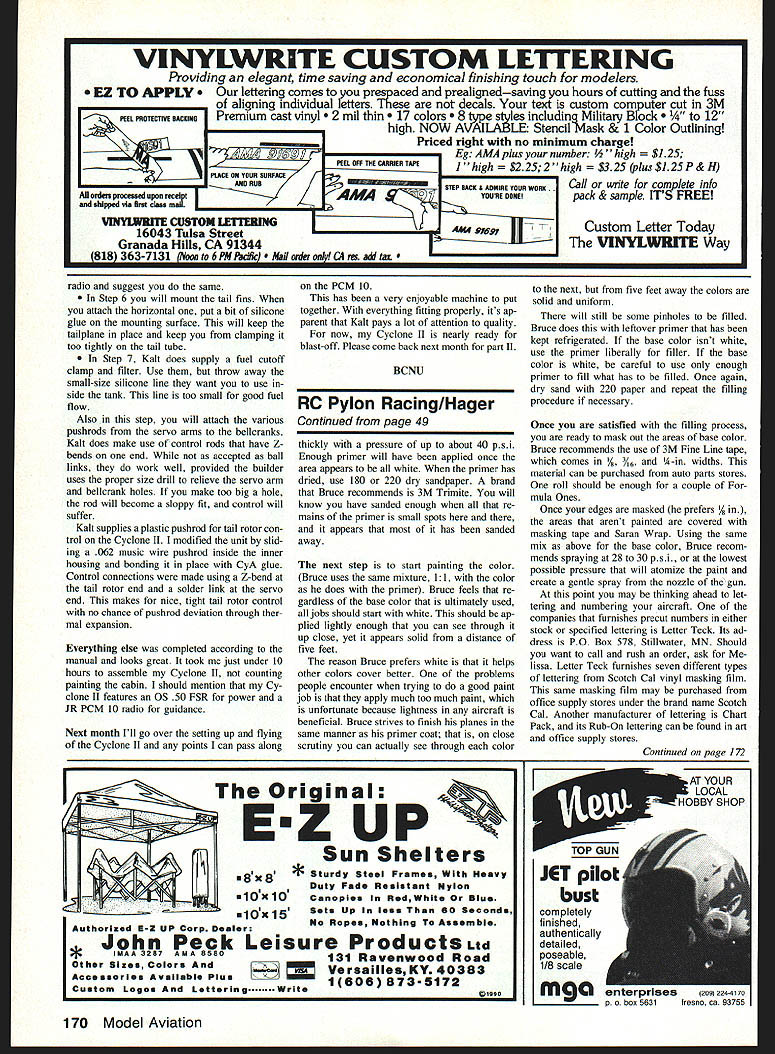
- Integral-drive-washer spinner for wobble-free operation.
This engine is built for racers by racers in the U.S.A. The FAI version comes complete with spinner and pipe, ready to go for $425. The Formula One engine comes with spinner for $350.
"Wow! That's a lot of money," you say. Well, most Formula One fliers are paying about $325 to buy a SuperTigre X-40 that has been reworked. Here you are buying a custom racing engine for only $25 more.
Performance Specialties and Dave Shadel
Performance Specialties is owned and operated by Dave Shadel, two-time FAI Pylon World Champion and holder of more than a dozen national pylon racing titles. It is a full-time business dedicated to high-performance parts and service for model aircraft engines. The company provides sales and service for all popular brands and offers custom rework for special applications. Its Formula One racing engines have won virtually every major racing event since 1984.
In 1989 the company began providing parts and service to aerobatics fliers seeking higher performance for their pattern aircraft. World-class aerobatics fliers Dave Patrick (Canada) and Chip Hyde (United States) flew custom engines built by Performance Specialties at the 1989 F3A World Championships.
Performance Specialties will mark its fifth year in business in 1990. All products are backed by outstanding customer service. Contact Dave to discuss your requirements. Business hours: 10:00 a.m. to 5:00 p.m. (Pacific) Monday–Thursday. Telephone: 1-619-729-1658.
About Henry Nelson
Anyone who has raced or knows anything about Quarter Midget, FAI CL Combat, FAI CL Team Racing, FF FAI Power knows the Nelson .15 power plant. Henry is a master at building, answering questions about, and selling engines. He can be reached at 1-412-538-5282.
Super Finishes: Bruce Richmond's Method
I ran across an article in the NEPRO newsletter that reveals the secret of how Bruce Richmond gets those fantastic finishes on his Formula Ones. A superior finish is appreciated by every modeler, and at National Formula One races finish quality determines the launch order. Bruce Richmond, one of the top Formula One racers in the country, is also famous for his finishing work—"Body By Bruce" is a known identification mark on many superbly finished aircraft.
Bruce not only races and wins, he builds many of the Formula One aircraft other top racers use. At one Nationals, about six of the first ten aircraft picked for finish quality were "Body By Bruce" Formula Ones. Bruce has provided a step-by-step explanation of how he achieves these super finishes. He recommends K&B epoxy paints, though other methods also produce great results. The method below is Bruce's proven approach.
Preparation and Pinhole Filling
- Start with the tail feathers attached to the fuselage and the wing fully resined.
- Fill pinholes in the fiberglass by rubbing the fuse with a mixture of water and spackle. Once dry, dry-sand with 220 paper. This first stage fills about 80% of the pinholes.
- Important: do not wet-sand at this stage—water will revert the spackle to a mudlike composition and reopen pinholes.
- After dry sanding, make a mixture of K&B primer and white microballoons and dab over remaining pinholes liberally. When dry, sand with 220 paper and repeat as necessary until pinholes are filled.
- Continue this process—no wet sanding—until pinholes remain closed even under scrubbing with the tap.
Priming
- Mix one part K&B primer, one part satin catalyst, and one part thinner. Mix well; the mixture should be adequate for two Formula One models.
- Bruce recommends spraying the primer on thickly at up to about 40 psi. Apply until the area appears uniformly white.
- When the primer has dried, use 180 or 220 dry sandpaper (3M Trimite is a recommended brand). Sand until only small spots of primer remain and most has been removed.
Base Color and Filling
- Start painting the base color. Bruce uses the same mix proportions for color as for primer.
- Bruce prefers white as a base color because it helps other colors cover better. Apply the base lightly so it may appear slightly translucent up close but solid from about five feet.
- Avoid applying too much paint—lightness is important. Bruce's ideal is that on close inspection you can see through each color to the next, yet from a distance the colors look solid and uniform.
- Fill any remaining pinholes with leftover primer kept refrigerated. If your base color isn't white, use primer as filler; if the base is white, use the base color sparingly for filling. Dry sand with 220 and repeat as necessary.
Masking and Multi-Color Work
- Mask edges using 3M Fine Line Tape (available in 3/32", 1/16", and 1/32" widths). One roll should be enough for a couple of Formula One models.
- Cover areas not to be painted with masking tape and Saran Wrap.
- Using the same mix as for the base, spray at 28–30 psi, or at the lowest pressure that will atomize the paint and produce a gentle spray.
- Thin the paint to proper consistency so it lays down evenly. Apply several light coats rather than fewer heavy coats to avoid runs.
- Minor touch-ups can be made with leftover primer or paint, then dry sanded and resprayed as necessary.
- For lettering and numbering Bruce prefers Letter Tech (P.O. Box 578, Stillwater, MN). Letter Tech supplies several types of lettering and Scotchcal vinyl masking film. Chart Pack rub-on lettering is another option available in art and office supply stores.
- Remove the masking and carefully wet sand with 400 paper. Each color should be sanded before applying the next color. Sanding each color lap prevents the trim line from becoming a ridge.
- Using this technique Bruce can apply five colors in one day, allowing about two hours drying time between colors.
Final Sanding, Canopy, and Decals
- Once all colors and lettering are applied, wet sand the entire plane with 400 paper, including the canopy.
- Sanding the canopy will make it uniformly cloudy. Then take a soft material (something like a baby diaper), wet it with K&B thinner, and wipe the canopy once. The thinner partially dissolves the canopy material and fills heavy scratches—restoring clarity.
- Apply decals, then clean the entire aircraft with only water and a washcloth. Remove any tape residue with lighter fluid.
- Use compressed air to blow out hinge lines and then wipe down the aircraft with a tack rag. Repeat cleaning until the surface is free of foreign matter.
Clear Coating
- Bruce recommends Ditzler auto finish DAU75 with catalyst DXR79. One quart will do four Formula One-size airplanes.
- DXR79 is suitable up to about 100°F; use DXR80 if temperatures exceed 100°F.
- Mixing instructions call for about a 6:1 mix, but Bruce recommends between 8:1 and 6:1.
- Use only enough thinner to atomize the spray. This should give a finish dry enough to touch in about an hour and safe to handle overnight.
- One of Bruce's tricks is to let the aircraft dry in the bathroom where humidity helps keep dust out of the air.
- To reduce dust attracted by static during spraying, spray a couple of cardboard boxes near the garage door and spray a little material into the air as a "decoy." This helps clear dust from the air.
Equipment, Consumables, and Tips
- Expect to use about 8–10 oz of finish per Formula One aircraft.
- Use a carburetor-type gun such as DeVilbiss or Binks (about $125–$140), or a Badger gun ($40–$60). Use a Badger airbrush for trimming—it's easy to clean.
- Acetone cleans everything very well if available.
- 3M Fine Line tape can be pulled off easily; remove it one half hour after the paint has sunk.
- Keep tools clean with plenty of K&B thinner; clean nozzles frequently during spraying.
Safety Rules
- Wear a charcoal-filter mask.
- Do not spray resin if you have been drinking—alcohol increases the toxic effects.
- Work in a well-ventilated area.
- Keep your tools clean with plenty of K&B thinner; don't be afraid to clean the nozzle frequently.
- Use appropriate spray equipment (DeVilbiss, Binks, Badger).
- Acetone is an excellent cleaner where available.
- Remove 3M Fine Line tape about a half-hour after paint sinks.
Well, there you have it—a proven method of finishing by a super finisher. Now none of us has any excuse not to show up at the races with a number-one finished airplane to be proud of.
See ya!
(Names and addresses of K&B suppliers were promised but will appear next month.)
Transcribed from original scans by AI. Minor OCR errors may remain.

