
Radio Control: Pylon Racing
Bill Hager 4 Holly Springs Dr. Conroe, TX 77302
RACE results from the 22nd annual Tangerine races are in. But first, some new products and other news worth mentioning.
New products
- For Q500 fliers who want a good low-priced radio, Futaba has a new PCM four- or six-channel set. I am flying one in my Quickie, and it works great. The four-channel retails for about $249.95 — quite a buy.
- Pacer Technology, manufacturer of ZAP and other adhesive products, will provide support for Formula 1 Pylon Racing in 1990. Assistance will range from providing products at local races for quick repairs to partial sponsorship of the annual NMPRA (National Miniature Pylon Racing Association) invitational championship race. "We are proud to be a part of the high performance world of RC Pylon Racing with our line of high performance adhesives," said Pacer president Jim Munn.
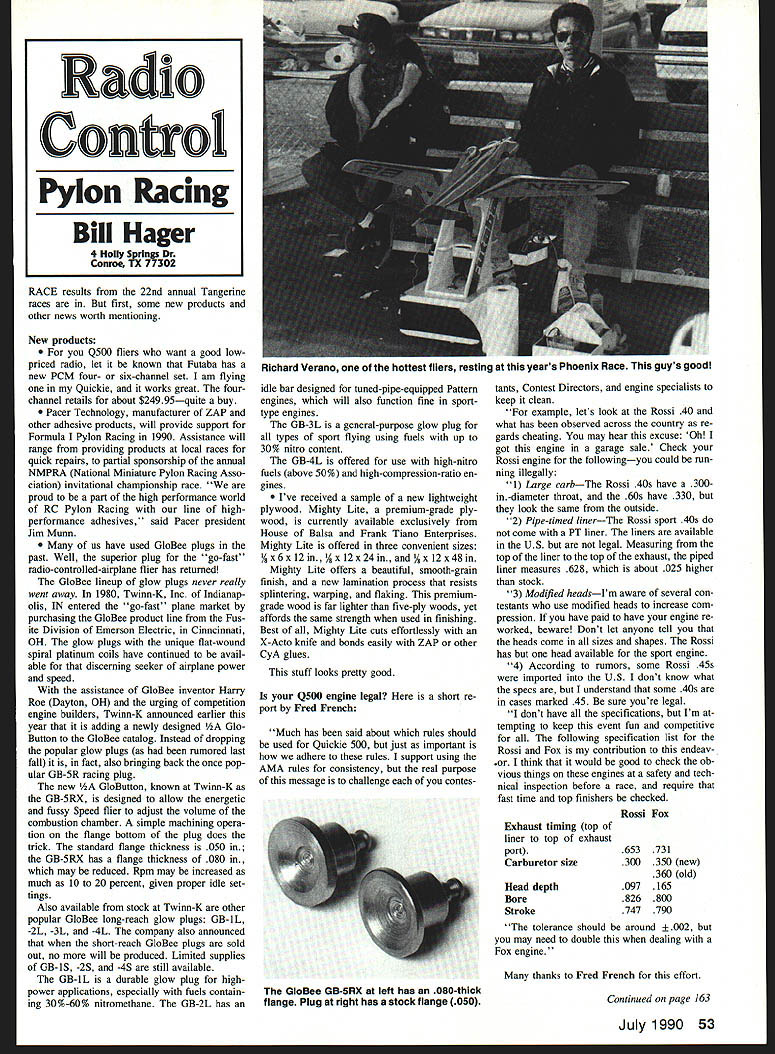
- The GloBee lineup of glow plugs — long favored by "go-fast" RC airplane fliers — is still available. In 1980 Twinn-K, Inc., of Indianapolis, IN entered the "go-fast" plane market by purchasing the GloBee product line from the Fusite Division of Emerson Electric in Cincinnati, OH. The glow plugs with the unique flat-wound spiral platinum coils have continued to be available for that discerning seeker of airplane power and speed.
With the assistance of GloBee inventor Harry Roe (Dayton, OH) and the urging of competition engine builders, Twinn-K announced earlier this year that it is adding a newly designed AA GloBee Button to the GloBee catalog. Instead of dropping the popular glow plugs (as was rumored last fall), it is, in fact, also bringing back the once-popular GB-SR racing plug.
The new GB-5 Button, known at Twinn-K as the GB-5RX, is designed to allow the energetic and fussy speed flier to adjust the volume of the combustion chamber. A simple machining operation on the flange bottom of the plug does the trick. The standard flange thickness is .050 in.; the GB-5RX has a flange thickness of .080 in., which may be reduced. RPM may be increased as much as 10 to 20 percent, given proper idle settings.
Also available from stock at Twinn-K are other popular GloBee long-reach glow plugs: GB-1L, GB-2L, GB-3L, and GB-4L. The company also announced that when the short-reach GloBee plugs are sold out, no more will be produced. Limited supplies of GB-1S, GB-2S, and GB-4S are still available.
- GB-1L: durable glow plug for high-power applications, especially with fuels containing 30%–60% nitromethane.
- GB-2L: has an idle bar designed for tuned-pipe-equipped Pattern engines; also works fine in sport-type engines.
- GB-3L: general-purpose glow plug for all types of sport flying using fuels with up to 30% nitro content.
- GB-4L: offered for use with high-nitro fuels (above 50%) and high-compression-ratio engines.
- I've received a sample of a new lightweight plywood, Mighty Lite, a premium-grade plywood currently available exclusively from House of Balsa and Frank Tiano Enterprises. Mighty Lite is offered in three convenient sizes: 3/16 x 6 x 12 in., 1/8 x 12 x 24 in., and 1/8 x 12 x 48 in. It offers a beautiful smooth-grain finish, resists splintering, and a new lamination process makes the wood far lighter than five-ply woods yet affords the same strength used in finishing. Best of all, Mighty Lite cuts effortlessly with an X-Acto knife and bonds easily with ZAP or other CyA glues.
Is your Q500 engine legal? (Report by Fred French)
Much has been said about which rules should be used for Quickie 500, but just as important is to use the AMA rules for consistency. The real purpose of this message is to challenge each contestant, Contest Director, and engine specialist to keep it clean.
For example, check your Rossi .40 — you could be running illegally:
- Large carb — The Rossi .40s have a .300-inch diameter throat. The .60s have .330; they look the same from the outside.
- Pipe-timed liner — The Rossi sport .40s do not come with a PT liner. The liners are available in the U.S. but are not legal. Measuring from the top of the liner to the top of the exhaust, the piped liner measures .628 in., about .025 in. higher than stock.
- Modified heads — Several contestants have used modified heads to increase compression. If you have paid to have your engine reworked, beware! Don't let anyone tell you the heads come in sizes and shapes. The Rossi has only one head available for the sport engine.
- Mismarked cases — According to rumors, some Rossi .45s were imported into the U.S. and some .40 cases may be marked .45. Be sure you're legal.
I'm attempting to keep events fun and competitive. I'm not after all the specifications, but I'm attempting to keep it real and fair for all. The following specification list for the Rossi and Fox is my contribution to this endeavor. I think it would be good to check the obvious items on these engines at a safety and technical inspection before a race and require that fast-time and top finishers be checked.
Engine specifications (Rossi / Fox):
- Exhaust timing (top of liner to top of exhaust port): Rossi .653 in. — Fox .731 in.
- Carburetor size: Rossi .300 in. — Fox .350 in. (new); .360 in. (old)
- Head depth: Rossi .097 in. — Fox .165 in.
- Bore: Rossi .826 in. — Fox .800 in.
- Stroke: Rossi .747 in. — Fox .790 in.
"The tolerance should be around ±.002, but you may need to double this when dealing with a Fox engine."
Many thanks to Fred French for this effort.
Tangerine races (22nd Annual)
With the start of the Nineties season comes one of the Southeast's main RC events. The RACF always seems to put together one of the best multievent competitions, and this year was certainly no exception. The weather changed drastically for the better at the start of Tangerine week. It was hard to believe on Friday, but a week previously most of northern Florida had snow! On pylon racing days it was short-sleeve and short-pants weather, a far cry from the middle of winter.
Pylon began later in the week, after Pattern, with Quarter Midget flagging it off on Friday. This was the first chance the pylon guys had to see the newly extended runway. It was great being able to keep the plane on asphalt during a hot landing. Quarter Midget had some great old rivalries, along with a good showing of upstarts to make this another R/C race.
There were a number of disappointments, from the heartbreak of collisions on the ground to the ever-popular Rockwell hardness test on the number three pylon. Rumor has it that because you took first place, this was Mike Langlois' first Midget race. Also in the hardware from the local area were Dennis O'Brien with second place, and Vern Smith with third place and fast time.
Saturday was SEMPRA Sport Day, and the number of entries registered (46) was typical for the Tangerine: 32 Expert and 14 Standard. A 4 x 10 matrix allowed racing aplenty, meaning the crew really earned their pay from the club and us racer-types. Buster Armstrong won top honors in Standard class with another time below 1:30. Welcome to Expert, Buster — you're a threat; we're going to have to deal with him from now on. Congratulations! After the flyoff, second and third went to Jack and Baschbach — these two guys have potential this year.
Expert was not an easy task this year. If you didn't have a perfect score you were somewhere near the bottom. The three guys who did were Racer Jake Jacobson, North Carolina's John Gelinas, and Florida's Jeff Kerlo. The flyoff didn't change the positions.
The best crash I can remember — actually, the most crashes with one plane in the same flight — has to go to Steve Dennett. Steve midaired coming back from the number one pylon, which removed half the outer wing panel. Then, while recovering from that, he drilled pylon two. The remains hit the ground to finish it off. Now that's Expert material!
Formula One was alive in Florida, as 19 entries proved on Sunday. There was some great competition in the Pretty Plane category. I saw Rick Landers do a really nice job on a Prather F. Toni — I've seen fewer colors in a rainbow. As I understand it, the paint booth he used is also used by Lockheed L-1011s. The Pretty Plane layout was in consecutive order from number one on. After the pilots' meeting, the judges (Bartels and Klutz) moved Rick's plane a couple of slots back. When Rick passed the lineup, he appeared close to bursting with emotion as he headed toward the pit area but tried not to show it. Racing sure creates many emotions—especially with friends like these! Rick did receive the Pretty Plane award.
Norm Johnson took home a souvenir from pylon three, the flag with a silhouette of his plane cut in it. That's when you're on the course. John McDermott finished on top, Dennis O'Brien second, Drew Telford third.
Race results
Expert Sport Pylon (through round five):
- Jake Jacobson — 20 pt. (1:21.8)
- John M. Gibson — 20 pt. (1:24.02)
- Jeff Kerlo — 20 pt. (1:25.98)
- Jim Katz — 18 pt. (1:26.01)
- Ken Fidler — 17 pt. (1:26.64)
- Racer Rick Landers — 16 pt. (1:29.36)
- Jimmy Bartels — 16 pt. (1:25.36)
- Mike Langlois — 15 pt. (1:21.01)
- Bill Williamson — 15 pt. (1:21.59)
- Mark Brown — 15 pt. (1:23.83)
Standard Sport Pylon:
- Buster Armstrong — 19 pt. (1:24.09)
- Michael Baschbach — 15 pt. (1:30.70)
- Jerry Jaab — 15 pt. (1:37.11)
- Boy Hawkins — 13 pt. (1:36.28)
- Scott Garrett — 13 pt. (1:43.52)
- Bill Serotta — 12 pt. (1:35.87)
- Glen T. Reames Jr. — 11 pt. (1:35.94)
- Jonathan Erskine — 11 pt. (1:37.96)
- Steve Dennett — 10 pt. (1:27.17)
- Bruce Wedlund — 10 pt. (1:44.07)
Quarter Midget:
- Mike Langlois — 24 pt. (1:19.84)
- Dennis O'Brien — 23 pt. (1:20.34)
- Vern Smith — 22 pt. (1:19.63)
- Dave Lasha — 22 pt. (1:22.32)
- Mark Brown — 21 pt. (1:20.91)
- Steve Kovach — 19 pt. (1:29.75)
- Bob Schuster — 17 pt. (1:24.45)
- Carl Simms — 16 pt. (1:23.63)
- Racer Rick Landers — 15 pt. (1:25.73)
- Steve Adams — 15 pt. (1:32.12)
Formula One:
- John McDermott — 20 pt. (1:18.35)
- Dennis O'Brien — 19 pt. (1:19.81)
- Drew Telford — 17 pt. (1:23.34)
- Barry West — 16 pt. (1:27.57)
- Michael Kluz — 14 pt. (1:12.68)
- Paul Benezra — 12 pt. (1:20.37)
- Bob Schuster — 12 pt. (1:32.60)
- Stormin' Norm Johnson — 11 pt. (1:15.42)
- Gary Walker — 10 pt. (1:25.70)
- Racer Rick Landers — 9 pt. (1:23.50)
Best time: Brian Richmond — 1:08.08
Next month: How to make a 90-second clock for the start/finish line.
Support the organization that is responsible for what we have in racing today. Support the NMPRA. To join or for information, write to Ron Schorr, 5224 Teasdale, North Hollywood, CA 91607.
See you next month.
Transcribed from original scans by AI. Minor OCR errors may remain.

