
Radio Control: Pylon Racing
Bill Hager
4 Holly Springs Dr. Conroe, TX 77302
New stuff
I don't often make it a point in this column to highlight commercial products, but I do try to pass on information that will help the racer. So here goes — a look at some products that Ace R/C offers:
- Digi-Pace I battery cycle-tester: No serious flier could do without a device to cycle-test batteries. Most of the competition fliers I know use one.
- Tach Master II: I bought this as a kit and built it in one evening. It works great.
- Ace battery chargers and receivers: I have several of these.
- Add-A-Trickle: This device allows you to add a trickle charger to any existing overnight charger. After the initial or overnight charge, flip the switch and you get about a 10 mA trickle. At this low rate you can leave your batteries plugged in indefinitely without worrying about overcharging. Your batteries will always be at peak charge. No more worrying about remembering to put things on charge the night before a race. I have one on every charger.
See your local dealer for more information on Ace R/C products.
About a year ago I bought a new type of needle valve to use on my X-40 racing engines. At first glance it didn't look much different from what we'd been using for years, but it was different. It sets much better than anything I've ever used. After applying just a small amount of pressure on the jam nut, the needle stays put — it doesn't break or work loose after running. It's a first-class needle valve assembly, manufactured by Dave Layman of Boss Racing Engines, 7515 Brookleaf Dr., Houston, TX 77041. Dave also does custom engine work.
Several months ago I received a piece of plywood from Frank Tiano Enterprises. This material seems much lighter than usual plywood but is just as strong. Those still looking to save weight in building might want to try it.
Promoting racing
Duane Gall (whom I quote many times in this column) sent me a copy of a letter he also sent to the NMPRA (National Miniature Pylon Racing Association). Here's what Duane wrote:
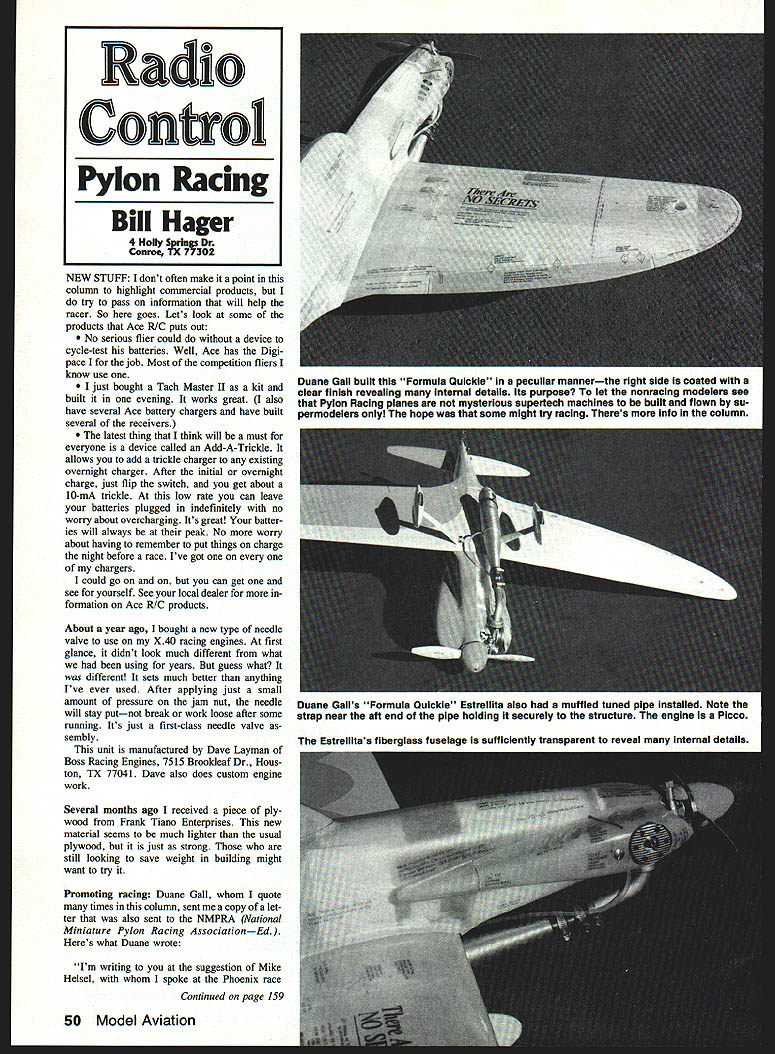
"I'm writing to you at the suggestion of Mike Helsel, with whom I spoke at the Phoenix race last weekend. The topic of discussion was a familiar one: 'How can we debunk and demystify the whole idea of competition flying in general, and racing in particular, so the average Joe doesn't think you have to be some kind of rocket scientist to get into it?' I offered, as a modest first step, a plane I built this year (photos enclosed).
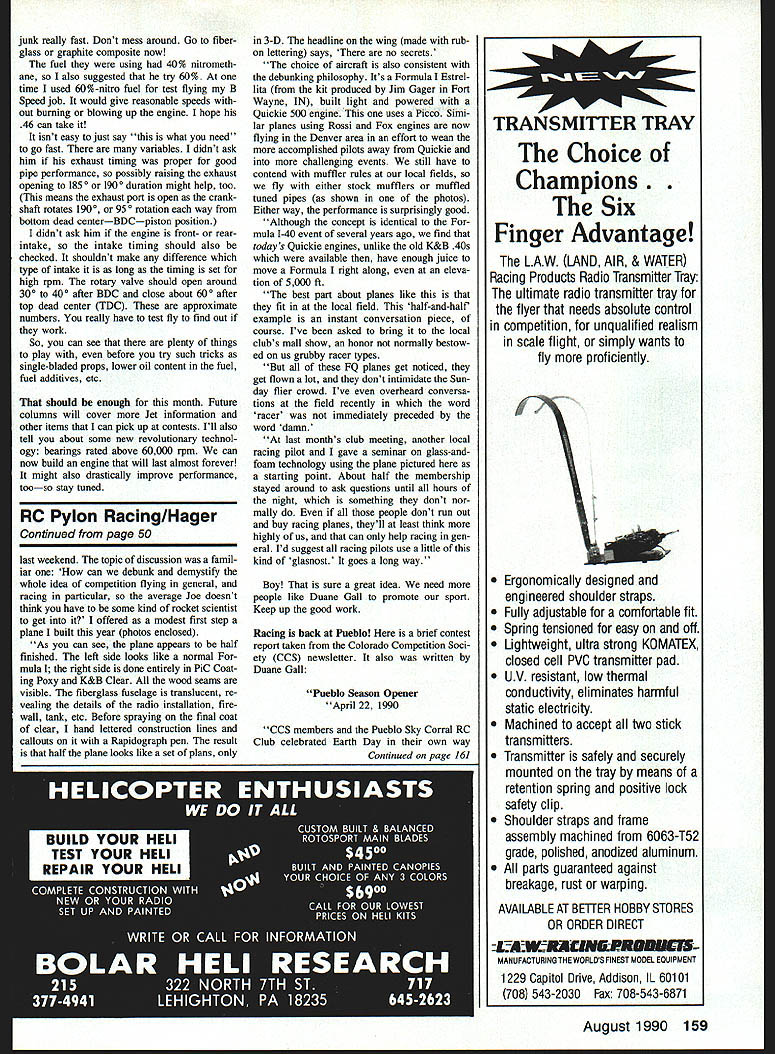
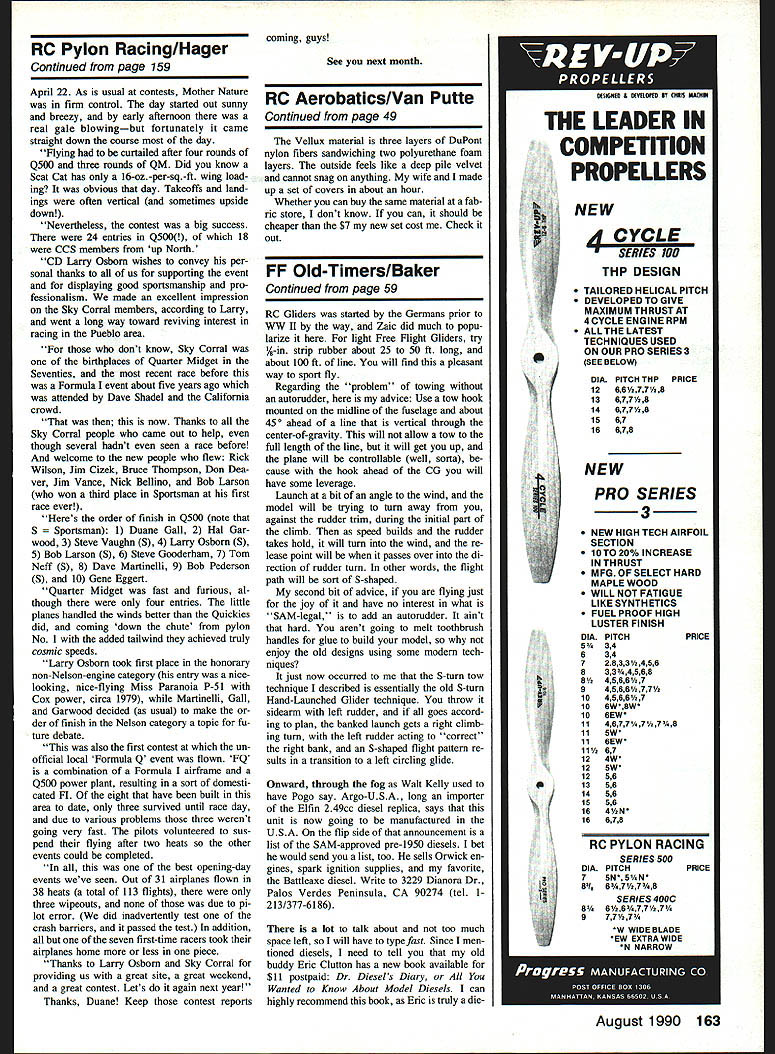
"As you can see, the plane appears to be half finished. The left side looks like a normal Formula; the right side is done entirely in PiC Coating Epoxy & K&B Clear. All the wood seams are visible. The fiberglass fuselage is translucent, revealing the details of the radio installation, firewall, tank, etc. Before spraying on the final coat of clear, I hand-lettered construction lines and callouts on it with a Rapidograph pen. The result is that half the plane looks like a set of plans, only in 3-D. The headline on the wing (made with rub-on lettering) says, 'There are no secrets.'
"The choice of aircraft is also consistent with the debunking philosophy. It's a Formula I Estrellita (from the kit produced by Jim Gager in Fort Wayne, IN), built light and powered with a Quickie .50 engine. This one uses a Picco. Similar planes using Rossi and Fox engines are now flying in the Denver area in an effort to wean the more accomplished pilots away from Quickie and into more challenging events. We still have to contend with muffler rules at our local fields, so we fly with either stock mufflers or muffled tuned pipes (as shown in one of the photos). Either way, the performance is surprisingly good.
"Although the concept is identical to the Formula I-40 event of several years ago, we find that today's Quickie engines, unlike the old K&B .40s which were available then, have enough juice to move a Formula II right along, even at an elevation of 5,000 ft.
"The best part about planes like this is that they fit in the local field. This 'half-and-half' example is an instant conversation piece, of course. I've been asked to bring it to the local club's mall show, an honor not normally bestowed on us grubby racer types.
"But all of these FQ planes get noticed, they get flown a lot, and they don't intimidate the Sunday flier crowd. I've even overheard conversations at the field recently in which the word 'racing' was not immediately preceded by the word 'damn.'
"At last month's club meeting, another local racing pilot and I gave a seminar on glass-and-foam technology using the plane pictured here as the starting point. About half the membership stayed around to ask questions until all hours of the night, which is something they don't normally do. Even if all those people don't turn out and buy racing planes, they're at least thinking more highly of us, and that can only help racing in general. I'd suggest all racing pilots use a little of this kind of 'glossing.' It goes a long way."
Boy — that is a great idea. We need more people like Duane Gall to promote our sport. Keep up the good work.
Racing is back at Pueblo!
The following brief contest report was taken from the Colorado Competition Society (CCS) newsletter. It was written by Duane Gall.
Pueblo Season Opener — April 22, 1990
CCS members and the Pueblo Sky Corral RC Club celebrated Earth Day in their own way on April 22. As is usual at contests, Mother Nature was in firm control. The day started out sunny and breezy, and by early afternoon there was a real gale blowing — but fortunately it came straight down the course most of the day.
Flying had to be curtailed after four rounds of Q500 and three rounds of QM. Did you know a Scat Cat has only a 16-oz.-per-sq.-ft. wing loading? It was obvious that day. Takeoffs and landings were often vertical (and sometimes upside down!).
Nevertheless, the contest was a big success. There were 24 entries in Q500(!), of which 18 were CCS members from "up North."
CD Larry Osborn wishes to convey his personal thanks to all of us for supporting the event and for displaying good sportsmanship and professionalism. We made an excellent impression on the Sky Corral members, according to Larry, and went a long way toward reviving interest in racing in the Pueblo area.
For those who don't know, Sky Corral was one of the birthplaces of Quarter Midget in the Seventies, and the most recent race before this was a Formula I event about five years ago which was attended by Dave Shadel and the California crowd.
That was then; this is now. Thanks to all the Sky Corral people who came out to help, even though several hadn't even seen a race before! And welcome to the new people who flew: Rick Wilson, Jim Cizek, Bruce Thompson, Don Deaver, Jim Vance, Nick Bellino, and Bob Larson (who won third place in Sportsman at his first race ever!).
Here’s the order of finish in Q500 (S = Sportsman):
- Duane Gall
- Hal Garwood
- Steve Vaughn (S)
- Larry Osborn
- Bob Larson (S)
- Steve Goedemans
- Tom Neff
- Dave Martinelli
- Bob Pederson (S)
- Gene Edgert
Quarter Midget was fast and furious, although there were only four entries. The little planes handled the winds better than the Quickies did, and coming "down the chute" from pylon No. 1 with the added tailwind they achieved truly cosmic speeds.
Larry Osborn took first place in the honorary non-Nelson-engine category with a nice-looking, nice-flying Miss Panarion P-51 with Cox power (circa 1979), while Martinelli, Gall, and Garwood left the Nelson category finishing order a topic for future debate.
This was also the first contest at which the unofficial local "Formula Q" event was flown. "FQ" combines a Formula I airframe with a .090 power plant, resulting in a sort of domesticated F1. Of the eight that have been built in this area to date, only three survived until race day, and due to various problems those three weren't going very fast. The pilots volunteered to suspend their flying after two heats so the other events could be completed.
In all, this was one of the best opening-day events we've seen. Out of 31 airplanes flown in 38 heats (a total of 113 flights), there were only three wipeouts, and none of those was due to pilot error. (We did inadvertently test one of the crash barriers, and it passed the test.) In addition, all but one of the seven first-time racers took their airplanes home more or less in one piece.
Thanks to Larry Osborn and Sky Corral for providing us with a great site, a great weekend, and a great contest. Let's do it again next year!
See you next month.
Transcribed from original scans by AI. Minor OCR errors may remain.

