
Radio Control: Pylon Racing
Author
Bill Hager 4 Holly Springs Dr. Conroe, TX 77302
This Month
Two topics are in store this month: a letter from Lyle Larson on how to make your Q500 go faster, and a look at some racing around the country.
Irving RC Flyers Association — Contest Report (Bob Greer)
Contest Date: April 21–22, 1990
The city of Irving bought North Lake Park from Dallas in 1988. Included in the park was an old, rundown flying field. The city of Irving shut down the park for repairs over the winter of 1988. It became obvious that Irving would make an excellent partner, but we needed an organization to work with them.
Dr. Miles took the initiative to form the Irving RC Flyers Association. In partnership with the city, it was agreed that Irving would fund improvements to the flying site, and the fliers association would put on a minimum of four major contests per year. While developing the field, Pylon, Pattern, Fun, Giant Scale, Scale, and general flying were considered. The result was a 650 x 75-ft runway with a 75 x 75-ft pad for pylon takeoff.
Construction started in earnest in February of 1990. I scheduled a contest for late April — Q500 on Saturday and F1 on Sunday. In early March a three-inch base of gravel was ready; three inches of asphalt were to follow. Just prior to laying down the asphalt, oil was sprayed on the gravel. Then it rained, and rained, and rained for the next two months. The city scheduled and rescheduled up until the day before the contest. It rained two inches that day. As a result we deferred F1 until August, and decided to race two days.
The weather was perfect: low eighties with light winds directly out of the south. The club bought a 12 x 60-piece indoor/outdoor carpet for a takeoff pad. It worked well. By 9:00 a.m. Saturday we had registered 43 Q500 and 8 Q.M. contestants. It was the highest number of contestants we've had for Q500 in seven years.
We decided to move Q.M. to Sunday. To make for more competitive racing, we separated the Novices (23) and Experts (20). The result was great, competitive racing.
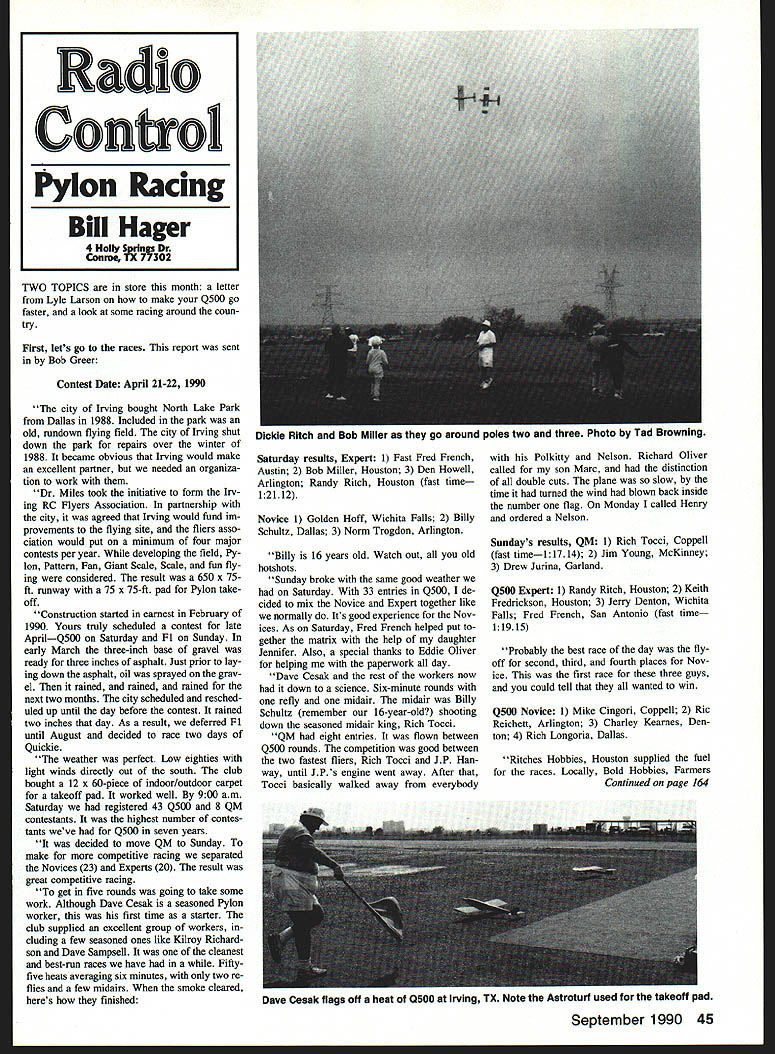
To get in five rounds was going to take some work. Although Dave Cesak is a seasoned pylon worker, this was his first time as a starter. The club supplied an excellent group of workers, including a few seasoned ones like Kilroy Richardson and Dave Sampsell. It was one of the cleanest and best-run races we have had in a while: fifty-five heats averaging six minutes, with only two reflights and a few midairs. When the smoke cleared, here's how they finished.
Saturday results — Expert
- 1) Fast Fred French, Austin
- 2) Bob Miller, Houston
- 3) Den Howell, Arlington
- Randy Ritch, Houston (fast time — 1:21.12)
Saturday results — Novice
- 1) Golden Hoff, Wichita Falls
- 2) Billy Schultz, Dallas
- 3) Norm Trogdon, Arlington
Billy is 16 years old. Watch out, all you old hotshots.
Sunday broke with the same good weather we had on Saturday. With 33 entries in Q500, I decided to mix Novice and Expert together like we normally do. It's good experience for the Novices. As on Saturday, Fred French helped put together the matrix with the help of my daughter Jennifer. Also, a special thanks to Eddie Oliver for helping me with the paperwork all day.
Dave Cesak and the rest of the workers now had it down to a science: six-minute rounds, one refly and one midair. The midair was Billy Schultz (remember our 16-year-old?) shooting down the seasoned midair king, Rich Tocci.
Q.M. had eight entries. It was flown between Q500 rounds. The competition was good between the two fastest fliers, Rich Tocci and J.P. Hanway, until J.P.'s engine went away. After that, Tocci basically walked away from everybody with his Polkitty and Nelson. Richard Oliver called for my son Marc, and had the distinction of all double cuts. The plane was so slow, by the time it had turned the wind had blown back inside the number one flag. On Monday I called Henry and ordered a Nelson.
Sunday results — Q.M.
- 1) Rich Tocci, Coppell (fast time — 1:17.14)
- 2) Jim Young, McKinney
- 3) Drew Jurina, Garland
Sunday results — Q500 Expert
- 1) Randy Ritch, Houston
- 2) Keith Fredrickson, Houston
- 3) Jerry Denton, Wichita Falls
- Fast Fred French, San Antonio (fast time — 1:19.15)
Probably the best race of the day was the flyoff for second, third and fourth places for Novice. This was the first race for these three guys, and you could tell they all wanted to win.
Sunday results — Q500 Novice
- 1) Mike Cingori, Coppell
- 2) Ric Reichett, Arlington
- 3) Charley Kearnes, Denton
- 4) Rich Longoria, Dallas
Ritches Hobbies, Houston supplied the fuel for the races. Locally, Bold Hobbies, Farmers Branch, Mike's Hobby Hangar, Carrollton, and RC Hobbies, Carrollton, all donated merchandise and gift certificates for the worker raffle.
Congratulations to the winners.
Officials and Judges
- Novice judges: John Reiter, Jamie Clancy, Kevin Hiatt
- Intermediate Scale judges: Jerry Hicks, Kevin Burner, Randy Gibson
- F/M judges: Bill Jeric, John Adams, Craig Heath
- Contest Director (Mr. Microphone): Tim Lampe
- Field Technical Director: Tom Dooley
These guys sure did a good job getting the city to build the new flying field. It can still be done!
Letter from Lyle Larson — How to Make a Q500 Go Faster
I'm sitting here recovering from knee surgery. I can't get to my shop to build, so I thought that I would write about why some people's airplanes are faster than others.
How many times have you been to a race and seen someone else's airplane going much faster than everyone else's? The first thing you think is, "Boy, I wish I had that engine!" or "he is much better at the back-cutting to go that fast!" More often it's the latter.
I thought that I would share with you how I built my Quickie 500 racer. It's the Larson T-tail. I used it to set the short-course California record at 59.87, and Henry Bartle used it to set the AMA class record of 15.46 in May of this year. It also set both fast times at the last two Nationals and placed first in the 1988 Nationals and third in the 1989 Nationals.
Now, before everyone thinks that I'm tooting my own horn, I don't think that there is a nickel's worth of difference in any of the Q500s on the market. With the rules we have in AMA Quickie, there isn't much you can do. Do you suppose that's why they made the rules that way? The building techniques that I am going to share with you can be done to almost any Q500.
First of all, I don't think that different airfoils make that much difference. However, the way you build the wing does. I use 1/8" balsa on the top and 3/32" on the bottom. I don't furnish 3/32" wood in my kit because it's cheaper; I furnish it because of its strength. Additionally, I use a spar at the high point of the wing. The spar is 1/8" ply, 1/16" in and 12" long. After the wing is joined I use two layers of 2-oz fiberglass cloth on the top and bottom of the wing, giving more strength than a single 4-oz layer. The cloth sticks out 4" on each side of the centerline of the wing. I build the wing complete, cut my ailerons, then hinge them. I use three-point hinges in each aileron.
Now look at your trailing edge. You do not want to use very soft wood. Also, place your torque rods at least 1-1/2" from the edge of the aileron. Never cut lightening holes in the foam. It changes the smooth airflow over the wing. After MonoKoting your wing, seal the gap on the bottom of the aileron and the bottom of the elevator. Use MonoKote for this also. The heavier your MonoKote job is, the faster the airplane will go.
Next — the fuselage. What can be done to a fuselage to make the airplane go faster? You have to have a 2-1/4" firewall and 2-1/2" in the middle. I use a 3/16" thick firewall reinforced with 1/16" triangle stock. Most kits come with 1/8". That extra 1/16" adds a lot of strength and knocks down vibration. Vibration is great on a chair or in a bed, but it kills engine rpm.
After the fuselage is completed, use two layers of 2-oz cloth over the firewall and back about 3" on the sides and top. I also shape the leading and trailing edges of my landing gear. There isn't much that you can do on the tail. I use 1/8" balsa, again for strength. On the leading and trailing edges, I insert 1/64" ply and sand the leading and trailing edges very sharp. On the wing I use a very sharp leading edge. With the slow speeds of Q500, I don't believe that the sharp leading edge causes hunting or other unpredictable behavior. I also use a sharp leading edge on my Formula One.
I balance the plane at about 30% of the wing. You might be saying right now, "What a tank." All of my Q500s weigh about 3-3/4 lb. That includes the Rossi engine. The weight is in the wing. However, it won't bend (if a wing on a Quickie bends, it is slow). Henry Bartle's plane weighed 3 lb. 14 oz., and the engine was inspected after the heat.
I wish I could say that my kit was far superior to all kits on the market, but it's not. It just has better plans and wood. Additionally, it has a practice flying plan — an imaginary course with a .20-powered trainer airplane. It doesn't take a race to practice with it.
If you have any questions, please feel free to call me at 1-714-661-7430.
Good, consistent flying is the only way to the winner's circle. And the only way to get good is a whole lot of practice.
How is racing in your area? Do you have any neat ideas or helpful tips that you would like to pass on? Send everything directly to me, and I'll pass it on.
See you at the races.
Transcribed from original scans by AI. Minor OCR errors may remain.

