
Radio Control: Pylon Racing
Bill Hager
4 Holly Springs Dr. Conroe, TX 77302
WOW! Our 1990 racing season is about at an end, and what a busy summer it's been. We have racing in Texas and up North. But first, a handy new item.
As most of you pylon racers know, setting a needle on just about any engine can be pretty tricky. No matter how you locate your tank, your engine will run from slightly rich at the beginning of the race to almost overlean at the end.
If you set your engine too rich, you may just be getting moving as the race ends. If you start out too lean, you'll go like gangbusters at first, then begin to run too lean about midway through. You risk a blown plug and/or a ruined engine. I've found that a regulator helps control richness of the mixture and, as a result, I can control some aspects of the race. Of course regulators have been used in Control Line Speed for years, but how do they work?
Using a Fuel Regulator
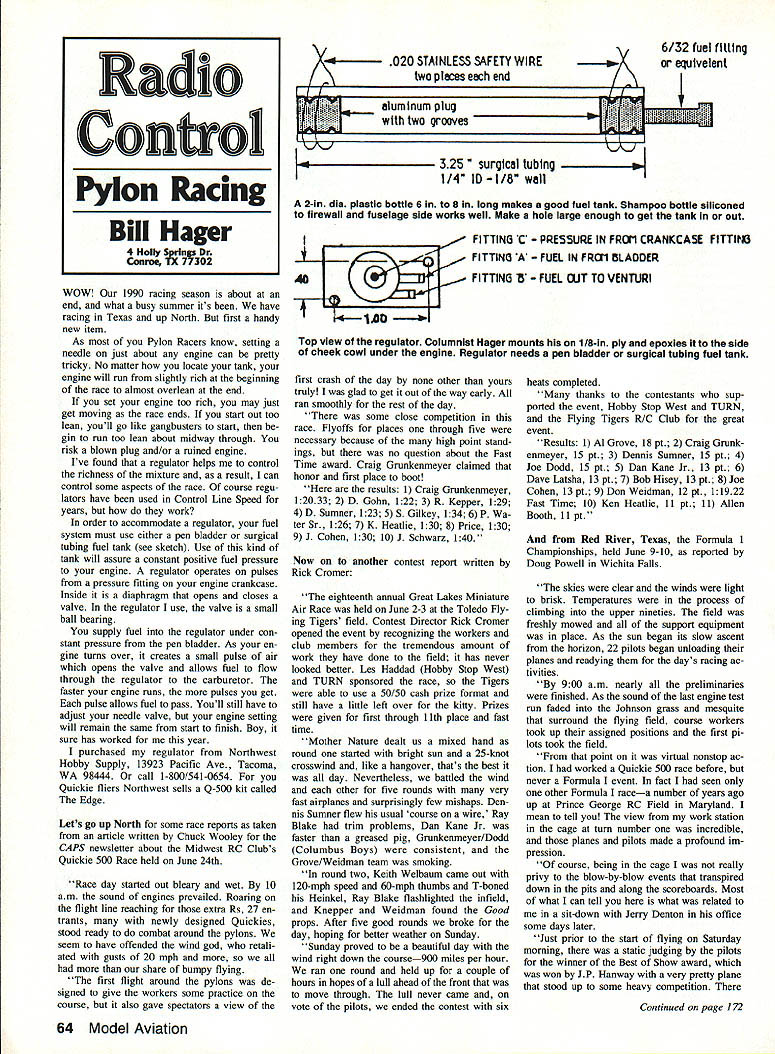
To accommodate a regulator, your fuel system must use either a pen bladder or surgical tubing fuel tank (see sketch). Use of this kind of tank will assure a constant positive fuel pressure to your engine. A regulator operates on pulses from a pressure fitting on your engine crankcase. Inside it is a diaphragm that opens and closes a valve. In the regulator I use, the valve is a small ball bearing.
You supply fuel into the regulator under constant pressure from the pen bladder. As your engine turns over, it creates a small pulse of air which opens the valve and allows fuel to flow through the regulator to the carburetor. The faster your engine runs, the more pulses you get. Each pulse allows fuel to pass. You'll still have to adjust your needle valve, but your engine setting will remain the same from start to finish. It sure has worked for me this year.
I purchased my regulator from Northwest Hobby Supply, 13923 Pacific Ave., Tacoma, WA 98444. Or call 1-800-541-0654. For Quickie fliers Northwest sells a Q-500 kit called the Edge.
Midwest RC Club Quickie 500 Race — June 24 (from Chuck Wooley, CAPS newsletter)
Race day started out bleary and wet. By 10 a.m. the sound of engines prevailed. Roaring on the flight line, 27 entrants, many with newly designed Quickies, stood ready for combat around the pylons. The wind gods seemed offended and retaliated with gusts to 20 mph, making for bumpy flying. The first flight around the pylons was designed to give the workers some practice on the course, but it also gave spectators a view of the first crash of the day — by none other than yours truly! I was glad to get it out of the way early. All ran smoothly for the rest of the day.
There was some close competition in this race. Flyoffs for places one through five were necessary because of the many high point standings, but there was no question about the Fast Time award. Craig Grunkenmeyer claimed the honor and first place to boot!
Results:
- Craig Grunkenmeyer
- D. Gohn
- R. Knepper
- D. Sumner
- S. Gilkey
- P. Water
- K. Heatlie
- Price
- J. Cohen
- J. Schwarz
Great Lakes Miniature Air Race — June 2–3 (report by Rick Cromer)
The eighteenth annual Great Lakes Miniature Air Race was held June 2–3 at the Toledo Flying Tigers field. Contest Director Rick Cromer opened the event by recognizing the workers and club members for the tremendous amount of work they have done to the field; it has never looked better. Les Haddad (Hobby Stop West) and TURN sponsored the race, so the Tigers were able to use a 50/50 cash prize format and still have a little left over for the kitty. Prizes were given for first through 11th place and fast time.
Mother Nature dealt us a mixed hand as round one started with bright sun and a 25-knot crosswind that made for very difficult flying. Nevertheless, we battled the wind and each other for five rounds with many very fast airplanes and surprisingly few mishaps. Dennis Sumner flew his usual consistent course. Ray Blake had trim problems. Dan Kane Jr. was fast as a greased pig. The Grunkenmeyer/Dodd (Columbus) team was consistent. The Grove/Weidman team was smoking.
In round two, Keith Welbaum came out with 120-mph speed and T-boned his Heinkel. Ray Blake flashlighted into the infield. Knepper and Weidman found good props. After five good rounds we broke for the day, hoping for better weather on Sunday.
Sunday proved to be a beautiful day with the wind right down the course. The pilots ran rounds and held up a couple of hours hoping for a lull ahead of a weather front; the lull never came, so the pilots voted to end the contest after six heats.
Many thanks to the contestants who supported the event—Hobby Stop West, TURN, and the Flying Tigers R/C Club—for a great event.
Results:
- Al Grove — 18 pts.
- Craig Grunkenmeyer — 15 pts.
- Dennis Sumner — 15 pts.
- Joe Dodd — 15 pts.
- Dan Kane Jr. — 13 pts.
- Dave Latsha — 13 pts.
- Bob Hisey — 13 pts.
- Joe Chelnowicz — 12 pts.
- [name omitted]
- [name omitted]
Additional Contest Report (Bill Hager)
There were no mediocre planes at the event. In fact, they were all so well done that I don't know how pilots selected which one they would show from the two or three each had brought along. I would still be out there trying to decide if I'd had a vote! The collection was absolutely beautiful.
The takeoff area was too narrow to support four planes up, so all of the heats were three-plane blasts. Plans have been made and things are in the works to widen the takeoff area so four-plane heats can be accommodated next spring.
Top 10 finishers for Saturday:
- Randy Rich — 1:14.80
- Richard Oliver — 1:17.00
- D. Cranfield — 1:21.89
- Phil Bussell — 1:17.42
- Jim Young — 1:19.85
- Bill Hager — 1:15.39
- Hubert Willis — 1:19.05
- Norm Johnson — 1:14.73
- Bob Jett — 1:14.87
- Sam Womack — 1:16.56
Just to keep everyone's attention, there were two midairs on Saturday, both occurring just out of turn number three. Poor Bob Greer was a participant in one of those little high-speed tangos with Dave Layman. Bill Hager and Jerry Small tried to trade a little paint in flight and wound up getting their planes all dirty, if easier to transport (under the seat).
Sunday's action was just as hot and heavy. To make sure that he had the moves down pat, Bob Greer provided all those present with what had to be the most violent midair collision since the invention of the prop. It happened about 20 ft. directly behind and above my head as I stood in the gate at turn number one. The pilot in my lane had not made the clock, so I was locked on the podium when it happened. I felt bad for the pilots but the crash itself was right out of the movies. There was another midair just out of turn number three, but it was tame by comparison with the Bob Greer/Hubert Willis fiasco earlier and I completely forgot to get the names of the pilots involved. (Yours truly — Bill Hager; Jerry Small — BH.)
Top finishers on Sunday:
- Dub Jett — 1:16.85
- Red Crandell — 1:19.44
- Phil Bussell — 1:20.59
- Bill Hager — 1:16.14
- Montie Montieri — 1:16.20
- Clay Gary — 1:15.09
- Dave Layman — 1:13.81
- Norm Johnson — 1:14.15
- Randy Rich — 1:15.29
- Sam Womack — 1:27.72
Fast time for the meet was a 1:10.90 turned in by Jerry Small.
There was a lot of really good, close (and tight) racing action on both days, and I can personally vouch for the quality of the food that was available. I heard nothing but praise for the condition of the field—its size and its location. I think the two quotes heard most often were, "Y'all have the best racing facilities around," and, "For a grass field, it is absolutely fantastic shape." Those nice words made me feel kinda proud of our field and proud to have been a small part of the core of club members who came out to work the event. I got to meet some super-nice guys, see some beautiful planes and some really competitive racing; and besides all that, Bob Greer, I'll be a long time talking about that Sunday midair of yours!
Take it from me, the guys put on a first-class race and the field was in great shape.
See you next month.
Transcribed from original scans by AI. Minor OCR errors may remain.

