
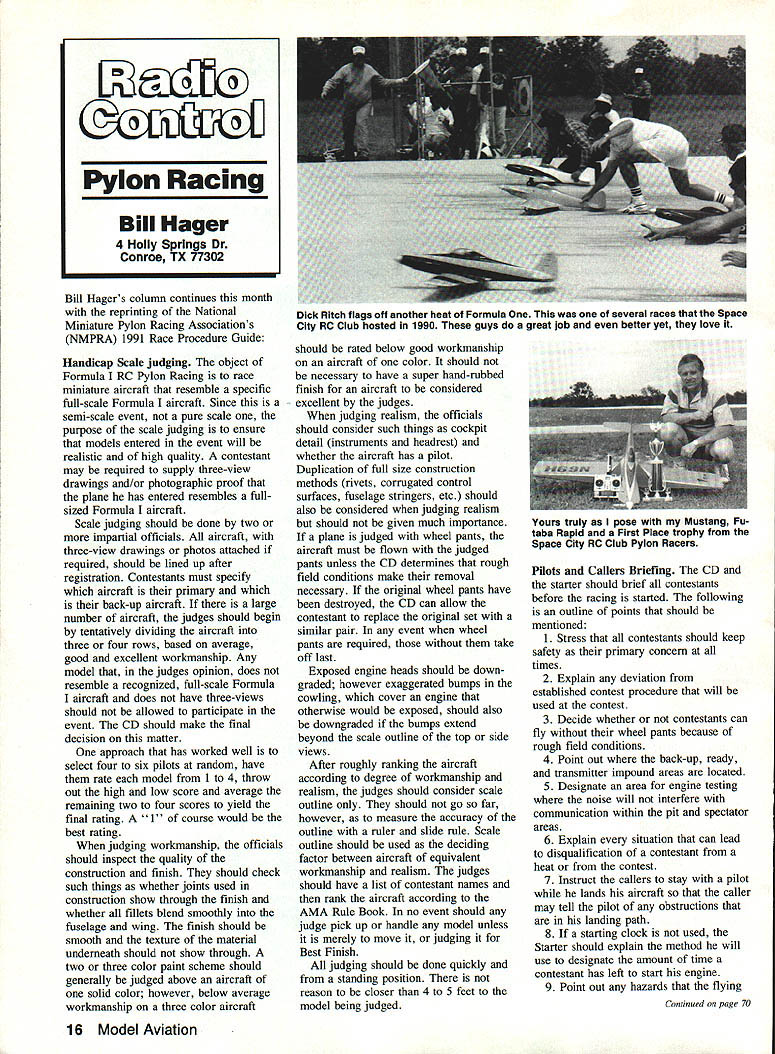
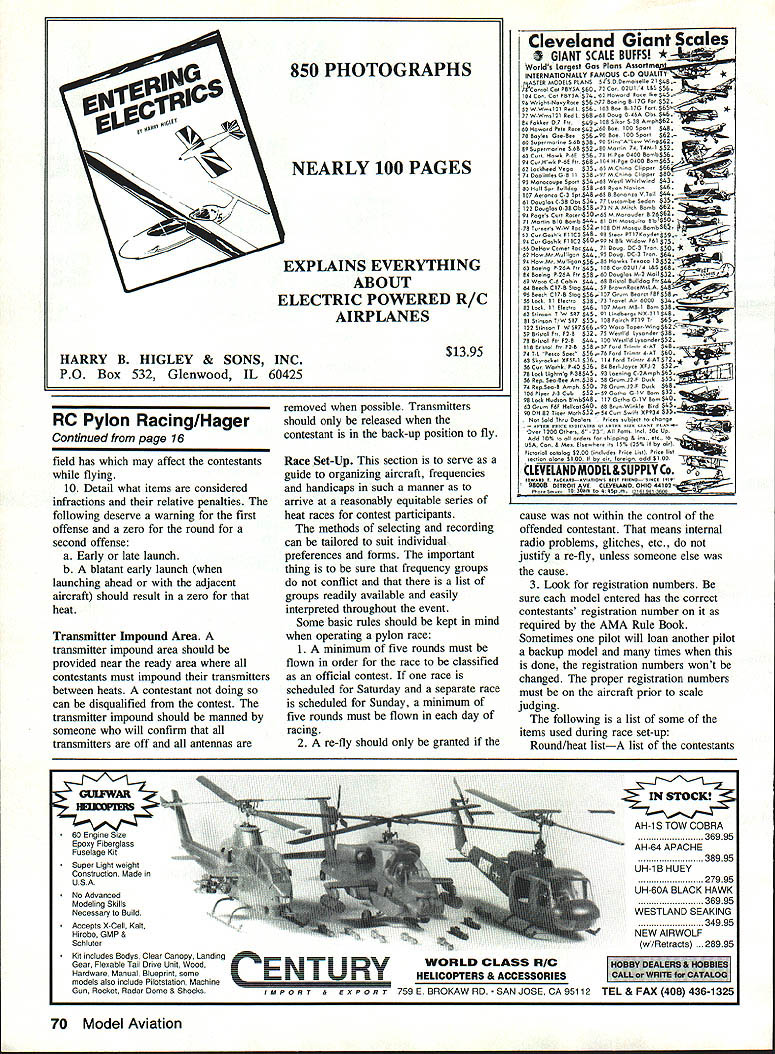
Radio Control: Pylon Racing
Bill Hager 4 Holly Springs Dr. Conroe, TX 77302
Handicap Scale Judging
The object of Formula I RC Pylon Racing is to race miniature aircraft that resemble a specific full-scale Formula I aircraft. Since this is a semi-scale event, not a pure scale one, the purpose of the scale judging is to ensure that models entered in the event will be realistic and of high quality. A contestant may be required to supply three-view drawings and/or photographic proof that the plane he has entered resembles a full-sized Formula I aircraft.
Scale judging should be done by two or more impartial officials. All aircraft, with three-view drawings or photos attached if required, should be lined up after registration. Contestants must specify which aircraft is their primary and which is their back-up aircraft. If there is a large number of aircraft, the judges should begin by tentatively dividing the aircraft into three or four rows, based on average, good and excellent workmanship. Any model that, in the judges' opinion, does not resemble a recognized full-scale Formula I aircraft and does not have three-views should not be allowed to participate in the event. The Contest Director (CD) should make the final decision on this matter.
One approach that has worked well is to select four to six pilots at random, have them rate each model from 1 to 4, throw out the high and low score, and average the remaining two to four scores to yield the final rating. A "1" of course would be the best rating.
When judging workmanship, the officials should inspect the quality of the construction and finish. They should check such things as whether joints used in construction show through the finish and whether all fillets blend smoothly into the fuselage and wings. The finish should be smooth and the texture of the material underneath should not show through. A two- or three-color paint scheme should generally be judged above an aircraft of one solid color; however, below-average workmanship on a three-color aircraft should be rated below good workmanship on an aircraft of one color. It should not be necessary to have a super hand-rubbed finish for an aircraft to be considered excellent by the judges.
When judging realism, the officials should consider such things as cockpit detail (instruments and headrest) and whether the aircraft has a pilot. Duplication of full-size construction methods (rivets, corrugated control surfaces, fuselage stringers, etc.) should also be considered when judging realism, but should not be given great importance. If a plane is judged with wheel pants, the aircraft must be flown with the judged pants unless the CD determines that rough field conditions make their removal necessary. If the original wheel pants have been destroyed, the CD can allow the contestant to replace the original set with a similar pair. In any event, when wheel pants are required, those without them take off last.
Exposed engine heads should be downgraded; however, exaggerated bumps in the cowling that cover an engine that otherwise would be exposed should also be downgraded if the bumps extend beyond the scale outline of the top or side views.
After roughly ranking the aircraft according to degree of workmanship and realism, the judges should consider scale outline only. They should not go so far, however, as to measure the accuracy of outline with a ruler and slide rule. Scale outline should be used as the deciding factor between aircraft of equivalent workmanship and realism. The judges should have a list of contestant names and then rank the aircraft according to the AMA Rule Book. In no event should any judge pick up or handle any model unless it is merely to move it, or judging is for Best Finish.
All judging should be done quickly and from a standing position. There is no reason to be closer than 4 to 5 feet to the model being judged.
Pilots and Callers Briefing
The CD and the starter should brief all contestants before racing is started. The following is an outline of points that should be mentioned:
- Stress that all contestants should keep safety as their primary concern at all times.
- Explain any deviation from established contest procedure that will be used at the contest.
- Decide whether or not contestants can fly without their wheel pants because of rough field conditions.
- Point out where the back-up, ready, and transmitter impound areas are located.
- Designate an area for engine testing where the noise will not interfere with communication within the pit and spectator areas.
- Explain every situation that can lead to disqualification of a contestant from a heat or from the contest.
- Instruct the callers to stay with a pilot while he lands his aircraft so that the caller may tell the pilot of any obstructions that are in his landing path.
- If a starting clock is not used, the Starter should explain the method he will use to designate the amount of time a contestant has left to start his engine.
- Point out any hazards in the flying field which may affect the contestants while flying.
- Detail what items are considered infractions and their relative penalties. The following deserve a warning for the first offense and a zero for the round for a second offense:
a. Early or late launch. b. A blatant early launch (when launching ahead or with the adjacent aircraft) should result in a zero for that heat.
Transmitter Impound Area
A transmitter impound area should be provided near the ready area where all contestants must impound their transmitters between heats. A contestant not doing so can be disqualified from the contest. The transmitter impound should be manned by someone who will confirm that transmitters are off and all antennas are removed when possible. Transmitters should only be released when the contestant is in the back-up position to fly.
Race Set-Up
This section is to serve as a guide to organizing aircraft, frequencies and handicaps in such a manner as to arrive at a reasonably equitable series of heat races for contest participants.
The methods of selecting and recording can be tailored to suit individual preferences and forms. The important thing is to be sure that frequency groups do not conflict and that there is a list of groups readily available and easily interpreted throughout the event.
Some basic rules should be kept in mind when operating a pylon race:
- A minimum of five rounds must be flown in order for the race to be classified as an official contest. If one race is scheduled for Saturday and a separate race is scheduled for Sunday, a minimum of five rounds must be flown each day of racing.
- A re-fly should only be granted if the cause was not within the control of the offended contestant. Internal radio problems, glitches, etc., do not justify a re-fly unless someone else was the cause.
- Look for registration numbers. Be sure each model entered has the correct contestant's registration number on it as required by the AMA Rule Book. Sometimes one pilot will loan another pilot a backup model and many times when this is done the registration numbers won't be changed. The proper registration numbers must be on the aircraft prior to scale judging.
The following is a list of some of the items used during race set-up:
- Round/heat list — A list of the contestants and their starting orders for each heat of each round. This list is prepared from information on the Race Coding list and the Contestant Code List and is used for preparing Heat Cards.
- Heat card — The document upon which each contestant in a heat and his starting position and code number are recorded. One card is required for each heat of each round. Pilot warnings are posted by the starter when appropriate. The heat card should contain both the name and frequency of the contestant.
- Score board — Blackboard, prepared chart, or whatever is used to record the running score of each contestant in each round. Times should also be recorded here. Post any warnings received from the starter.
- Matrix Development "Execution" — While the aircraft are being handicapped, the contestants' information cards should be divided into their respective frequencies. The total number of contestants is then divided by four. This result is the ideal number of contestants in each of four frequency groups for 4-plane races.
If this number happens to come up a whole number, water will probably run up a hill that day. So, assuming that there are 26 entries, each group must be adjusted to whole numbers, such as: Group I, Group II, and Group III — 7 cards; Group IV — 5 cards. This will produce a 4 x 7 matrix with five 4-plane heats and two 3-plane heats. In any case when the number of entrants is not evenly divided by four you must go to the next larger multiple of four.
Use of the NMPRA Frequency Control System will make construction of the racing matrix much easier. Copies are available from the NMPRA district Vice President in your area. Read it, understand it, and use it!
Some Hints and Pitfalls
- If you are using the latest set of matrix schedules there should not be any contestant who is scheduled for back-to-back heats. This may be a pitfall to be aware of in any case.
- Sooner or later, two contestants will be on the starting line with the same frequency. This is one reason for the Contestant Code List. Find them on the list, and compare frequencies to what they put on their information cards. In 99 cases out of 100 one of them will have written down the wrong frequency. If you hit the 100th time, you'd better run fast.
- The starter's decision is final! Record what he sends and direct all assassins to the CD.
- A re-fly should only be allowed if there is a breakdown of equipment or a problem with the decision of a race starter.
The Ready Area
In addition to aircraft on the starting line, aircraft should be called to a back-up and ready line in front of the registration desk. The ready line should not be on the course between the No. 2 and No. 3 pylons (see safety section).
The Pit Boss
The pit boss (could also be the transmitter impound boss if the impound and ready areas are adjacent) should get the heat cards from the registration desk and, using the PA system, call the contestants for each heat to the back-up line. A contestant will be called again when his heat moves to the ready line and it is then the responsibility of the contestant to be on the ready line by the time his heat moves to the starting line. An efficient contest will turn around heats in six minutes or less from the start of one to the start of the next.
On the back-up line, the pit boss should inform each contestant of his starting position. When a heat moves to the starting line, the pit boss should seat the heat cards and get the contestants to the starting line in the correct sequence. Either the pit boss or some other contest official should notify the starter, either through an intercom or by waving a black flag, when an aircraft flies over the pit or spectator area.
The Flight Recorder
The flight recorder will have the heat cards for each heat on the starting line. He will confirm that the contestants are in the correct starting order. It is recommended that the flight recorder have a watch to time the first-place finisher. Near the end of a race, he should help the starter ascertain the order of finish.
As the aircraft cross the finish line, the flight recorder should write down on the heat card the position in which each contestant finishes. The flight recorder should then record the times of each contestant from the lap counters' stopwatches. The heat card is then sent back to the registration desk where the positions should be converted to points. First place should receive 4 points, second 3, third 2, fourth 1, and no finish 0. If all heats are three-plane heats the first receives 3, second 2, third 1, and no finish 0. The points and the times are then recorded on the score board and announced over the PA system.
The Starter
The starter should have a stopwatch, a green and a checkered flag, and a hard hat. The starter is the head official of the flight line and is expected to be fully backed up by the CD in all of his decisions. The starter and the CD should be two separate people. This gives the starter a back-up or second opinion in the event of a dispute, which will save many arguments. The starter should stand to the west of the starting line, closest to the No. 1 aircraft.
When all of the aircraft are lined up from left to right on the starting line for a heat, the starter should have each contestant, starting with the No. 1 position, hold his aircraft above his head for identification with the appropriate flagman at the No. 1 pylon. The top, bottom and sides of the aircraft should be shown. When all planes are identified, the starter should remind the contestants to turn on their radio systems and then announce the beginning of the starting period.
If there is not a starting clock, a system should be established whereby the starter will notify the contestants of the amount of time that is left. He may wave a flag over his head and count off at preset time intervals, for example. If all engines are started before the end of the starting period, the starter should check with each pilot to confirm that he is ready for his plane to be released. The starter should flag the aircraft off as quickly as possible and should start his stopwatch as he drops the first flag.
If one or more contestants should have difficulty starting their engines, the starter should then flag off the first aircraft when the starting period has elapsed, whether the pilots who were having difficulty are ready or not. Each aircraft must be released when its flag is dropped, i.e., the No. 1 aircraft is released when the flag is dropped the first time, the No. 2 aircraft is released when the flag is dropped the second time, etc. This means that if the No. 2 aircraft, for example, does not get its engine started, the No. 3 aircraft must still wait for the flag to be dropped for the third time before being released.
If an aircraft is blatantly released before it receives its flag, the contestant is disqualified in that heat. If an aircraft is damaged during a heat and continues flying, the starter may disqualify the contestant if, in his opinion, the aircraft has sustained enough damage to make flying unsafe. If the starter plans to enforce this recommendation, all contestants must be notified of such possible action at the pilot's briefing. In this situation, a contestant must land his aircraft immediately after notification or face automatic disqualification from the contest. If a contestant is disqualified for unsafe flying, or receives two cuts during a heat, he must pull out of the race immediately after being personally notified or face automatic disqualification of his next heat.
A disqualified pilot should not land his aircraft until the remaining aircraft in the heat have finished racing. A disqualified aircraft should be flown at a higher altitude out of the way of the other aircraft; however, if a pilot is experiencing radio problems, he must land immediately. The starter has sole authority to disqualify a contestant for unsafe flying and his decision is final.
The starter should flag each aircraft as it crosses the finish line on its last lap. He should stop his watch when the first aircraft finishes. This will serve as a backup to the lap counters' watch. The starter may disqualify any contestant who lands his aircraft between the No. 2 and No. 3 pylons.
If a pilot cuts either the No. 2 or No. 3 pylon on his last lap and still receives the flag, the pilot must fly another lap before he is officially considered to have finished the race. If a cut on the last lap is a pilot's second cut in the heat, he is still disqualified even if he received the checkered flag.
In the case of a "photo finish," the starter, assisted by the flight recorder, is the sole judge of which aircraft finished in front.
If there is a disagreement between the pilots and officials concerning the results of a race, the matter should be settled immediately on the flight line by the starter. If a pilot feels that a mistake in lap counting has caused him to place lower than he should have, the official results can be changed only if a lap counter freely admits making a mistake or if all pilots in the heat agree that the results should be changed. If one or more pilots disagree, the matter should be dropped without further discussion.
If there is a foul-up at the No. 1 pylon, such as a flagman flagging the wrong aircraft or a malfunction in a light, the offended contestant has the option of requesting that he be re-flown. Only the aircraft involved in the contested position will be re-flown. The re-fly will only determine the finish position for the aircraft for the contested heat. Radio problems, unless proven to not be the contestant's fault, will not be grounds for a re-fly.
Lap Counters
The contest director should select his most experienced workers as lap counters. They should each be equipped with stopwatches and hard hats. It has been found that the use of cards is the most reliable and easy-to-manage system of counting laps. Each lap counter should have cards numbered 0 to 10 plus a checkered card to signify that the heat is over. The cards should be of the color corresponding to their position. It is recommended that the No. 1 position be yellow, No. 2 green, No. 3 white and No. 4 orange. Each card should be slightly larger than the previous card. For example, card No. 6 should be slightly larger than card No. 5. This helps ensure that only one card at a time will be flipped over. The lap counters should be positioned so that the cards are visible to the contestants.
Each heat should begin with all the No. 0 cards showing. Lap cards should always show the number of the lap the contestant has completed at that time. The lap counters should look at their aircraft carefully on the starting line to ensure recognition throughout the heat. They should consistently keep their eyes on their aircraft during a heat.
When a lap counter is informed that his aircraft has cut a pylon, he should not flip over a lap card for that lap. Instead, he should flip over the cut card. There should be three cut cards. One card should be white and should be the card that is showing at the beginning of a race since it signifies no cuts. The second card should be red and signifies one cut. The third card should be black and signifies two cuts. When a pilot is informed that his aircraft has two cuts, they must pull out of the race and land only after the heat is over.
The lap counters should start their watches when the starter drops the first flag. When an aircraft is on its last lap, the lap counter should stand and point at it so that the starter knows which aircraft is about to finish. Lap counters should stop their watches when the starter drops the checkered flag for their aircraft. Due to the lack of reliability in watches, they may aid in determining the finish order but should not be the determining factor.
The duties of the head lap counter may be combined with that of the flight recorder if enough help is not available. There should be an intercom set up between the head lap counter and the No. 1 pylon judge. If possible, there should also be a communications system set up between the head lap counter and the No. 2 and No. 3 pylon judges and the registration desk.
Between each heat, the head lap counter should write down the color of the aircraft in each starting position. When the No. 2 and No. 3 judges call in a cut, they should identify the color of the plane that cut the pylon. For example, the pylon judge should say "the white and red aircraft just cut the No. 2 pylon." The head lap counter would then see what the starting position of the aircraft is and notify the appropriate lap counter. When the No. 1 pylon judge calls in a cut, he should identify the aircraft by its starting position.
The head lap counter must inform the lap counters of every cut that occurs during a heat. He should check that each lap counter follows the correct procedures throughout a race.
Number 1 Pylon Judge and Flagmen
The No. 1 pylon judge should be a responsible, adult worker. He should have communications with the head lap counter and should relay all cuts called by the flagmen. Both the judge and the flagmen should be in immediate agreement on a cut, with the No. 1 pylon judge being the final authority.
It is the general consensus among contestants and officials that the use of shutters at the No. 1 pylon is preferred to the use of lights. If shutters are not available, a good alternative is flags. It is recommended that each of the four flagmen have a flag corresponding to his position, i.e., the No. 1 flagman should have a yellow flag, the No. 2 flagman should have a green flag, the No. 3 flagman a white flag, and the No. 4 flagman an orange flag.
The No. 1 flagman should be closest to the pylon. When the aircraft are identified, each flagman should wave his flag over his head when his plane is held up to acknowledge that he recognizes the craft. If more than one plane in a heat is painted the same color, the head lap counter should describe that aircraft in detail to the No. 1 pylon judge, who should relay the information to the appropriate flagman.
The flagmen must watch their aircraft at all times during a heat. Before a heat is started each flagman should have his flag raised over his head. Each flagman should drop his flag smartly as his aircraft draws even with the No. 1 pylon. The No. 1 pylon judge should check that each flagman is not standing in front of or behind the pylon and that the flagmen are not dropping their flags too early or too late. The flagmen should have their flags raised every lap at least by the time the aircraft round the No. 3 pylon.
When an aircraft does not fly around the No. 1 pylon, the flagman should repeatedly wave his flag over his head and yell out his number to the pylon judge. Decisions on cuts must be made immediately. If there is doubt about whether an aircraft cut a pylon, a cut should not be called. This same basic procedure should be adhered to with the use of shutters or lights at the No. 1 pylon.
Number 2 and Number 3 Pylon Judges
The No. 2 and No. 3 pylon judges should be equipped with hand-held, freon-powered air horns (or equivalent sound-producing device), and, if possible, intercoms to the head lap counter. The pylon judges should blow their airhorns immediately after an aircraft flies inside either the No. 2 or No. 3 pylon. If two aircraft fly inside a pylon simultaneously, the air horn should be blown twice. The pylon judge should then tell the head lap counter which aircraft has cut.
Public Address Announcer
When the number of spectators warrants it there should be a P.A. announcer. He should be carefully picked to be both entertaining and informative to the contestants and spectators. He should use the contestant's information cards to the fullest extent when describing a race. When a heat is over he should announce the official results, then re-file the information cards and get the cards for the next heat.
When all the rounds are completed, the points earned by each contestant should be totaled on the score board. If two or more contestants have an equal number of total points, there should be a fly-off if frequency and time permit. Ties should otherwise be broken by a contestant's fastest time. The CD should have either the top three or top five finishers checked for legality according to the AMA Rule Book. The awards should then be handed out.
In addition to fulfilling the requirements of an AMA sanction, the CD must send the results of the contest to the Vice President of the NMPRA district in which the contest was held. The results should include the name, NMPRA number, the place of every official contestant and the contestant's fastest time. A contestant is considered official when he has attempted to make at least one flight. The CD should break all ties, all the way down to last place, for this report.
QM, Q-500, and FAI
All the previously described contest procedures also apply to QM, Q-500, and FAI except for the determination of contestant starting position. In QM, Q-500, and FAI there is no handicap scale judging. The pit boss should have each contestant draw a number (either 1, 2, 3, or 4) that will be his or her starting position in that heat. The pit boss should then transfer this information to the heat cards.
In addition, two workers should man a refueling station near the back-up area. There should be two fuel pumps for this fuel which must be supplied by the contest management. Every contestant must refuel his aircraft from these pumps before he enters the back-up area. To prevent any rule bending, aircraft should not be allowed to return to the pit area after the refueling operation. All appropriate regulations in the AMA Rule Book apply to this event.
See you next month.
Transcribed from original scans by AI. Minor OCR errors may remain.

